by Facilitation Expert | Mar 19, 2015 | Meeting Agendas, Meeting Structure
If it seems that workshops are actually well-run meetings, that is true to a large degree. Well-run meetings and facilitated workshops share similarities. The primary differences between meetings and workshops become evident with the characteristics of each.
All workshops are meetings while most meetings are not workshops
Roughly speaking, meetings deliver up outcomes or conditions, such as “increased awareness,” while workshops document outputs such as strategic plans, decisions, and detailed solutions.
Meeting Characteristics
Workshop Characteristics
- A building method—a way to solve a problem, develop a plan, reach a decision, agree on analytics, design a flow, etc.
- Agenda steps are typically not time-boxed, since early output typically supports product development or process improvement and innovation
- Include formally defined roles and depend on a neutral facilitator
- Remain focused on one development at a time, lasting from a few hours to a few days
Different reasons for hosting workshops versus meetings
Meetings tend to follow one of three themes, to . . .
- Endorse or decide
- Inform
- Monitor and review
Workshops focus on singular topics and strive to build detailed outputs. Successful workshops depend on:
- Knowing clearly what DONE looks like, specific output or deliverables
- An agenda design that engages participants
- Sequencing information-gathering activities or agenda steps
- Monitoring the workshop method to accomplish those goals

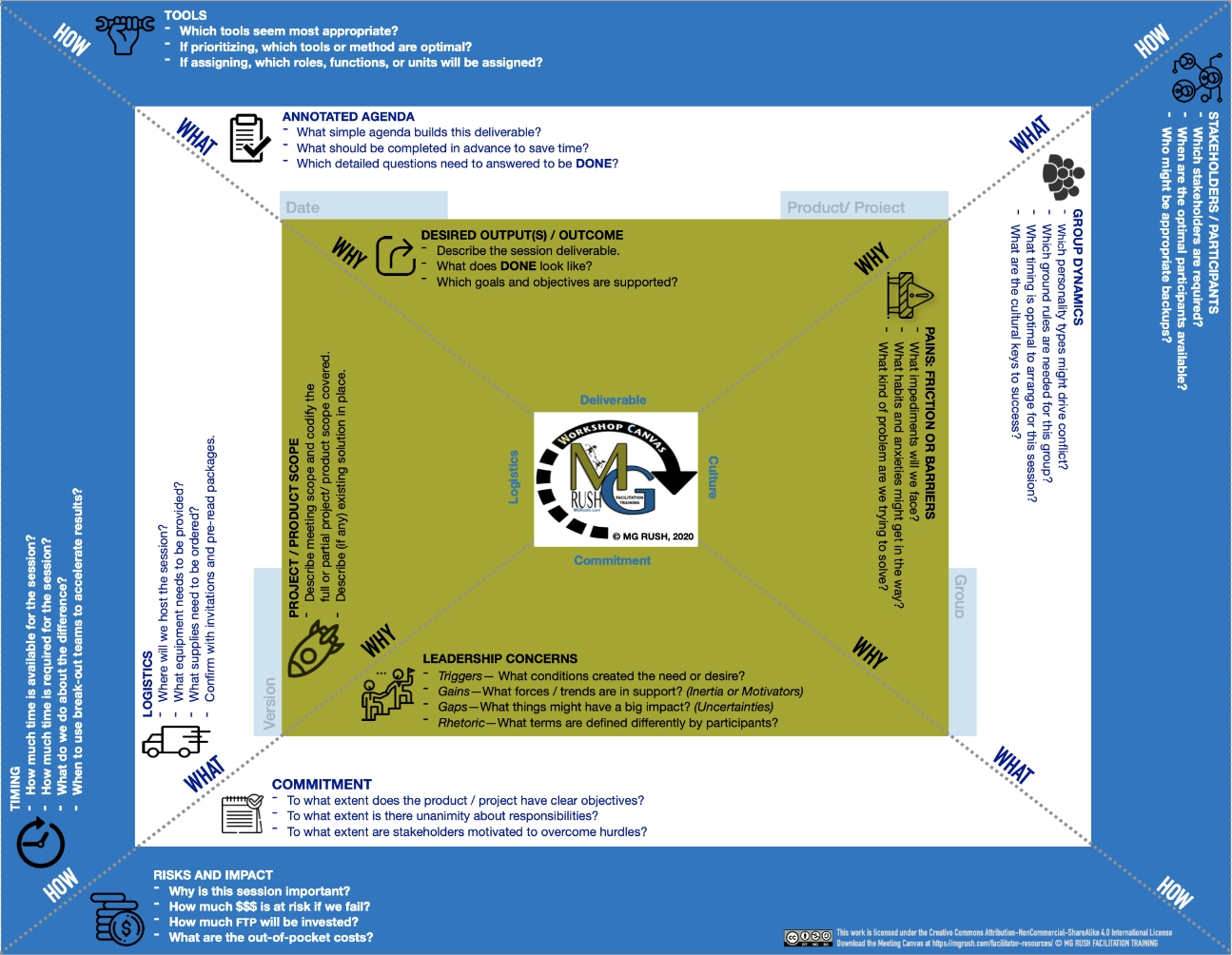
Difference Between Meetings and Workshops: The Workshop Canvas
Success for Both Meetings and Workshops
The critical elements necessary for the success of both meetings and workshops include:
- Availability and commitment from management, thus ensuring the availability of proper resources, personnel, time, and support
- A well-trained session leader with facilitation skills and meeting design skills
- Inflection points—gathering the information, making the decisions, and documenting the results
- Preparation—getting yourself and the participants ready to produce, quickly
- Review and resolution—distribute and integrate deliverable; into product, project, or other initiatives
Significant Differences of Meetings and Workshops
#1 Time Boxing
Meetings frequently limit the amount of time per agenda step. Therefore, with most workshop activities, front-end loading frequently makes it easier to complete the back-end steps and activities. Consequently, for most workshop activities, we estimate time but allow groups additional time to fully develop consensual assumptions up-front, when it matters most.
#2 Topic Dependency
Meetings consist of loosely related topics that serve to review and monitor, inform, and sometimes endorse (or decide). Participants during meetings are commonly passive while workshops demand activity and contributions. Meetings aim for an updated state of affairs or condition (outcome), while workshops create tangible deliverables or concrete ‘outputs.’ Contrasted to meetings, workshops create the ability to act upon clear workshop output.
#3 Concluding
Regularly held meetings (i.e., staff meetings or board meetings) end when time runs out, usually with an understanding that unfinished items will be picked up in the next meeting. When groups are building toward a workshop deliverable, the sequence of the steps is important and they cannot leap ahead or advance until the foundation work is complete.
#4 Facilitator Neutrality
Meeting leaders frequently do not exhibit neutrality. Effective meeting leaders learn to embrace the importance of neutrality and active listening. However, when required, participants force them to render an opinion or a decision. Workshop leaders should strive in every way possible to avoid suggesting content, knowing that the participants must own and live with their decisions. Similarly, workshop leaders risk total failure if they violate neutrality by offering up content. Participants do not expect complete neutrality from meeting leaders.
#5 Duration
Workshops tend to last longer than meetings. While the average meeting lasts from 30 minutes to two hours, the average workshop takes many hours or even a few sessions with multiple days. Complex deliverables such as a Project Charter or Requirements Gathering last multiple sessions that probably span many weeks.
Considerations about Meeting Workshop Differences
Due to time constraints, participant availability, and meeting space (real estate) options, much workshop activity gets spread across multiple weeks, turning a potentially natural, multiple-day workshop into multiple-week “meetings.” The structural difference between concurrent-day and concurrent-week approaches is that the break periods between activities are longer with the concurrent or multiple-week approach.
The session leader needs to be aware of workshop deliverables that are hidden in the term “meeting.” Simply because an event is being called a meeting or lasts for only an hour or two, does not give the session leader the right to show up unprepared or to become a judge of others, their input, and their opinions.
A Structured Technique Works with Both Meetings and Workshops Because . . .
- Assignments combine and finish timely.
- Clear tasks define outputs and directions.
- Consensus-derived information becomes input to subsequent activities.
- Groups make higher quality decisions than the smartest person
in the group.
- Meeting design may use existing agendas (meeting designs), such as structured analysis and prioritization methods.
- Ownership is clear.
- Participants have well-defined roles.
- Structured workshops provide well-defined deliverables.
- The group reaches a mutual understanding of business needs and priorities.
- The session leader stimulates participants with a toolkit of visual aids, documentation forms, and group dynamics skills.
- Structure and group dynamics provide more complete and accurate information.
Structured workshops conducted with workshop best practices are increasingly popular among among design sprints, requirements gathering, and business planning sessions that support business process improvement and product development.
Why? When properly conducted, workshops conducted with workshop best practices generate faster and more effective results than unstructured business discussions. Remember that the terms discussion, percussion, and concussion share a common suffix. Therefore, if you ever have a headache when departing a meeting, it is likely unstructured.
Common Reasons for Structured Workshops
Over the years we have catalogued the various workshops that we facilitated and share the reasons with you. Find them sequenced below in alphabetical order, rather than frequency, importance, or randomness:
- Any initiative requiring decision-making or consensual agreement between two or more people
- Business area analysis
- Business case development (including process optimization)
- Content management prioritization
- Executing your strategy, building action plans
- Gathering requirements
- Innovation, at least the creativity and ideation portion
- Key performance, measuring, and management indicators
- Knowledge management (including decision support)
- Maintenance activity to solve for missing descriptions of changes, precision with requirements, or problem identification
- New system or business development initiatives
- Performance management (including balanced scorecard and dashboards)
- Problem situation requiring arbitration or neutrality
- Process improvement—design or optimization
- Project management
- Problem-solving
- Product development processes
- Scientific inquiry or challenging paradigms
- Six Sigma® and Lean or other quality initiatives
- Strategic planning at any level in the organizational holarchy
- Team charters (including management perspectives and supporting strategic planning activities or tactical assignments)
- Virtual and online meetings and workshops
- Voice of the customer or advisory groups
Workshop Best Practices
Essential workshop best practices developed for facilitated sessions include:
- Defining consensus as a standard that can be supported rather than the ideal resolution that makes participants “happy”, helps set a better expectation that should prevent all participants from losing any sleep (a personal standard).
- Energize and engage participants by explaining the importance of the session in the beginning and strive to quantify the impact of the meeting on the project valued in cash assets at risk or FTP (full-time person) being deployed.
- Use a neutral facilitator. The facilitator must be neutral to the content discussed, allowing the participants freedom to edit and modify their own contributions. Neutrality provides trust that enables a higher level of participation and contribution by participants.
- Using a pre-defined deliverable, agenda, and participant list. Therefore, the deliverable and agenda for each session ought to be articulated in advance to transfer ownership to the session participants prior to the meeting. Thorough preparation helps the participants to focus on topics, questions, and activities that help the facilitator better control the context.
- Using a refrigerator (aka “parking lot” or “issue bin”) to store items out of scope or beyond reach for the time available helps separate the co-mingling of strategic issues, tactical maneuvers, and operational issues.
- Using a well-prepared deliverable and agenda, the facilitator can better control the scope of conversations, preventing circular and irrelevant discussions.
- Write it down. Because, if it is not written down, it never happens. Strive to capture verbatim comments and complete necessary edits after the meeting. Visual feedback builds more confidence among participants. Additionally, making the documentation immediately visible to participants minimizes one-on-one follow-ups and email conversations.
Benefits of Structured Workshops
- Organizations establish scalable, consistent processes that can be measured and continuously improved as a result of adopting a structured approach.
- Overall project life cycle can be shortened by weeks, thus helping business stakeholders realize project benefits early.
- Session participants demonstrate a high level of active engagement, claiming that structured sessions enable better use of their time.
- Structured approaches also produce higher quality outputs, allowing for issues and risks to be identified and resolved earlier in the life cycle when the cost to resolve them is smaller.
- Structured approaches enhance the value of the session leader’s role as a valuable provider of context rather than a mere producer of documentation.
- Workshop approaches result in an overall reduction of time and effort. In comparison studies, companies claim project life-cycle savings that exceed USD $100,000 and some exceeding one million dollars because they adopted a structured approach to meetings and workshops.
- Workshop approaches successfully shift project development activities from being template-driven to conversation-driven, thus helping build cohesive teams and collaboration amongst participants.
In a world where everyone can engage in decisions that affect them
______
Lead the Change—One Meeting at a Time
Are you ready to transform how decisions are made, problems are solved, and alignment is built in your organization?
True meeting leadership goes beyond setting an agenda. It requires a facilitator who can navigate complexity, balance voices, and drive toward outcomes with clarity and consensus. Our Professional Meeting Leadership Workshop and facilitation training equips you to do just that—blending human-centric methods with structured analytical tools to foster rigor, inclusivity, and results that stick.
- Practice live.
- Get expert feedback.
- Build confidence that lasts.
Whether your meetings suffer from unclear objectives, disengaged participants, or decision fatigue, this workshop will help you identify the root causes, apply proven facilitation techniques, and emerge as the leader every team needs.
Take the first step today—transform your meetings and magnify your impact.
______
👉 Click here to reserve your seat now.
#facilitationtraining #meetingdesign
Because every meeting should be a catalyst for change—not just another calendar event.
______
With Bookmarks no longer a feature in WordPress, we provide the following for your benefit and reference.
______
by Facilitation Expert | Mar 12, 2015 | Facilitation Skills, Meeting Support
Some of the best facilitators are NOT Subject Matter Experts within the topic and scope of the discussion. However, they cannot afford to be subject matter ignorant. They need to be subject matter conversant and understand the terms being used. They must understand the relationship of content to the deliverable, but they do NOT have to have an ‘answer.’
Subject Matter Experts
For example, we facilitated sessions in North America, Europe, and Asia with radiologists and directors of radiology. We supported a manufacturer to help them design their next generation of CT (Computerized Tomography) scanners. While NOT a physicist or radiologist we prepared by understanding the basic and essential principles of operation. We were also highly effective at facilitating discussions around pain points and possible solutions.
Neutrality, curiosity, and willingness to challenge assumptions are far more important facilitator skills than being an expert on the topic. Without the humility that encourages one to ‘seek to understand rather than being understood’, participants will drop out, go quiet, and disengage because they are thinking: “If this person (the leader or facilitator) already has the answer, then why are they seeking out my opinion?”
The better challenge or question may be, “What is the unit of measurement for distinguishing between ‘subject matter expertise’ and ‘subject matter conversant’?” For us, the answer is simple.
Context Preparation
Before the session begins, the facilitator and participants ought to be properly prepared. Optimal preparation includes writing down the meeting purpose, scope, deliverables, and simple agenda before the meeting begins. Make sense? Hopefully, you understand that the facilitator, at minimum, better know the reason for the meeting, WHY it is important (i.e., purpose), WHAT will be covered and NOT covered during the meeting (i.e., scope—that is necessary to prevent meeting scope creep, the number one killer of meetings), WHERE the group is headed (ie, the deliverable or what DONE looks like), and HOW they are going to get there (ie, the agenda or prepared structure).
Therefore the unit of measurement becomes the glossary or lexicon. How much does the facilitator understand the terms being used in the prepared meeting purpose, scope, deliverables, and simple agenda? To what extent does the facilitator’s understanding of those terms harmonize with the understanding of the participants, their culture, and the project team or work that must occur after the meeting concludes? To what extent do the participants share the same or identical meaning of the terms used?
We illustrate this importance by challenging you to explain the difference between a ‘goal’ and an ‘objective’. To us, they are NOT the same thing. We prefer an operational definition suggesting that ‘goals’ are directional and somewhat fuzzy. For example, a mountain climber may have a ‘goal’ of getting some good photographs when they reach the summit. An ‘objective’ however is truly SMART—i.e., Specific, Measurable, Adjustable (our preferred deviation from Deming’s original definition of Achievable), Realistic, and Time-based. For example, a mountain climber may need to be sheltered in a tent and sleeping bag at 3,000 meters by 17:00 before a storm blows in or they risk freezing to death.
Cultural Considerations
Some cultures define ‘goals’ and ‘objectives’ as the opposite of our preference, defining ‘objectives’ as fuzzy and goals as SMART. A good facilitator is agnostic and can use either set of definitions. They also know the importance of determining the optimal definitions BEFORE the meeting begins. They are responsible for controlling the context (i.e., contextual expertise) and not the content (i.e., subject matter expertise).
______
Don’t ruin your career by hosting bad meetings. Sign up for a workshop or send this to someone who should. MGRUSH workshops focus on meeting design and practice. Each person practices tools, methods, and activities every day during the week. Therefore, while some call this immersion, we call it the road to building high-value facilitation skills.
by Facilitation Expert | Feb 19, 2015 | Facilitation Skills
Prepared originally as a “Lunch and Learn Guide,” you will find twelve MGRUSH Structured Facilitation secrets followed by a thorough explanation of Facilitation’s Secret Sauce. The facilitation secrets are bulleted in alphabetical order, rather than in order of importance. Facilitation’s Secret Sauce provides instruction around leadership, facilitation, and meeting design.
Lunch and Learn: Structured Facilitation Secrets
Facilitation Secret — ONE:
7:59am preparation and interviews
(i.e., managing expectations and ownership, also true of Facilitation’s Secret Sauce)
-
- Comment: There is no ‘silver bullet’ for effective facilitation. If you don’t show up prepared, good luck with that.
Facilitation Secret — TWO:
Active listening
(because seeking to understand creates more value than being understood)
-
- Comment: Many understand that reflection is the key. However, reflecting on WHY people make claims is more important than simply repeating the claim.
Facilitation Secret — THREE:
Annotated agenda
(i.e., visualizing everything the session leader does or asks in advance)
- Comment: ‘Right-to-left’ thinking (or ‘starting with the end in mind’) makes demands of the facilitator. You must know what the deliverable looks like for each agenda step, each meeting activity, and each tool. Then write it down, so that you can focus on listening during your meeting or workshop, not thinking about what you should say or do next.
Facilitation Secret — FOUR:
Common nouns and purpose give rise to natural categories
(i.e., great tool and inherent rationale that supports grouping or “chunks”)
- Comment: Neophytes create categories when they probably should dive into the details. Most change occurs with HOW people perform activities, not WHAT they must do. But when categorization is required, building process terms, for example, common nouns are symptomatic or indicative of common purpose, the primary reason for categorization.
Facilitation Secret — FIVE:
Evaluations
(i.e., the importance of ongoing feedback to ensure continuous improvement)
- Comment: Through hours of practice and recorded sessions, MG RUSH five-day professional students receive six pages of individualized, written feedback directed at what they can do differently to be more effective.
Facilitation Secret — SIX:
Holarchy
(i.e., interdependent reciprocities—contextual explanation of how it all fits together)
- Comment: Commonly referred to as the ‘Butterfly Effect’ (mathematically called inter-dependent reciprocities), every action has an impact (positive or negative) on each project or initiative.
Facilitation Secret — SEVEN:
Life Cycle: Plan ☛ Acquire ☛ Operate ☛ Control
(i.e., great tool and inherent rationale behind all life cycle methodologies)
- Comment: While the technology perspective is called CRUD (Create, Read, Update, Delete), here is what the business community does with information. Every process requires four activities, at minimum. Subject matter experts often forget about Planning and Control activities that may be performed less frequently, sometimes only monthly or quarterly.
Facilitation Secret — EIGHT:
Numeric TO-WS (SWOT) leads to consensual actions [i.e., WHAT]
(i.e., Easily the best way to prioritize hundreds of items and build consensus around “WHAT” needs to be done to support the purpose)
- Comment: Capable of prioritizing the most complex issues, with dozens of criteria and options, MGRUSH’s proprietary tool and decision-making logic are used in most portfolio and program management offices.
Facilitation Secret — NINE:
Right-to-left thinking or, focus on the deliverable first
(i.e., starting with the end in mind—forcing the abstract into the concrete)
- Comment: Even a lousy facilitator can succeed when they know where they are going and what the group needs to answer and address to get DONE.
Facilitation Secret — TEN:
“The Purpose is to . . . So That . . . “ (i.e., amazing tool to extract the “strategy” behind something too small for a “strategic plan”)
- Comment: Easily the favorite new tool for many students and best echoed by an IBM’er with 35 years. “This is the tool I’ve been missing my entire career.”
Facilitation’s secret sauce to leading more effective meetings and workshops reminds us to put a CAP on wasted time and energy by embracing three behaviors:
Clear Thinking
- Clear thinking (i.e., yields consciousness)
- Active listening (i.e., yields competence)
- Prepared structure (i.e., yields confidence)
Facilitation’s Secret Sauce — Clear Thinking
When you are leading a meeting, it is critical that you know what the group intends to build, decide, or leave with. What was different when they walked into the meeting? The modern leader is a change agent, someone who takes a group from where they are when the meeting begins to where they need to be when the meeting ends. You need to start with the end in mind.
Nobody is smarter than everybody. The modern leader does not have all the answers but takes command of the questions. Through appropriate questions, meeting participants focus and generate supportable answers (or responses).
What does DONE look like? — Leadership Consciousness
Leaders know where they are going. For most meetings, clear thinking and a sense of direction are built in advance. Through preparation, determine and properly sequence well-scripted questions. If you were designing a new home, for example, you would consider the foundation and structure before discussing the color of the grout.
Unclear speaking and writing indicate unclear thinking. Your awareness about where you are leading the group needs to be expressed in writing, for your benefit and the benefit of others. If you are unable to capture the ‘deliverable’ of your meeting or workshop in writing, you are not ready to start your session. Once you can articulate WHY your meeting is important, then you are ready to proceed with the next step. WHAT must you do to be more facilitative?
Facilitation’s Secret Sauce — Active listening
Groups make higher quality decisions than the smartest person in the group. Why? Because groups, when properly led, are able to create options that did not exist before the individuals walked into the meeting. Input from one participant may cause another to think of something they had not considered before the meeting. For a group of nine people, we are looking for the tenth answer. With strong leadership and a little luck, that answer may also include or instill the spark of innovation.
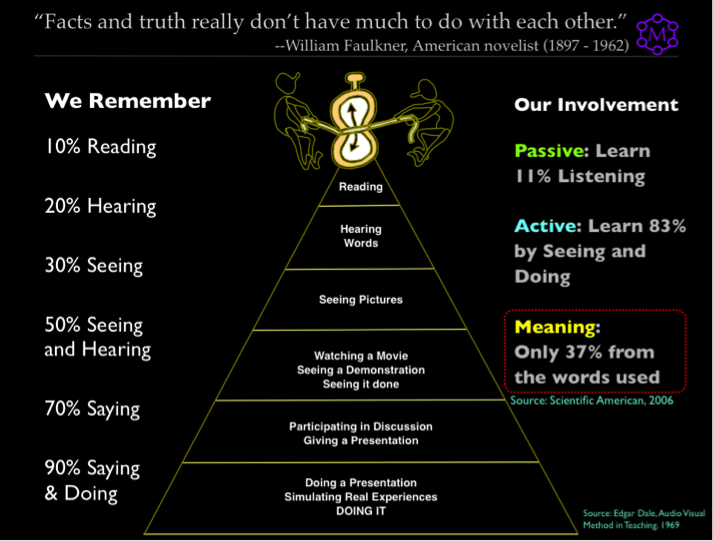
Ultimately we are not facilitating “words” in a meeting, so much as the meaning behind the words. Obviously, meetings occur without the use of the English language at all. Non-English meetings will still be effective because words are only the tools used by participants to signify their intent, meaning, and relationships behind the words. Subsequently, pictures and models are frequently more effective tools than narrative descriptions.
Be prepared to challenge participants. Active listening is a four-step process that is NOT like having a conversation. In a conversation, we make contact and absorb what the other person is saying. With active listening we need to feed back the reasons for what we have heard, confirm whether we got it right, and challenge for substantive omissions.
Feedback and Confirm
Active Listening
Having a conversation takes less time. Active listening however prevents misunderstanding and can help push the envelope towards options that were previously not considered, thus improving the quality of the decisions made.
Facilitation’s Secret Sauce — Prepared Structure
Ask yourself, would you typically rather attend a two-hour meeting or go to a movie? Most people would rather go to a movie for at least three reasons:
- Movies include a beginning, a middle, and an end. When did you last attend a meeting without one of those components?
- Movies embrace conflict. They do not scurry away from conflict; rather they use conflict to make the experience more compelling.
- Movies do not require involvement. It is easier and less embarrassing to fall asleep at a movie than a business meeting.
A leader should be disciplined and not unstructured. Prepared structure when working with groups, teams, and meetings refers to discipline, or the order of things. The meeting and workshop structure is like a road map for a trip. You can always take the scenic route or a detour, but you need a clear directive to know where to return.
Ironically, the more structured the meeting, the more flexible you can be. Without structure, or a road map, you can never tell exactly where you are, or more importantly, how much remains to be covered. With structure, you can divert from your plan and take the scenic route knowing that if the team runs into a dead end or gets bored with the scenery, you can always return to your map and planned guidance.
Left to their nature, groups tend to start “solving” before they complete proper and rigorous analysis. The leader needs to play the role of a process police person and should never be too nice. Teams do not want a nice leader; they want a leader who will get them where they are going, on time, and within budget. “Nice” can take place after the meeting is over, in a different role.
Naturally, the situation demands professionalism, respect, and common courtesy—but leading is not like having a group of friends, it is a group of associates, bound by a common cause.
Consensus Building
The nature of building consensus mandates that we seek understanding first about WHY we are doing something. If we cannot agree on WHY something is important, it is highly unlikely that you will later arrive at a consensus. We are seeking harmony, or better yet, the harmonization of different notes being played on different instruments—something akin to music, whether a symphony or hip-hop. The leader dictates tempo, volume, and who plays when. The leader does not however pick up an instrument and start playing on behalf of the meeting participants. It is the participants’ responsibility to play their instruments. It is the leader’s responsibility to provide cohesion.
Be a disciplined leader and know your structure before the meeting begins. Once you develop awareness about where you are leading a group, rigorously apply the discipline of structure to decide how you are going to lead them.
______
Don’t ruin your career by hosting bad meetings. Sign up for a workshop or send this to someone who should. MGRUSH workshops focus on meeting design and practice. Each person practices tools, methods, and activities every day during the week. Therefore, while some call this immersion, we call it the road to building high-value facilitation skills.
by Facilitation Expert | Feb 5, 2015 | Facilitation Skills, Meeting Agendas, Meeting Support
A facilitated structured meeting or workshop provides an environment designed to extract high-quality information in a compressed timeframe. A structured meeting uses visual aids and a team of experts to accelerate projects and increase the quality of decisions, outputs, deliverables, and outcomes.
Therefore, the major components of the MGRUSH structured meeting technique include:
- A model life cycle and methodology that eases adapting MGRUSH to a variety of planning, analysis, and design methodologies
- An intensive educational forum providing the necessary facilitation and communication skills, tools, and an understanding of facilitated meeting roles—not dogma or other inflexible, guru-like perspectives
- Collaborative activities designed to encourage discovery and promote innovation
- Stress-tested workshop and meeting approaches molded to fit most project situations
- Proficient leadership, based on critical skills such as:
- Project management and risk analysis support
- Expert resources (such as MGRUSH alumni tools and the Professional Reference Manual)
- Ten uniquely defined roles including session leader, documenter(s), meeting designer, business partner, technical partner, executive sponsor, team members, participants, coordinator, and observers
- Stimulating visual communication aids, used appropriately by a trained and certified professional facilitator.
A Structured Meeting is NOT
A structured meeting or workshop is NOT a replacement for analytical methodologies. Structured meetings and workshops work with methodologies to generate a uniform voice by providing an efficient two-way flow of information, from one person or group to another. Consequently, information developed with a consensual method provides value by becoming the foundation for additional information gathering, development, and decisions.
Session Leader
A neutral session leader (i.e., facilitator/ methodologist) provides the keystone for structured workshops. The session leader understands the preparation requirements, group dynamics, and appropriate methodology. Therefore, the session leader is responsible for managing the approach—the agenda, the ground rules, the flow of the conversation, etc.—but not the content of the discussion, or even necessarily the project(s) being supported by the discussion and decisions.
Effective Facilitator
Various academic research has found that the most effective type of facilitator was one that actively elicited questions and responses from the quietest participants to enable a balance among the players. Consequently, effectiveness is best achieved by building a safe and trustworthy environment, one that provides “permission to speak freely,” without fear of reprisal or economic loss.
Defined Products
Finally, the type of documentation generated drives workshop techniques. Some use templates to organize the notes taken during a workshop. The information collected starts out as raw or draft notes. Draft notes provide formal input to the project process. However, the meeting or workshop is not synonymous with the project, rather it compliments additional tasks and activities performed before and after the meeting or workshop, typically by the project team. A clear and consensually agreed upon path of next steps and “WHO does WHAT by WHEN” becomes the most common deliverable of meetings and workshops.
______
In a world where everyone can engage in decisions that affect them
______
Lead the Change—One Meeting at a Time
Are you ready to transform how decisions are made, problems are solved, and alignment is built in your organization?
True meeting leadership goes beyond setting an agenda. It requires a facilitator who can navigate complexity, balance voices, and drive toward outcomes with clarity and consensus. Our Professional Meeting Leadership Workshop and facilitation training equips you to do just that—blending human-centric methods with structured analytical tools to foster rigor, inclusivity, and results that stick.
- Practice live.
- Get expert feedback.
- Build confidence that lasts.
Whether your meetings suffer from unclear objectives, disengaged participants, or decision fatigue, this workshop will help you identify the root causes, apply proven facilitation techniques, and emerge as the leader every team needs.
Take the first step today—transform your meetings and magnify your impact.
👉 Click here to reserve your seat now.
#facilitationtraining #meetingdesign
Because every meeting should be a catalyst for change—not just another calendar event.
______
With Bookmarks no longer a feature in WordPress, we provide the following for your benefit and reference.
______
by Facilitation Expert | Jan 29, 2015 | Facilitation Skills, Meeting Support
A primary concern in meetings and information-gathering activities is getting good information—to build the right product the first time—and to make well-informed decisions. Significant trends show that groups are embedding the role of ‘facilitator’ in the culture and health of modern, especially holistic, organizations. Therefore, take strides to avoid poor facilitation.
“Perversely, organizations with the best human resource departments sometimes have less effective teams. That’s because HR tends to focus on improving individual rather than team behavior.”
— Diane Coutu, HBR, May 2009, pg 99
Successful Meetings Demand Collaboration and Avoid Poor Facilitation
Group decision-making processes are more prevalent than ever. Intellectual capital is critical to the growth and profit of service organizations. Manufacturers are becoming “infomediaries” and sourcing production based on worldwide, not parochial, views. Innovation determines the future prosperity of most organizations:
Meta-trends Demand Facilitative Leadership
- Cultural modernization—the basic tenets of modern cultures include equality, personal freedom, and individual requirements.
- Economic globalization—In developed economies, where formal institutions sustain order and predictability, consensus is critical to survival.
- Universal connectivity—information technology continues to inundate us with capabilities and the “death of distance” when we can find what we need.
- Transactional transparency—ubiquitous computing and comprehensive electronic documentation make leaders and decision-makers exposed.
- Individual limitations—empirical evidence that groups make higher quality decisions and are better at addressing more difficult or complex challenges.
Problems With Poor Facilitation
Decision-making and information-gathering share two problems:
- The first is the communication gap between those who have the information (e.g., information technology) and those who need to use it to build something (eg, business community or product development).
- The invariable power struggle between the players involved exacerbates poor facilitation. Egos make building consensus a significant challenge.
Power Struggles With Poor Facilitation
The power struggles between various departments or business units are often the result of language differences. Frequently, power struggles are not intentional but occur because of differing perspectives around the same issue. Reconciliation may be critical to organizational success, particularly for proactive organizations that want to lead change rather than be changed.
Errors & Omissions Through Poor Facilitation
The most effective way to reduce the cost of reaching objectives is to reduce errors and omissions. Groups recall and remember more than individuals and are capable of using their input to create an integrative response. Consensus helps prevent errors, but more importantly, it helps prevent omissions.
Help Needed to Avoid Poor Facilitation
Numerous analytical methodologies, design methodologies, life cycle techniques, etc., have evolved to address errors in the planning and development phase. While methodologies work well in analysis and design, they have not successfully addressed the information gathering necessary to gather effective and timely input.
______
Don’t ruin your career by hosting bad meetings. Sign up for a workshop or send this to someone who should. MGRUSH workshops focus on meeting design and practice. Each person practices tools, methods, and activities every day during the week. Therefore, while some call this immersion, we call it the road to building high-value facilitation skills.
by Facilitation Expert | Jan 1, 2015 | Leadership Skills
When dealing with anger, first understand that anger is as normal as any other emotion. We simply expect or want things to be different or better.
Most people direct their anger at those who have some control over them. However, anger can be healthy and is different from hostility, which is not healthy. Indeed, anger is often used to hide other feelings such as hurt or disappointment. Learn how to deal with anger in others and in yourself. The term ‘anger’ is only one ‘d’ short of the term ‘danger.’
In Others — Dealing with Anger
Dealing with Anger
- Acknowledge and affirm the participant’s beliefs.
- Anger is seldom directed at you personally. You are just convenient.
- Encourage the participants to talk about their anger. This helps to diffuse the anger.
- If you have contributed to the anger, let the participant vent before trying to explain or apologize.
- Use non-judgmental, active listening. This lets the participant know that you care. Never get hooked yourself.
In You — Dealing with Anger
- Acknowledge and accept the anger. Do not deny it or it will resurface at the wrong time.
- Deal with the problem that caused the anger and the anger itself separately. Do not make decisions when your anger is in control.
- Express your anger when it is safe and appropriate. Find safe outlets. Sometimes it even passes without having to express it.
- In a meeting or workshop, take a break, take a walk, verbalize calmly, and reprogram yourself.
- Recognize the cause of the anger and identify the other emotions you are feeling.
Remember that anger can be modified and danger avoided.
______
Don’t ruin your career by hosting bad meetings. Sign up for a workshop or send this to someone who should. MGRUSH workshops focus on meeting design and practice. Each person practices tools, methods, and activities every day during the week. Therefore, while some call this immersion, we call it the road to building high-value facilitation skills.
by Facilitation Expert | Dec 18, 2014 | Leadership Skills, Managing Conflict, Meeting Support
Facilitators must understand and manage meeting conflicts. Therefore, we must first understand our own internal conflict so that we are prepared to serve others. Critically, we should view our meeting conflict response as both a challenge and an opportunity.
Meetings are expensive and mitigating conflict provides one of the absolute best reasons for meetings. However, conflict also comes from the situation, and from you.
Don’t Run from Internal Conflict
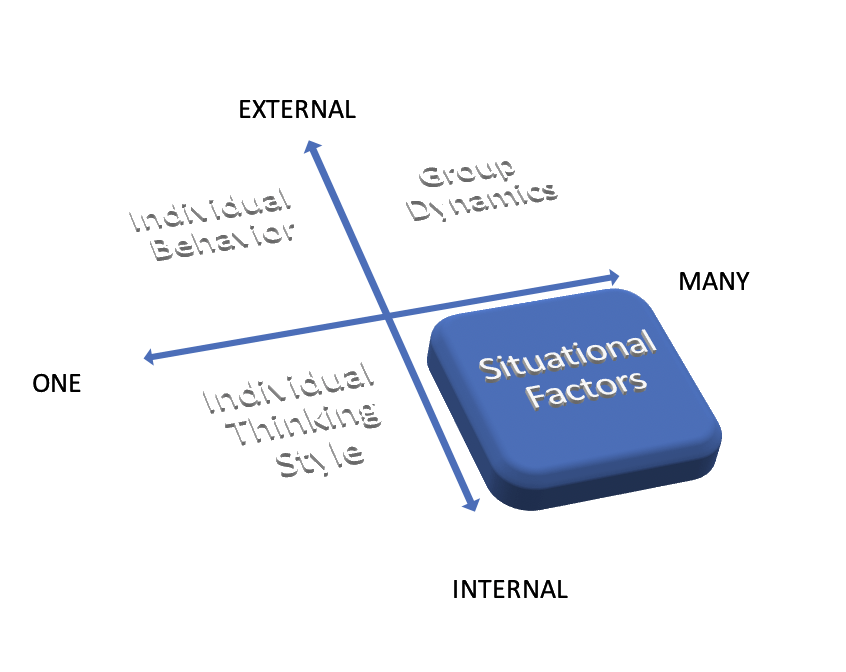
Conflict Response to Situational Factors
Internal conflict is fear, and all people have fears. However, when we allow these fears to control us, we lose our ability to perform. Therefore, the first step is to understand our fears. Once we do, we can control them and begin to manage conflict. Because fears never go away—you simply learn to acknowledge or contain them. Learn to control fears. Below are some typical facilitator fears:
Fly In Formation
Once you identify your personal fears, you can find ways to make them work to your advantage. Remember that the butterflies in your stomach will always be there. Therefore, you don’t want to remove them. However, you want to teach them to fly in formation.
External Conflict
Conflict in your group is natural and not necessarily bad when responsibly managed. Hence, you must channel conflict into productivity. Managed well, conflict leads to expanded information exchange, surfaced rationales, more options, and better group decisions that enable change. Managed poorly, conflict destroys. Effectively managed, conflict leads to positive transformation. However, if left festering in the hallways, conflict leads to chaos.
Conflict provides one of the best reasons for justifying the time and expense of a face-to-face meeting because it cannot be properly resolved with mail, attachments, and messaging. Because society places negative values on conflict at home and at school, we are not taught collaborative problem-solving skills. Therefore, let’s consider the external sources of conflict, barriers you will encounter, and responses that are proven effective.
Facilitative leaders can channel conflict into productivity. For example, look at the U.S. Federal Mediation and Conciliation Service.[1]
“A peaceful, harmonious place can be the worst thing possible for a business. Research shows that the biggest predictor of poor company performance is complacency. Therefore, conflict can shake things up and boost your staff’s energy and creativity.”[2]
Conflict Response
Recognizing the Need for Meeting Conflict Response
Recognize that conflict exists particularly when you sense resistance from the group. Therefore, if your intuition tells you that something is not right, you would be wise to listen to the symptoms:
Sources of Conflict
Primary sources of conflict in a typical workshop include the following. However, keep in mind that the two leading indicators are tenure (i.e., how long somebody has been around) and when their jobs, titles, or reporting situation is at risk of being changed:
- Competition—feeling out of control or the need to control
- Fears—participant fears as well as facilitator fears
- Habits—accustomed to disagreeing or arguing, cultural
- Listening filters—age, background
- Misinformation—rumors, especially about change
- Participants’ problems—out of control, unable to excel or bond
- Poorly defined objectives—misunderstanding of expectations
- Priorities—similar values, but varying priorities
- Semantics—understanding of words and intent
- Situations—business process improvement, restructuring, reorganizations, automating
- Thinking styles—vertical/ horizontal
- Ways participants view others—biases, heuristics, prejudices
Barriers to Meeting Conflict Response
The following barriers inhibit your ability to manage conflict:
- Ability or willingness to listen—yours and theirs
- Copper or fiber (online meetings)—inability to challenge participants in person
- Fears—yours and theirs
- Group norms—culture such as “we don’t discuss that here”
- Image—inability to save face
- Lack of skill—a weak or poorly trained facilitator
- Learned responses—Our past is hard to unlearn
- Time—consensus is seldom achieved quickly
- Vulnerability—real or perceived threats
Paradigm Challenges
Paradigms are established accepted norms, patterns of behavior, or shared sets of assumptions. They are models that establish boundaries or rules for success. Therefore, paradigms present structural barriers to creativity based on psychological, cultural, and environmental factors. Examples include:
- Flow charts, diagrams, and other conventions that people get comfortable with when presenting information that they rely on habitually (e.g., swim lanes).
- Stereotypes about men and women and their roles in business, family, and society
- Where people sit in meetings, when in person—once they find a seat it becomes “their seat” for the rest of the meeting, or meetings if the seat associates with their own desired level of position or power (could be high or low, and a seat up front or far back)
Groupthink
As creatures of habit, we blindly subscribe to our cultural paradigms, unknowingly allowing our biases and prejudices to affect our decision-making, and readily falling prey to groupthink. There is power in large numbers, but not necessarily an increase in quality. For example, voting reflects a method of groupthink decision-making. However, the winner is not necessarily a better decision, it only reflects a bigger number.
Challenge Both
When people raise objectives, discover the cause of the objection. By challenging participants, you convert their subject matter bias into its objective nature. What causes the objection and what is the measurement of the cause? The chili is too spicy (subjective) and may be converted into 1,400 Scoville units (objective).
- Ask about ‘Paradigm Shift’—“What is impossible today, but if made possible . . . What would you do differently?”
- Consider using Edward de Bono’s Thinking Hats (pg 216) where you impose perspectives such as the different tactics that might be taken by a monastery contrasted with an organized crime syndicate.[3]
- Force the group to look at a familiar idea or scenario in a new way by changing their perspective. Shifting perspectives frequently helps ‘shake’ paradigms.
- Have a few tools in your hip pocket, usually visual or riddle-based. Build a tool kit for immediate help and prepare a hip pocket set of Tools and procedures for the unexpected.
Anger and Some Other Stuff
How well do you personally respond to conflict? To effectively facilitate conflict, you must keep the situation constructive and . . .
- Build a tool kit for immediate help and prepare a hip pocket set of Tools and procedures for the unexpected.
- Know how to communicate acceptance by promoting integral thinking, a ‘Yes AND attitude’ not ‘Yes BUT . . .’
Anger—One letter short of Danger
Realize that anger is as normal as any other emotion. We expect or want things to be different or better. Most people direct their anger at those who have some control over them. However, anger can be healthy and is different from hostility, which is not healthy. Anger is often used to hide other feelings such as hurt or disappointment. Therefore, learn how to deal with anger in others and in yourself. Remain cautious, however, because the term ‘anger’ is only one letter ‘d’ short of the term ‘danger.’
When dealing with others’ anger:
- Acknowledge and affirm the participant’s beliefs.
- Encourage the participant to talk about the reasons for their anger. This helps diffuse the anger.
- Let the participant vent before trying to explain or apologize.
- Use nonjudgmental active listening. This lets the participant know that you care.
When dealing with your own anger:
- Acknowledge and accept the anger. Do not deny it or it will resurface at the wrong time.
- Deal with the problem that caused the anger as quickly as practical. However, do not make decisions when your anger is in control.
- Take a break, whether in person or online. Take a walk and reprogram yourself.
When you listen to participants, they become more prepared to listen to each other. Anger often dissipates and trust begins to emerge. Make sure that both you and the participants avoid communicating rejection. Rejection incites defensiveness and blocks listening.
Six Actions for Your Meeting Conflict Response
How do you respond to managing conflict? To effectively facilitate a conflict situation, you must keep conflict constructive and . . .
- Understand anger—dealing with yours and theirs.
- Know how to communicate acceptance—to promote open communications.
- Understand consensus—it is not compromised.
- Prepare properly—know if it is coming.
- Build a tool kit (see MGRUSH Facilitative Leadership Tools for immediate help and develop a hip pocket set of tools in preparation for the unexpected)—build teams and diffuse problems.
- Challenge—When people raise objectives, discover the cause of the objection. With active listening and proper leadership, the objection can be converted into a criterion. What causes the objection and what is the unit of measurement of the cause?
______
[1] The penalty for a Federal Mediator who violates neutrality is prison.
[2] Saj-Nicole, Joni and Damon, Beyer “How to Pick a Good Fight,” Harvard Business Review, December 2009, pg 50.
[3] De Bono, Edward “Six Thinking Hats,” https://www.amazon.com/Six-Thinking-Hats-Edward-Bono/dp/0316178314/
______
Don’t ruin your career by hosting bad meetings. Sign up for a workshop or send this to someone who should. MGRUSH workshops focus on meeting design and practice. Each person practices tools, methods, and activities every day during the week. Therefore, while some call this immersion, we call it the road to building high-value facilitation skills.
by Facilitation Expert | Oct 23, 2014 | Leadership Skills, Meeting Support
Before you send a meeting or workshop pre-read to participants, consider a formal meeting announcement rather than an informal calendar invite. If accepted, follow up the announcement with the invite, and then your pre-read package.
Meeting Announcement
While all of the following is not necessary, put yourself in the position of the participant. Therefore, ask yourself, “Would I be interested in knowing this _______?” Clearly, if the answer is ‘yes’, then consider putting it in your meeting announcement.
Therefore, some considerations include:
- Meeting facilitator contact information; including perhaps:
- Easy to cut and paste email
- URL for business group or division
- Primary telephone
- Mobile telephone
- URL for SharePoint or workgroup folder
- Meeting logistics; including perhaps:
- Date of meeting
- Time of meeting
- Duration of meeting
- Location of meeting (including a map if part of a large campus setting). Plus any hints about best access such as elevator banks to take or avoid
- Meeting participants; including perhaps:
- List of attendees
- Alternatively, consider adding their contact information as well
- Items that should or should NOT be brought with them
- Request for questions they would like answered during the meeting
- Meeting rationale; including:
- Purpose and scope of the meeting (50 words or less)
- Statement of meeting deliverables (i.e., output) or desired outcome
- DRAFT agenda items (knowing some minor changes may occur)
- Other miscellanies particular to your situation
While these considerations may appear burdensome, they are truly optimal. You can remove or subtract as you deem fit, but always make adjustments from the point of view of the participants, rather than what will make your life easier.
______
Don’t ruin your career by hosting bad meetings. Sign up for a workshop or send this to someone who should. MGRUSH workshops focus on meeting design and practice. Each person practices tools, methods, and activities every day during the week. Therefore, while some call this immersion, we call it the road to building high-value facilitation skills.
by Facilitation Expert | Oct 9, 2014 | Decision Making, Prioritizing
World scientists strive to map activity in the human brain. Presumably, a map of neural activity will shed light on how the brain works and how choices get made.
Concurrently, there has been an upsurge in related fields seeking to understand human nature and behavior. One focus on change: neuro accounting, neuroeconomics, neurotics, neurofinance, neuro leadership, neurolinguistics, neuro management, neuromarketing, and now . . .neurofacilitation.
Neuroeconomics♦ developed over 50 research groups around the world, “exploring the brain processes that underlie decision-making.” Economics focuses on how people make choices, especially when they cannot get everything they want. Traditional theory asserts that rational decision-making maximizes utility, satisfaction, or well-being. Yet daily, people and groups generate sub-optimal decisions, so the question remains—why?
Science continues to advance our understanding of decision-making. Look no further for proof than proximity. Scientists now know where in the brain choosing occurs. They understand where preferences reside, and how choices happen physically. While they learn to model ‘how we choose our underwear” (or how monkeys choose their juice), we professional facilitators must be held accountable for mapping how complex group decisions are made. Business meetings could be referred to as a neural net of decision-making.
Traceability
Maintaining a diligent trail of challenge and documentation provides a benchmark to support neurofacilitation. Group decisions require traceability. Take any decision back to your supervisor, executive sponsor, or steering team and they will immediately respond with “Why?” Why did your group make the decision they made?
Data sets are making it much easier to make more informed decisions. Teo cites three relevant examples related to individual decision-making:
1) Electronic road pricing that helps predict the changing demographics, vehicle types, and density of traffic.
2) In New York City data is available on every taxicab: whether they are occupied or empty, when patrons are waiting (or not), the size of the tips, etc.
3) Equity stock selections where information abounds on whom, when, how much, etc.
Yet there is no comparable example offered to shed light on the most important decisions being made that affect all of humanity, not solely one individual. For example, should we go to war, fire a missile, build a new nuclear plant, construct a new highway (or conduct road repair), approve a major project, hire a key executive, etc..
Professional facilitators ought to sensitize themselves to the importance of neurofacilitation; i.e., challenging the underlying rationale and carefully documenting the support behind all of the options, not only the final choice. You may never want to see the term ‘neurofacilitation’ again, but you know that it oversimplifies the true nature and complexity of group decision-making, and how groups or teams define “utility.”
~~~~~~~
♦ Cited by Anna Teo (The Business Times, 01/03/13),
______
Don’t ruin your career by hosting bad meetings. Sign up for a workshop or send this to someone who should. MGRUSH workshops focus on meeting design and practice. Each person practices tools, methods, and activities every day during the week. Therefore, while some call this immersion, we call it the road to building high-value facilitation skills.
by Facilitation Expert | Oct 2, 2014 | Decision Making, Managing Conflict, Prioritizing
A facilitator should typically avoid the term “happy”.
Our effort guides a group to a common or shared understanding that they can support and not lose any sleep over—something they can “live with.” Consensus does NOT mean that they are going to end up “happy.”
Look closely at the difference in meaning between the terms ‘objective’ and ‘subjective’. The ‘object’ is that outside of us that is being perceived. The ‘subject’ is the perceiver. In business, we frequently use the term ‘objective’ as something we intend to accomplish or realize. We use the term ‘subject’ when we are referring to meeting participants, or ‘subject matter experts’.
Subject matter experts, aka SMEs, express their preferences, requirements, needs, priorities, likes, dislikes, etc. about ‘objects’ or things outside of their immediate control. Two people eating chili for example may disagree on the chili’s level of spiciness. What is really hot to one person may be tepid to another. They are experiencing separate realities; they are reacting differently to the same object (the spiciness of the chili).
Scoville Units
No amount of argument will get them to agree on whether the chili is too spicy or not. Clearly, to one, it is, while to the other it is not. They are both right from their subjective points of view. The wrong approach would be to encourage them to meet halfway and call the chili semi-spicy. That would be like suggesting one with their left foot in a pail of hot water and their right foot in a pail of freezing water should on average, be comfortable.
Objectify the Subjective
Therefore a world-class facilitator strives to ‘objectify’ the subjective. Meaning, that they strive to find a common ground between both parties to which both parties agree without compromise. In the case of spiciness, we might be able to get both parties to agree that the chili is neither hot nor tepid, rather they might agree that it measures 3,000 Scoville units (i.e., the measure of pungency or the amount of capsaicin that makes peppers ‘hot’). The truly objective rating of the spiciness does not make either participant “happy” but it does give them a common ground about which they can argue for more or less in the specific, rather than the general.
While one may argue for more ‘heat’ and another argues for less ‘heat’ we can now more effectively facilitate precisely what is meant by heat, and wisely offer options such as offering two or three types of chili.
We are seeking agreement or consensus rather than making participants “happy” so please be careful when using the term, or similar terms that are “qualitative” by description but can be made “quantitative” through strong challenge, clear definitions, and excellent facilitation.
______
Don’t ruin your career by hosting bad meetings. Sign up for a workshop or send this to someone who should. MGRUSH workshops focus on meeting design and practice. Each person practices tools, methods, and activities every day during the week. Therefore, while some call this immersion, we call it the road to building high-value facilitation skills.
by Facilitation Expert | Sep 25, 2014 | Meeting Support, Meeting Tools
Always remember, to ask WHY before WHAT before HOW when you want to lead a group of people to shared understanding.
Success begins with developing common ground as to WHY a group has come together to plan, analyze, or design. Use of our Purpose Tool quickly builds an integrated viewpoint that coalesces the intent and purpose behind anything—from a large organization to a small product or process. Appealing to WHY something exists leads to meaningful suggestions about WHAT to do to support the purpose.
Common Purpose
Create clear deliverables before your meeting, but start your meeting either building or confirming the purpose of the object of your deliverables. For example, if creating a simple decision about a gift for someone, determine the purpose of the gift first. Next prompt for gift ideas and decision criteria. Some in the group may be serious while others could treat the gift as a “gag” (i.e., comedic relief). Best to reach an understanding about the purpose of the gift before launching into gift ideas.
Support the Purpose
Contrasting the abstract with the concrete yields insight into the simple difference between WHAT and HOW. WHAT groups may need includes decisions, plans, and amplified understanding. Any discussion about deliverables such as decisions, plans, and prioritization should always appeal to WHAT is required to support WHY the common purpose exists and align with WHY it is important.
Likewise, detailed design and HOW things get done may also appeal to WHY it exists. In a safety-sensitive culture, for example, the risk of injury and potential damage to health, safety, or environment must be reconciled with WHY something exists. To prevent 100 percent risk abatement may be too expensive, so strive to reduce as much potential injury as common sense, timing, and budget allow.
______
Don’t ruin your career by hosting bad meetings. Sign up for a workshop or send this to someone who should. MGRUSH workshops focus on meeting design and practice. Each person practices tools, methods, and activities every day during the week. Therefore, while some call this immersion, we call it the road to building high-value facilitation skills.
by Facilitation Expert | Sep 18, 2014 | Managing Conflict, Meeting Support
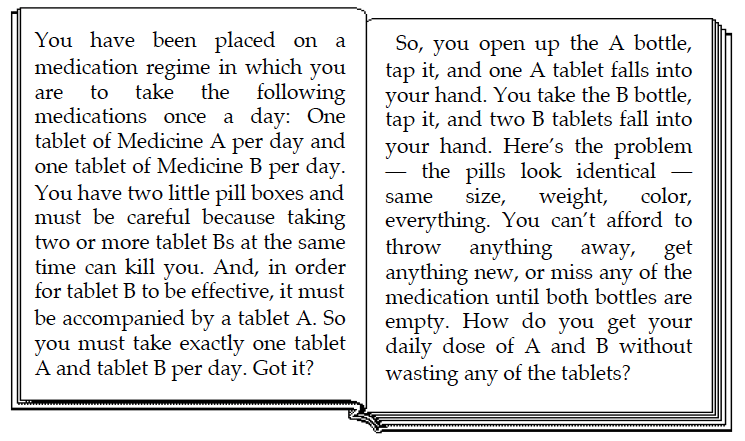
Those of you familiar with the MGRUSH curriculum remember the challenge of the “bookworm” exercise that only one or two participants get correct per year.
Here is another similar, quickly run challenge to test groups resistant to change or inclined to simply “vote on things.” Remember, Challenge the Status Quo.
Keeping Groups Mentally Sharp
Answer
Add an “A” tablet to the mix. Now you have two full tablets of each, not knowing which is “A” and which is “B”. Cut each tablet in half without mixing the halves. Then take one-half of each of the four tablets. The remainder will also provide the proper dosage for another treatment (e.g., tomorrow).
Application
Use our “bookworm” problem, this “medicine” example, or similar “tests” to stir things up, especially with groups that become too complacent. Remember as well to remind your participants shouting “We don’t do things that way around here.” That WHAT they do may rarely change, but HOW they do it changes constantly, whether they realize it or not.
Other participants are given an understanding of the value of stimulating thinking processes throughout the day. Creative thinking is the key to breakthrough, and innovation is a primary driver of profit.
______
Don’t ruin your career by hosting bad meetings. Sign up for a workshop or send this to someone who should. MGRUSH workshops focus on meeting design and practice. Each person practices tools, methods, and activities every day during the week. Therefore, while some call this immersion, we call it the road to building high-value facilitation skills.
by Facilitation Expert | Sep 11, 2014 | Communication Skills, Leadership Skills
Nonverbal expressions, like words (see Facilitate Meaning, Not Words), connote multiple messages.
After you finish this article, you will be strongly tempted to embrace the MGRUSH recommendations. Keep your elbows tucked in, your hands below your heart, and keep them open, facing up. Some would call this approach, keeping your hands to yourself.
For example, extending the index and little fingers upward, with a fist, shaped like a “V” (with the middle and ring fingers tucked down into the palm, along with the thumb) can signify victory or good luck in the Americas. The same non-beral gesture represents a vulgar insult in Italy.
A single thumb up, commonly used to express “all right” in the United States, counts as the number one in Germany, the number five in Japan, and is seen as a vulgar insult in Afghanistan, among other places (akin to the middle finger prone upward in the United States).
Scuba divers universally acknowledge the clasping of the thumb and index finger into a circle (or, “AOK”) as the buddy signal that all is fine. The circle will be perceived as a vulgar insult in Russia and Italy. However, it signifies “pay me” in Japan and displays a sense of “worthless” in France.
Yes or No?
Even a simple nod of the head from side to side typically signifies “no” or “I’m not in agreement” in the United States. However, it may signify “yes” or “no problem” in India and elsewhere. The slight vertical nod of the head up and down signifies “I’m OK with it” in the United States. But it may signify “no” or “I don’t see it” in Greece and elsewhere.
While nonverbal cues are intended to simplify understanding, it is rather apparent that they can obfuscate consensus in a multicultural setting. As with everything, context is critical to understanding, and the role of the facilitator is to police context on behalf of the participants—so be careful, and keep your hands to yourself.
______
Don’t ruin your career by hosting bad meetings. Sign up for a workshop or send this to someone who should. MGRUSH workshops focus on meeting design and practice. Each person practices tools, methods, and activities every day during the week. Therefore, while some call this immersion, we call it the road to building high-value facilitation skills.
Related articles
by Facilitation Expert | Sep 4, 2014 | Leadership Skills, Meeting Support
You’ve heard plenty about what to do, but the Seven Deadly Sins of Facilitating also suggest what NOT to do.
The following are real, powerful, and sequenced alphabetically.
Simply because the facilitator hears what was said does not imply everyone heard what was said. The key to active listening is thorough reflection. Whether it’s audio (i.e., spoken) or visual (i.e., written down), the facilitator’s role is to ensure common understanding, not assume that common understanding exists simply because something was spoken.
-
Modifiers:
Deadly Sins of Facilitating
Nouns and verbs are a facilitator’s friend. Modifiers such as adjectives and adverbs cause dissent. For example, we may all be eating the same bowl of chili, but it may be both hot (i.e., spicy) and not so hot to different people, both correct in their assessment. Most arguments are caused by how spicy the chili is, not by whether or not it is chili.
-
Neutrality (or lack thereof):
A session leader who offers content and judgment appears to the participants to have the “answer”. They will go quiet as they listen to what the leader believes to be true, comparing and contrasting the espoused point of view with their own truth. In the role of facilitator, do not offer up or evaluate content during the session.
Ask one question at a time. Do not try to facilitate more than one issue at once. Close it out before moving on to the next issue. Most groups will succeed if they are facilitated to a position where the issue is clear and properly managed, one issue at a time.
Prefer substance to style. Avoid impersonal pronouns such as it, this, and those. Speak clearly and substitute words like “bunch” or “lots” for consultese like “plethora.” Strive to speak in a manner that would be understood by your grandmothers.
Session leaders who analyze the content fill their minds with analysis that places a large stress on their ability to hear what others are saying. Analyzing participant input makes it very difficult to provide a comprehensive reflection of what was said.
There is no secret or “silver bullet” to effective facilitation if the session leader shows up ill-prepared. Aside from active listening, with a strong emphasis on reflection, there aren’t any skills to help a facilitator during a session who shows up unprepared.
______
Don’t ruin your career by hosting bad meetings. Sign up for a workshop or send this to someone who should. MGRUSH workshops focus on meeting design and practice. Each person practices tools, methods, and activities every day during the week. Therefore, while some call this immersion, we call it the road to building high-value facilitation skills.
by Facilitation Expert | Aug 28, 2014 | Analysis Methods, Planning Approach
Any type of descriptive or prescriptive plan, process, or series of activities can then be illustrated with a simple process flow diagram. A process flow diagram describes WHO does WHAT by WHEN, in support of some agreed-upon purpose. Therefore, here is a simple method you can use as your planning agenda.
Rationale for Agreeing on a Simple Planning Agenda
Groups have a tendency to forget activities or events that occur less frequently, particularly infrequent or irregular activities that support planning and control. The following helps to squeeze out potential and costly omissions.
Your Simple Planning Agenda for Agreeing on WHO Does WHAT by WHEN
You may consider using this simple agenda with a brief discussion of the supporting method that follows:
- Introduction
- Purpose of __________ (topic, sphere, or business area)
- Activities
(NOTE: Take each “thing” from the purpose statement above and ask—“What do you do with this thing ?”—forcing “Verb-Noun”)
- Sequencing
(NOTE: Test for omissions using the Plan ➺ Acquire ➺ Operate ➺ Control prompting)
- Value-Add
(NOTE: e.g., SIPOC)
- Swimlanes
(NOTE: e.g., process flow diagram)
- Wrap
A Planning Agenda Method Builds Agreement on WHO Does WHAT by WHEN
The MGRUSH Professional Facilitative Leadership manual provides additional developmental support on the steps below.
- Determine the business purpose of the planning area, product feature, process topic, or functional sphere. Use the “Purpose is to . . . So that . . . “ tool.
- Next, use the brainstorming method—List. Label the top of the flip chart with “VERB-NOUN” and ask the group to identify all the activities required to support the business purpose created in the prior step. Enforce the capture as verb-noun pairings only.
- Use the Plan➠Acquire➠Operate➠Control life cycle prompt to stimulate discussion about missing activities.
- Demand at least one to two planning, one to two acquiring, bunches of operating, and at least one to two controlling activities for each business topic.
- After identifying the various activities, convert the verb-noun pairings into “use cases” or some form of input-process-output. Build one use case for each pairing.
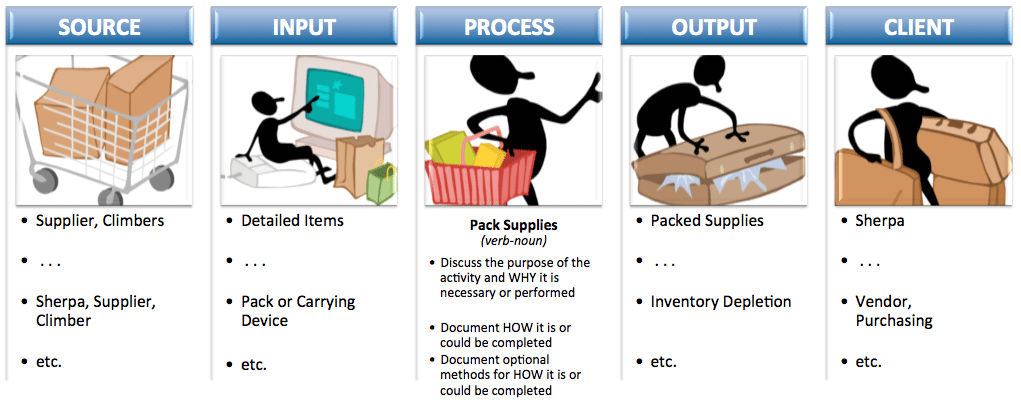
- Continue assigning SIPOC tables to sub-teams. SIPOC stands for the Source of the input, Input(s) required to complete the activity, Process (i.e., our activity), Output resulting from the activity, and Customer or client of the output. Demonstrate one or two in entirety with the whole group and then separate the participants into two or three groups.
- For each activity (i.e., verb-noun pairing), build a narrative statement that captures the purpose of the activity (i.e., WHY) and HOW it is being performed, then:
- Identify the specific outputs or what changes as a result of having completed the activity.
- Link each output with the customer or client of each; i.e., who is using each output.
- Next, identify the inputs required to support the activity.
- Finally, identify the sources for each input.
Illustrative SIPOC: Planning Agenda Yielding WHO Does WHAT by WHEN
Summary of steps to be included in this sequence
An illustrative SIPOC chart is shown below based on a mountain climbing metaphor. The focal verb-noun pairing is “pack supplies”.
- First, identify the activity (i.e., process) and its purpose and discuss WHY it is performed.
- Next, detail HOW it is or should be performed.
- List the outputs from the completed activity.
- Link the outputs to the respective clients or customers.
- List the inputs needed to complete the activity.
- Identify the source(s) for each of the inputs.
Planning Agenda Success Keys for Agreeing on WHO Does WHAT by WHEN
Therefore, to build a clear definition of “requirements”, provide a visual illustration or template. Additionally,
- Have the group pre-build all the potential sources and customers of the process and code them so that when you build the SIPOC tables, the group can refer to the code letter/ number instead of the full name (thus substantially speeding up the method). As you discover new sources or customers, simply add them.
- Learn to ‘shut up’ after asking questions and seek to understand rather than be understood.
- Write down participant responses immediately and fully.
- Provide visual feedback, preferably through modeling.
- Advance from activity identification to the inputs and outputs required to support the activity; then associate each with its sources and clients (SIPOC).
- Separate the WHAT (i.e., abstract) from the HOW (i.e., concrete).
______
Don’t ruin your career by hosting bad meetings. Sign up for a workshop or send this to someone who should. MGRUSH workshops focus on meeting design and practice. Each person practices tools, methods, and activities every day during the week. Therefore, while some call this immersion, we call it the road to building high-value facilitation skills.
by Facilitation Expert | Aug 14, 2014 | Leadership Skills, Meeting Support
Charter for Compassion
Ultimately, consensus-building requires intuition and a higher self to overcome the selfishness of physical and emotional demands.
We became signatories with over 100,000 other people who have “Liked” the Charter for Compassion. We encourage you to do the same.
For a quick and light reading, take a look at what they are aspiring towards Charter Members. Use the hot links embedded in this post to seek out further support and involvement on your behalf or the behalf of your organization.
The Charter for Compassion is a document that transcends religious, ideological, and national differences. Supported by leading thinkers from many traditions, the Charter calls on people to activate the Golden Rule around the world.
Text of the Charter for Compassion:
The principle of compassion lies at the heart of all religious, ethical and spiritual traditions, calling us to treat all others as we wish to be treated ourselves. Compassion impels us to work tirelessly to alleviate suffering of our fellow creatures, to dethrone ourselves from the centre of our world, and to honour the inviolable sanctity of every single human being, treating everybody, without exception, with absolute justice, equity and respect.
It is also necessary in both public and private life to refrain consistently and empathically from inflicting pain. To act or speak violently out of spite, chauvinism, or self-interest, to impoverish, exploit or deny basic rights to anybody, and to incite hatred by denigrating others—even our enemies is a denial of our common humanity. We acknowledge that we have failed to live compassionately and that some have even increased the sum of human misery in the name of religion.
Therefore we call upon all men and women~to restore compassion to the centre of morality and religion~to return to the ancient principle that any interpretation of scripture that breeds violence, hatred or disdain is illegitimate~to ensure that youth are given accurate and respectful information about other traditions, religions and cultures ~ to encourage a positive appreciation of cultural and religious diversity~to cultivate an informed empathy with the suffering of all human beings—even those regarded as enemies.
We urgently need to make compassion a clear, luminous and dynamic force in our polarized world. Rooted in a principled determination to transcend selfishness, compassion can break down political, dogmatic, ideological and religious boundaries. Born of our deep interdependence, compassion is essential to human relationships and to a fulfilled humanity. It is the path to enlightenment, and indispensable to the creation of a just economy and a peaceful global community.
The Charter has been translated into over 30 languages.
______
Don’t ruin your career by hosting bad meetings. Sign up for a workshop or send this to someone who should. MGRUSH workshops focus on meeting design and practice. Each person practices tools, methods, and activities every day during the week. Therefore, while some call this immersion, we call it the road to building high-value facilitation skills.
by Facilitation Expert | Jul 17, 2014 | Communication Skills, Decision Making, Prioritizing
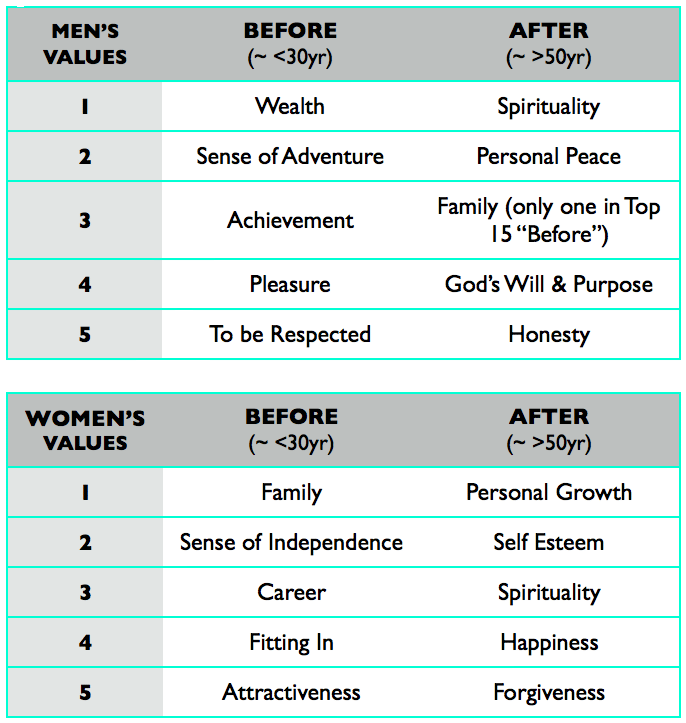
Most meeting participants embrace a set of similar values with different priorities. The difference lies in their relative strength, or ranking of the values.
Participants’ rankings however are not static. Their ranking changes based on their perspective at the moment.
Hiring Characteristics as an Example
When selecting, interviewing, and hiring associates, most human relations experts would agree that five of the core characteristics that are sought in new hires include (listed alphabetically):
- Capacity (mental)
- Integrity (moral)
- Knowledge and Experience (physical)
- Motivation (emotional)
- Understanding (intellectual)
Traditional Prioritization
Facilitating Different Priorities
Frequently, Knowledge and Experience filter out and disqualify potential hiring candidates. Next Understanding, typically reflected by educational degrees, may be used to filter more desirable from less desirable candidates. Next, Capacity is tested, frequently using actual test instruments about personality, cognitivity, and comprehension. Integrity is then considered, including perhaps, background checks to verify information and uncover undisclosed facts. Finally, Motivation is considered, but generally accepted, since it is assumed that those seeking employment are motivated by monetary gain, at minimum. Arranged in a sequence of priority, the characteristics line up as follows:
- Knowledge and Experience (physical)
- Understanding (intellectual)
- Capacity (mental)
- Integrity (moral)
- Motivation (emotional)
Potential Prioritization
Pretend you own the company, however. Contrary to the prioritization above, you would probably embrace the following prioritization when hiring a new employee:
- Integrity; because without integrity, all other actions are suspect at best, and dangerous at worst.
- Motivation; because without motivation, all other actions (or inactions) may be shallow.
- Capacity; because without mental capacity, actions may be blind.
- Understanding; because without understanding actions are impotent.
- Knowledge and Experience; Lastly without the attributes above, actions are misdirected or useless.
Note with the re-prioritization above, the complete reversal from Experience as number one to least important as number five. Participants with a bias toward the Traditional Prioritization will conflict, and make building consensus challenging when confronted by participants using the Potential Prioritization, or some other variation.
As a facilitator, what can you do about it? We discuss the proper sequence for building consensus around conflicting prioritization in other articles, The Three Steps to Conflict Resolution: Appeal to Purpose, Active Listening, and Enterprise Objectives.
______
Don’t ruin your career by hosting bad meetings. Sign up for a workshop or send this to someone who should. MGRUSH workshops focus on meeting design and practice. Each person practices tools, methods, and activities every day during the week. Therefore, while some call this immersion, we call it the road to building high-value facilitation skills.
by Facilitation Expert | Jun 26, 2014 | Managing Conflict, Meeting Support
Paradigms
Paradigms are established accepted norms, patterns of behavior, or a shared set of assumptions. Shaking them causes fear, uncertainty, and doubt; also known as the FUD Factor. Paradigms provide models that establish boundaries or rules for success. Paradigms may present structural barriers to creativity based on psychological, cultural, and environmental factors. Examples include:
- Flow charts, diagrams, and other conventions for presenting information (e.g., swim lane diagrams)
More Similarities Than Differences
- Stereotypes about men and women and their roles in business, family, and society
- Where people sit in meetings—once they find a seat it becomes their seat for the rest of the meeting
Not All Bad
There are many more paradigms in life. Paradigms are not bad unless they become barriers to progress. People either understand paradigms or risk being left behind. What is impossible with one paradigm is easy with another—because “I didn’t know any better.” When paradigms change, everyone starts over.
Changing Paradigms
To cause groups to challenge and possibly modify their paradigms, do the following:
- Ask the “Paradigm Shift” question—“What is impossible today, but if made possible . . . What would you do?”
- Force the group to look at a familiar object or idea in a new way.
- Use the “Five-year Old” routine—ask—“But why?” frequently, or until the group thoroughly discusses an issue, its assumptions, and implications.
- Develop a clear problem statement or use a problem such as the example provided below).
“An automobile traveling on a deserted road blows a tire. The occupants discover that there is no jack in the trunk. They define the problem as “finding a jack” and decide to walk to a station for a jack. Another automobile on the same road also blows a tire. The occupants also discover that there is no jack. They define the problem as “raising the automobile.” They see an old barn, push the auto there, raise it on a pulley, change the tire, and drive off while the occupants of the first car are still trudging towards the service station.”
Getzels, J.W., Problem-finding and the inventiveness of solutions,
Journal of Creative Behavior, 1975, 9(1), pp 12-18.
Shifting perspectives will frequently help “shake” paradigms. Consider using Edward de Bono’s Thinking Hats or imposing some other perspective or comparison such as:
- A monastery compared to the “mafia”
- Steve Jobs compared to Bill Gates
- Ant colony compared to a penal colony
- A weather system compared to a gambling system
- Mother Teresa of Calcutta compared to Genghis Khan
- Etcetera
FUD Factor: People DO Change
Research by Dyer (2007), has proven that people do change. There is a quantum shift of values after twenty to thirty years of life.
Change occurs across both men and women, although their before and after values remain different. The shifts shown below occur after a relatively significant change in maturity, such as we find today with “empty nesters” or people who find themselves no longer hosting others, in particular, their children.
Note the implications for a facilitated session with people coming from all four categories shown below.
The FUD Factor: Men and Women Do Change
______
Don’t ruin your career by hosting bad meetings. Sign up for a workshop or send this to someone who should. MGRUSH workshops focus on meeting design and practice. Each person practices tools, methods, and activities every day during the week. Therefore, while some call this immersion, we call it the road to building high-value facilitation skills.
by Facilitation Expert | Jun 19, 2014 | Managing Conflict, Meeting Support
Differences — People think differently.
As session leader, you empower participants and their ability to understand and communicate with each other. Additionally, you enable them to think creatively about their business. Hence, the following two subjects deal with the way people think—horizontal/ vertical thinking and paradigms.
People Also Learn Differently
Horizontal/ Vertical
Participants in a workshop argue over a seemingly simple issue. Consequently, two people hear the same thing and react as if they were in different meetings. Why? Because people interpret information differently. Meanwhile, there are many theories about how people process information.
One theory states that the two spheres of the brain, the right and the left, govern our thinking with right brain or left brain thinking.
However, another theory that explains the differences more clearly is Communicoding. This theory states that there are two modes of thinking for processing information, vertical and horizontal. These two modes of thinking may have a difficult time communicating with each other because the way that each perceives the world is different. What are they?
Vertical Thinker
A vertical thinker is often described as very logical, organized, and detail-oriented. Therefore, vertical thinkers:
- Easily discern the immediate dynamics of a problem.
- Identify specific details and relate issues to reality.
- Know what can be accomplished within a given time.
- See barriers and obstacles to be removed.
- Take the likely paths to reach results.
- Work well in structured environments.
The vertical thinker’s main characteristic is that they find differences. Vertical thinkers can decompose something and design something new from the pieces. They work from exclusion.
Horizontal Thinker
A horizontal thinker is often described as far-sighted, innovative, and conceptual. Therefore, horizontal thinkers:
- Easily discern the underlying dynamics of a problem.
- Identify contextual details—relating issues to a larger perspective.
- Know what impact can be achieved within a given context.
- See possibilities and benefits to strive for.
- Take the unlikely paths to reach results.
- Work well in unstructured environments.
Horizontal thinkers’ main characteristic is that they find similarities. They are able to find the common thread—to make new associations among unrelated items. They work from inclusion.
To Identify
As a facilitator, you cannot change the way people think—and never label participants. You do help the participants in a workshop learn to hear each other and to better understand their communication challenges. Clues that thinking differences are causing problems are:
- One person argues about the problems while another is focused on the benefits.
- One person trying to get to the details while the other is trying to focus on the ideas.
- People use the same words yet meaning something different or arguing as if they are saying something different.
- Using different words that seem to be saying the same thing.
To Fix
When you hear communication problems consider the following:
- Capture what each person is saying—write it on the flip charts without putting their names by the ideas.
- Draw pictures using visual aids, flip charts, and models. By using visual support or other exercises, participants learn about their business.
- Get the group to see both similarities and differences.
- Move the focus of the group away from people and onto the
issue(s) at hand.
- Summarize both similarities and differences and get the group to decide what to do with them or move along to the next step.
Register for a class or forward this to someone who should. MGRUSH‘s professional facilitation curriculum focuses on practicing methodology. Each student thoroughly practices and rehearses tools before class concludes. While some call this immersion, we call it the road to building impactful facilitation skills.
______
Don’t ruin your career by hosting bad meetings. Sign up for a workshop or send this to someone who should. MGRUSH workshops focus on meeting design and practice. Each person practices tools, methods, and activities every day during the week. Therefore, while some call this immersion, we call it the road to building high-value facilitation skills.
by Facilitation Expert | Jun 12, 2014 | Leadership Skills, Meeting Support
There are four workshop documents each facilitator must provide or ensure:
- Pre-Read
- Annotated Agenda
- Slide Deck
- Output Notes (Deliverables)
Workshop Documents — Pre-Read
Your participants need to show up at your workshop prepared and ready to contribute. Do not assume they will. Lead them. Provide them with a compelling pre-read. First of all, the pre-read should include at least the components shown below. If your pre-read is a large document, provide a personalized cover letter asking each subject matter expert to focus on topics and pages that you have highlighted. Consequently, your courtesy encourages them the obligation to take time to read their parts.
One of Four Workshop Documents: Participants’ Package, (Pre-read)
Workshop Purpose, Scope, Deliverables, and Simple Agenda
EVERY meeting, even a fifty-minute session, needs to have an articulate purpose, boundaries (i.e., scope), and either well-codified outputs or a generally described outcome document. The deliverables (or output/ outcome) describe what DONE looks like when the session ends. A description of the deliverables describes ‘DONE’ and what the group delivers during the meeting. The agenda, hopefully structured (NOT simply a ‘discussion’; a term closely related to ‘percussion’ and ‘concussion’), shows the group how it is going to get to the deliverable or the end of the session.
Questions to be Addressed
Since you want your participants to show up prepared, help them. Agree in advance (optimally through private interviews) on what questions ought to be raised during their session and have them prepare responses before the meeting begins. Confirm with them the validity of the questions and obtain their feedback about questions they may wish to add, deemed important, and perhaps missing from your original list of questions. Consider the most important reason for meetings—building consensual answers to questions important to the group.
Mission, Value, and Vision
When arguments arise, active listening should be used first to avoid people, who unknowingly, may be in violent agreement with each other. When active listening fails, sometimes due to the stubbornness of participants, an appeal must be made to WHY the meeting is being held. Because no one wants more meetings. They only want results that accelerate projects and activities that occur after the meeting. To reconcile arguments, be prepared to appeal to the objectives of the project/ product, program, business unit, or enterprise that your meeting supports.
Glossary of Terms
You cannot afford to allow arguments about the meaning of terms you use and build into your preparatory efforts. For example, some consider Goals as fuzzy statements and Objectives are SMART. To others, the opposite is true. For some people, Mission is why they show up and Vision is where they are going. To others, it is the opposite. Standardize your operational definitions, share them, and enforce consistent use and interpretation.
Space for Participants’ Note-taking
As a kind gesture, provide some extra space for them to take notes. It will be appreciated.
Workshop Documents — Your Personal, Annotated Agenda
Your detailed methods should be built as if you were there visualizing every step in advance. Include breakout teams, team names and members, and CEOs (i.e., Chief Easel Operators), but most importantly, detail how you will analyze their input (i.e., the second activity of Brainstorming). Our typical annotated agenda runs 20 pages long, even for a three-hour session.
Workshop Documents — Slide Deck
Provide the participants copies of the slides you use, and do not forget to include operational definitions. You don’t need our help here since this is what you do best; i.e., create decks.
Workshop Documents — Output Notes
Your effort to create a solid pre-read, annotated agenda, and slide deck makes meeting notes a snap. Simply drop in the content developed during the meeting alongside the content provided by your pre-read, annotated agenda, and slides. As a result, you are ready to call it good. Congratulations on completing your four essential meeting documents.
NOTE: Which of these four meeting documents can you afford to skip? None of them of course, unless you avoid death by PowerPoint and spare them the deck by referring to content you already provided in the pre-read.
In a world where everyone can engage in decisions that affect them
______
Lead the Change—One Meeting at a Time
Are you ready to transform how decisions are made, problems are solved, and alignment is built in your organization?
True meeting leadership goes beyond setting an agenda. It requires a facilitator who can navigate complexity, balance voices, and drive toward outcomes with clarity and consensus. Our Professional Meeting Leadership Workshop and facilitation training equips you to do just that—blending human-centric methods with structured analytical tools to foster rigor, inclusivity, and results that stick.
- Practice live.
- Get expert feedback.
- Build confidence that lasts.
Whether your meetings suffer from unclear objectives, disengaged participants, or decision fatigue, this workshop will help you identify the root causes, apply proven facilitation techniques, and emerge as the leader every team needs.
Take the first step today—transform your meetings and magnify your impact.
👉 Click here to reserve your seat now.
#facilitationtraining #meetingdesign
Because every meeting should be a catalyst for change—not just another calendar event.
______
With Bookmarks no longer a feature in WordPress, we provide the following for your benefit and reference.
______