by Facilitation Expert | May 29, 2014 | Communication Skills, Meeting Support
Meeting and workshop participants by definition ought to be participatory. To get and stay involved, subject matter experts (i.e., SMEs or participants) need motivation to both show up (or attend) and to actively contribute over the course of a meeting.
The role of facilitator or session leader mandates the need to link value from their participation to the greater good, and in return HOW the individuals will benefit, also known as persuasion.

Avoid a Gun to the Head as Motivation
The three classic forms of persuasion include:
- Internalization (indicative of the will or the WHY of a meeting),
- Identification (indicative of the wisdom or the WHAT of a meeting), and
- Forced Compliance (indicative of the activity or the HOW of a meeting)
Persuasion via Internalization
The most powerful, long-lasting, and effective form of motivation occurs when their meeting contributions result in personal gain. To internalize suggests an individual that can associate their input with the meeting output. And the meeting output ultimately generates a return on their investment of time and energy.
When the facilitator can demonstrate that the meeting output (i.e., deliverable) demonstrably affects the quality of life of a participant, how much money they will make, who they will work for, who will work for them, or equally powerful factors, they have internalized the need for participation.
Participants who can link the group goal back to their own lives, such as developing a line of sight toward some extrinsic gain such as increased income or a more balanced workload, view their existing competencies and potential contributions as a validation of their time and energy. To the extent that their contributions positively impact the deliverable, their participation in meetings increases dramatically.
The facilitator ought to make clear the value of their contributions and strive to quantify the financial risk if the meeting fails. Typically risk may be expressed in financial units (e.g., dollars) or labor values (i.e., FTE or full-time equivalent). If the facilitator cannot link individual contributions to some measurable value, meeting participation will likely be dominated by the participants who can internalize the value of their contributions, at the expense of other participants who remain less clear about how they will be impacted by the meeting deliverable. One could view internalization as the ability to apply SMART principles by quantifying value and creating valid objectives for subject matter experts.
Persuasion via Identification
A less effective and less sustaining form of motivation or persuasion develops from a fuzzier or qualitative form of motivation. In modern society, the analogy is advertising. To the extent that participants identify with meeting goals, the more likely they contribute. They also make their contribution more frequent and robust.
Charismatic session leaders can frequently persuade with their personality styles because participants can identify with their passion and exuberance. Identification represents an extrinsic form of motivation, rather than the intrinsic form obtained through internalization.
Successful persuasion occurs when the larger group (e.g., the entire organization) links back to the smaller team (i.e., meeting participants). When the team is viewed as successful by the organization, they are also viewed as successful individuals. Participants feel or believe that the organization will positively view their personal competencies based on the performance of the team.
Persuasion via Forced Compliance
A valid analogy to understand forced compliance develops when one views a “gun to their head.” In other words, do it or you will be harmed. Forced Compliance best describes the motivation of most people attending “staff” meetings. They really don’t want to go, but risk penalty or even termination if they fail to appear.
While a powerful motivator to attend, forced compliance does little to increase participation. In fact, most people with a gun to their head will say or contribute little. Strive to avoid this form of motivation, because if it is required to get people to attend, most likely the meeting is not necessary in the first place.
Leaders who rely on forced compliance are not thinking clearly. They need to revisit internalization and establish a line of sight for the participants so that each participant can approximate the true value of their attendance and contributions.
______
Don’t ruin your career by hosting bad meetings. Sign up for a workshop or send this to someone who should. MGRUSH workshops focus on meeting design and practice. Each person practices tools, methods, and activities every day during the week. Therefore, while some call this immersion, we call it the road to building high-value facilitation skills.
by Facilitation Expert | May 22, 2014 | Planning Approach, Prioritizing
Scope creep wreaks havoc on projects and group decision-making. Meetings also spin out of control because the leader allows the co-mingling of strategic, operational, AND tactical issues. Each deserves a different approach, preparation, and decision-making. Do NOT allow your meetings to jump back and forth between different issue types.
Many people spend a large portion of the workday attending meetings. Strive to understand the clear purpose of the meeting and what it needs to deliver. All meetings have an effect on group decision-making, or they should not be held. While many meetings appear innocuous, such as staff meetings, people take their learnings and make new decisions based on new information. All meetings should impact group decision-making and the power of choice.
Group Decision-making and Strategy (Planning) Issues
Control Decision-making Method
The input of a strategy session makes clear WHY something is important and the output becomes WHAT we are going to do about it. Most planning sessions are “strategic” to the needs of the group attending because the output is WHO does WHAT.
Most academic approaches strongly encourage a TO-WS (SWOT) analysis to lead to a consensual understanding of WHAT a group of people needs to do to reach their goals (fuzzy) and objectives (SMART). A thorough TO-WS (SWOT) analysis takes hours, not minutes.
Do NOT allow for a discussion of strategic issues during operational updates and other meetings that are organized primarily to share information. Take the strategy issues that arise, document them clearly, and set them aside for discussion during a true planning session when enough time is allowed to digest complex topics.
Likewise, do NOT allow the group to dive into too many details if you are completing strategy or analysis work. Keep the discussion in the abstract (e.g., accelerate vehicle). If the discussion becomes too concrete (e.g., foot on the pedal), you risk incomplete planning or analysis. Do not allow discussions about HOW activities will be performed when the purpose of the meeting is to establish WHAT needs to be done (e.g., acceleration).
Group Decision-making and Operational (Analysis) Issues
Problem-solving might be separated into problems requiring immediate attention and long-range problems that require a complex and perhaps cultural change. Most “immediate” problems focus on satisfying stakeholders at the expense of the supplier or supply chain. Long-term problems lack a sense of urgency resulting in lengthy discussions that remain on topic but lead to shallow or unclear deliverables. The structure provides help for analysis meetings.
Most operational support meetings lack structure. Problem-solving provides a decent example. Participants frequently commit the bias of “solving”. They jump from the problem to the solution and skip the critical step of analysis. For example, if we jump from symptoms to cures, there is a likelihood we will miss something. If however, we structure the meeting to understand all of the possible causes of the symptom and focus discussion on the cause and not the symptom, we will not likely miss something significant. In requirements gathering for example, “poor requirements” are not typically gathered as wrong requirements; rather, they are “poor” because of the things we missed.
Group Decision-making and Tactical (Design) Issues
When pushed into the concrete details of staffing, purchasing, or other work methods, separate the decision criteria from the options. Groups are capable of making higher quality decisions than the smartest person in the group because:
- Representing diverse stakeholder interests generates more robust criteria
- By using diverse subject matter experts, we increase the likelihood that their understanding of causal relationships (i.e., cause and effect) will be captured,
- Groups create more options than aggregating individuals and more options are directly linked to higher quality decisions.
Group Decision-making and Leadership Role
Do not forget to understand your role, style, and relationship when using groups to support decision-making. When you intend to advocate for a specific decision, have someone else facilitate the session. If you are untrained professionally, and the issue is complicated, complex, or politically charged, someone else should facilitate it. If you begin as the facilitator, but someone else emerges as commanding group respect (typically because they exude neutrality), consider turning the session over to them.
Be prudent, no one wants more meetings. They only want results.
______
Meetings must rise above the tiny opening of words and embrace the fullness of human insight—through listening, visuals, stories, numbers, and symbols. The transformation begins not with tools, but in mindset. Leave your ego at the threshold, and step into the structures of meetings that get results.
In a world where everyone can engage in decisions that affect them
______
Lead the Change—One Meeting at a Time
Are you ready to transform how decisions are made, problems are solved, and alignment is built in your organization?
True meeting leadership goes beyond setting an agenda. It requires a facilitator who can navigate complexity, balance voices, and drive toward outcomes with clarity and consensus. Our Professional Meeting Leadership Workshop and facilitation training equips you to do just that—blending human-centric methods with structured analytical tools to foster rigor, inclusivity, and results that stick.
- Practice live.
- Get expert feedback.
- Build confidence that lasts.
Whether your meetings suffer from unclear objectives, disengaged participants, or decision fatigue, this workshop will help you identify the root causes, apply proven facilitation techniques, and emerge as the leader every team needs.
Take the first step today—transform your meetings and magnify your impact.
______
👉 Click here to reserve your seat now.
#facilitationtraining #meetingdesign
Because every meeting should be a catalyst for change—not just another calendar event.
______
With Bookmarks no longer a feature in WordPress, we provide the following for your benefit and reference.
______
by Facilitation Expert | May 8, 2014 | Communication Skills, Leadership Skills, Meeting Support
We have argued for years that unclear speaking (or writing) is indicative of unclear thinking and will impact shared project team values.
For example, most people do not distinguish between the meaning of a “group” or a “team.” Conversely, we find the difference so important, that it could represent the difference between “life” and “death.” Note the following impact on shared project team values.
Groups of people assemble. Teams get assembled.
With groups, members strive to arrive at a deliverable that satisfies each member. Therefore, people define “satisfaction” with respect to their individual interests. The primary challenge is building a deliverable (or decision) that satisfies the interests of all members who are acting on their own as individuals (or potentially as representatives of larger stakeholder interests). Individual reactions vary, even when attending a concert together and hoping to be satisfied by the music or entertainment.
Pushing in the Same Direction
The presence of teams suggests an overriding shared goal that sits independent of the interests of the individual members. With high-functioning teams, members emphasize the importance of the shared goal and make their personal interests subservient to the shared goal. Successful teams share a reaction, typically positive in nature. They will push or pull in the same direction to support a common cause.
Distinguishing Attributes
Some of the variables you need to consider when optimizing facilitated methods for teams include understanding the following questions:
- How effective and trusted has group decision-making been in the past for the organization?
- How much effort has been invested in understanding the quality of decision-making?
- To what extent will the formal leader of the team share the same or similar perspective?
- How much do the individuals share perspectives or derive from a similar level within the organization?
- To what extent does the culture promulgate distributed decision-making, where individuals are trusted to take a course of action that supports both the organization and the individual?
- To what extent is the group an actual unit in the organizational structure (e.g., reporting to the same leadership) or diversely representing many functional or geographic areas?
Be Conscious
As a leader stress the difference between groups and teams. Expect high performance, or you might not get it. Answer the questions above to support your selection of tools along the MGRUSH decision-making continuum that best serve your team and organizational situation.
______
Don’t ruin your career by hosting bad meetings. Sign up for a workshop or send this to someone who should. MGRUSH workshops focus on meeting design and practice. Each person practices tools, methods, and activities every day during the week. Therefore, while some call this immersion, we call it the road to building high-value facilitation skills.
by Facilitation Expert | May 1, 2014 | Decision Making, Meeting Structure, Meeting Tools, Prioritizing
After reviewing some material about the optimal methodology (i.e., approach) for distribution planning, related to an ERP (Enterprise Resource Planning) project, it became quickly evident that the expert’s recommendation followed the core principles for building consensus.
The three indisputable components when building consensus around decision-making building include:
- Purpose (or, intent)
- Options
- Criteria
Since not all criteria are of equal value, the author suggested weighting the criterion, referred to as “service outputs.” Even when you make a simple decision about buying new underwear, you consider the purpose (e.g.; workout, daily, formalwear, etc.), your options (typically stuff on the shelf at the store), and your criteria (i.e.; style, price, size, etc.). Not surprisingly, you also weigh the criteria, as size is probably the most important criterion, followed closely by price. All three components add value when building consensus.
In their model, they suggest the following:
- Identify which channels you are seeking to penetrate
- Isolate the most important segments within each channel
- Identify their “service outputs” and then to . . .
- List clearly
- Rank
- Prioritize
- Eliminate
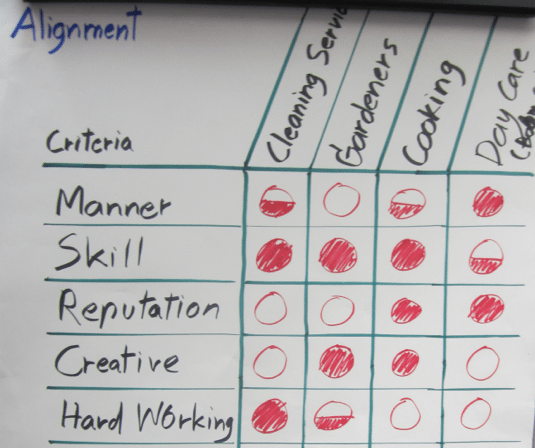
By arraying your options against your decision criteria, you can display decisions on a single page. We call the visual array a decision matrix. Compare your options to your criteria.
Consensus Building – Decision Support Matrix
CAUTION
Do not ask a close-ended question such as “Does this criteria affect this option?” Rather, ask the open-ended question that yields a powerful visual; namely, “To what extent does this criterion impact this option (i.e., High, Low, or Medium). It’s easier to build consensual understanding when taking a non-narrative approach as shown below.
The example suggests the important attributes sought when hiring domestic staff for a wealthy household. Note for example that “Reputation” is less important when hiring a new Gardener than when hiring someone for Day Care support of the children. Again, note that “Creativity” is more important when hiring a chef than when hiring Cleaning Support. The group can easily evaluate the importance of the options by the extent they are supported by the criteria. The group can also see the relative importance of an individual criterion by evaluating its impact across all of the options.
Remember, the secret is to ask the open-ended question, “To what extent . . .” Additionally, since the example is a simple, “plain vanilla” illustration, modify it to your own situation, and consider using the Bookend tool to force-fit an even distribution of Highs, Lows, and Moderates across the options or within each option. See the link that follows for further explanation on the use of Bookends.
By the way, some of the criteria used in the distribution channels example might include:
- Adaptability (e.g., to economic upheaval, competitive forces, etc.)
- Effectiveness (e.g., return on investment, market share, etc.)
- Efficiency (e.g., expense to revenue, cost of doing business, etc.)
- Quality (e.g., customer satisfaction, on-time performance, etc.)
______
Don’t ruin your career by hosting bad meetings. Register for a workshop or forward this to someone who should. MGRUSH facilitation workshops focus on meeting design and practice. Each participant practices tools, methods, and activities every day during the week. Therefore, while some call this immersion, we call it the road to building high-value facilitation skills.
Related articles
by Facilitation Expert | Apr 17, 2014 | Communication Skills, Leadership Skills
You and I have been victims of numerous false, urban legends. So please beware of the overconfidence effect among subject matter experts. For example:
- The Great Wall of China is NOT visible from outer space
- You use a lot more than ten percent of your brain
- Relatively speaking, it’s much safer to take candy from strangers than from family members. Statistically, family members are more likely than strangers to poison others.
Cognitive biases receive much press because they negatively impact decision quality. Subject matter experts (i.e., SMEs) are frequent victims of an “availability” bias that causes them to exhibit an overconfidence effect — and they may be wrong. Challenge the overconfidence effect of your subject matter experts with a “hip-pocket” tool, something you carry with you at all times.
Background
When delivered face-to-face, people treat information as more credible and will more likely refer to it. Participants are frequently impressed by the charisma of the deliverer rather than the value of the information.
Subject matter experts tend to overestimate their contributions that are produced jointly with others. Thus, they overestimate the importance of their contributions and close themselves off from the possibility of other “right” answers.
For example, two people eating the same bowl of chili will react differently. One may claim the chili is “hot” (i.e., spicy) while the other claims it is “not”. Both are right, so we might appeal to Scoville Units to “objectify” their claims.
Solution
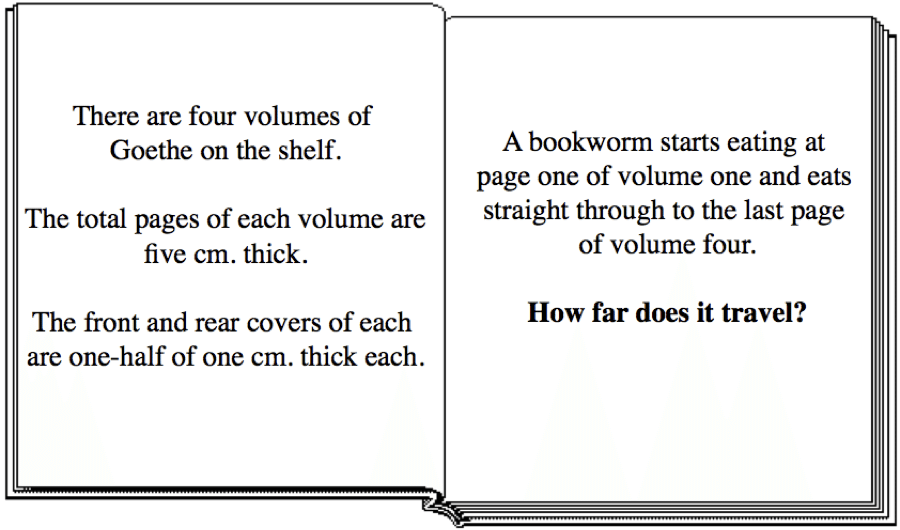
Be prepared to demonstrate that SMEs may have “an” answer, but not the only answer. Humble overconfident subject matter experts with a host of “hip-pocket” challenges. Demonstrate that their answer may be sub-optimal (or even wrong) and that voting is a poor method of decision-making. The Bookworm’s Travels, one of our personal favorites, represents one of hundreds of similar exercises used to shake paradigms.
Solve the question yourself. You will need to write us for the correct answer but we can assure you that the correct answer is not “23.” Keep in mind that these are English books, written from left to right, and stacked in proper sequence, from Volume One through Volume Four, vertically.
Test Overconfident Subject Matter Experts with a Bookworm’s Travels
______
Don’t ruin your career by hosting bad meetings. Register for a workshop or forward this to someone who should. MGRUSH facilitation workshops focus on meeting design and practice. Each participant practices tools, methods, and activities every day during the week. Therefore, while some call this immersion, we call it the road to building high-value facilitation skills.
by Facilitation Expert | Apr 10, 2014 | Facilitation Skills, Meeting Support
Meeting participant preparation differs high-performance groups from normal or underperforming groups. Many people attend sessions with concern over What is in it for me.
Meeting participant preparation suggests that is neither the right attitude nor the right question. What they should ask is “What do you need or want from me (so that we can get done faster)?” What you should be encouraging is participant preparation.
Meeting Participant Preparation — What Do You Need from Me?
As a facilitator or session leader, it is virtually impossible to shift their attitude at the start of a meeting. To cause a shift in participant thinking, attitude, and behavior requires clear and two-way communication before the meeting begins.
Meeting Participant Preparation — What Does DONE Look Like!
Most meetings (at least the good ones) typically result in Action Plans and agreed-upon roles and responsibilities for making things happen. We expect to hold the participants accountable for their follow-up and get them involved before the meeting starts to understand and agree to the Purpose, Scope, Deliverables, and Simple Agenda for the meeting.
As the facilitator, you should expect participants to show up prepared. It is your responsibility to define “prepared.” How can participants arrive prepared if they do not know the purpose of the meeting before it starts? How can participants stay focused and complete on time if they do not understand the scope of the meeting (as discrete from the scope of the project the meeting may be supporting)? What can you do to get your participants prepared faster? Do they know “what done looks like (i.e., deliverable)”? How can participants agree to follow-up assignments if they are not permitted to provide their input, clarifications, and calibrations about HOW they are going to get done on time (i.e., the Agenda)?
Meeting Participant Preparation — If It Was Simple, We Wouldn’t Meet
Ultimately the reason for most meetings and workshops is that we need consensual answers to relatively complex questions. If the questions are simple, typically we do not need a meeting nor are there consensual challenges. Knowing that effective meetings develop consensual answers to questions and problems, the session leader must prepare and know in advance of the meeting, the questions that need to be answered.
Once developed and understood, do not hide the questions to be asked in a meeting. Share them in advance. Since select subject matter experts (i.e., participants) likely provide input on questions that are ‘closer to home.’ You can highlight the questions on an individual basis and explain to each participant that you expect them to think in advance about their responses. Explain that when the questions(s) are asked that you have highlighted, they need to take the lead. You expect them to take the lead and be among the first to offer up their subject matter expertise.
It’s not easy to run a successful meeting. That is why many meetings fail or frail. Your job is to make sure the meeting or workshop is off and running the moment you start. The only way to ensure that level of productivity is to prepare your participants in advance.
______
Don’t ruin your career by hosting bad meetings. Sign up for a workshop or send this to someone who should. MGRUSH workshops focus on meeting design and practice. Each person practices tools, methods, and activities every day during the week. Therefore, while some call this immersion, we call it the road to building high-value facilitation skills.
by Facilitation Expert | Apr 3, 2014 | Meeting Structure, Meeting Tools, Prioritizing
In managing capital projects or leading teams, facilitators often grapple with prioritization, where every item can feel equally important. However, allowing everything to be “most important” dilutes focus and slows down decision-making. This is where our Bookend method and accompanying rhetorical techniques come into play, offering a strategic solution to rank priorities efficiently and meaningfully.
Why the Bookend Method Works
The primary challenge with traditional, linear approaches to prioritization is that they encourage discussions around gray areas—those items that fall into moderate categories (e.g., “moderately important,” “reasonable cost”). Unfortunately, these middle-ground discussions often lead to drawn-out debates that add little to decision quality.
Instead, experience shows that extreme criteria—the highest and lowest importance factors—drive impactful decision-making. By focusing on these extremes, the Bookend method bypasses fruitless arguments and identifies the most crucial factors first.
The Problem with Traditional Prioritization
Untrained facilitators often begin with a linear approach, asking whether an item is high, medium, or low in importance. The result? Most items end up in the “high” category, diluting the overall value of the list. While each item on the list may indeed be important, the method fails to differentiate clearly between them.
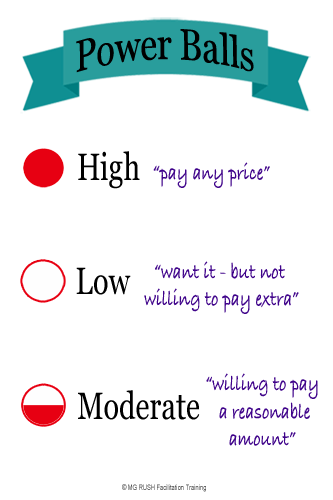
By using the Bookend method, facilitators avoid these pitfalls and achieve better balance across categories. PowerBallls make this easy as demonstrated below.
How the Bookend Method Works
- Identify the Extremes: Start by asking, “Which item is the most important?” and mark it using the filled circle PowerBall icon. Then ask, “Which is the least important?” and mark it with the empty circle PowerBall icon.
- Work Toward the Middle: Repeat the process, alternating between the next most important and least important items, until two-thirds of the list is scored.
- Address the Middle: For the remaining one-third, ask the group, “Will you lose any sleep over categorizing these as moderate?”
- Consistent Language: Always ask in singular terms—“which is”—to focus discussions. Be ready to take multiple inputs if participants speak simultaneously.
- Bucket Distribution: Divide the total list into three categories (high, moderate, low) while ensuring balance. If necessary, adjust by adding or removing an item from a category, maintaining overall distribution.
- Force-Ranking Alternative: For a more granular ranking, apply the highest available number for the most important, the lowest for the least important, and alternate until all items are ranked.
Use the Bookend Method to Avoid Wasting Time with Lists
Use Cases and Flexibility
When comparing illustrations or scenarios, ask questions like:
- Which is most similar?
- Which is least similar?
Repeat the process until one-third of the items remain uncategorized, placing them in the moderate bucket.
For discussions around personal or group strengths and weaknesses:
- What is your greatest strength?
- What is your greatest weakness?
Again, repeat this process until the list is reduced to one-third, placing the remainder into the moderate category.
We discourage overly complex breakdowns (e.g., one-quarter or three-quarter categories) unless they help avoid unnecessary debates. Flexibility is key—apply this method pragmatically to keep the group focused on progress, not arguments.
Numeric Alternative (Six Levels)
For more complex scenarios where finer gradations are needed, consider this six-level system:
- Low Importance
- Moderately Low Importance (if needed)
- Moderate Importance
- Moderately High Importance (if needed)
- High Importance
- Null (Will not have)
By guiding groups to focus on extremes and avoid gray areas, the Bookend method enables efficient, impactful decision-making. It saves time, reduces frustration, and enhances the clarity of priorities.
_____
In a world where everyone can engage in decisions that affect them,
_____
With Bookmarks no longer a feature in WordPress, we need to append the following for your benefit and reference
by Facilitation Expert | Mar 20, 2014 | Analysis Methods
To build an operational and consensual definition that your group can live with, in their own words, and with their understanding, use the following Definition tool. Since narrative descriptions alone may fall short of expressing the complete meaning, we also want to fortify the consensual definition with an illustration and examples.
Use this robust method for consensual definitions of terms, phrases, or expressions with a group of meeting or workshop participants. Keep in mind that the standards expected below are demanding. They include five effective activities. Keep this tool in your hip pocket and use it whenever you encounter serious discord over the meaning of something. You may also need this tool when you manage open issues (i.e., Parking Lot) and your participants do not agree or cannot remember what something meant.
Additionally, the analysis activity of brainstorming begins when the ideation energy begins to wane. An indicator that it may be time to transition to analysis could be a question raised about what a term means, or someone raising an argumentative point that something can or cannot satisfy a specified condition or requirement.
Session leaders are faced with groups and participants (who may be in violent agreement with each other) who need to develop a consensual understanding of what a particular term, phrase, or expression means. The most underutilized tool in the sphere of facilitation is a robust definition tool. Therefore the first step frequently required to support effective analysis requires properly defining something.
Purpose of Consensual Definitions
To build a consensual definition of a term or phrase that the group can live with, in its own words, and with its own understanding. Since narrative descriptions alone may fall short, support your consensual definition with an illustration and examples.
Rationale Behind Consensual Definitions
Consensual Tool for Definitions
This MGRUSH tool supports a consensual understanding of terms and phrases. Use something more robust to develop rich definitions for complex ideas like processes. Hence, for an entire workshop(s) Activity Flows may be more useful.
Method to Build Consensual Definitions
When a term or phrase requires further definition or understanding, it may be best to compare it to a dictionary definition(s). However, do not begin with dictionary definitions. Rather, offer them as a stimulus for the group after drafting their own definition. The five additional activities include:
- First, identify “WHAT THE TERM OR PHRASE IS NOT”.
- Next, compile a narrative sentence or paragraph that generally describes it. Compare later to a dictionary or other professional definitions and support.
- Then list the detailed bullets that capture the specific characteristics or specifications of the term or phrase as intended by the participants. For example, with a camera, we might detail requirements for the number of megapixels, zoom range, etc.
- Obtain or build a picture of concrete items or create an illustration of the item if it is abstract or dynamic (e.g., process flow).
- Provide at least two actual, real-life examples from the participants’ experience that vivify the term or phrase. For example, a utility bill can be defined, but it is helpful to show an actual invoice (e.g., electricity for the period 15JAN20xx to 14FEB20xx).
______
Lead the Change—One Meeting at a Time
Are you ready to transform how decisions are made, problems are solved, and alignment is built in your organization?
True meeting leadership goes beyond setting an agenda. It requires a facilitator who can navigate complexity, balance voices, and drive toward outcomes with clarity and consensus. Our Professional Meeting Leadership Workshop and facilitation training equips you to do just that—blending human-centric methods with structured analytical tools to foster rigor, inclusivity, and results that stick.
- Practice live.
- Get expert feedback.
- Build confidence that lasts.
Whether your meetings suffer from unclear objectives, disengaged participants, or decision fatigue, this workshop will help you identify the root causes, apply proven facilitation techniques, and emerge as the leader every team needs.
Take the first step today—transform your meetings and magnify your impact.
👉 Click here to reserve your seat now.
(Limited availability) #facilitationtraining #meetingdesign
Because every meeting should be a catalyst for change—not just another calendar event.
______
With Bookmarks no longer a feature in WordPress, we provide the following for your benefit and reference.
______
by Facilitation Expert | Mar 13, 2014 | Meeting Tools, Planning Approach, Problem Solving
Assuredly, organizational executives are known to go off-site to conduct strategic planning sessions, building consensus around vision and strategy to lead an organization to the future it seeks.
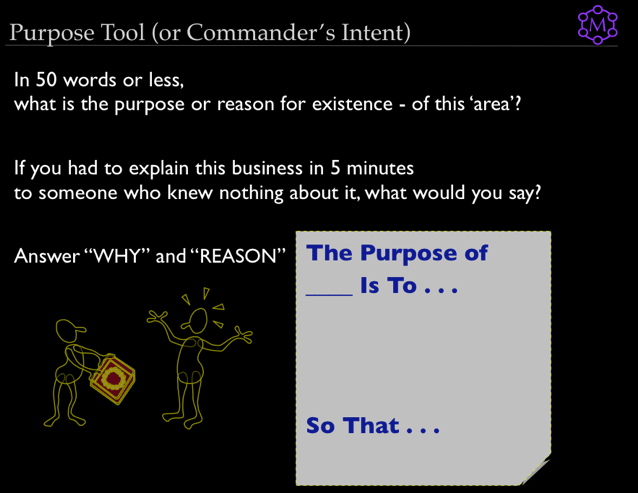
Yet infrequently, if ever, the Account Payable Department (or, some other function, process, activity, or product) justifies off-site strategic planning sessions. They still need consensus around why that department (or, some other function, process, activity, or product) exists, where they are going, and how they are going to measure their progress. To build consensual understanding around WHY something exists or WHY it is important, consider using our meeting Purpose Tool. If used appropriately, Commander’s Intent (aka, the meeting Purpose Tool) may be the second most frequently used workshop tool, after Brainstorming.
Meeting Purpose Tool (aka Commander’s Intent)
The Purpose Tool (or, Commander’s Intent)
This activity yields a wonderful, group-constructed statement that captures the integrated reason, plan, scope, and benefits of a business area.
Meeting Purpose Tool Rationale
Provides the group with a consensually built backdrop that can be appealed to. Helps galvanize consensus around analytical methods and decision-making that follow.
Meeting Purpose Tool Method
Either on one easel or two separate easels, in advance, you should build out the visual prompt (preferably in a separate color), that “The Purpose of ____ is to . . . (ellipsis) So that . . . (ellipsis).”
- Prompt your participants with “The Purpose of ____ is to . . .”
- While scribing, print the last word from the previous input, and prompt them audibly with “So that . . .” because you want to keep the energy high.
- Do not use hyphens as you capture, rather use commas as you are helping them build one, long run-on sentence.
- Do not wordsmith the results but be certain to reread, review, and confirm that they have created a statement that everyone can live with. Basically, you have created a strategic plan at the level of a business area or activity—why it is important.
- Review during the workshop as an appeal to ensure that the discussion stays on topic. If necessary, either take off-topic discussion and ask that it be placed in the Issue Bin or go back and modify this statement to allow for its inclusion.
______
Don’t ruin your career by hosting bad meetings. Sign up for a workshop or send this to someone who should. MGRUSH workshops focus on meeting design and practice. Each person practices tools, methods, and activities every day during the week. Therefore, while some call this immersion, we call it the road to building high-value facilitation skills.
by Facilitation Expert | Mar 6, 2014 | Meeting Tools, Problem Solving
The following Creativity tool stimulates the ideation activity of Brainstorming and enables people to express ideas and beliefs non-verbally, even if they cannot or will not do it orally. This is especially beneficial for developing visions of the business, system, or organization. The Creativity tool should also be used when defining, especially complex products or processes.
Creativity Tool Method
Creativity Tool Example
The Creativity tool allows each team to draw pictorial answers to a specific question or to provide solutions for a specific scenario. Additionally, the Creativity tool frequently takes less time than narrative capture. If you use the Creativity tool early during the workshop, you can mount visually stimulating wallpaper that participants will refer to later. Since teams rather than individuals generate the results, you provide timid participants permission to speak freely by enabling them to defend or explain what their teams created. Complete the following:
- Divide the group into smaller teams of three to five people. Watch the mix of people—plan how you want to mix them.
- Explain what they will be doing and provide a visual prompt of the question(s) that need to be answered. Examples:
- Draw a picture of how the organization looks today.
- Illustrate how you would like the organization or system to look in the future.
- Draw your vision of where you are going with the business or system.
- (illustrative) Provide answers to the question, “What do you expect to get out of this workshop?”
- You can use one or more of the above examples or your own. Therefore, if you have the teams draw pictures of both today and the future, you empower them with the ability to compare and contrast.
- Provide a time limit, flip chart paper, and colored markers.
- When finished, have each team present their drawing(s). Consider using the Bookend tool for identifying commonalities and items that may be extremely unique. Keep the drawings mounted on the wall and do NOT mark on them.
- Separately, capture their narrative explanations and feedback and confirm that the narrative reflections are accurate and complete.
Creativity Tool Notes
The Creativity tool is powerful in drawing out beliefs and ideas. Use it effectively by knowing how you are going to use the output.
______
Don’t ruin your career by hosting bad meetings. Sign up for a workshop or send this to someone who should. MGRUSH workshops focus on meeting design and practice. Each person practices tools, methods, and activities every day during the week. Therefore, while some call this immersion, we call it the road to building high-value facilitation skills.
by Facilitation Expert | Feb 27, 2014 | Meeting Support
Use icebreakers to get participants vocal and more participatory sooner by introducing themselves beyond name and title. The following examples can be used by virtual participants as well. When virtual, make sure all participants identify themselves before speaking.
Questions to Launch Effective Icebreakers (aka Meeting Sparks)
Effective Icebreakers (aka Meeting Sparks)
- A simple yet effective method: “If I were a . . . “ approach such as—“If I were a gem, I would be a ____” or “If I were a flower, I would be a ____” or “If I were a bird, I would be a _____” or “If I were a vehicle, I would be a _____”
- Describe your dream career as a child.
- Describe the first event you remember vividly in life.
- Explain how you got one of your scars (and where it is).
- Explain your strangest paying job or chore.
- If you could change anything about the way you were raised, what would it be?
- If you were a room in a house, which room are you and why?
- “My hero is . . .”
- Name a talent that you have and no one here knows about it.
- Name the last song you sang out loud by yourself.
- Sound out or act out your high school mascot.
- Tell us an animal you would like to be, and why.
- Tell us your favorite James Bond actor and explain why.
- The title of your autobiography?
- Two truths and a lie—participants guess the lie.
- Use one word to describe where you are right now.
- What kitchen appliance or tool would you be and why?
- What would you bring with you on a desert island?
- What’s on your reading list or nightstand?
- When wake up tomorrow having gained any one quality or ability, what would it be?
- Which model and type of automobile would you be and why?
- “Would you rather?” questions; e.g., Would you rather be invisible or be able to read minds? Would you rather live without music or live without television? Would you rather be 4 feet tall or 8 feet tall?
- Your favorite ice cream?
Meeting Sparks – another phrase for icebreakers
- Based on a project theme, create new surnames for participants; e.g., Lori Aconcagua (i.e., the highest mountain in South America).
- Begin with a “Fun Fact” sharing by each individual of something previously unknown to everyone.
- On a rotating basis, have an assignee bring in a joke.
- Start the meeting with a song and award a prize to the first person who correctly identifies the name artist or both.
______
Don’t ruin your career by hosting bad meetings. Sign up for a workshop or send this to someone who should. MGRUSH workshops focus on meeting design and practice. Each person practices tools, methods, and activities every day during the week. Therefore, while some call this immersion, we call it the road to building high-value facilitation skills.
by Facilitation Expert | Feb 20, 2014 | Leadership Skills, Meeting Agendas, Meeting Support
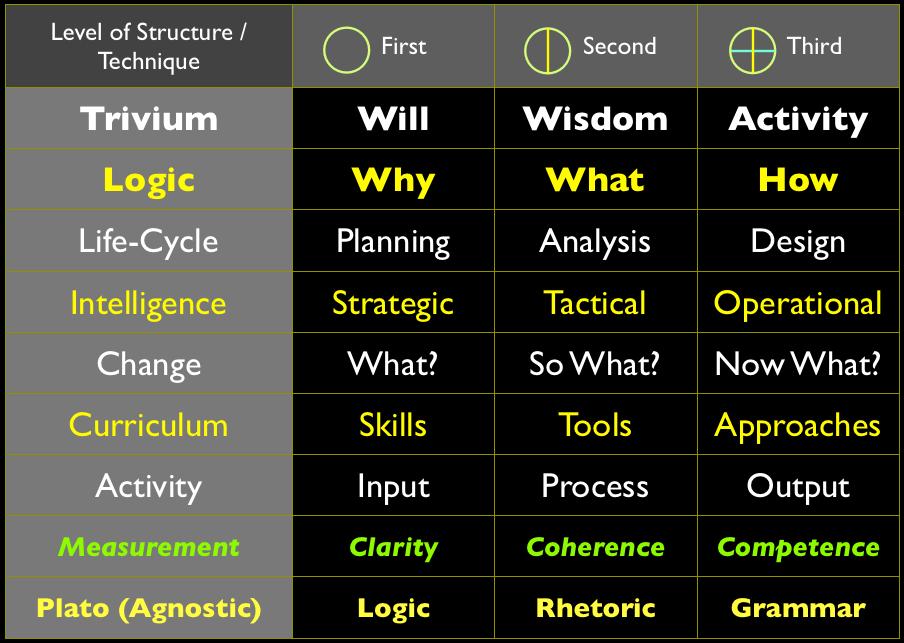
The rule of thirds helps guide the facilitator and meeting designer. The Project Management Institute (PMI) refers to planning, analysis, and design as separate stages across a project or product development.
At ground level, the basic Use Case refers to Input>Process>Output as the basis for understanding requirements. Many of the world’s great religions of philosophy embrace the concept of a trinity. From Shiva, Vishnu, and Brahma of Hinduism to the great agnostic Plato, who referred to logic, rhetoric, and grammar as the trivium; testing of which allowed citizens to vote.
The Trivium
As elementary students, we learned the importance and proper sequencing of WHY before WHAT before HOW.
The Trivium: source Terrence Metz
Let’s look at two components of Goldblatt’s Theory of Constraints (aka Triple Constraint Theory), namely time and quality.
Time
Optimally allow at least one hour of preparation time for each hour of meeting or workshop time. Early in the role of facilitator, as you develop your experience, competencies, and body of knowledge, the ratio can be much higher. Many suggest a practical ratio of two hours of preparation to every one hour of meeting or workshop time. The less familiar you are with the agenda and the tools you plan to use, the larger the ratio you can estimate.
Unfortunately, people forget the importance of the back-end as well; namely, what to do and invest after the meeting or workshop. Please make certain that your documentation is complete, and that it sizzles. Frequently the only residue of value left after a meeting or workshop is the document, and if it was not documented, it did not happen.
Take time to add context, typically cut and paste from your annotated agenda if thoroughly constructed. Context provides the background and rationale, the WHY, behind WHAT gets done during the meeting.
For example, take a decision made by a group to the executive sponsor or decision review board and their first question is WHY. Why did you make that decision? Let us be careful to document the rationale, the BECAUSE, behind the various components within a deliverable. Explain why they were built, how they relate to each other, and how they accelerate the project your meeting supports.
Quality
PMI refers to it as “front-end loading”, in other words, do not underinvest in the planning and building consensus around WHY something is important. For example, why do perform this function, process, or activity? Why we do something dramatically affects what we will do to support it.
Note the difference between a primary residence to raise a family and a beach house or camp hut used for family vacations. The purpose alone dictates different decisions and designs. A family vacation house for example may emphasize more beds than privacy, or give the family room more space while minimizing the study or library.
Even during a meeting, make sure you include a beginning, a middle, and an end. All too frequently, meetings fail to include one of them. Most people would rather go to a movie than a meeting because even a poor movie has a beginning, a middle, and an end. Do not discount the value of an effective review and wrap, and see Four Activities to Efficiently and Effectively Wrap-up a Meeting to manage the end, better than most.
______
Don’t ruin your career by hosting bad meetings. Sign up for a workshop or send this to someone who should. MGRUSH workshops focus on meeting design and practice. Each person practices tools, methods, and activities every day during the week. Therefore, while some call this immersion, we call it the road to building high-value facilitation skills.
by Facilitation Expert | Feb 6, 2014 | Analysis Methods, Communication Skills
In the role of facilitator, you will discover a lot of power by using metaphors or analogies to explain your method. Avoid using the content and experience of the subject matter experts. In other words, a metaphor is worth a thousand pictures.
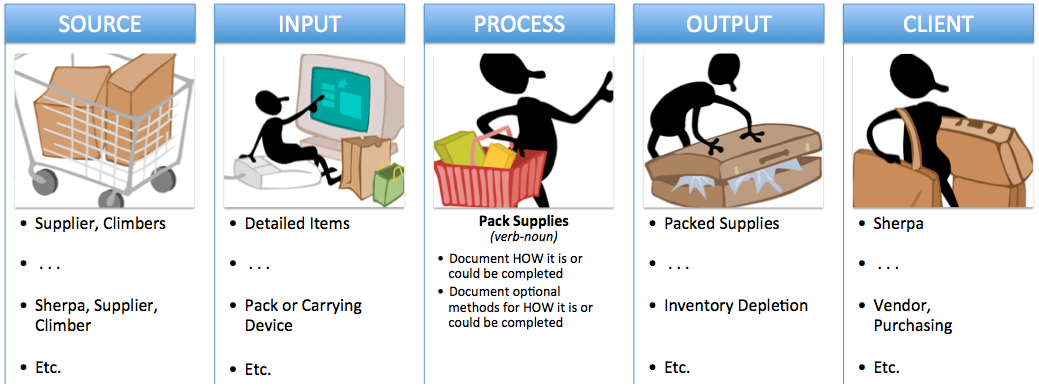
To use “their” content violates neutrality. Use a metaphor or analogy about which you have passion. A metaphor helps you to explain it to your great-grandmother, the test of ultimate clarity. In the following example, we use “Mountain Climbing” to explain one form of a USE CASE, called SIPOC (i.e., Source, Input, Process, Output, and Client/Customer).
Illustrative Analogy (SIPOC): A Metaphor is Worth a Thousand Pictures
Previously completed work that helped to identify some of the “requirements” could have led us to understand that one of the activities required to support the purpose of mountain climbing has been identified as “pack supplies” (note the simple verb-noun pairing). Rather than explain the SIPOC tool orally, we can provide a picture or illustration of the tool by using the metaphor or analogy of mountain climbing.
Right-to-Left Thinking
The phrase “right to left thinking” (similar to “start with the end in mind”) derives from SIPOC. There are five discrete activities, namely:
- Anchor the framework with the activity or process, here previously identified as “Pack Supplies”. Since subject matter experts (aka SMEs) perform similar tasks differently, socialize and document how the activity is or should be performed, allowing for multiple perspectives. Later, take this material and transpose or append it to process flow diagrams or swimlanes.
- Identify the outputs or things that result from the completed activity. A “thing” could be information, a transaction, or a tangible item. Think of a “thing” as a noun such as a person, place, or object about which we need more information to make an informed decision.
- For each discrete output, discuss where it goes or who is the client or customer of the output. Note there could be more than one client for each output. For example, information called “Inventory Depletion” is shared with both the purchasing role so that they can reorder and perhaps the vendor to enable auto-replenishment.
- Working to the left side, identify the things needed to complete the activity.
- Finally, identify the source(s) of each thing, noting again that there could be multiple sources for a single item. The “Pack” for example, might come from the sherpa, supplier, or even the climber.
By using an illustrative analogy you can now explain to your meeting participants where you are in the agenda and how the agenda steps support one another. Using an analogy reinforces that your role remains content-neutral. The analogy makes abstract terms such as “input” concrete or tangible and more easily understood. Remember, a metaphor is worth a thousand pictures.
______
Don’t ruin your career by hosting bad meetings. Sign up for a workshop or send this to someone who should. MGRUSH workshops focus on meeting design and practice. Each person practices tools, methods, and activities every day during the week. Therefore, while some call this immersion, we call it the road to building high-value facilitation skills.
by Facilitation Expert | Jan 23, 2014 | Decision Making, Problem Solving
“Contrary to popular opinion, you don’t need weird shoes or a black turtleneck to be a design thinker . . .” so goes the article from Harvard Business Review♦. The author suggests five characteristics found in design thinkers (i.e., innovators) that relate directly to the core competencies required for effective facilitation. Included (in alphabetical order) are Collaboration, Empathy, Experimentalism, Integrative Thinking, and Optimism.
Design Thinker: Collaboration
The increasing complexity of options and decision-making demands the involvement of many, rather than one. Lone genius has been replaced with cross-disciplinary subject matter experts. Select subject matter experts have the talent to succeed, the initiative, and the motivation to succeed, but frequently do not know how to succeed in a group setting. Many are subject matters across disciplines with experience drawn upon multiple backgrounds and organizations. At IDEO for example, they engage engineers, marketers, anthropologists, industrial designers, architects, and psychologists, among others.
Design Thinker: Empathy
Understanding that there is more than one right answer, seeking the best among multiple perspectives lends itself to creating an answer that did not walk into the meeting; but rather one that is created during the meeting. To support creation, empathy in the form of active listening with a neutral session leader becomes critical.
Design Thinker: Experimentalism
Challenging subject matter experts to make their thinking visible, from the heart, can advance the rationale behind their thoughts that breed both consensual understanding and breakthrough solutions. Through observation and questioning, session leaders can inspire and transfer ownership of the meeting output.
Design Thinker: Integrative Thinking
While analytical methods are certainly helpful, integrative approaches support innovation. A neutral facilitator can help a group understand multiple perspectives and build a solution(s) to reconcile seemingly contradictory points of view. For example, one participant may prefer black and another prefers white. Instead of viewing them as opposing thoughts, how can we integrate both black and white? Immediate answers include options such as two-tone, plaid, polka dot, shades of grey, etc.
Design Thinker: Optimism
Successful session leaders rely on confidence in method rather than expertise around content to generate higher quality solutions. Practically speaking, however, optimism and confidence come from experience, so don’t forget to try, practice, and some more. There is usually more than one right answer. You may not be the best facilitator in the world, but you are the best facilitator your group can find.
Trust that in the role of session leader, they need you more than anything else, to lead with Collaboration, Empathy, Experimentalism, Integrative Thinking, and Optimism. With this technique, you can open the doors of perception that make it easier for your group to develop breakthrough solutions.
~~~~~~~
♦ June 2008 (pg 87)
______
Don’t ruin your career by hosting bad meetings. Sign up for a workshop or send this to someone who should. MGRUSH workshops focus on meeting design and practice. Each person practices tools, methods, and activities every day during the week. Therefore, while some call this immersion, we call it the road to building high-value facilitation skills.
by Facilitation Expert | Jan 16, 2014 | Planning Approach
Research by Ana Guinote and Mario Weick shows that people in positions of power are particularly ineffective planners.
People who feel powerful focus on getting what they want and ignore the potential obstacles that stand in the way. The planning fallacy: the planning efforts of powerful people rely frequently on “best case scenarios” and lead to far shorter time estimates than more practical plans that take into account what may go wrong.
Overconfidence: The Fallacy of Planning
Good time management starts with the deliverable and breaks it into manageable pieces, understanding the activities required to support each, and an estimate based on multiple factors such as group size, functionality, and experience. However, most leaders are relatively poor at estimating the time they will need to complete any task. Psychologists refer to this as both the planning fallacy and the bias of overconfidence. Fallacies and biases put us at increasing risk of reaching our objectives on time.
The Overconfidence Bias Damages
You can learn more accurately how to predict the length of an activity and become a better estimator and planner if you consider the potential obstacles and two other factors.
- Reflect on your past experiences and how long similar activities have taken in the past, and
- Break the activity into smaller pieces or tasks (e.g., questions or steps) and factor in the time for each task.
For example, Brainstorming as an activity should be broken into three tasks, namely:
- Diverge or List—estimate time based on whether or not you are using break-out teams, ELMO rule (Enough, Let’s Move On), etc.
- Analyze—estimate based on the tool to be used (e.g., PowerBalls or Decision Matrix) and allow time for scrubbing the list. Estimate separately for some time for thorough definitions, capturing omissions, and deleting sub-optimal input.
- Converge or Decide—estimate based on providing substantial reflection (i.e., active listening) around the rationale for decisions made and allow extra time for testing the decision against the initial purpose of the decision.
______
Don’t ruin your career by hosting bad meetings. Sign up for a workshop or send this to someone who should. MGRUSH workshops focus on meeting design and practice. Each person practices tools, methods, and activities every day during the week. Therefore, while some call this immersion, we call it the road to building high-value facilitation skills.
Related articles
- Planning fallacy: why people suck at planning (sandglaz.com)
- Article: Estimating on agile projects: what’s the story, what’s the point? (infoq.com)
by Facilitation Expert | Jan 9, 2014 | Meeting Support
If you seek innovation and breakthroughs during your group meetings or workshops, do not clone yourself.
Constantly strive to blend and mix various ingredients that stimulate participants, such as tactile stimulation. Prepare to keep all of your participants stimulated. We call it the “Zen” of the experience—that is appealing to all the senses to stimulate and maintain vibrancy, including chenille stems.
Stimulate the Senses
Tactile Stimulations Adds to the Zen of the Experience
As you know, moods and judgments can be influenced by unrelated experiences of sight and sound. For example, we typically feel happier on sunny days and perhaps more relaxed when listening to certain types of music. Research shows that heat and humidity provoke more fighting, violence, and even riots.
Visual Stimulation
You are encouraged to use multiple colors to break up the monotony of a single color hue. You are encouraged to use icons and illustrations to break up the monotony of recording notes purely in the narrative format. Likewise, use matrices, tables, and templates to stimulate your participants.
Music Helps a Lot
Our popular break timers blend a musical background that could best be described as eclectic—everything, from Frank to Frank as in Frank Sinatra to Frank Zappa. We even suggest the use of Purell®, citrus fruit, and fresh air to alert participants who may be dozing off. Likewise, we encourage the use of 30-30, or 30-second stand-up and stretch breaks every 30 minutes.
Tactile Stimulation Works
In a similar fashion, we have used chenille stems (aka pipe cleaners) and foam stickers for nearly twenty years now. While not all participants use them, research by Joshua Ackerman, Christopher Nocera, and John Bargh shows that the weight, texture, and hardness of the things we touch are unconsciously factored into decisions that have nothing to do with what is being touched. Tactile stimulation works.
Most people associate smoothness and roughness with ease and difficulty. Note the expressions “smooth sailing” and “rough seas ahead.” According to the researchers, people who completed a puzzle with pieces covered in sandpaper described their interaction as more difficult and awkward than those with smooth puzzles. Chenille stems offer both silky smoothness and flexibility, characteristics we seek from our participants and meetings. Let the chenille stems make everything seem better, they work, and research confirms why.
______
Don’t ruin your career by hosting bad meetings. Sign up for a workshop or send this to someone who should. MGRUSH workshops focus on meeting design and practice. Each person practices tools, methods, and activities every day during the week. Therefore, while some call this immersion, we call it the road to building high-value facilitation skills
by Facilitation Expert | Dec 26, 2013 | Analysis Methods, Decision Making
Most of us have heard that a picture tells a thousand words. Consensually built pictures, especially those covering complex topics and interactions, can be used to help solve and resolve a thousand arguments.
We are reminded by the IIBA (International Institute of Business Analysis) Quick Tip Bulletin #58 about the value of one type of picture of the business, called a Context Diagram.
Illustrative Context Diagram
A Context Diagram, also known as a Scoping Picture or Picture of the Business (area) may look complicated and un-informing to the uninformed, but a picture of the business quickly enables a session leader to tighten the reign on scope creep issues that plague many meetings and workshops.
The Context Diagram on the right illustrates “who” the business interacts (here, an organization or business called “Home Finance”) with, “what” the business receives from them, and “what” the business gives to them. Many refer to the “whats” as inputs and outputs. Inputs and outputs are used in requirements gathering to narrow the scope of discovery and discussion. The picture helps both the participants and the facilitator focus on the deliverable.
How to Build a Context Diagram
Consider using the simple agenda shown below. It captures the answers to three simple questions to complete the modeling:
- WHO do we work with to support our purpose (e.g., Actors or Agents)?
- WHAT do we get from them (inputs)?
- WHAT do we give them (outputs)?
Consequently, modify this “plain vanilla” agenda for a Context Diagram as shown or as you see fit. Use the MGRUSH 7-step introductory sequence and 4-step review and wrap for the workshop bookends. Have an ample supply of Post-It® Notes available, in at least three different colors, sizes, or shapes to distinguish the WHO from the inputs and outputs. Once complete, and consensually validated, you can proceed further with follow-up meetings or workshops to further define and illustrate WHO the business uses to support its purpose, and what activities (Activity Flow or Functional Decomposition workshop, leading to use cases such as SIPOC) and information (Logical Modeling or Entity Relationship Diagram) are also required to support their business purpose.
The following shows the simple agenda that typically takes two to four hours to complete. Also, refer to your MG Rush Professional Facilitative Leadership manual for more details.
- INTRODUCTION
- PURPOSE OF THE BUSINESS AREA
- WHO INTERACTS (Actors)
- WHAT COMES IN (Inputs)
- WHAT GOES OUT (Outputs)
- MODEL AND VALIDATION (Walk-thru)
- THE SCOPE DEFINED (Narrative)
- REVIEW AND WRAP
______
Meetings must rise above the tiny opening of words and embrace the fullness of human insight—through listening, visuals, stories, numbers, and symbols. The transformation begins not in tools, but in mindset. Leave your ego at the threshold, and step into the structures of meetings that get results.
In a world where everyone can engage in decisions that affect them
______
Lead the Change—One Meeting at a Time
Are you ready to transform how decisions are made, problems are solved, and alignment is built in your organization?
True meeting leadership goes beyond setting an agenda. It requires a facilitator who can navigate complexity, balance voices, and drive toward outcomes with clarity and consensus. Our Professional Meeting Leadership Workshop and facilitation training equips you to do just that—blending human-centric methods with structured analytical tools to foster rigor, inclusivity, and results that stick.
- Practice live.
- Get expert feedback.
- Build confidence that lasts.
Whether your meetings suffer from unclear objectives, disengaged participants, or decision fatigue, this workshop will help you identify the root causes, apply proven facilitation techniques, and emerge as the leader every team needs.
Take the first step today—transform your meetings and magnify your impact.
______
👉 Click here to reserve your seat now.
#facilitationtraining #meetingdesign
Because every meeting should be a catalyst for change—not just another calendar event.
______
With Bookmarks no longer a feature in WordPress, we provide the following for your benefit and reference.
______
- Benefits and Best Practices Using Structured Facilitative Workshops (mgrush.com/blog)
- What is the Difference Between Structured Facilitation and Kum Ba Yah Facilitation? (mgrush.com/blog)
- Guidelines for Selecting Appropriate Structured Facilitation Tools (mgrush.com/blog)
- Phase One Results from a Facilitated Business Process Improvement Project (mgrush.com/blog)
- Why We Need Trained, Professional Facilitators Who Can Guard Against Bias (mgrush.com/blog)
by Facilitation Expert | Dec 12, 2013 | Managing Conflict
Here is a quick and somewhat humorous listing of fourteen different facilitator typologies or “personalities” you might seek to avoid. Our favorite is “The Pretender.”
14 Facilitator Types
The “I Can’t Hear You” Guy—
The facilitator refuses to listen, probably because they are too busy analyzing, judging, and processing information.
The Blabber—
The facilitator who loves the sound of his or her own voice, and actually believes they are adding value when speaking about content rather than context.
The Centerpiece—
The facilitator makes him or her the real content of the workshop because, of course, it’s all about them.
The Drill Sergeant—
The facilitator is rigidly stuck on the agenda and puts the clock above quality content.
The Guardian—
The facilitator makes certain that all conversation goes through him or her and not from participant to participant, so as not to lose control.
The Ice Cube—
The distant and aloof facilitator is unwilling to personalize the experience, sometimes becoming accusatory.
The Know-it-all—
The facilitator always has the answer. The know-it-all who can’t say “I don’t know.”
The Marathon Man—
The facilitator piles activities on top of one another, doesn’t allow for breaks, and ignores the need for groups to pause, reflect, and absorb topics and ideas.
The Molasses Man—
The facilitator is painfully slow and doesn’t have an innate feel for pacing, variety, or style.
The Parrot—
The facilitator relentlessly recaps information, restates ideas, and summarizes the obvious (although sometimes justifiable for groups that are challenged to focus and “be here now.”)
The Passenger—
The facilitator lets people talk too long and gives up the reins of facilitation to whoever is speaking at the time.
The Pretender—
The facilitator doesn’t ask real questions but only “pretense questions” that are really designed to give the facilitator an excuse to pontificate.
The Storyteller—
The facilitator tells far too many cutesy stories or “war stories” and never gets deep into the content.
The Tunnel Driver—
The facilitator who keeps doing the same thing or uses the same method hour after hour.
______
Don’t ruin your career by hosting bad meetings. Sign up for a workshop or send this to someone who should. MGRUSH workshops focus on meeting design and practice. Each person practices tools, methods, and activities every day during the week. Therefore, while some call this immersion, we call it the road to building high-value facilitation skills.
by Facilitation Expert | Nov 21, 2013 | Facilitation Skills
Facilitating for-profit business plans and requirements captures substantially different challenges than facilitating a Kum-Ba-Yah community forum or other volunteer-based meetings. While active listening serves both scenarios, decision-making that supports most business initiatives differs from win-lose voting methods.
Frequently, business facilitators are not seeking agreement, but rather harmony. The difference follows. Agreement suggests that everyone is singing the same note, perhaps even with the same instrument. Boring. Reminiscent of the railroad industry trying to protect itself, rather than redefining its role as transportation and logistics.
Harmony implies we are seeking an outcome where everyone’s musical note or expression is heard, from whatever instrument they play. Successful facilitation provides appropriate structure so that the deliverable captures all instruments and all tones, like a symphony. The sound of cicadas every few years represents agreement. The music of Pyotr Tchaikovsky reflects a symphonic movement.
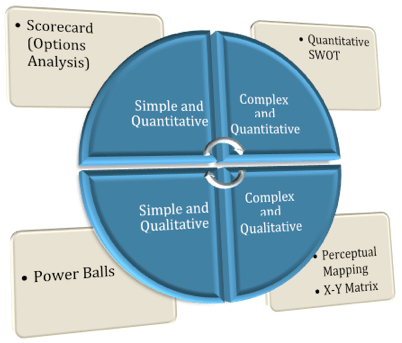
Structured Decision-Making
When seeking consensual understanding, as in decision-making, for example, the right structure makes it easier for your participants. Consider the PowerBall approach when you can help drive a group toward a simple decision surrounding a well-articulated question (e.g., What should we buy?).
For complicated situations, use the Scorecard approach that separates fuzzy from SMART criterion. By applying weightings you generate a quantitative score to compare your options. For highly complex situations like portfolio management, always embrace the TO-WS (SWOT) analysis (introduced to the MGRUSH workshops in its quantitative form in 2004). In the facilitator’s world, our approach to TO-WS is like comparing a Tchaikovsky composition to playing the same note over and over on a kazoo.
Structured Decision-Making Matrix
Harmony Over Agreement
As facilitators, our business constraints rarely afford the time and luxury of sitting around the campfire singing Kum-Ba-Yah and building trust. Therefore, build your structure in advance. Then lead the method best suited to reconcile the business challenges and trade-offs you expect. Everyone agreeing will keep you in the box, suffocating innovation. But with harmony, you don’t even see the box, as you lead to the creation of a solution that no single participant envisioned when they entered your workshop.
______
Don’t ruin your career by hosting bad meetings. Sign up for a workshop or send this to someone who should. MGRUSH workshops focus on meeting design and practice. Each person practices tools, methods, and activities every day during the week. Therefore, while some call this immersion, we call it the road to building high-value facilitation skills.
by Facilitation Expert | Nov 14, 2013 | Meeting Support, Meeting Tools
This Meeting Icebreaker is from our collection of practical tips, tools, and techniques. Our tips are gathered from our experience, training classes, and alumni contributions.
IceBreaker Tip One: Warming Up A Group
This icebreaker tip is useful for people who are unfamiliar with each other, or for familiar groups that need some new dimension to their relationships for the purpose of the workshop. Because it may take up to one-half hour for a group of nine, manage your time accordingly.
Ice Breaker Tip — Newspaper or Magazine Headline
- 2 minutes: Have each person write their name on a small piece of paper. As they finish, collect the names in a container (e.g., bowl, box). Next, have each participant draw or select a piece of paper.
- 5-10 minutes: Allow a few minutes for each person to find the person named on their piece of paper and “interview” them. In addition, encourage them to take notes from the interview because you want them to share the highlights.
- 3 minutes: Now have the participants write a newspaper or magazine headline that describes an event or accomplishment of the person named on their piece of paper. Consider a specific newspaper or magazine that most members of the group are likely to read. Either emphasize a personal or professional accomplishment, but consistently emphasize the perspective you choose. Point your participants to a frequently read page or within a specific column of the magazine or newspaper.
- 5-10 minutes: Finally, have each person read the headline for the person named on the piece of paper.
IceBreaker Tip Two: Alternative
Move the headline to some point in the future (e.g., five years from now) when it becomes the aspiration of the participant rather than an actual accomplishment.
______
Don’t ruin your career by hosting bad meetings. Register for a workshop or forward this to someone who should. MGRUSH facilitation workshops focus on meeting design and practice. Each participant practices tools, methods, and activities every day during the week. Therefore, while some call this immersion, we call it the road to building high-value facilitation skills.