by Facilitation Expert | Oct 31, 2013 | Leadership Skills
To improve or enhance your personal skills and to help you understand the skills to seek in others that support effective change, you will find seven top skills for managing change.

Change Management
These skills are those most frequently identified by employers according to Syracuse University public affairs professor Bill Coplin, author of “10 Things Employers Want You To Learn In College.” With our focus on change and business process improvement, we have modified them and listed them in order of priority as they apply to facilitating and managing change:
1. Integrity—
“Do what you say you are going to do.” Without integrity and work ethic, all the other skills could be dangerous. Coplin includes self-motivation and time management.
2. Communications—
Because the greatest and most innovative ideas are impotent if they are not adequately explained to others. Coplin separates verbal or oral communications from written ones and also emphasizes editing and proofing one’s work.
3. Team Work—
Because change never occurs in a vacuum and effective change relies on distributed ownership. Stakeholders need to embrace the change or it will fail. Coplin mentions one-on-one, relationship building, and influencing people through leadership.
4. Infomediary—
Because effectively receiving, archiving, and distributing information that each stakeholder needs to plan, operate, and control the change effort to their level of satisfaction. Colin refers to gathering information and keeping it organized.
5. Measurement—
“If you can’t measure it, you can’t manage it” so become adept with quantitative tools, statistics, graphs, and spreadsheets. Know how to objectively measure why something is important.
6. Questioning—
Few skills are harder to teach and yet as important as knowing the right question to ask. Subject matter experts abound in most organizations, they need to be stimulated by the right question in the proper context, and they can deliver.
7. Problem Solving—
While Coplin emphasizes identifying problems, developing possible solutions, and launching solutions, we would add the importance of properly analyzing the problems as well. Do not leap from identification to solution without a thorough understanding of the implications of the problem.
______
Don’t ruin your career by hosting bad meetings. Sign up for a workshop or send this to someone who should. MGRUSH workshops focus on meeting design and practice. Each person practices tools, methods, and activities every day during the week. Therefore, while some call this immersion, we call it the road to building high-value facilitation skills.
Related articles
- What is Change Management? (catherinescareercorner.com)
by Facilitation Expert | Oct 10, 2013 | Meeting Structure, Meeting Tools
Facilitators rely on hundreds of tools to gather information, support decision-making, encourage innovation, build camaraderie, strive for higher quality, or guide a facilitator through an unplanned pathway. Therefore, your selection of the “best” structured facilitation tools depends on many factors.
A note of caution—Beginning facilitators often have a difficult time feeling comfortable because of the newness of the tools. Some experienced facilitators overuse a tool. They may forget that when you are comfortable using a hammer, not everything is a nail. Some guidelines to follow when using tools:
Overview of Helpful Structured Facilitation Tools
- There is more than one appropriate option. For example, we can capture initial input or meaning from participants through Brainstorming (i.e., narrative), Creativity (i.e., drawing), PowerBalls (i.e., iconic), or TO-WS (SWOT) (i.e., numeric).
- Only use a tool if it is correcting a problem or situation. The tool must add value or it distract from the method. For example, do not lead a team-building exercise if the team is highly functional.
- Do not ask the group permission to use a tool. You are the leader and need to set the method—so do it.
- Never present the tool as a game or a gimmick. This often leads to resistance. Discipline your rhetoric when explaining the Purpose tool. For example, do not ask about ‘today’s purpose’ since you are expected to know the purpose of the meeting.
- Except for team-building tools, explain the deliverable from each tool used and how it supports completing the deliverable.
- Do not be afraid to use a new tool—they have all been field-tested and work well when used properly.
- Build tool contingencies into your agenda—ie, plan to use a specific tool. However, if a problem arises, do not be afraid to substitute for something more appropriate.
- For tools designed to correct situations such as team dysfunction and lack of creativity, remember that most groups did not become dysfunctional in ten minutes and the situation will not be corrected through a ten-minute exercise. It often takes numerous exercises and a great deal of time to see a real difference. Do not give up and you will earn their respect for perseverance.
The “Right” Structured Facilitation Tool
Selecting the best tool to use by understanding the desired outcome. Avoid becoming so comfortable with one or two that those are the only tools you use. To select an appropriate tool:
- Identify the problem.
- Define the desired outcome.
- Review the tool selection chart below to help determine which tool helps achieve your desired outcome.
Team-Building Tools
Suggested steps for effective team-building exercises include:
- Prepare your materials in advance, along with prompts and assignments (e.g., CEO and team names), and rehearse new or complicated tools.
- Provide clear and explicit instructions, preferably posted or written down as handouts. Emphasize any rules.
- Monitor group activity closely, especially in the beginning, and make yourself readily available for clarifying areas of fear, doubt, or uncertainty.
- Compare the purpose with the output. Reinforce the learning and how it applies to accelerating the group’s performance toward your meeting or workshop deliverables.
Structured Decision-Making Tools
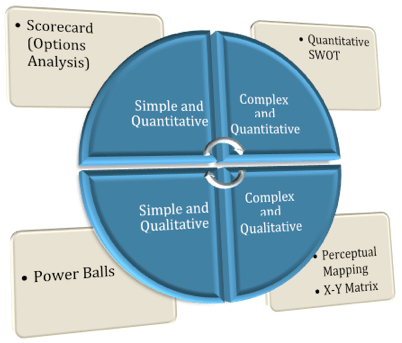
Use the following matrix to help guide you to the most appropriate decision-making tools based on the type of information
(i.e., qualitative or quantitative) and complexity of the decision
(i.e., concrete or abstract).
Decision-Making Matrix to Guide Selection of Structured Facilitation Tools
Additional Sources for Structured Facilitation Tools
Continue to add to your tool chest. When co-located in an enterprise with other facilitators, build a Community of Practice (i.e., CoP) that archives tools, visual prompts, and retrospective reviews. Strive to speed up selection and avoid repetition for your participants.
For additional exercises and tools for facilitators look at Games Trainers Play and More Games Trainers Play by John Newstrom and Edward Scannell, New York, McGraw-Hill Book Company, various. You can also order the IAF (International Association of Facilitators) Handbook of Group Facilitation and other resources at Amazon.com among others. There are thousands of tools and resources for facilitators and team-building tools in English and other languages.
______
Don’t ruin your career by hosting bad meetings. Sign up for a workshop or send this to someone who should. MGRUSH workshops focus on meeting design and practice. Each person practices tools, methods, and activities every day during the week. Therefore, while some call this immersion, we call it the road to building high-value facilitation skills.
by Facilitation Expert | Sep 19, 2013 | Managing Conflict
Individuals and groups can frankly be wrong when they think they are right. Professional facilitators get groups to focus on the conflict of the issues and ideas rather than the conflict between the people advocating those ideas. At the same time, they need to guard against meeting bias.
Guard Against Meeting Bias
The chance of error when making complex decisions is amplified by the amount of data required to support the decision Properly facilitated, groups of people can see through the fog clearer than those biased with the information they bring to a meeting or workshop.
Note the following impactful biases cited by the World Future Society in its March-April 2013 edition of “The Futurist.”
Bias Factors Affecting Group Decision-Making and Meeting Bias
- Confusing desirability and familiarity with probability
- Cost of detailed primary research, leading to shortcuts
- Distortion of data by media through selection and repetition
- Forecaster’s bias which involves a preference for change or patterns
- Homogenization of distinct multiple data sources (for cost savings)
- Lack of clear confidence intervals (how clean the data is)
- Mistaking correlation for causation (a very common error)
- Organizational biases
- Over-immersion in local social values or perceptions
- Political research sponsorship
- Preconceptions—framing complex issues in a skewed fashion (selective perception)
Professional facilitators help objectify the subject matter experts’ points of view with challenges and structured discussion. They help depersonalize issues from people, so that ideas can stand on their own merit and value, not inflated by the charisma of persuasive participants.
Guard against selective perception
As their session leader, remember that everything heard in a meeting or workshop is interpreted and filtered differently by participants. They will hear or see differently based on their individual biases, or colored lenses. To illustrate the point, the vastly different pictures below are all from the same area in space using different lenses including radio, infrared, visible light, x-ray, gamma ray, and others.
NASA Public Domain
Parallel or Sloped?
Or, consider the following where we discover the horizontal lines below are truly parallel and not askew. Some will claim that “no way” are the lines parallel, when in fact they are perfectly parallel.
Same Height?
Additionally, look at the people in the picture below and understand that they are the exact same height, although appearances deceive. Be on guard always against biases that disrupt consensus building, and embrace the effective presentation tips discussed elsewhere.
______
Don’t ruin your career by hosting bad meetings. Sign up for a workshop or send this to someone who should. MGRUSH workshops focus on meeting design and practice. Each person practices tools, methods, and activities every day during the week. Therefore, while some call this immersion, we call it the road to building high-value facilitation skills.
by Facilitation Expert | Sep 12, 2013 | Decision Making
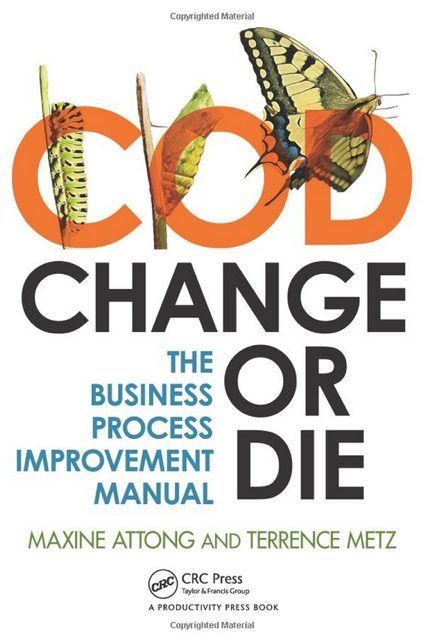
If you or your group recognizes the opportunity to improve, you’ll benefit from Change or Die – The Business Process Improvement Manual (available on Amazon and other fine bookstores.) Co-written by Maxine Attong and Terrence Metz, it details a proven method, built upon proven examples of shared development and ownership.
Extracted from “Change or Die: The Business Process Improvement Manual,” published by CRC Press, the Taylor and Francis Group.
Change or Die captures the developments that occur during the planning phase of a Business Process Improvement project (BPI). The method described builds over time, upon multiple, facilitated workshops. For workshop agendas, tools, and details, refer to the book, pages 167 to 171, or other “Best Practices” articles at this MGRUSH site.
How to Facilitate Business Process Improvement
Business Process Improvement (BPI) Planning
Organizations make large investments in the development of their strategic plan. For example, the market rate for professional support services to help develop strategic plans may require four percent of the investment sums for consulting. Sometimes more. Over the years, we have also developed templates that we use over and over, to bring about consistent results. Hence, we use facilitated workshops to extract information and build consensus from senior management about their dreams and hopes for the organization.
The strategic plan reflects an understanding of why, what, and how. When the client wants to do it, how much it will cost, and the estimated return on monies invested. Overall, the strategic planning document provides a clear view of the organization’s intent and should be used to baseline performance.
The BPI strategic plan becomes clear during executive sanction. Following this, the BPI project can move ahead and transition from the process examination team to the implementation team. The process examination team’s plan provides clear communications to senior management about the team’s intention for the BPI. Specifically, they illustrate how it supports the organization’s strategic initiatives. Therefore, now is the time to sell the project to the executive team, receive their approval, and release the resources needed to complete a successful project.
Purpose of the Business Process Improvement Plan
BPI provides a reference point against which the process examination team will be evaluated. The BPI plan also provides a synopsis of what the BPI team(s) has been working on. Therefore, the document legitimizes the critical nature of the proposed BPI project.
Given the team’s first and foremost opportunity to sell the project, the team must:
BPI Phase One Check-Off
- Be prepared to defend the tables, statements, and figures presented.
- Document known assumptions.
- Ensure that others can audit their transparent methods and results.
- Establish the accuracy of the data.
- Include charts and tables.
- Plan carefully.
- Prepare an oral presentation with visual supplements for management.
- Sell the project—your organization’s future may just depend on it.
- Solicit support from the project sponsor.
Business Process Improvement Plan Elements
The BPI plan is the process examination team’s last action before the project transitions to the implementation team. As a result of the team’s findings and decisions, the BPI plan includes the following:
- Executive Summary
- The Problem
- The Solution
- Resources Needed
- The Process
- Vision, Goals, and Objectives
- SWOT Analysis
- Project Team
- Risks and Opportunities
- Resources
- Next Steps
- Conclusion
Executive Summary
Create a snapshot of the project that captures the imagination of the executives. Therefore, concisely state the results that will be created by its completion. Hence, include the project costs and expected return on the investment. Consequently, bear in mind that the executive summary may be all that an executive has time to read, so the summary serves as the deciding factor of whether the project gets approved or not.
The Problem
BPI responds to or anticipates a changing environment. The reader needs to identify with and believe that the problem is real and that the organization’s ability to meet its goals and objectives will be compromised if the problem goes unresolved.
State the pain that the process causes to the stakeholders and why it needs to be stopped. Process measurements and workflows provide evidence of what is wrong with the existing process.
The Solution
Develop a lofty purpose for the BPI. Therefore, state HOW and WHY the BPI project will resolve the problems identified.
Resources Needed
The project budget shows the investment needed by type of expense. Therefore, clearly state the return on the investment and the period for the returns. And for sure, including the assumptions that went into the number crunching.
The Process
Codify the reasons why you chose the specific process for improvement. Demonstrate that an auditable and transparent method was used for the selection of the process to be improved and include the results of the analysis.
Vision, Goals, and Objectives
Paint a picture of the future process; what it looks like, and how it assists the organization in achieving its strategic objectives. Therefore, include the vision, goals, and objectives of the BPI project and align them to your organization’s vision.
TO-WS Analysis
Strengthen the argument for the process vision, goals, and objectives by showing how strengths and opportunities relate to the vision. Consequently, determine how the weaknesses and the impact of threats might be reduced, converted, or removed by the project.
Project Implementation Team
Explain the implementation team and how and why the members were selected. Explain the selection criteria and present the implementation team charter.
Risks
The Risk Register highlights the risks with the highest probability of affecting the project. Explain the mitigation/ elimination strategies. Summarize the change management plan and the stakeholder analysis and include them with your strategies.
Opportunities
Highlight the opportunities that BPI presents. Therefore, identify any opportunities that have been taken advantage of thus far, such as the quick wins discussed earlier.
Resources
Include the updated project budget and highlight the critical costs. Hence, shows the basis of the project rate of return and the payback period.
Next Steps
Present an updated project plan and give an overall view of the next steps and the estimated dates. Highlight the key activities such as BPI plan acceptance by management, implementation team training, process design, project testing and implementation, and project completion.
Conclusion
Here provide a review and wrap-up of all the above. Do not introduce added information during the conclusion. All members of the process examination team and implementation teams need to sign off on the document (obtain signatures) showing commitment and buy-in of its contents.
Change or Die provides a life cycle approach on how to facilitate business process improvement within 250 pages of primary text. Hence, both print and electronic editions come with another 100 pages of workshop agendas, tools, and activities. The print edition contains a CD containing over 100 tables and templates in electronic form. Therefore, the nominal investment will pay for itself within the first hour or two of your perusal.
MGRUSH alumni will recognize some proven tools (eg, Guardian of Change) and some new activities to stimulate group performance. Consequently, the workshop agendas have been stress-tested with other clients and are proven to work.
Our publisher, Productivity Press, represents an imprint of the publishing house, CRC Press which operates as the science and technology book division of the Taylor & Francis Group. Established in 1783 in the United Kingdom, Taylor & Francis Group of the academic publishing arm of Informa plc. represents one of the longest-established publishers in the history of printing.
Maxine Attong (co-author, MGRUSH alumnae, and resident of the Republic of Trinidad and Tobago) may be found around the world signing copies at various conferences. You can’t miss her world-class smile (if you are lucky). Terrence Metz (co-author, MGRUSH alumni, lead instructor, and Managing Director) may be found elsewhere hosting MGRUSH workshops. Hence. either will gladly sign a copy for you and discuss questions you may have about deriving value from our team approach on how to facilitate business process improvement.
Meetings must rise above the tiny opening of words and embrace the fullness of human insight—through listening, visuals, stories, numbers, and symbols. The transformation begins not in tools, but in mindset. Leave your ego at the threshold, and step into the structures of meetings that get results.
In a world where everyone can engage in decisions that affect them
______
Lead the Change—One Meeting at a Time
Are you ready to transform how decisions are made, problems are solved, and alignment is built in your organization?
True meeting leadership goes beyond setting an agenda. It requires a facilitator who can navigate complexity, balance voices, and drive toward outcomes with clarity and consensus. Our Professional Meeting Leadership Workshop and facilitation training equips you to do just that—blending human-centric methods with structured analytical tools to foster rigor, inclusivity, and results that stick.
- Practice live.
- Get expert feedback.
- Build confidence that lasts.
Whether your meetings suffer from unclear objectives, disengaged participants, or decision fatigue, this workshop will help you identify the root causes, apply proven facilitation techniques, and emerge as the leader every team needs.
Take the first step today—transform your meetings and magnify your impact.
______
👉 Click here to reserve your seat now.
#facilitationtraining #meetingdesign
Because every meeting should be a catalyst for change—not just another calendar event.
______
With Bookmarks no longer a feature in WordPress, we provide the following for your benefit and reference.
______
by Facilitation Expert | Sep 5, 2013 | Leadership Skills
The discipline of structured facilitation differs from what we respectfully refer to as “Kum Ba Yah” or “warm and fuzzy” facilitation which frequently begins by co-creating ground rules.
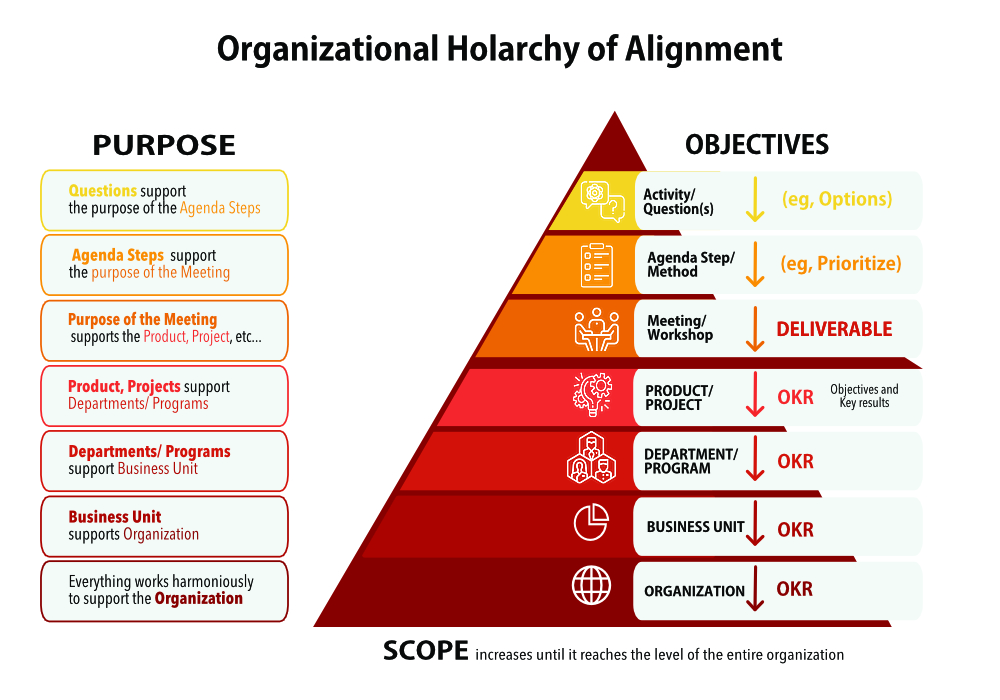
Most corporate environments simply do not afford enough time to follow the slow but sure path of building trust and camaraderie among participants. The holarchy provides a good reason why structured facilitation accelerates faster.
Structured Facilitation Begins with Your Holarchy
Enterprise Alignment
Typical meetings involve report-outs and updates such as staff meetings (typically, loosely structured). Structured facilitation supports workshops and non-staff meetings that occur when report-outs and updates are complete. Frequently structured facilitation supports a specific scope of work we refer to as a “project.” The difference between a project and the program it supports is the same difference one finds between a process and an activity. Both an activity and a project have a discrete starting and stopping time. Programs and processes, however, are typically ongoing or sustaining. We could calculate how much time you invest per year in the activity of “paying bills”. Yet, the process of “accounts payable” never stops.
Why is this important? When active listening fails to reconcile different viewpoints, structured facilitation through a disciplined facilitator takes the team back to the project objectives or the reason for the meeting in the first place. Next, we can view the program goals to improve consensual understanding as to why the project was approved. Finally, we can appeal to the business unit and/ or enterprise objectives to see which argument best supports or aligns with our primary objectives, mission, and vision.
Appealing to Objectives
Appealing to the objectives to reconcile arguments underlies structured facilitation that is missing from many Kum Bah Yah settings. Notice, for example, to stimulate peace in the Middle East, the structured facilitation approach suggests reconciling arguments first with active listening and then by appealing to the objectives in the holarchy, shown in the diagram below. However, when there are no SHARED purpose, scope, and objectives, there is no ultimate appeal for resolving arguments.
In corporate environments, all arguments are best answered by which position most strongly supports the corporate objectives. With Kum Bah Yah, the objectives may be competing. Therefore we rely on a different tool set, than pure decision-making science. Both structured facilitation and unstructured facilitation have their time and place but do not confuse one for the other. No corporate culture can invest two or three hours to build ground rules at the start of meetings and workshops. We do need a clear line of sight, however, to the project, program, business unit, and enterprise objectives that our meeting supports.
______
In a world where everyone can engage in decisions that affect them
______
Lead the Change—One Meeting at a Time
Are you ready to transform how decisions are made, problems are solved, and alignment is built in your organization?
True meeting leadership goes beyond setting an agenda. It requires a facilitator who can navigate complexity, balance voices, and drive toward outcomes with clarity and consensus. Our Professional Meeting Leadership Workshop and facilitation training equips you to do just that—blending human-centric methods with structured analytical tools to foster rigor, inclusivity, and results that stick.
- Practice live.
- Get expert feedback.
- Build confidence that lasts.
Whether your meetings suffer from unclear objectives, disengaged participants, or decision fatigue, this workshop will help you identify the root causes, apply proven facilitation techniques, and emerge as the leader every team needs.
Take the first step today—transform your meetings and magnify your impact.
👉 Click here to reserve your seat now.
#facilitationtraining #meetingdesign
Because every meeting should be a catalyst for change—not just another calendar event.
______
With Bookmarks no longer a feature in WordPress, we provide the following for your benefit and reference.
______
by Facilitation Expert | Aug 22, 2013 | Meeting Structure
To facilitate consensus around simple decision-making, consider the following scenario and do not forget to help the group articulate the purpose of the project your meeting supports.
Let us say for example that four of us are taking a trip from Minneapolis to New Orleans. Therefore, consider why we are going, the options, and how we might get there. Moreover, take into account the WHY WHAT HOW of any decision.
Options (HOW)
WHY WHAT HOW
- Airplane
- Automobile (motorized 4-wheel vehicle)
- Bicycle
- Boat (or, canoe)
- Bus
- Hitchhike
- Horseback
- Limousine rental
- Taxi cab
- Walk
- Etc.
Consequently, to decide among the competing options we would consider the constraints and requirements. Therefore, let us call those considerations, the decision criteria. Because they provide an understanding of WHAT we must consider in our decision. Additionally, consider some of the decision criteria, as follows:
Criteria (WHAT)
- Accessibility
- Comfort
- Cost
- Ecological impact
- Expected arrival date (if any)
- Fears or phobias
- Length of trip
- Quality of participants (e.g., physical vitality)
- Quantity of participants
- Time of year
- Etc.
Purpose (WHY)
To effectively build consensus around which option to select, the criteria are essential. However, we are missing a primary component; i.e., WHY are we taking the trip? Frequently, groups fail to understand or build the necessary purpose statement that underlies effective decision-making. As facilitators and participants, since the purpose may be clear in our own minds, we assume that everyone else’s purpose is the same as ours.
Prove it. Make certain you facilitate and codify a purpose statement, whether using the MGRUSH Purpose Tool or some other method; the purpose of the trip is essential to deciding HOW we are going to get to our destination.
______
Don’t ruin your career by hosting bad meetings. Sign up for a workshop or send this to someone who should. MGRUSH workshops focus on meeting design and practice. Each person practices tools, methods, and activities every day during the week. Therefore, while some call this immersion, we call it the road to building high-value facilitation skills.
by Facilitation Expert | Aug 15, 2013 | Meeting Tools
Purpose of 30-3 Project Updates: Time is precious. Stakeholders want and need project updates. But, do not want to over-invest. Dashboards are a fine example, relying on green lights, yellow lights, and red lights to highlight the status of project activities.
Another approach you can use for project updates includes the “30 in 3” update. It takes less than 30 minutes to create and less than three minutes to read.
Project Updates Method
Project Updates
You may choose to build the following on your own. In the spirit of Sprint Reviews and Daily Scrums, you can easily use a similar method. With a group of people, build a consensually agreed-upon message. It’s a good thing when it sounds like we all attended the same meeting.
Project Updates Audience and Message
Either start with a list of the primary (and perhaps secondary) stakeholders or build one. For each, ask the group what they would tell that stakeholder if they were asked at the water cooler, coffee pot, or on an elevator ride. Secure agreement from your group especially, on specific words or terms that should or should NOT be used. Amazingly, when you ask a group of people to update the same project, you will discover disconnects about the shared knowledge and perspective that are best repaired while you still have the team at your disposal.
Project Updates Benefit
Having agreed on what to say and what NOT to say, you have built-in a measure of quality control for your meeting output or messaging. When a coherent and cohesive team of talented people is marching in unison, there is no end to what they can accomplish.
______
Don’t ruin your career by hosting bad meetings. Sign up for a workshop or send this to someone who should. MGRUSH workshops focus on meeting design and practice. Each person practices tools, methods, and activities every day during the week. Therefore, while some call this immersion, we call it the road to building high-value facilitation skills.
by Facilitation Expert | Aug 8, 2013 | Facilitation Skills
Getting participants to focus on the same thing at the same time represents one of the hardest thing to accomplish with a group of people. Therefore, learning to remove distractions reflects a core skill and primary responsibility of the meeting leader.
Your Rosetta Stone: Remove Distractions
Remember that all questions you have about what you can or should do may be answered by the question, “Is it a distraction or not?” If it is not a distraction, then it should be acceptable. If it is a distraction, then it is your responsibility to remove distractions so that your group can remain focused on the topic.
For example, if you put your hands in your pocket to rest for a few minutes, it is probably OK. However, if you start juggling your keys or coins, the distraction is unacceptable. If a participant closes their eyes, let them rest. If they start snoring, then intervene to remove the distraction.
Core Skills Where You Need to Remove Distractions
Remove the Electronic Leashes
As a facilitator, you need to manage four core skills including presentation, active listening, questioning, and observation/ neutrality. For these to be effective, you must reduce or eliminate distractions so that the group can stay focused.
These four core skills are critical to effective facilitation.
- Presentation skills are necessary for effective communication
- Active listening is a tool for effective understanding
- Questioning is a tool for effective information-gathering
- Neutrality is a tool for balance and integrity
Removing distractions is an essential discipline for core skills and may guide all of your behavior.
Note for example the challenges that correspond with the four skills:
- Verbal disfluencies and fillers such as saying “Uhm” too often
- Observing something else when the meeting participant is talking
- Providing answers rather than method
- Making judgments or using the word “I” too often
______
Don’t ruin your career by hosting bad meetings. Sign up for a workshop or send this to someone who should. MGRUSH workshops focus on meeting design and practice. Each person practices tools, methods, and activities every day during the week. Therefore, while some call this immersion, we call it the road to building high-value facilitation skills.
by Facilitation Expert | Aug 1, 2013 | Facilitation Skills
Turning Facilitation Guidelines Into Gold
As facilitator, you exhibit your weight in gold by following these fifteen simple, yet critical facilitation guidelines.
15 Facilitation Guidelines
- Session leaders must observe and listen to all that the group says and does. Be there! Immerse your body, mind, and spirit in the method of the group.
- Recognize all group input and encourage participation. Your ability to convey interest and enthusiasm in the group about the importance of the deliverable will be critical to your success as a session leader.
- Scan the group for nonverbal responses (including observers).
- Facilitation represents a helping mechanism. Ask questions rather than lecturing the workshop participants. Listen and keep your group involved.
- Stay on the task. Never lose sight of the holarchy. Avoid straying to other topics no matter how informative the topic may be or how much it may interest you or the group. Let the participants help keep the group on course if you are a weak process policeman.
-
Of all the facilitation guidelines, the most important may be to stay neutral. Do not lose your neutrality. Eliminate your personal bias and opinions from the discussion. The goal remains for the participants to provide answers or options, not you.
- Learn to expect hostility, but do not become hostile with your group or any participant. You must develop an attitude of acceptance. You may not agree necessarily with what is being said, but you can listen, accept, and record their answers and opinions. Let the group evaluate the content.
- Avoid being the expert authority on the subject. You can be an authority figure, but your role is to listen, question, enforce the method, or offer tools and options.
- Put the participants on break at no longer than 90-minute intervals. Be specific about the length of breaks, typically ten minutes. Adhere to your times and always be punctual.
- Use breaks to free a discussion when it is deadlocked. Breaks give the participants a chance to clear their minds and come to a new understanding.
- Do not let your prejudices interfere with your role as a session leader. Let go of the need to win everyone over to your point of view. The group will do the work. You are there to serve the group. Assist them in reaching the outcome.
- During breaks, arrange the flip chart pages, taped on the wall, to build a histogram of progress made in the workshop.
- During transitions and before you break for lunch or the end of the day, summarize the workshop progress and next steps. Give the group a thought to ponder and commend them for the amount of work they have completed.
- Do not keep people too long (eight to nine hours are about as long as people can remain productive).
- Stop a workshop if the group is sluggish and difficult to control, even if they wish to continue. Explain that, when people are burnt out, no progress occurs.
Additionally, there are three guiding principles of effective facilitation.
The fifteen guidelines above may come and go, taking breaks for example. Throughout any ceremony, event, meeting, or workshop, however, the following principles stay in place from start to finish. They include:
- First and foremost the principle of No Harm, and where used, explaining the purpose behind Safety Moments. For diversity and other messages, some embrace OE Moments as well (i.e., Operational Excellence).
- The second is focus and staying vigilant to remove distractions.
- The third is managing and stressing perspective or point of view and leaving egos in the hallway.
No Harm Demands Collaboration
NO HARM
The principle of No Harm provides an essential basis for a group of people coming together to work and decide collaboratively. The facilitator must be both conscious of the principle and its enforcement in the role of process policeman. Nothing is more important to encourage full participation than having the feeling (from a participant’s point of view) that you will not be harmed by what you say.
Let us never forget that the reason for meetings is to generate deliverables but the reason for deliverables is to serve the people. People always come first.
FOCUS
It is virtually impossible to get a group to focus by telling them to focus. We must be wise enough, as facilitators, to remove all the distractions. By removing distractions the only items remaining are those that demand the group make traction and progress to get DONE.
Distractions come in many varieties including physical (e.g., temperature), emotional (e.g., job security), intellectual (e.g., future impact), intuitional (e.g., impact on others), etc. Removing distractions is the biggest hurdle faced by facilitators. Doing so creates traction.
Traction cannot be developed by telling a group to focus. Facilitators must remove distractions so that the only thing remaining for the group is to focus on the issue at hand. Scope creep occurs when discussion advances beyond the scope of the deliverable, and frequently becomes a distraction, causing non-productive meetings.
PERSPECTIVE
When working for a company, organization, NGO, or other entity, participants must be reminded that they represent others through their role. Roles dictate diverse types of behavior and mannerisms. For example, most people treat a parent differently than a child or a cousin. Because they are in different roles, facilitators must remind participants about their role and the duty (fiduciary responsibility) to speak on behalf of others, whether current or future stakeholders.
______
In a world where everyone can engage in decisions that affect them
______
Lead the Change—One Meeting at a Time
Are you ready to transform how decisions are made, problems are solved, and alignment is built in your organization?
True meeting leadership goes beyond setting an agenda. It requires a facilitator who can navigate complexity, balance voices, and drive toward outcomes with clarity and consensus. Our Professional Meeting Leadership Workshop and facilitation training equips you to do just that—blending human-centric methods with structured analytical tools to foster rigor, inclusivity, and results that stick.
- Practice live.
- Get expert feedback.
- Build confidence that lasts.
Whether your meetings suffer from unclear objectives, disengaged participants, or decision fatigue, this workshop will help you identify the root causes, apply proven facilitation techniques, and emerge as the leader every team needs.
Take the first step today—transform your meetings and magnify your impact.
______
👉 Click here to reserve your seat now.
#facilitationtraining #meetingdesign
Because every meeting should be a catalyst for change—not just another calendar event.
______
With Bookmarks no longer a feature in WordPress, we provide the following for your benefit and reference.
______
by Facilitation Expert | Jul 11, 2013 | Planning Approach
Executing Your Strategy was published by Harvard Business School Press and written by two MGRUSH alumni.
This tightly woven book provides a formula and clear instruction on how to transform strategy into projects and activities. Authors Mark Morgan and William Malek (both ex-professors of Stanford University), spoke with us about the importance of professional facilitation to helping groups “plan your work” (strategy) and “work your plan” (project).
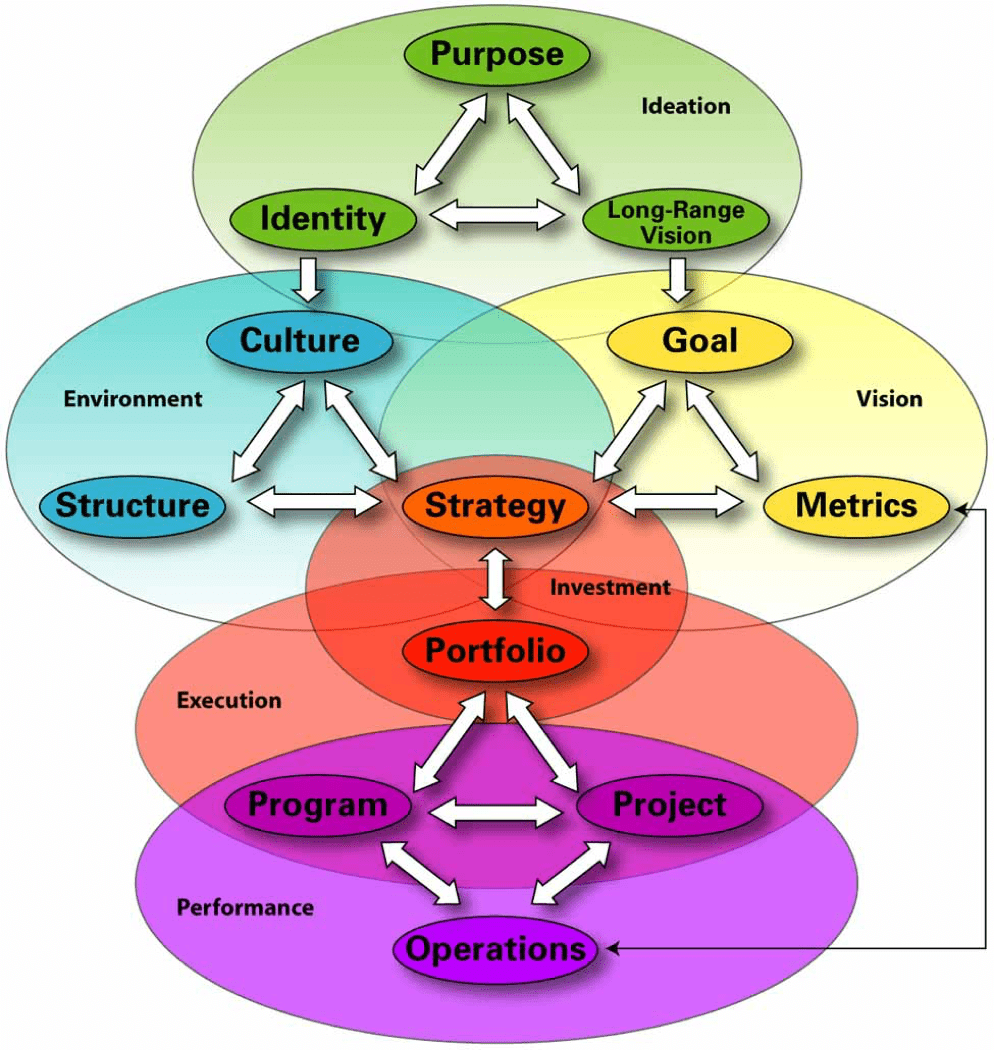
Strategy Execution Framework
They frame a strong argument for their six INVEST imperatives (or, domains). You will find their phases quite valuable when managing your own program portfolios:
- Ideation—communicating purpose, identity, and intent
- Nature—aligning strategy with culture and structure
- Vision—clarity of goals and metrics
- Engagement—portfolio management
- Synthesis—program and project execution
- Transition—benefit to mainstream operations
From an our selfish perspective, they highly recommend building a Center for Strategic Excellence. The Center would anchor itself upon effective, neutral facilitators and structured meeting design. We hope you are doing your best across your departments to nurture facilitative leadership around you, your staff, and your program office. Their INVEST approach will help.
______
Don’t ruin your career by hosting bad meetings. Sign up for a workshop or send this to someone who should. MGRUSH workshops focus on meeting design and practice. Each person practices tools, methods, and activities every day during the week. Therefore, while some call this immersion, we call it the road to building high-value facilitation skills.
by Facilitation Expert | Jul 4, 2013 | Communication Skills
We have learned during facilitated meetings and workshops, that it’s not easy for participants to respond to broad questions like “How do you solve global hunger?” While meaningful, the question’s scope is too broad (and perhaps vague) to stimulate specific, actionable (ie, SMART) responses like “We could convert eight abandoned mine shafts in Somalia to create temperature controlled food storage areas.” To improve group clarity, use the following.
Extemporaneous leaders have a tendency to transition during meetings with broad questions like, “Are we OK with this list?”, “Can we move on?”, or “Anything else?”. Facilitate with structure and precision by modifying your transitions with these three questions, adapted to your own situation:
- Do we need to clarify anything? (scrub for clarity)
- Do we need to delete anything? (scrub for relevancy or redundancy)
- Do we need to add anything to this list? (scrub for omissions)
The three detailed questions make it easier for meeting participants to analyze, agree, and move on.
______
Don’t ruin your career or reputation with bad meetings. Register for a workshop or forward this to someone who should. MGRUSH professional facilitation workshops focus on practice. Each participant thoroughly practices and rehearses tools, methods, and approaches throughout the week. While some call this immersion, we call it the road to building impactful facilitation skills.
Related articles
- Punctuation Precision, Humorously Proven by “Eats, Shoots & Leaves” (mgrush.com/blog)
- 40 Proven Questions to Determine and Mitigate Meeting or Workshop Risk (1 of 5) (mgrush.com/blog)
- You Can Effectively Facilitate a Group of People With These Three Principles (mgrush.com/blog)
- SCAMPER is a Mnemonic to Prompt for Excellent, Impromptu Questions (mgrush.com/blog)
by Facilitation Expert | Jun 27, 2013 | Communication Skills
Eats, Shoots and Leaves
Our bias about the importance of rhetorical precision has been discussed and emphasized in other blogs. Hard to believe it took us almost ten years to read Lynne Truss’s book, “Eats, Shoots and Leaves”. Her primary chapter topics include the use or abuse of apostrophes, commas, dashes, and other. To understand the title, note the implied humor that follows “A panda walks into a café . . .” Here are some of our favorite examples, copied dot for dot from the book, to prove the importance of a single dot of ink and how it could affect building consensus.
A woman, without her man, is nothing.
A woman: without her, man is nothing.
Or
“A re-formed rock band is quite different from a reformed one. Likewise, a long-standing friend is different from a long standing one. A cross-section of the public is quite different from a cross section of the public.”
Or
Is it extra-marital sex or extra marital sex?
Is it a pickled-herring merchant or a pickled herring merchant?
If you are sensitive to details, you will enjoy this book, light reading or reading under a light. As Joseph Robertson wrote in 1785,
“The art of punctuation is of infinite consequence in writing (NOTE: facilitative documenting); as it contributes to the perspicuity, and consequently to the beauty, of every composition.”
This is one self-help book that gives you permission to love punctuation.
______
Meetings must rise above the tiny opening of words and embrace the fullness of human insight—through listening, visuals, stories, numbers, and symbols. The transformation begins not in tools, but in mindset. Leave your ego at the threshold, and step into the structures of meetings that get results.
In a world where everyone can engage in decisions that affect them
______
Lead the Change—One Meeting at a Time
Are you ready to transform how decisions are made, problems are solved, and alignment is built in your organization?
True meeting leadership goes beyond setting an agenda. It requires a facilitator who can navigate complexity, balance voices, and drive toward outcomes with clarity and consensus. Our Professional Meeting Leadership Workshop and facilitation training equips you to do just that—blending human-centric methods with structured analytical tools to foster rigor, inclusivity, and results that stick.
- Practice live.
- Get expert feedback.
- Build confidence that lasts.
Whether your meetings suffer from unclear objectives, disengaged participants, or decision fatigue, this workshop will help you identify the root causes, apply proven facilitation techniques, and emerge as the leader every team needs.
Take the first step today—transform your meetings and magnify your impact.
______
👉 Click here to reserve your seat now.
#facilitationtraining #meetingdesign
Because every meeting should be a catalyst for change—not just another calendar event.
______
With Bookmarks no longer a feature in WordPress, we provide the following for your benefit and reference.
______
Related article
- Beguiling Grammar (writeatyourownrisk.wordpress.com)
by Facilitation Expert | May 16, 2013 | Analysis Methods
The MGRUSH meeting risk assessment method comes from answering a series of questions about a project, its stakeholders, and meeting participants. Our meeting risk assessment method is based on project risk assessment work completed by F. Warren McFarlan and James McKenney of Harvard Business School.
Meeting risk should be assessed for every major session. Use the MGRUSH Meeting Risk Assessment tool during your preparation activities.
What is Risk?
Risk derives from exposure to the following:
- Failure to achieve benefits
- Higher implementation costs
- Longer implementation time
- Performance that is less than expected
While risk is not “bad” — failure to manage risk becomes dangerous.
Meeting Risk Defined
Meeting risk appears at three layers:
Business — Project — Technique
- Business risk represents the exposure to an incomplete or late project.
- Project risk represents the likelihood of missing timelines, falling short of delivery standards, or grossly exceeding cost estimates.
- Technique risk represents the potential for major problems caused by a specific procedure or tool (ie, meeting design).
Meeting Risk Components
The Meeting Risk Assessment tool provides a method of measuring meeting risk using four vectors:
Size — Politics — Complexity — Diversity
. . . indicates the overall project size measured by effort, scope, and quantity of meetings and workshops. Project size affects planning and coordinating the required information needed to support the project. Questions cover work hours, duration, the number of sessions, the number of different types of sessions (i.e., how many different agendas are required), and whether you are located at high-level planning or detailed design in your life cycle. Therefore, the larger the project, the greater the potential risk when holding group meetings or sessions. Consequently, you need to know that size can be a significant driver of risk and thus structure your sessions appropriately (such as assigning a more experienced session leader or a team of session leaders).
. . . is an indication of the structure of the business and the volatility of the information required to support the deliverable. Therefore, it measures how difficult it will be to specify and organize the information exchange. Questions cover the newness of the topic, whether the solution is a replacement or new (i.e., evergreen), engineering or process complexity, the extent of changes required for both internal and external customers, environmental changes required, and acceptance of the methods. Because the more complex an existing system is or the newer a business is, the more difficult it is to specify its requirements. Complexity and newness often lead to incomplete or vague requirements. Consequently, adjustments may include building more thorough agendas or using prototyping for some of the needs and requirements gathering.
. . . is an indication of the political and personality climate of a project. Therefore, highly political groups tend to cloud the issues at hand and make sessions more difficult. Questions cover rating the attitudes of customers (internal or external), management, and participants; commitment of upper management; the level of controversy; past cooperation between customers and staff; the amount of flexibility allowed the participants; and stability of the organizations involved. Because highly political organizations or unstable organizations (i.e., numerous reorganizations) can make gathering requirements difficult (cutting through the ‘unknowns’) or short-lived (the participants won’t assume ownership when finished). Consequently, political risk is reduced by using the MGRUSH Professional Facilitation technique. The solution requires a politically savvy session leader and extensive planning to gain management commitment and proper resources.
-
Customer Organization (ie, heterogeneity)—
. . . is an indicator of the nature and familiarity of the organization. Furthermore, diversity looks at the participants’ ability to cooperate with each other and the logistics involved in getting everyone together. Questions cover the number of departments, the number of participants, the location of participants (geographical, domestic, and international), their prior experience working together (if any), and the knowledge of both the participants and the project team. Because, if an organization is cooperative and has few political axes to grind, yet is located around the country and the world, it will be more difficult to prepare for the sessions as well as to schedule everyone for the workshops. Consequently, it becomes expensive to bring people from many sites to one location—especially if the estimated workshop duration is incorrect. Therefore, this type of risk calls for a session leader who has experience with logistics and estimating meeting duration.
When To Assess
Assess meeting risk for every important session. Complete the assessment as part of your initial preparation. Then reassess meeting risk for each stage or phase gate meeting, decision review, or look-back. If meeting risk is not going down as you move through the project life cycle, your meetings may become trouble.
Mitigating Meeting Risk
Discovering that a meeting is high risk alone is insufficient. You must do something to manage the risk. Here are some tips:
High Complexity
- Have a speaker (not you) stimulate the participants with ideas to drive creativity and inspire innovation.
High Politics
- Develop consensus by building vision with leadership. Conduct a leadership workshop to write down the purpose, scope, objectives, and vision for the new business, product, or process.
Large Project
- Conduct four to five requirements gathering workshops. Then conduct a review with senior management to see what needs adjustment.
Diverse Organization
- Schedule numerous face-to-face visits or conference calls during your preparation.
Meeting Risk Factors Estimation
With Excel, we use 38 questions to assess risk which creates a score from 1 to 100 (high risk). Contact us for details and the scales for each question. We can also send you the risk analysis file to conduct your own calculations.
Project Size
Size factors measure the overall project size of effort, scope, and number of workshops. Therefore, helps determine risk due to the complexity of planning and coordinating large projects and the resources they consume.
1. Work Hours: Total work hours (1,000s) for the project?
2. Duration: What is the project’s duration?
3. Number Projects: Number of other projects supporting the program?
4. Dependency: Is there another project on which this project is likely or totally dependent?
5. Stakeholders: How many stakeholder types will use the new solution?
6. Workshop Quantity: Estimated number of workshops for the entire project?
7. Workshop Types: How many different types of workshops will be held?
8. Beginning Phase: In which phase are you starting?
Complexity
Complexity factors measure the structure of the business, its volatility, and requirements. Therefore, this measures how tough it will be to understand the requirements.
1. Project Type: The project may best be described as (i.e., a planning session), a replacement for a process or product, a change to an existing process or product, or a new process or product.
2. Replacement Percentage: What percentage of activities can be replaced on a one-to-one basis?
3. Project Complexity: From an engineering point of view, what is the degree of complexity of the project?
4. Changes: How severe are the changes with the project?
5. First Time: Are the proposed methods the first of the kind for the project team?
6. First for Business: Are the proposed methods the first of the kind for the business?
7. Business Acceptance: Will the business accept the new methods for developing the requirements?
8. Team Acceptance: Will the project team readily accept the new methods for developing the requirements?
9. New Technology: Is new or unfamiliar technology needed?
10. Success Dependent: Does the project’s success depend on new technology?
12. Outside Purchase: Are purchased or outside sources being used?
13. Vendor Support: How solid is vendor support with the outside purchases?
Political Factors
The political factors show the personality and climate around the project.
1. Business Attitude: What is the mindset of the business?
2. Management: How committed is upper management to the project?
3. Controversy: What is the level of controversy around the requirements?
4. Participant Level: What is the job level of the participants?
5. Cooperative Users: How cooperative are groups with each other?
6. Flexibility: The participants have how much flexibility in making the final decision?
7. Processing Flexibility: The participants have how much flexibility in making the process design?
8. Design Flexibility: The participants have how much flexibility during detailed design?
9. Stability: How stable is the organization?
Heterogeneity
The heterogeneity factors show the diversity and nature of the business. These factors look at the ability of the business to cooperate in coordinating all the stakeholders.
1. Number of Units: Number of departments (other than the project team) involved with the project?
2. Participants: Number of participants?
3. Locations: Number of geographical sites?
4. Multinational: What is the range of multinationals?
5. Prior Experience: Have the participants ever worked on a project together before?
6. Business Change: Must the business change to meet the requirements of the project solution?
7. Project Knowledge: How knowledgeable is the business in the area of the project process?
8. Business Knowledge: How knowledgeable are the subject matter experts in the process?
9. Team Knowledge: How knowledgeable is the project team about the solution?
Meeting Risk Summary
Of the four areas, Size and Politics provide the most concern, and then Complexity and Diversity.
Meeting Risk Assessment supports understanding the sources of risk. Contact MGRUSH for a quantitative Meeting Risk Assessment tool. We developed it in along with Dr. Howard Rubin (developer of ESTIMACS). Or, see your MGRUSH alumni links to access the EXCEL file that speeds up calculations and risk estimates.
______
Don’t ruin your career by hosting bad meetings. Sign up for a workshop or send this to someone who should. MGRUSH workshops focus on meeting design and practice. Each person practices tools, methods, and activities every day during the week. Therefore, while some call this immersion, we call it the road to building high-value facilitation skills.
by Facilitation Expert | May 2, 2013 | Meeting Tools, Problem Solving
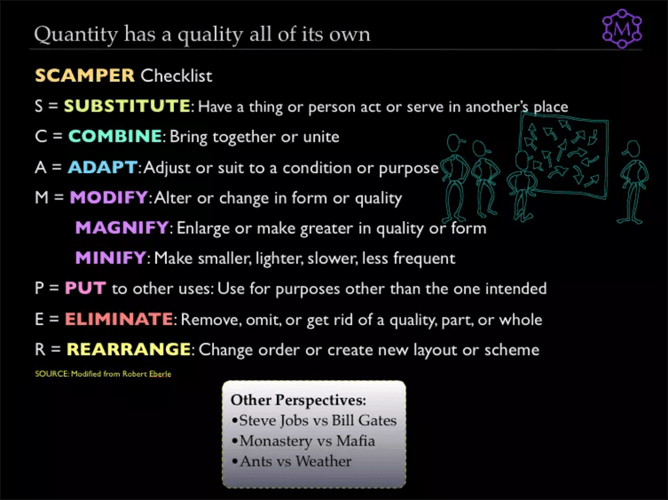
SCAMPER provides a ‘hip-pocket’ tool; i.e., an unplanned method of developing appropriate questions on an impromptu basis.
With SCAMPER, you may also take raw input (i.e., first-cut ideation lists) and challenge participants to calibrate their raw input into something closer to the form of the answer being sought. Use the questions prompted by SCAMPER to stimulate more ideas quickly. For example, “How might we combine ‘A’ and ‘B’?”
“The intellect has little to do on the road to discovery. There comes a leap in consciousness, call it intuition or what you will, and the solution comes to you and you don’t know how or why.”
— Albert Einstein
SCAMPER Method
SCAMPER is a Mnemonic Prompt
Select appropriate questions offered through the mnemonic known as SCAMPER and challenge some of the raw data or initial input to help the group build and understand additional options.
SCAMPER — Similar Perspectives
In addition to SCAMPER, consider changing perspective to capture new ideas. For example, assign analogies of famous people, organizations, or entropic situations. Ask—“What would (insert blank from below) do in this scenario?” Or, compare and contrast results through break-out groups, such as:
- Steve Jobs and Apple versus Bill Gates and Microsoft
- A monastery versus the mafia (organized crime)
- A university versus the military
- An ant kingdom versus the weather system (ecosystem), etc.
Nobody is smarter than everybody because groups create more options than individual ideas that are aggregated. SCAMPER or changing perspectives makes it easier to create new ideas during the meeting that did not exist prior to the meeting. Any group or individual is known to make higher quality decision when provided with more options.
______
Don’t ruin your career by hosting bad meetings. Sign up for a workshop or send this to someone who should. MGRUSH workshops focus on meeting design and practice. Each person practices tools, methods, and activities every day during the week. Therefore, while some call this immersion, we call it the road to building high-value facilitation skills.
by Facilitation Expert | Mar 21, 2013 | Planning Approach
It’s hard enough to get a family of four to agree on where to go out to eat much less getting a group of executives/ managers to agree on where they want to take their organization. To facilitate a vision for an organization—where it wants to go, appeal to both the head and the heart, supporting the question, “Why change?”
A clear vision statement of the future state helps to gain genuine commitment. Therefore, define vision first.
Defined: A vision is a desired position specified in sufficient detail so that an organization recognizes it when they reach it. A consensual vision provides direction and motivation for change.
Relationships
Facilitate vision to drive the objectives and define where the organization is going. A defined vision enables you to define key measures and more detailed objectives. Lay them out en route to ensure obtaining the vision.
Deliverable
When you facilitate vision, you create a clearly defined statement between 25 and 75 words in length.
Options
Use one of three methods:
- Define the vision statement by having your group use the Creativity Exercise (in MGRUSH Tools) to draw and illustrate where they are going. Have each breakout team describe their picture to the others and then capture an integrated vision statement, converting the pictures into narrative.
- Or, prepare a draft vision statement (frequently gathered from the senior manager of the group) and write it on a flip chart. Define a vision statement then review this with the group and have them modify it to meet their needs.
- Or, using the Temporal Shift tool below, have the group develop a newspaper or magazine headline that they would like to see in a major newspaper on the date of the vision—e.g., “What would the newspaper headline read on January 15, 20xx?” Next, have them embellish the headline with the story behind the headline. Hence, this headline and story support the vision.
TEMPORAL SHIFT TOOL
Purpose
Helps facilitate vision by getting groups to agree on where to go or be at some point in the future.
Rationale
Have you ever had a problem getting a group of friends or family to agree on where to go to eat? Now try to get a group of bright professionals to agree on where they are headed! It is much easier to ask and build consensus around “Where have you been?” or, “What type of legacy have you left behind?”
This step defines the specific vision of the organization—where it wants to go. Projects, initiatives, activities, and organizational effort are directed toward attaining the vision. Vision drives objectives and other key measures, not the other way around.
Method
Hand out recent copies of an appropriate industry organizational or trade magazine or periodical familiar to the participants. Turn them to a specific page (could be the front cover) or column that is frequently read. The Wall Street Journal could be a default publication that you use, but decide which section will display the headline based on the type of group you are working with.
Have each group develop a newspaper headline that they would like to read on the date of their vision—e.g., “What would the headline read on January 15, 20xx?” Have them embellish the headline with the 250-word story behind the headline.
Bring the groups together to compare and contrast. Work the Bookends looking for similarities and differences. First, convert the headline. The story items supporting the headlines can then be used to add detail to the vision.
NOTE: Pretend they are on a beach in the future and pick up this periodical, what you are really asking them is “What is the legacy you have left behind as a result of the effort at hand?” Establish the time in the future based on when this group has disbanded.
Suggestion
See the following website for headlines from around the world:
http://www.newseum.org/todaysfrontpages/ or
http://www.pressreader.com.
Timing
Facilitating vision typically takes from 30 minutes to two hours.
Closure
This step is complete when you have a statement (not necessarily grammatically pure) that the group believes captures the target or vision of where they want to go. Check with them to see if they can recognize the target defined by their vision and would agree if they get there.
Reply with any questions you might have by commenting below. For additional methodology and team-based meeting support for your change initiatives, refer to our store http://mgrush.com/shop/ or consider the book “Change or Die, a Business Process Improvement Manual” for much of the support you might need to lead more effective groups, teams, and meetings. Don’t forget to illustrate using your metaphor, as a metaphor is worth a thousand pictures.
______
In a world where everyone can engage in decisions that affect them
______
Lead the Change—One Meeting at a Time
Are you ready to transform how decisions are made, problems are solved, and alignment is built in your organization?
True meeting leadership goes beyond setting an agenda. It requires a facilitator who can navigate complexity, balance voices, and drive toward outcomes with clarity and consensus. Our Professional Meeting Leadership Workshop and facilitation training equips you to do just that—blending human-centric methods with structured analytical tools to foster rigor, inclusivity, and results that stick.
- Practice live.
- Get expert feedback.
- Build confidence that lasts.
Whether your meetings suffer from unclear objectives, disengaged participants, or decision fatigue, this workshop will help you identify the root causes, apply proven facilitation techniques, and emerge as the leader every team needs.
Take the first step today—transform your meetings and magnify your impact.
👉 Click here to reserve your seat now.
#facilitationtraining #meetingdesign
Because every meeting should be a catalyst for change—not just another calendar event.
______
With Bookmarks no longer a feature in WordPress, we provide the following for your benefit and reference.
______
by Facilitation Expert | Mar 7, 2013 | Meeting Agendas
Chairing meetings requires many of the skills to facilitate effectively
Success begins with vision and meeting vision comes alive by articulating the purpose, scope, and objectives in advance. Other considerations that support successful facilitating or chairing rely heavily on people skills such as:
Leadership when Chairing Meetings
- Ability to trust in the good nature of the human spirit, even in high-risk situations
- Accepting participants for what they are and not what you wish they were
- Capacity to approach people for their present value rather than past performance
- Embracing human nature that does not require approval or recognition
- Willingness to treat everyone, even casual acquaintances, with common courtesies and kindness
Flexibility when Chairing Meetings
Effective leaders when chairing meetings also remain flexible. Ironically, the best-prepared and fully structured plans afford the most freedom and flexibility because they provide a backup plan if ad hoc or spontaneous discussions prove fruitless. As emphasized in other posts, communicating clearly is important to any leader, facilitator, or chair. Beware of participant biases and tendencies including:
- Missing the context through which a claim may be valid
- Overgeneralization that causes lost or misinterpreted meaning
- Presumptions that everyone is thinking what the subject matter expert is thinking
- Primacy and recency effects—whereby the first and final arguments carry more weight
- Use of terms that are unclear or ambiguous
16 Tips When Chairing Meetings
Additionally, and specifically when chairing meetings, as opposed to workshop facilitators, here are seventeen additional and valuable tips:
- Always know your deliverable is the same as the meeting objective and logically identical to starting with the end in mind. In the world of Lean Sigma, this is called “right to left” thinking.
- Always strive to separate facts and evidence from beliefs and opinions.
- Arrive first and prepare your physical space for optimal seating arrangements.
- Clarify frequently so that everyone is offered an opportunity to question and challenge. They will find it easier to challenge you as chair, than the original speaker who may own the content.
- Consider posting the deliverable visually on a large sheet of paper, and restate periodically to reinforce the purpose of the meeting.
- Explain your role and aspiration to embrace the people and communication skills mentioned above.
- Help manage conflict and do not simply ignore it. Some of the best ideas and strongest solutions result from getting conflict out in the open where everyone can understand.
- Limit the size of the meeting by keeping representation between five and nine participants, known to be the “sweet spot” for optimal decision-making. The Agile mindset calls this seven, plus or minus two.
Additionally . . .
Manage housekeeping (administrivia) such as bathroom locations and safety procedures during your introduction.
- Manage transitions carefully by reviewing a closed agenda step and clearly moving on to the next open agenda step.
- Prepare, presell, and at the start of the meeting review the meeting purpose, scope, objectives, agenda, and estimated duration. Because participants should own the meeting output, they have a right to influence how the output is built.
- Protect your participants but realize that it is not your job to reach down their throat and pull it out of them. As employees or associates, they have a fiduciary responsibility to speak up when they can offer value.
- Remain impartial during arguments, or at least demonstrate the appearance of impartiality so that participants can arrive at their own conclusions.
- Restrict discussion to agenda items or you will subject yourself to scope creep within the meeting, and risk not getting done on time.
- Seek contributions from everyone but do not embarrass anyone by forcing them to speak.
- Start on time and police and breaks carefully as well. Do not penalize participants who are on time by starting late.
- Take breaks when necessary, likely more than traditional. A five-minute break every 40 minutes may be better than a fifteen-minute break every two hours.
______
Don’t ruin your career by hosting bad meetings. Sign up for a workshop or send this to someone who should. MGRUSH workshops focus on meeting design and practice. Each person practices tools, methods, and activities every day during the week. Therefore, while some call this immersion, we call it the road to building high-value facilitation skills.
by Facilitation Expert | Feb 14, 2013 | Meeting Agendas, Meeting Structure, Meeting Support, Meeting Tools
Effective meetings are first based on a clear line of sight to an end result, preferably something that can be documented.
Yet, frequently meeting purposes rely on determining WHAT deliverable or result to create. Consequently, using meeting time to determine the meeting output indicates unclear thinking and weak meeting design. Avoid wasting time by knowing your purpose in advance. The eight most common meeting purposes and benefits and problems include the following.
Eight Meeting Purposes
Analysis
- Highly complex situations may require multiple subject matter experts. Frequently, experts have their own vocabulary and a meeting helps to clarify understanding and agreement about terms and definitions. Have you ever run a meeting with Ph.D. engineers and creative marketing folks together? As a result, sometimes it sounds like they are from different planets. Carefully document operational definitions that arise during analysis sessions. You may discover people violently agreeing with each other. Unfortunately, they use different words to describe the same thing or define the same thing differently.
Assignments
- Structured meetings or workshops provide an excellent means of building agreement around roles and responsibilities. Furthermore, when using a structured method, you can leave the meeting with a consensually built GANTT chart, estimation of resource requirements, and approximation of budget needs. Because “WHO Does WHAT by WHEN” captures the primary reason behind a planning session, focus on the actions first before you make the assignments.
Decision-Making
- Since resources typically fall short of the demands, prioritization remains critical for high-performance groups. As a result, no teams possess the time or resources to do everything. Consensual understanding around prioritization provides a compelling reason for hosting a meeting or workshop. Since items that need to be prioritized range from the simple to the complicated through the complex, identify the most appropriate tool for prioritizing, before the meeting starts. Then, prepare a backup approach as well.
Idea Generation
- Because groups create more options than simply aggregating the input of participants, groups are smarter than the smartest person in the group. Many of the best ideas did not walk into the meeting because they were created during the meeting, based on stimulation provided by the input from others. Use SCAMPER or Changing Perspectives to drive more ideas, thus increasing your likelihood for applied creativity, innovation, or breakthrough.
Information Exchange
- By far and away the most common reason for meetings may also be the worst possible reason for justifying a meeting. With instant access and electronic filing cabinets, coming together face-to-face is a very expensive way to exchange information (albeit potentially quicker and less costly when conducted online). A better justification would be to address questions about clarity, agreement, and omissions of information that has already been exchanged. Alternatively, use meeting time to explore the impact the information might have on the plans and behavior of meeting participants and related stakeholders.
Inspiration and Fun
- Use meetings to reward, incentivize, and incite because they can be effective at motivating others. They are usually hosted on a large scale and include complimentary events or sessions that may advance learning and improve teamwork. Therefore, anticipate using breakout sessions by creatively preparing activities appropriate for your participants and the situational constraints. The quality of group output increases tremendously when you contrast and compare input from different teams. Plus, with breakout sessions, you are giving quieter people permission to speak freely. Participants afraid of speaking up in a group are less reticent to make contributions to the conversations that occur with a few people in a breakout session.
Persuasion
- Persuading and convincing others to agree with your argument or decision represents the worst possible reason for holding a meeting. Consider the three primary forms of persuasion, namely: identification (e.g., advertising), internalization (i.e., long-lasting), and forced compliance (i.e., “gun to the head”). Because meetings display ineffectiveness using any of the three primary forms of persuasion, they rarely succeed at convincing others. In fact, they can backfire. When the leader appears to have already made up their mind, participants wonder why they had to waste their time in a meeting. If you have the answer, tell them, and do not conduct a meeting. Meetings represent a highly expensive forum for information-sharing.
Relationships
- Simply bringing together people face-to-face provides the glue that pulls people together and gets them to work more cooperatively. Frequently venting, or managing conflict, results in increased effectiveness. When people don’t agree with each other and need to reconcile their points of view invest in face-to-face meetings. Arguments are rarely settled by text messages and PDF documents. Many times, conflict and arguments also require a referee, the perfect time to engage a facilitator.
Five compelling reasons to host facilitated sessions
Why host facilitated sessions? Making choices represents the most important actions people take every day, to decide. Properly made decisions amplify productivity. Choose wisely when to work alone, speak with another person, or call for a team meeting. The advantages of a structured meeting or workshop include:
Host Facilitated Sessions
- Higher quality results: Groups of people make higher quality decisions than the smartest person in the group. Facilitated sessions encourage the exchange of different points of view. Structure enables groups to identify new options. In fact, any person or group with more options at its disposal makes higher-quality decisions.
- Faster results: Facilitated sessions accelerate the capture of information. Faster output results when meeting participants (aka subject matter experts) arrive prepared. Participants arrive with an understanding of the questions and issues at hand.
- Richer results: By pooling skills and resources, diverse and heterogeneous groups develop more specific details and anticipate future demands, subsequently saving time and money in the project or program life-cycle.
- People stimulate people: Properly facilitated sessions lead to innovation and the catalyst for innovative opportunities because many perspectives generate a richer (360-degree) understanding of a problem or challenge, rather than a narrow, myopic view.
- Transfer of ownership: Facilitated sessions motivate further action by creating deliverables that support follow-up efforts. Professional facilitators use a method that builds commitment and support from the participants, rather than directing responsibility at the participants.
To Host Facilitated Sessions
Conducting facilitated sessions includes preparatory time, actual contact time during the session, and follow-up time as well. Therefore, successful sessions depend upon clearly defined roles, especially distinguishing between the role of facilitator and the role of methodologist (that are also discrete from the role of scribe or documenter, coordinator, etc.). To ensure getting done faster, carefully managed sessions embrace ground rules.
Thorough preparation and advance effort before the session ensures higher productivity:
- Researching both meeting design options and content to be explored
- Review and documentation of minutes, records, findings, and group decisions that affect the project being supported with this particular meeting or workshop session
- Completion of individual and small group assignments prior to sessions
Incite Involvement, Incent Ownership
Professional and structured facilitation generates high involvement among all participants. Therefore, appropriate terms for describing them include workshops or workouts. Consequently, avoid an overly ambitious agenda and plan for at least two, ten-minute breaks every four hours. Use our MGRUSH ten-minute timers to ensure that breaks do not extend to eleven or twelve minutes. Strive to provide dedicated resources, such as a facilitator professionally trained in structured methods.
Discourage unplanned interruptions, especially with phones and laptops. “Topless” meetings are increasingly popular, meaning no laptops or devices (e.g., smartphones). Allow exceptions for accessing content needed during the session. “No praying underneath the table” is another rule used to discourage people from using gadgets on their laps, presumably beyond the line of sight of others. In fact, everyone can see what they are doing anyway. For serious consensual challenges or multiple-day sessions, conduct sessions away from the participants’ everyday work site to minimize interruptions and everyday job distractions.
Chief Collaboration Officers
Granted, much of the material above becomes the responsibility of the facilitator. But if they won’t do it, you better. Remember, collaborative work replaces thousands of dollars lost in poorly run meetings. Harvard Business Review (HBR) states further that collaboration answers many of the business challenges. HBR encourages leaders to promote collaborative work and teamwork, and suggest . . .
“. . . we believe that the time may have come for organizations to hire chief collaboration officers.”
In a world where everyone can engage in decisions that affect them
______
Lead the Change—One Meeting at a Time
Are you ready to transform how decisions are made, problems are solved, and alignment is built in your organization?
True meeting leadership goes beyond setting an agenda. It requires a facilitator who can navigate complexity, balance voices, and drive toward outcomes with clarity and consensus. Our Professional Meeting Leadership Workshop and facilitation training equips you to do just that—blending human-centric methods with structured analytical tools to foster rigor, inclusivity, and results that stick.
- Practice live.
- Get expert feedback.
- Build confidence that lasts.
Whether your meetings suffer from unclear objectives, disengaged participants, or decision fatigue, this workshop will help you identify the root causes, apply proven facilitation techniques, and emerge as the leader every team needs.
Take the first step today—transform your meetings and magnify your impact.
👉 Click here to reserve your seat now.
#facilitationtraining #meetingdesign
Because every meeting should be a catalyst for change—not just another calendar event.
______
With Bookmarks no longer a feature in WordPress, we provide the following for your benefit and reference.
______
by Facilitation Expert | Feb 7, 2013 | Facilitation Skills
Without effective leadership, you can win the agenda but lose the meeting. Meeting competence demands that you take responsibility to prevent collective incompetence.
For example, do not allow ‘showboating’ and meetings within meetings. Additionally, consider the following suggestions to improve meeting competence.
Meeting Competence Considers . . .
Meeting Competence Derives from the Discipline
- Acronyms and BuzzWords—Create a visual legend for cryptic terms. Participants assume that others understand everything they say. We may not but we do need a facilitator to help validate acronyms and buzzwords.
- Competition—do not allow participants to play political games. Keep them focused on the deliverable of each question, agenda item, and meeting result.
- Different Agendas—Ensure participants that you know where you are and where you are going and do not permit competing agendas that cause scope creep and meetings that go out of control.
- Distractions—The guiding principle for every facilitator is to remove distractions so that the group can focus on the issue at hand. Distractions range from creature comfort (e.g., temperature) to cultural (e.g., electronic leashes such as smartphones).
- Impotent Members—Many meetings involve people who are brought in to observe, rather than contribute. If so, separate them physically by seating them in the back or around the perimeter.
- Miscommunications—listen, observe, clarify, and confirm. Need we say more?
- Outside Pressures—Get to know your participants and some of the issues that drive their thinking and behavior. Complete your assessment before the meeting begins. You cannot conduct personality profiling during a meeting and be an effective listener at the same time.
- Personal Feelings—As a neutral facilitator, depersonalize issues that arise and have others focus on performance, not the people.
- Triviality—Do not allow your participants to dive too deep into the weeds and talk about HOW when most discussions should focus on WHAT needs to be different. If strategic issues (i.e., WHY) arise, set them aside for a different forum.
Meeting Competence May Demand that Less is Better
With meetings, less can be more. Holding unnecessary meetings can undermine your reputation. Do not confuse or substitute meetings for work. As a meeting participant, never attend to yourself without knowing what you want to accomplish during the meeting and what you need to take out of it. As we say repeatedly and illustrate as the title of the MG RUSH meeting competence holarchy, know what “DONE” looks like. Your meeting competence will follow.
______
Don’t ruin your career by hosting bad meetings. Sign up for a workshop or send this to someone who should. MGRUSH workshops focus on meeting design and practice. Each person practices tools, methods, and activities every day during the week. Therefore, while some call this immersion, we call it the road to building high-value facilitation skills.
by Facilitation Expert | Jan 24, 2013 | Communication Skills, Decision Making, Facilitation Skills, Managing Conflict, Meeting Tools, Planning Approach, Problem Solving
First, here is the traditional Pros and Cons method according to its creator, Benjamin Franklin:
How to Facilitate Group or Team Decisions Using Pros and Cons
“For pros and cons, my way is to divide half a sheet of paper by a line into two columns; writing over the one pro, and over the other con; then during three or four days’ consideration, I put down under the different heads short hints of the different motives, that at different times occur to me. for or against the measure. When I have thus got them all together, in one view, I endeavor to estimate their respective weights; and, where I find two (one on each side) that seem equal, I strike them both out. If I find a reason pro equal to some two reasons con, I strike out the three.
He Continues . . .
If I judge some two reasons, con equal to three reasons pro, I strike out the five; and thus proceeding I find at length where the balance lies; and if, after a day or two of farther consideration, nothing new that is of importance occurs on either side, I come to a determination accordingly. Though the weight of reasons cannot be taken with the precision of algebraic quantities, yet, when each is thus considered separately and comparatively, and the whole lies before me, I think I can judge better and am less likely to make a rash step; and in fact I have found great advantage from this kind of equation, in what may be called moral or prudential algebra.”
Modern Franklin Pros and Cons
This updated Pros and Cons tool supports decision-making for a group of people. Use it as a proxy for Benjamin Franklin’s Pros and Cons method. His approach is better suited for an individual than a group of people. Especially with controversial issues, it is always helpful to consider multiple points of view.
Method for Modern Franklin Pros and Cons
To safely argue a controversial issue, carefully (and with advanced forethought about the options for either a homogeneous, heterogeneous, or hybrid blend of teams) separate your participants into three teams: Affirmative, Dismissive, and Observer. Give the affirmative and dismissive teams every fifteen minutes to develop their arguments, respectively supporting or refuting the issue. The observer team drafts criteria by which it may evaluate and assess the issue. Have the teams present their arguments to the observer team formally—as if it were a debate or court of law. Next . . .
- Affirmative and dismissive teams prepare for two-minute rebuttals to defend their positions.
- The observer team then describes the criteria they recommend using to help decide the issue, based on arguments presented by both affirmative and dismissive teams.
- Teams take another five minutes to revise their arguments based on observer criteria and the discussion sequence described above repeats.
- After round two, teams reform as one to discuss the issues. If the discussion reaches an impasse, switch members among different teams, carefully placing louder voices on the teams opposite of their apparent voice, so they are forced to represent the “other” side.
Do not intentionally polarize participants. Ensure that your teams comprise participants who hold a variety of views. As session leader (i.e., both facilitator and meeting designer), select the teams—do not allow the participants to choose. In most debates, the side one takes is not known until minutes before the debate, so that all debaters prepare to argue both sides of an issue.
Benefits for Modern Franklin Pros and Cons
The benefits realized include:
- Amplifies, expands, and stretches the issues, criteria, and perspectives.
- Allows the group to build an integrative view of all sides of the issue.
- Provides more robust and coherent arguments, issues, and criteria.
______
In a world where everyone can engage in decisions that affect them
______
Lead the Change—One Meeting at a Time
Are you ready to transform how decisions are made, problems are solved, and alignment is built in your organization?
True meeting leadership goes beyond setting an agenda. It requires a facilitator who can navigate complexity, balance voices, and drive toward outcomes with clarity and consensus. Our Professional Meeting Leadership Workshop and facilitation training equips you to do just that—blending human-centric methods with structured analytical tools to foster rigor, inclusivity, and results that stick.
- Practice live.
- Get expert feedback.
- Build confidence that lasts.
Whether your meetings suffer from unclear objectives, disengaged participants, or decision fatigue, this workshop will help you identify the root causes, apply proven facilitation techniques, and emerge as the leader every team needs.
Take the first step today—transform your meetings and magnify your impact.
👉 Click here to reserve your seat now.
#facilitationtraining #meetingdesign
Because every meeting should be a catalyst for change—not just another calendar event.
______
With Bookmarks no longer a feature in WordPress, we provide the following for your benefit and reference.
______
by Facilitation Expert | Jan 17, 2013 | Facilitation Skills, Meeting Support, Problem Solving
Facilitative leadership provides the best assurance that team leads/ project managers can overcome project pitfalls.
Borrowing from the PMBoK (i.e., Project Management Institute Body of Knowledge) and other published sources, the following are seven of the most common project pitfalls. Meeting leadership comments about each follow.
Using Facilitative Leadership
To Overcome Project Pitfalls
7 Project Pitfalls
- Abandonment of Planning
- Feature (Scope) Creep
- Omitting Necessary Tasks
- Overly Optimistic Schedule
- Suboptimal Requirements Definition
- Underestimating Testing
- Weak Team
Abandonment of Planning
Do not abandon your plan or the planning effort. No matter how proactive you are, some contributors will underperform, customers will request changes, and technical issues will prevent you from delivering some features on time. It’s not a question of “if” but “when”. As soon as you start to deviate from your plan, intelligently refactor, but stick to it. Never abandon your plan.
Feature (Scope) Creep
As time goes on, customers learn more about their needs and they come up with new features and ways of improving existing ones. Don’t let these changes throw your project plan out of control. Gather the feedback, analyze it, prioritize it, document it, and schedule the changes as mutually agreed upon. You’re not going to build the perfect product in one release. Deliver on your existing commitments, and try to facilitate a deeper understanding of many of the change requests. Omissions can be quite costly, so don’t immediately discount the value of understanding.
Omitting Necessary Tasks
A project schedule should not simply comprise the tasks required to develop product and process features. It should also include other derivative activities, such as interacting with customers, writing detailed functional specifications, and receiving technical training. Team-support activities cannot be skipped and therefore should not be ignored when baselining a project schedule.
Overly Optimistic Schedule
Meeting schedules should be aggressive, yet realistic. Demanding an overly optimistic schedule greatly reduces your chance of completing a project on time. Be aggressive with your plan, but remain realistic.
“Even particularly smart people in extremely high-performing situations will consistently underestimate how much time it takes to complete certain tasks.”—Daniel Kahneman, Nobel Prize
Suboptimal Requirements Definition
While showing illusionary progress, coding before requirements gathering actually delays project completion. Spending time early refining requirements can save weeks later on.
Underestimating Testing
Projects tend to underestimate how much effort is required to test a major release. As a rule of thumb, one-third of the entire project should be spent testing and fixing defects for major releases. A consensual understanding of test results and implications is key to stakeholder ownership.
Weak Team
Various resources claim that there is as much as a ten-to-one efficiency ratio between top performers and mediocre ones. Second-rate members contribute to project failures in many ways. They deliver late, do stuff that doesn’t support the project, and allow defects in their work that lack the level of quality deemed acceptable by you and other stakeholders. Select your team members carefully. At the end of the day, even the best project manager can’t succeed with a weak team.
______
Don’t ruin your career by hosting bad meetings. Sign up for a workshop or send this to someone who should. MGRUSH workshops focus on meeting design and practice. Each person practices tools, methods, and activities every day during the week. Therefore, while some call this immersion, we call it the road to building high-value facilitation skills.