by Facilitation Expert | Jan 10, 2013 | Facilitation Skills
Here are 15 quick tips to help you become a more successful facilitative leader.
- “The wisdom of the crowd” effect has long been recognized, but scientists have gone further by showing that the strategy works even when the crowd consists of one person (Scientific American Mind, pg 14, Oct-Nov 2008).

Fun Facts
- Brain research on Buddhist monks seems to indicate that “HOW” you think, not “WHAT” you think about, improves brain activity (The Futurist, pg 36, Sep-Oct 2007).
- Decision-making is important because making a decision signifies the beginning of an activity, and the value of consensus derives from harmonized activities.
-
Everest in Tibetan is Qomocangma (pronounced, CHO MOL UNG MA), and in Nepalese is Sagaratha.
- Extract more value from interactions: Companies have been automating or offshoring an increasing proportion of their production and manufacturing (transformational) activities and their clerical or simple rule-based (transactional) activities. As a result, a growing proportion of the labor force in developed economies engages primarily in work that involves negotiations and conversations, knowledge, judgment, and ad hoc collaboration—namely, tacit interactions.
- Facilitating through video or telepresence involves three considerations not found when facilitating audio-only meetings, namely:
a. Clothing; for example, stripes or patterned shirts are not recommended during a videoconference and may not display well at the remote site(s).
b. Plain-colored shirts and pants/skirts are optimal. Also, avoid wearing white and red.
c. Restrict movement as much as possible. Excessive movements are disruptive to viewers at the far site(s). Have a backup plan for your meeting or class in the event of connection failures or equipment problems.
-
Howard Gardner (Harvard University) has introduced two more types of innate intelligence, bringing his documented total to nine:
a. Existential Intelligence—Sensitivity and capacity to tackle deep questions about human existence, such as the meaning of life, why we die, and how we get here.
b. Naturalist Intelligence (“Nature Smart”)
- Instead of de Bono’s Thinking Hats approach, consider assigning people or groups to emulate other famous people (e.g.; Steve Jobs, Bill Gates, Mahatma Gandhi, Michelle Obama, etc.) or collections (e.g.; ant colonies, weather, monastery, mafia, etc) and ask the group—“How would this person or collection address the problem at hand?”
- Marking the 200th anniversary of the birth of Charles Darwin and the 150th anniversary of his seminal work on the theory of evolution, we are reminded NOT the strongest of the species survives, NOR the most intelligent; rather, “the one most responsive to change.”
-
Note the irony: “I’ll see it when I can believe it.”
- Parsimony: The Golden Rule is only 11 words
- Research shows that innovation won’t happen without a diverse workforce. So, don’t clone yourself.
- The only qualification for innovation is having been five years old. On average, a five-year-old laughs 100 times per day while the 44-year-old laughs only eleven times per day.
- The original Palm Pilot had only four features: tasks, calendar, contacts, and memos.
- The single most powerful word in negotiations is “HUH?” It says, “Tell me more”, without offering rejection or objection.
______
Don’t ruin your career by hosting bad meetings. Sign up for a workshop or send this to someone who should. MGRUSH workshops focus on meeting design and practice. Each person practices tools, methods, and activities every day during the week. Therefore, while some call this immersion, we call it the road to building high-value facilitation skills.
by Facilitation Expert | Jan 3, 2013 | Problem Solving
Through more robust planning and preparation, the facilitator and methodologist can do much to amplify the brainstorming tool. Here are five activities to help you. The Harper-Collins book “Brainsteering: A Better Approach to Breakthrough Ideas” written by the brothers Kevin and Shawn Coyne reinforces these five, highly practical considerations to facilitate effective innovation sessions.
Brainsteering
Develop Optimal Questions
If the deliverable is the marketing plan, you cannot ask, “What is included in the marketing plan?” The question is so broad as to be meaningless. Break it down. Mathematically, “Y” is a function of multiple “X”s and there are big “X”s and little “x”s. Draft, shape, and sharpen your questions in advance of the meeting, and then share them with your participants. Some of the big “X”s of a marketing plan include segmentation, targeting, positioning, messaging, media, etc.
The Coyne brothers emphasize that loosely managed sessions are inferior to approaches that provide more structure. Remember as well to sequence your questions. The target audience, for example, should be identified before discussing the messages to send. As consultants, we discovered that providing clients with answers is not as valuable as helping them focus on the optimal questions.
Select a Variety of Participants
If you want the same old answers, then clone yourself. If you want something new, then stir up the pot. Invite roles normally excluded such as customers who have terminated our services, employees who departed for other opportunities, or simply a diversity of departments and roles within your organization. Breakthrough ideas are dependent on “stirring up the pot.” Arm them with the questions in advance.
Lock in Your Analysis Method
Once ideas have been generated, they must be analyzed and frequently prioritized. Prepare yourself in advance (see MGRUSH ‘s Definition and Simple Prioritization tools). Any known constraints such as eliminating ideas that require regulatory approval need to be identified in advance. Do not permit a wasted session where the highly prioritized ideas are denied because they fail to comply with some internal standard or governance issue.
Break into Sub Teams
Encourage high-energy, no-discussion break-out sessions to generate lots of ideas quickly. This gives quiet people permission to speak freely and invigorates a group rather than keeping them locked down in a traditional meeting. We agree with the Coyne brothers that sub-teams sized from three to five people each provide an excellent forum for conversation and opportunity for breakthroughs. Appoint a CEO for each team (chief easel officer) and have them report back to the group at large when your analysis begins. (see How to Manage Breakout Sessions).
Police Your Sub Teams
Make sure they stay on topic and focus on the precise question(s). Do not allow them to drift and analyze their ideas. Rather, enforce their responsibility to make their ideas clear so that they can present their ideas with confidence. Instruct them on building a separate list of ideas worth capturing that do not answer the question precisely. We do not want to lose any good input, but we do not want to over-invest by spending time on the answers to questions other than those we want them to focus on.
The Coyne brothers fail at this point to advance the hardest step within Brainstorming, the analysis. Not surprisingly, this is where most leaders, groups, and methods are frail. Analysis is a major priority of our focus and curriculum. Continue to fortify your skill set with tools and improvement suggestions available with the hot links above.
______
Don’t ruin your career by hosting bad meetings. Sign up for a workshop or send this to someone who should. MGRUSH workshops focus on meeting design and practice. Each person practices tools, methods, and activities every day during the week. Therefore, while some call this immersion, we call it the road to building high-value facilitation skills.
- Are we brainstorming the wrong way? (holykaw.alltop.com)
- Generate Great Ideas by Connecting with Customers (seomoz.org)
by Facilitation Expert | Dec 27, 2012 | Meeting Agendas, Meeting Structure, Meeting Support, Meeting Tools
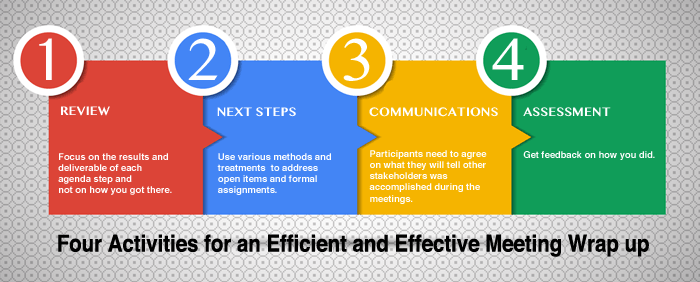
Daniel Pink’s book When: The Scientific Secrets of Perfect Timing stresses the importance of the meeting wrap-up. He calls it “ending on a high note.” Others refer to the power of the recency effect. Below find four critical activities needed to facilitate clear and actionable results during your meeting wrap-up. The result from many productive meetings can be summed up with four words: “WHO DOES WHAT & WHEN.“
#1-Review, #2-Next Steps, #3-Communications, and #4-Assessment.
Do not skip any of these four activities but expand and contract your treatment of them based on your situation and constraints.
For an Effective Meeting Wrap-up, End Your Meetings – Don’t Let Them Stop
Meeting Wrap-up #1 – Review
Do not relive the session, but do review the outputs, decisions, assignments, and so on. Focus on the results and deliverables from each Agenda Step, not on how you got there. Participants do not need a transcript. They need to be reminded about significant takeaways and offered the opportunity to ask for additional information or clarification before the session ends. Be prepared to use the Definition Tool to address uncertainties or disagreements about the meaning of something.
If possible and practical, use the documentation generated during the session to structure a quick walk-through. During the walk-through, include real-life examples for participants to see how well the deliverable performs. Next, assign responsibility to “Parking Lot” items (i.e., Open Issues) that remain valid and unresolved.
Meeting Wrap-up #2 – Next Steps
Two types of action items are developed during meetings: items within the scope and required to complete the deliverable and items out of scope but too important or opportunistic to disregard.
Assignments Within the Scope of the Deliverable
During the meeting, record open issues as they arise. Various terms describe open issues that develop during meetings, most frequently called a meeting parking lot.
Have your group list the action items that they have already agreed to or will undertake—starting tomorrow. List the items, clarify them, and have someone take responsibility. Assign a deadline (month, day, year) for a status update.
Consider applying the RASI tool (Transform Your Responsibility Matrix Into a GANTT Chart) to convert your action items into a project plan. Remember, absence or silence is unacceptable during assignments. Therefore, do not permit making assignments to someone who is not attending the meeting, either live or virtually.
Assignments Out of Scope of the Deliverable
Facilitate your meeting parking lot activity after you have completed closed issues and assigned other action items that are within the scope of the deliverable. Then, review each open issue. Make sure the open issue remains valid. Over the course of meetings, some open issues are no longer “open”. If so, delete them or mark them accordingly (e.g., OBE = Overcome by Event, or taken care of).
Standard Activities for Managing a Meeting Parking Lot
Append each open issue using the following sequence:
-
- The issue is more fully defined—a complete, coherent statement of description
- Note the single individual responsible for communicating back to the group on the status of the open issue (frequently viewed as who ‘will do’ or complete the open issue)
- Expected completion or progress update (month, day, year)
- How progress or completion will be communicated to your group of participants
- If follow-up requires a file, give the file a name to make future ‘searches’ easier
- Consider email size limitations, file naming conventions, and file-server security restrictions
Alternative Methods for Managing a Meeting Parking Lot
We call a simple method for managing meeting parking lot issues a “2 by 4.” Meant to connote a standard piece of lumber, the method suggests a quick, three-question approach—namely:
To – By – For to Manage Meeting Parking Lot
- To: Do what?
- By: Who and when?
- For: What purpose or benefit?
Steve Jobs, ex-CEO of Apple Inc., called this assignment activity essential, the heart of a meeting. He called the person assigned a specific task the DRI (“Directly Responsible Individual”). For each project, and every task in that project, he wanted someone accountable. Their congratulations or blame depended on how they did.
For complex open issues, or big hairy audacious goals (BHAG) that might constitute major or multiple new products or projects and cannot simply be assigned to someone, use the Content Management Tool. Use the output from this meeting (what) as input for a future meeting when the time, place, and people are available to conduct further analysis and make appropriate decisions or assignments. In that next meeting, begin with this open issue as input by asking “So what?” or “Why do we care?
Once the next steps and assignments are clear, your meeting is nearly over, except for . . .
Meeting Wrap-up #3 – Communications
Here you lead the participants to agree on what they will tell other stakeholders was accomplished during the meeting. Additionally, you get your group to agree on how it will communicate results to others.
At a minimum, team members need an “elevator speech” that can deliver an effective synopsis of the meeting results. At the other extreme, if the meeting is strategic, there could be numerous audience types such as the investment community, suppliers, trade personnel, etc. If so, identify the key audience members before discussing the message, medium of communication, and frequency of communication for each.
When it is important that it sounds like the participants attended the same meeting together, consider agreeing on the rhetoric used to describe the meeting. Typically, the two major audiences are:
- What do we tell our bosses or superiors?
- What do we tell people dependent on our results (i.e., stakeholders)?
Take a few moments to homogenize the rhetoric and help them agree on what they will tell people who ask. More importantly, agreement on what NOT to tell others. At a minimum consider two audiences and record the bullets or sound bites for each. Separately consider, for example, participants’ superiors and other stakeholders (e.g., peers or customers). See STOP! Were We Even In The Same Meeting? for detailed instructions.
If necessary, discuss HOW TO communicate with the target audience such as face-to-face, email, etc. For complicated communications plans, further, discuss frequency or how often to set up regular communications. It may be necessary to schedule the communications so that the superiors are informed before other stakeholders. Failing to plan suggests planning to fail. Meeting participants will use separate methods and discrete rhetoric that may generate different understandings among stakeholders who are expected to share similar understandings.
Meeting Wrap-up #4 – Assessment
Get feedback on how well you did and what you can do to be better. Set up or mark a whiteboard by the exit door and create two columns, typically PLUS and DELTA (ie, the Greek symbol ∆ or “change”) but also known as OFI (Opportunity for Improvement), “Benefits & Concerns” (also known as the “B’s & C’s”), “Star/Delta”, and Appreciative (+) or Opportunistic (-). Have each participant write down on a small Post-it® note, at least one thing they liked about the meeting (+) and one thing they would change (∆). Ask them to mount each note in its respective column as they exit.
Effective leaders will not let their meetings wrap up until participants have been offered a final opportunity to comment or question, action steps have been discussed, messaging has been agreed to, and feedback for continuous improvement has been solicited. Continue to fortify your skill set with additional tools and improvement suggestions available in our Facilitation Best Practices.
One way to stir things up in meetings would be to begin calling the Parking Lot a Meeting Refrigerator. Here is why.
Other terms used by organizations include Issue Bin, Coffee Pot, Water Cooler, Elevator Speech, Limbo, Chestnuts, Popcorn, and our favorite, Refrigerator. (Refrigerator reflects a term used in the Middle East because the items temporarily stored there can be preserved and cooked up later). Regardless of the term you use, open issues need to be managed properly rather than left unassigned as a list of items without context or assigned next steps.
Changing an organizational culture provides as many challenges as you can imagine, typical of mergers and acquisitions. Without some patience, time, and more patience, most efforts fail. Meanwhile, change itself faces so much resistance that it will not happen ‘overnight.’
We can however take little stabs at calibrating, modifying, and shifting behaviors. For example, calling the Parking Lot a Meeting Refrigerator. Eventually, change occurs once it hits an inflection point.
The term Parking Lot connotes a place of rest, where no progress is made, and stuff begins to rust. Sometimes, people forget or ignore items left in the parking lot. Therefore, they might rust or accumulate a lot of dust (or snow) before we manage them.
Place items in a Meeting Refrigerator (instead of a Parking Lot) to preserve and protect them. In addition, some things we take out of a Meeting Refrigerator can be re-cooked to provide an entire meal(s), where our business meals are frequently called projects. So call the ‘Parking Lot’ a Meeting Refrigerator because your open items are worth preserving and protecting, rather than ignoring.
______
In a world where everyone can engage in decisions that affect them
______
Lead the Change—One Meeting at a Time
Are you ready to transform how decisions are made, problems are solved, and alignment is built in your organization?
True meeting leadership goes beyond setting an agenda. It requires a facilitator who can navigate complexity, balance voices, and drive toward outcomes with clarity and consensus. Our Professional Meeting Leadership Workshop and facilitation training equips you to do just that—blending human-centric methods with structured analytical tools to foster rigor, inclusivity, and results that stick.
- Practice live.
- Get expert feedback.
- Build confidence that lasts.
Whether your meetings suffer from unclear objectives, disengaged participants, or decision fatigue, this workshop will help you identify the root causes, apply proven facilitation techniques, and emerge as the leader every team needs.
Take the first step today—transform your meetings and magnify your impact.
👉 Click here to reserve your seat now.
#facilitationtraining #meetingdesign
Because every meeting should be a catalyst for change—not just another calendar event.
______
With Bookmarks no longer a feature in WordPress, we provide the following for your benefit and reference.
______
by Facilitation Expert | Dec 6, 2012 | Leadership Skills
Leadership style depends largely on the flow of content: Directive—one-way, Consultative—equal partner in content, and Exploratory—facilitative, not adding content.
Directive
A leader who predominantly gives direction and guidance with little participation or content added by the group characterizes this leadership style. Directive leadership is appropriate when the purpose is to share information quickly and clearly, such as briefings, staff meetings, symposiums, etc.
Consultative
This leadership style is characterized by consulting with colleagues and subordinates in an open and respectful, not manipulative manner, during the meeting. Consultative leadership is appropriate when the purpose is to have the group make decisions with contributions and equal participation from the leader.
Exploratory
This pure and optimal facilitation style should be the predominant approach used for task-building and assignment meetings. In an exploratory approach, the leader is neutral in terms of contributing content to the meeting but is responsible for providing and managing the technique and agenda. In many task-related meetings, an outside facilitator is used to provide exploratory leadership while the business owner participates with a consultative leadership style.
No One Style
There is neither a single ‘right’ answer nor one right leadership style. The appropriate style is dependent on the particular type of meeting situation and the nature of the group. Leaders of teams that work well together can use the exploratory style more frequently. Leaders with contentious groups either need to be directive or employ a neutral facilitator for their meetings. Managing meetings is much like managing people—be flexible and use the most appropriate style depending on the situation.
Guidelines
Strolling and Smiling Makes You More Likable
The same skills are required to lead a meeting as are required to facilitate a meeting. Keep the following guidelines in mind, especially when leading:
- Plan and choose to use the most appropriate leadership style before you get into the meeting. For leading without facilitation, you will probably be either directive or consultative. If you are a facilitator, be consistent with being exploratory.
- Let the group know at the outset of the meeting which style of leadership you intend to use. They will respond positively if they know how to work with the style and role that you have chosen.
- If you are being consultative, use facilitation skills to get the group to participate as much as possible.
- Be aware of the influence you and your ideas have on the group. When you are not neutral, as when you are voicing an opinion about content, the members listen to your ideas. If they are dropping out, back off and become more exploratory.
- A good meeting leader may be a good facilitator with an opinion, but be careful. When leading content is appropriate, follow the guidelines above as well as general guidelines for managing people. Lead, but never continually remind the group that you are the leader.
Regardless of Style, Increase Your Leadership Likability By Strolling and Smiling More
Some of the best meeting designers are also capable of facilitating complex topics requiring much pre-thought and structure. However, sometimes they fall flat on the personality factor, coming off as dispassionate, aloof, or insensitive.
Most facilitators default in the other direction, they are typically warm and possess leadership likability but are frail when it comes to workshop breakdown structure and asking precise questions. It is frankly easier to teach a meeting designer or methodologist how to warm up to an audience than it is to teach people how to think—that is, how to think clearly. Simply start strolling and smiling more.
As most North Americans are afraid of public speaking, the worst thing they could do is hide behind a podium to protect themselves. The separation amplifies the ‘me’ versus ‘them’ space, causing them to become fearful and underperform. In the role of facilitator, soften the edges by integrating yourself. Do not speak AT the participants; rather have a conversation WITH the participants.
Strolling Helps
Increase Friendliness by Avoiding Podiums
Becoming conversational and more natural increases likability. One solution involves getting closer, measured in terms of physical proximity, to your participants. The easiest way to achieve closeness without violating personal space is to stroll closer to them.
When stuck in a small conference room with a big table or a huddle room with no perimeter, the strolling is difficult but can be managed by walking around the table, and around the room. The U-shaped seating arrangement however makes it much easier to stroll around, get closer to participants, and therefore be more conversational.
Use your space wisely. If participants are vibrant and need a documenter, then stay at the easel as a scribe, while their energy remains high. But when uncertainty or disagreement arises, begin to slowly step forward to make it easier to demonstrate active listening, and to display a sense of respect and importance toward the participant who is speaking.
In the case of an argument, make sure that evidence and claims to support the participants’ positions go through you, and not around you. There is probably no better time to be in the middle of the U-shaped seating environment than when participants are arguing. They need a referee, and serving as a referee is part of the role of facilitator.
Smiling Helps More
The two universally accepted non-verbal gestures are open hands and smiling. Open hands signify culturally that you have no weapons and will not harm the participants. Open hands are far more welcoming than the opposite, pointing.
Smiling is also accepted throughout all cultures. A genuine, smile is found appealing and increases the likeliness that your participants will warm up to you. We must be careful however not to smile too much, inappropriately, or to laugh too loud.
Please smile occasionally, even with serious topics. If the facilitator remains too stern and sober, the participants will tense up, reducing the likelihood of collaboration and innovative thinking. If you need further help to learn to smile, practice. Use your introduction material to practice and ask a co-worker or family member to observe and comment on the appropriate timing for a warm smile.
______
Don’t ruin your career by hosting bad meetings. Sign up for a workshop or send this to someone who should. MGRUSH workshops focus on meeting design and practice. Each person practices tools, methods, and activities every day during the week. Therefore, while some call this immersion, we call it the road to building high-value facilitation skills.
Related articles
- When To Get All Bossypants (inc.com)
- Every Leader Is an Artist (blogs.hbr.org)
by Facilitation Expert | Nov 29, 2012 | Meeting Support
While there are three primary types of business meetings: information-sharing, instructional or directional task-related meetings, and facilitated or developed task-related meetings, an effective leader must closely manage the meeting boundaries to prevent scope creep and get done on time.
Information-Sharing Meetings
Control Meeting Boundaries
Information-sharing meetings primarily capture one-way communication with the information presented by the speaker to the group. Furthermore, this type of meeting includes symposiums, instructional groups, staff meetings, and other presentations that attempt to communicate essential information to a group. Interaction from participants with the meeting leader normally gets limited to questions and comments.
Task-Related Meetings
Task-related meetings use the knowledge and experience of group members to accomplish a work task, such as problem-solving, decision-making, fact-finding, planning, etc. These meetings are highly interactive and involve two-way communication between all participants. Task-related meetings also tend to fall apart more quickly with poor meeting management. The two differences include:
- Directed—the leader runs the meeting and controls the agenda. These are the most common types of meetings.
- Facilitated—an impartial facilitator runs the meeting and controls the agenda and technique. These are the least common but are growing in use, as they are the most effective for decision-making and building consensus.
The Model Meeting
To effectively manage a meeting, a meeting leader must pay attention to the dynamics of the group. Having a model to work from helps the leader understand the group’s behavior to keep meeting dynamics in balance. This enables the leader to sort problems from non-problems and respond appropriately.
Why a Model?
Looking back on the list of the 14 most frequently mentioned problems in meetings (see “Some of the Challenges and Costs Associated with Hosting Meetings”), we can attribute all of them to one primary cause; a lack of structure. If this sounds like an oversimplification, it is, but only partially. You may be asking yourself, “If structure has been the only problem with meetings, why are meetings in corporate America a waste of money?” It seems like unstructured meetings are the effect of meeting dementia. Take a closer look at the components of the model meeting.
Meeting Boundaries
Meeting boundaries provide the limits or scope, which separate the meeting and its components from the external environment. Clear and unbroken boundaries are essential to good meeting management. It is the meeting leader’s responsibility to keep the boundaries from being violated (broken) resulting in a breakdown in structure. Therefore, consider both types of meeting boundaries:
- Time boundaries
- Physical boundaries
Time Boundaries
Time boundaries govern the start time and stop time of the overall meeting, as well as the length of the meeting. Meetings starting late seem to be an accepted norm. All meetings should start at their scheduled time and not exceed the stop time.
Barring a major catastrophe, every meeting must start precisely on time. Meetings that start late are in trouble right from the start. The delay starts to send a message to the participant that degrades the perceived importance of the meeting. The meeting is taken less seriously and sets the stage for additional boundary violations.
If the meeting begins late because the leader is not ready, he or she loses credibility which is hard to recover. Meetings that start late because the leader is waiting for latecomers are just as bad. This communicates positive reinforcement to the latecomers, while negatively reinforcing those that came on time.
Running overtime must be avoided at all costs. In cases where the discussion is crucial, continue only after obtaining consensus from the group. Otherwise, summarize and reschedule another meeting to conclude the discussion.
How many meetings extend beyond their useful length? The meeting duration should never exceed 45 to 50 minutes unless it is a facilitated workshop. By setting up your meetings for 45 or 50-minute increments, you provide a courtesy to the participants, affording them time to refresh between meetings.
Meetings more than one hour long take too much energy and have the opportunity to drag. Workshops, properly facilitated, can last for a number of days, but the rationale for the extended duration generates a deliverable. Standard meetings taking longer than one hour should be broken into multiple sessions of fifty minutes.
Physical Boundaries
Physical boundaries separate the meeting space from the rest of the outside world. The physical environment impacts the psychological environment. Most noteworthy, studies show that a formal atmosphere inhibits the mood of both groups and individuals. The best meeting results occur when people feel comfortable. When informality balances with focus on the work task. Psychologists refer to this as a state of “relaxed concentration”. The meeting leader’s responsibility ensures that proper physical boundaries are established and maintained.
______
Meetings must rise above the tiny opening of words and embrace the fullness of human insight—through listening, visuals, stories, numbers, and symbols. The transformation begins not with tools, but in mindset. Leave your ego at the threshold, and step into the structures of meetings that get results.
In a world where everyone can engage in decisions that affect them
______
Lead the Change—One Meeting at a Time
Are you ready to transform how decisions are made, problems are solved, and alignment is built in your organization?
True meeting leadership goes beyond setting an agenda. It requires a facilitator who can navigate complexity, balance voices, and drive toward outcomes with clarity and consensus. Our Professional Meeting Leadership Workshop and facilitation training equips you to do just that—blending human-centric methods with structured analytical tools to foster rigor, inclusivity, and results that stick.
- Practice live.
- Get expert feedback.
- Build confidence that lasts.
Whether your meetings suffer from unclear objectives, disengaged participants, or decision fatigue, this workshop will help you identify the root causes, apply proven facilitation techniques, and emerge as the leader every team needs.
Take the first step today—transform your meetings and magnify your impact.
______
👉 Click here to reserve your seat now.
#facilitationtraining #meetingdesign
Because every meeting should be a catalyst for change—not just another calendar event.
With Bookmarks no longer a feature in WordPress, we provide the following for your benefit and reference.
______
Related articles
- Mission or Vision – What is the Difference? (mgrush.com/blog)
- Facilitating Crucial Conversations (mgrush.com/blog)
- How to Design Culture: 16 Patterns to Build Adaptive Learning Organizations (emergentbydesign.com)
by Facilitation Expert | Nov 22, 2012 | Managing Conflict
Amazingly, talented people who care can come together and yet fail demonstrably in a ‘meeting.’
Meetings fail because the participants do not know HOW TO succeed. Meeting challenges include anything that takes the energy from meetings. To deal with low energy, first understand the causes of meeting challenges.
Chaos
Without Structure
To contend with difficulties, take a closer look at how a normal business meeting processes information. Like all other forms of energy, unless you harness and manage meetings within a structured environment, chaos will result. The structure takes the creative energy generated in a group and converts it into something productive. The creative energy available to any group comes as ideas and information. When information and ideas are processed in business meetings, it is usually done without adequate structure.
Information Problems
Meeting Challenges
The following information processing problems occur because of unstructured meetings:
- Disruptive interruptus—limits the continuity of the group’s ideas.
- Inconclusive progressions—moving on to another topic and not adequately concluding or summarizing the previous topic.
- Information queuing—mentally storing comments while waiting for an opportunity to speak. When the time comes, the timing is inappropriate and the discussion gets derailed.
- Mixing abstractions—two people talking at different perspectives and levels of detail, different wavelengths, or different levels of resolution.
- Solution jumping—prematurely discussing solutions before the problem has been adequately defined.
- Topic jumping—inappropriately changing the topic. (In the average unstructured meeting, groups change topics every minute and a half.)
Complicating Factors
Complicating even further are the tactics used by meeting leaders to deal with information-processing problems. Three common and unsuccessful approaches:
- Heavy-handed control—overreaction that results in the inhibition of creativity and analysis.
- Symposium style—speaking one at a time in sequence. Eliminates the advantage of spontaneous interaction.
- Withdrawal—results in no direction at all.
Decision Problems
Decisions are made generally by:
- Default (that’s the way they wanted it anyway)
- Dominance (the squeaky wheel syndrome)
- Groupthink (no one disagrees or questions the decision because all assume someone—usually a strong leader—has the right answer. This is one of the explanations for the “Bay of Pigs” incident—no one argued with the decision).
- Sheer exhaustion (we give up—do what you want)
Decision Styles
In response to the problems of decision-making, some leaders have adopted tactics such as:
- Authoritarian (good control and quick, but is often wrong and creates low morale)
- Consensus (encourages participation/ unanimity, but is slow without someone to facilitate it through discipline and structure)
- Majority rules (very democratic and participative, but allows tyranny of the majority and is slow)
- Minority rules (permits persuasion, but creates political resentment)
Underdevelopment
Remember, while the number of meetings is growing, the mismanagement of meetings is costing a substantial amount of money each year. Wasted time equals wasted resources. Meeting leadership is an underdeveloped management skill, but it can be learned.
Meeting Types
There are as many types of meetings as there are meeting leaders. Most meetings, however, fall into three general categories:
- Information sharing meetings
- Task-related meetings—directed or instructional
- Task-related meetings—facilitated or developed
Loss of Creative
Energy
Session leaders typically use more than 60 percent of the communication time available in a meeting, leaving at most 40 percent of the talk time for participants, or 24 minutes in a one-hour meeting. Unequal distribution means much of the creative energy located within the group is not being tapped, decreasing the productivity of the meeting. Hence, it’s no wonder meetings fail because of low energy.
______
Don’t ruin your career by hosting bad meetings. Sign up for a workshop or send this to someone who should. MGRUSH workshops focus on meeting design and practice. Each person practices tools, methods, and activities every day during the week. Therefore, while some call this immersion, we call it the road to building high-value facilitation skills.
Related articles
- 3 Ways to Keep Meetings Short (Every Time) (inc.com)
- How to Design Culture: 16 Patterns to Build Adaptive Learning Organizations (emergentbydesign.com)
by Facilitation Expert | Nov 15, 2012 | Meeting Support
Meetings are frequently a fix for poor leadership. Most would rather go to a movie than sit in a two-hour meeting. Almost all poor movies at least contain a beginning, middle, and end. Indirect meeting costs represent a huge area for cost control and improved return on investment.
Meetings are very expensive. Today’s business world is asymmetric, and holding meetings to share information may be a poor use of precious resources. Dashboard devices provide a better means for information updates than staff meetings. The Scrum approach addresses three questions during daily Scrums, but participants frequently remain standing so that meetings adjourn quickly:
- What has been accomplished since we last met?
- What accomplishments are targeted next?
- Which challenges require additional support?
Indirect Meeting Costs and Challenges
The best reason to pull people together is to build something that we cannot do apart, to arrive at consensus, to decide on something. Consider replacing weekly meetings with periodic workshops, knowing that the use of facilitators greatly improves productivity.
Role of Meetings
We live in a meeting society. Along with billions of people, our world also contains more than 200 nation-states, 4 million local communities, 20 million economic organizations, 200 million extended families, and hundreds of millions of other formal and informal groups. In order for groups to exist, individuals that make up these groups must meet and interact.
Current Trends
The increased growth in the number and length of meetings is due to the accelerated rate of change that now rules today’s business environment. The rapid and constant change in technology, particularly information technology and business process management, has dramatically increased the volatility of the global marketplace. As technology takes over more routine functions and allows faster access to data, managerial skills shift, calling for increased communication clarity and small group skills.
Flatter Structures
Another trend emerging as a result of an accelerated environment is the growth of more efficient and flatter organizational structures. These organizations have fewer management layers and, therefore fewer levels of decision-making. Flatter structures result in more group decision-making by specialists from disparate areas within the organization. Consequently, the ability to effectively communicate cross-functional support in meetings has taken on increased importance.
Participative
Management
A by-product of replacing hierarchy with holarchy is an increasing emphasis on participative employee ownership. Participative management bases itself on the following premises:
- The quality of decisions is improved if all employee expertise is considered, and
- The act of employee participation leads to better acceptance of the decisions.
50 Percent Productive
Studies have estimated that meetings are at most 50 percent productive. Thus the typical manager wastes approximately 240 hours per year (about 30 days) at a cost to the average Fortune 500 Company of greater than one hundred billion USD per year. By using proper meeting management, a single company could recover 25 to 35 percent of these costs or hundreds of millions per year.
Intangible Costs
The intangible costs associated with poor meeting management are overlooked at all levels of management. Meetings serve as opportunities for senior management to appraise and search out potential leaders within an organization. As lower-level managers take on more responsibilities, they spend more of their time in meetings with executives at higher levels. Consequently, their success as executives is tied to their ability to make the most out of their meeting time.
Psychological Costs
Participating in a poorly run meeting is frustrating, resulting in apathy, resentment, and a lack of commitment toward the meeting’s outcome. This attitude carries over to the workplace. Therefore, in many cases, subverting good ideas that come from the meetings.
Meeting Dementia
People and organizations have developed “meeting dementia because poorly run meetings have been around for so long and remain prevalent. Some view poorly run and unproductive meetings as the norm, and that’s just the way it is. This viewpoint seems to have been inherited by observing others who have led poorly run meetings, who in turn learned from others making the same mistakes, and so on.
Indirect Meeting Costs and Challenges
The major problems with meetings, surprisingly, don’t have to do with personalities or the inability of group members to get along with one another. Almost all problems are typically task-related—i.e., people do not know the mechanics of HOW TO lead effective meetings. The following list highlights 14 of the most frequently mentioned problems by over 1,000 managers:
- Getting off subject
- No goals or agenda
- Too long
- Poor preparation
- Inconclusive
- Disorganized
- Ineffective leader/ lack of control
- Irrelevant information discussed
- Time wasted
- Started late
- Ineffective for making decisions
- Interruptions (inside and out)
- Dominators
- Rambling discussion
Meetings must rise above the tiny opening of words and embrace the fullness of human insight—through listening, visuals, stories, numbers, and symbols. The transformation begins not with tools, but in mindset. Leave your ego at the threshold, and step into the structures of meetings that get results.
In a world where everyone can engage in decisions that affect them
______
Lead the Change—One Meeting at a Time
Are you ready to transform how decisions are made, problems are solved, and alignment is built in your organization?
True meeting leadership goes beyond setting an agenda. It requires a facilitator who can navigate complexity, balance voices, and drive toward outcomes with clarity and consensus. Our Professional Meeting Leadership Workshop and facilitation training equips you to do just that—blending human-centric methods with structured analytical tools to foster rigor, inclusivity, and results that stick.
- Practice live.
- Get expert feedback.
- Build confidence that lasts.
Whether your meetings suffer from unclear objectives, disengaged participants, or decision fatigue, this workshop will help you identify the root causes, apply proven facilitation techniques, and emerge as the leader every team needs.
Take the first step today—transform your meetings and magnify your impact.
______
👉 Click here to reserve your seat now.
#facilitationtraining #meetingdesign
Because every meeting should be a catalyst for change—not just another calendar event.
______
With Bookmarks no longer a feature in WordPress, we provide the following for your benefit and reference.
______
by Facilitation Expert | Nov 8, 2012 | Meeting Support
The National Speakers’ Association stated that the most important change speakers could make to be more effective would be to be more facilitative.
By that, they meant the use of interaction, solicitation, and capture of participants’ ideas. Whether you are a speaker, teacher, coach, or traditional facilitator, it is good to develop competence around how to use easels, large Post-It® paper, and broad chiseled markers. Here are some tips for you or your documentor. The paper continues to offer superior benefits to digital capture because most complex issues cannot be fully rendered or understood with one screen of bulleted items. Additionally, if it is not documented, it did not happen.
“Never use computer applications for something that you do not understand and cannot first do yourself.”
—Francis Webster Jr
Begin with good materials and supplies. Few things will frustrate an expert facilitator more than cheap paper and poor-quality easels. Most will carry their own, preferred markers. Large, Post-It style presentation sheets provide immediate and visual feedback to participants. Working with paper makes it faster to edit and refer to work that was drafted or completed earlier.
When you use easels and large-format paper, consider the following tips:
- Anticipate where you will mount your sheets. Be sensitive about everyone’s sight lines. Save your prime, center real estate for scrubbing and scoring ideas during each agenda step.
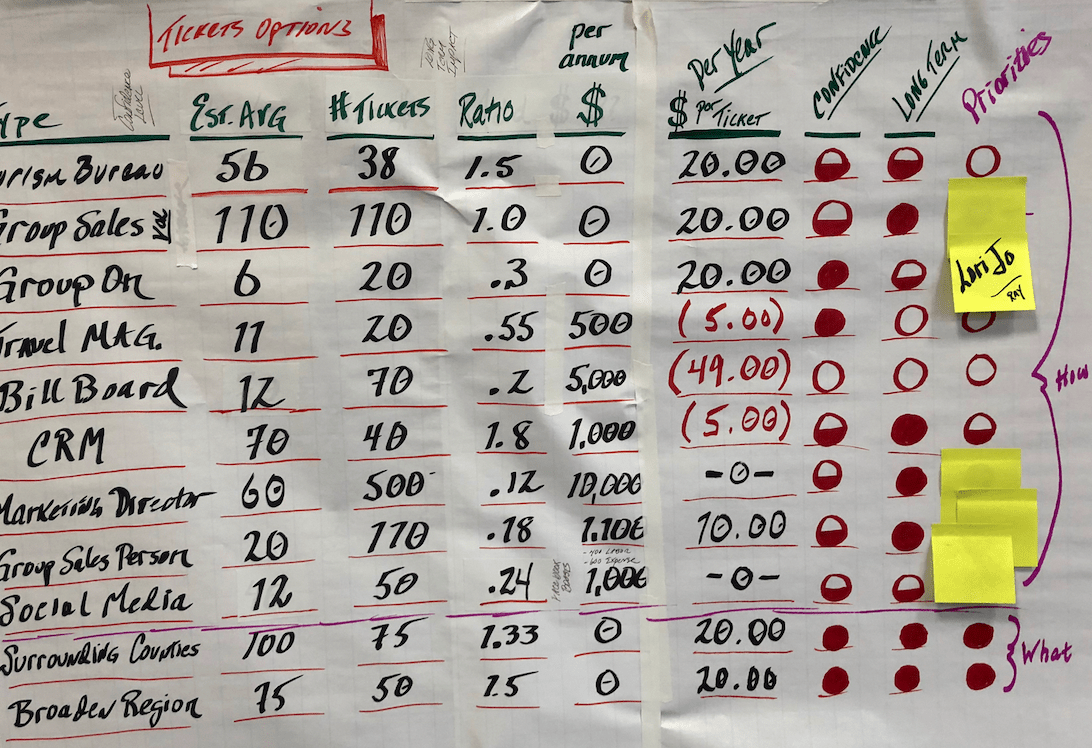
- Banners or headlines provide an excellent opportunity for iconic support and color splash. Create them in advance. Then unveiled, they connote a strong sense of preparation and importance.
Easel Sample
- Experts suggest using a minimum of three colors per sheet. Only use black or dark blue for primary content. Use red for edits and scoring, and use green for linking, or edits (shows chronological shift). Use lighter colors for grid lines, table lines, or illustrations.
- Pre-drawn illustrations (in pencil or light marker) enable you to draw over thin lines with broad markers in the session as needed.
- Rip, do not flip, completed pages. Participants need to see their prior work and a bunch of flipped sticky pages get caught up in a clump that is difficult to disentangle.
Additionally when you use easels . . .
- Save valuable real estate along the left-hand column, defaulting to hyphens of indented items that may be further defined or scored during the analysis step with a prioritization tool.
- Use flip chart graph paper with blueline squares to keep the size of your writing consistent. Try out the size of the letters before the session to see if the person farthest away can read them. Capital letters should be two to three inches tall and lowercase letters should be one to two inches in height.
- Visual displays whether illustrative, iconic, or colorful prove to stimulate participants and increase the quality of contributions and feedback.
- Wedge tip markers work best for writing and pointed tip markers provide good highlights. Use the broad side or flat edge of the wedge tip so that your writing is visible from six to eight meters.
- You may speed up the capture process during the ideation step of Brainstorming by using two scribes (i.e., documentors). Work this out in advance, and if relying on a participant for help, give him or her some time at the end to add his or her own ideas.
Other Support
For additional and specific product recommendations, see your FAST Session Leader reference manual or refer to the Alumni Only resource section of our website. Specifically, the document entitled Facilitator’s Tool Kit lists many of the items that can be used to support more effective facilitation through the use of easels.
“The problem with digitizing brainstorming is that we don’t need to save what we brainstorm . . . The critical thing is the conclusion . . . The slick brainstorming capture tools . . . Will probably not be as successful as hoped. There are significant differences among collecting and processing and organizing and different tools are usually required for them.” [pg 271] — David Allen, Getting Things Done
______
Don’t ruin your career by hosting bad meetings. Sign up for a workshop or send this to someone who should. MGRUSH workshops focus on meeting design and practice. Each person practices tools, methods, and activities every day during the week. Therefore, while some call this immersion, we call it the road to building high-value facilitation skills.
by Facilitation Expert | Oct 25, 2012 | Communication Skills
The effective facilitator helps meeting participants become better listeners. Dr. Ralph Nichols, “Father of the Field of Listening”, notes three behaviors that perfectly align with the roles of facilitator, and your hope to be more effective, that create better listeners during meetings.
First of all, anticipate the speaker’s next point
.
As a facilitator, your anticipation helps shape your direction. For example, should you walk closer to the speaker or to the easel to capture their comments? Therefore, if you anticipate correctly, learning has been reinforced. If you anticipate incorrectly, participants wonder why, causing unnecessary noise.
Another is to identify the supporting elements a speaker uses in building points.
The primary role of the facilitator is to make it easy to extract the participants’ points of view. Then, ensure that the supporting reasons are captured and recorded, preferably on an easel, screen, or whiteboard so that all the meeting participants can view the same information.
Build understanding among your participants by seeking the reasons and evidence supporting their thoughts. Or, as we say in the MGRUSH curriculum, “Make Your Thinking Visible.” Typically speakers rely on three methods to convince others:
Better Listening
- They explain the point,
- Speakers get emotional and harangue the point, or
- They illustrate the point with a factual illustration.
A sophisticated listener knows this.
He or she spends a little time identifying the difference between thought speed and speaking speed to identify the evidence being used to support any claims. Consequently, listening behavior becomes highly profitable if measured by communication efficiency.
A third way that improves the listening skills of your participants make summaries of the main evidence and examples. Good listeners take advantage of short pauses to summarize and absorb support for participants’ claims. Periodic summaries reinforce learning tremendously.
Most of us listen poorly for a variety of reasons. First, we have not been trained and few training opportunities exist (although the MGRUSH Professional Facilitative Leadership workshop offers a significant exception). We think faster than others speak. Plus, listening represents hard work and requires complete concentration. While it remains a challenge to be a good listener, good listeners get big rewards.
______
Don’t ruin your career by hosting bad meetings. Sign up for a workshop or send this to someone who should. MGRUSH workshops focus on meeting design and practice. Each person practices tools, methods, and activities every day during the week. Therefore, while some call this immersion, we call it the road to building high-value facilitation skills.
by Facilitation Expert | Oct 18, 2012 | Meeting Support
You must consider these three questions before you take on the role of session leader for any meeting or workshop.
Prompted by “Three (Incredibly Simple) Questions The Most Successful People Use To Change The World,” Forbes contributor Mike Maddock published an article that could have been cut and pasted (figuratively) from the MG RUSH Facilitation Reference manual. Indeed, to lead a successful meeting, these three questions (slightly modified) should be considered for every meeting or workshop before the meeting begins, especially when you are the session leader.
Before the Meeting You Must Know — What is the deliverable?
(Forbes: What’s the outcome I want?)
Three Questions Before Meetings
Start with the end in mind. What does DONE look like? Where are you going? How do you know when you get there? For meetings, our focus is clearly on output (i.e., a thing) rather than outcome (ie, a new condition) since we are typically unable to generate new outcomes before the meeting ends. We can however create the input required to catalyze new outcomes, and that is the purpose of the meeting.
#2 You Should Know — What are the problems and challenges I foresee?
(Forbes: What stands in my way?)
Emphasizing the importance of thorough preparation and interviewing your participants in advance, your preparatory time should be stressed when collaboration is required or consensus is absolutely necessary. What people, issues, or components of the culture are going to get in the way of collaboration and consensus? Your answers will yield the insight necessary to build optimal agendas and activities for each specific meeting situation.
You Could Know #3 — Who has already created this type of deliverable?
(Forbes: Who has figured it out already?)
Chances are, you are not the first session leader in the history of mankind to confront your type of deliverable and situational challenges. Find others who have already done it. The manager of one MGRUSH FAST alumnus calls it, “Once stolen, half done.” Focus on others within your own organization through formal networks like a Community of Practice (CoP) or Community of Excellence (CoE) and informal relationships and friendships. Learning from the experience of others will jumpstart your chances of success, so please do not be shy about asking for help.
______
Don’t ruin your career by hosting bad meetings. Sign up for a workshop or send this to someone who should. MGRUSH workshops focus on meeting design and practice. Each person practices tools, methods, and activities every day during the week. Therefore, while some call this immersion, we call it the road to building high-value facilitation skills.
Related articles
by Facilitation Expert | Sep 26, 2012 | Leadership Skills
Comparing facilitators vs dictators we surprisingly discover that the term ‘facilitator’ becomes more popular. As measured by frequency of use, the trend for facilitator rises since 1995. The message is clear. If you want to be more popular, be a facilitator and not a dictator!
For example, in the chart and results below, we compared the occurrences of the terms ‘war’ and ‘peace.’ As you can tell, the use of both terms are declining. The term ‘war’ remains largely prevalent and the term ’peace’ experienced a slight rise during the Viet-Nam conflict era, the 70’s.
“Brain Breaks” and other mental stimulation are valuable for increasing group performance as measured by the velocity and innovativeness of ideas. Therefore, use Google’s Ngram Viewer as a way to stimulate group energy, team building, and topic-related discussion—all at the same time. Consequently, have some fun on your own, and help get participants back from breaks and lunch in a timely fashion with this tool. For other “Brain Breaks” do not forget to access your MG RUSH alumni resources.
-
War or Peace
Simply turn your browser to http://books.google.com/ngrams and insert commas to separate phrases or terms and compare their occurrence in published English language books over the past 200 years.
Facilitators vs. Dictators
In a world where everyone can engage in decisions that affect them
______
Lead the Change—One Meeting at a Time
Are you ready to transform how decisions are made, problems are solved, and alignment is built in your organization?
True meeting leadership goes beyond setting an agenda. It requires a facilitator who can navigate complexity, balance voices, and drive toward outcomes with clarity and consensus. Our Professional Meeting Leadership Workshop and facilitation training equips you to do just that—blending human-centric methods with structured analytical tools to foster rigor, inclusivity, and results that stick.
- Practice live.
- Get expert feedback.
- Build confidence that lasts.
Whether your meetings suffer from unclear objectives, disengaged participants, or decision fatigue, this workshop will help you identify the root causes, apply proven facilitation techniques, and emerge as the leader every team needs.
Take the first step today—transform your meetings and magnify your impact.
______
👉 Click here to reserve your seat now.
#facilitationtraining #meetingdesign
Because every meeting should be a catalyst for change—not just another calendar event.
______
With Bookmarks no longer a feature in WordPress, we provide the following for your benefit and reference.
______
Related articles
by Facilitation Expert | Sep 20, 2012 | Communication Skills
Numerous alumni have asked if we have read Crucial Conversations: Tools for Talking When Stakes are High, and so we did.
Most of us do not take the time to read everything on our “Book List”. Therefore, please find our takeaways from Crucial Conversations as they apply to being a more effective facilitator. For your benefit, they are listed sequentially according to the page numbers in the first edition (2002).
First Part
Crucial Conversations and the Dialogue Model
- Glossary – Crucial conversations provide a discussion between two or more people where the stakes are high, opinions vary, and emotions run strong.
- Page xii – Crucial conversations do not simply transact and inform, rather they transform. They create a middle way, not a compromise, between two opposites on a straight-line continuum, like a higher middle ground. Think of the apex of a triangle.
- Page xiii – Most breakthroughs in life are truly “break-withs” meaning that we must let go of old habits, patterns, and beliefs to allow room for new ideas to rise.
- Page 20 – Skilled facilitators find a way to get all the relevant information considered in the discussion, providing an integrative path whereby the question is not “Who gets the biggest piece?” but rather “How can we make the pie bigger?”
- Page 24 – Decision-making quality is improved with increased shared meaning and crucial conversations. For additional discussion on this critical topic, see our posting on the importance of rhetorical precision and how participants can be in violent agreement with each other, and need someone to listen.
- Page 29 – Ironically, the most talented people continuously try to improve their dialogue skills. Hopefully, that means you and I as well.
- Page 43 – Focus on AND, not BUT. Stifle comments that begin with “X, Y, and Z may be true BUT . . .” and force your participants to use the word AND as in “X, Y, and Z may be true AND . . .”
- Page 49 – When it’s safe, people can say anything. When it’s unsafe, participants start to go blind. Remember the first responsibility of the facilitator is to protect the people in the room. The deliverable is sought only to serve the people and not the other way around. Make them safe, first and foremost.
Second Part
- Page 126 – Begin with facts because facts are the least controversial, the most persuasive, and the least insulting. By MG Rush standards, facts are objective components to which we can all agree. Remember to convert the subjective (as in subject matter expert) to the objective by asking about the unit of measurements (resulting in objective Scoville units rather than subjective comments about the chili being hot).
- Page 141 – One of the best ways to persuade others is with your ears—by listening to them. Frequently participants simply need to know that someone else understands their point of view. Do not forget that active listening implies providing reflection about what they said and confirming whether or not you were correct, an essential component of crucial conversations.
- Page 164 – Four methods of decision-making: command, consult, vote, and consensus. While the FAST technique discourages voting, even these world-class authors (e.g., Steven Covey) suggest using consensus building for complex issues with high stakes, where everyone must support the final choice.
- Page 182 – Dialogue Model (slightly modified)
See www.crucialconversations.com for further insight: Crucial Conversations: Tools for Talking When Stakes are High by Kerry Patterson (Author), Joseph Grenny (Author), Ron McMillan (Author), Al Switzler (Author), Stephen R. Covey (Author), Publisher: McGraw-Hill; first edition (June 18, 2002), ISBN-10: 0071401946, ISBN-13: 978-0071401944
______
Don’t ruin your career by hosting bad meetings. Sign up for a workshop or send this to someone who should. MGRUSH workshops focus on meeting design and practice. Each person practices tools, methods, and activities every day during the week. Therefore, while some call this immersion, we call it the road to building high-value facilitation skills.
by Facilitation Expert | Aug 23, 2012 | Analysis Methods
Here are some sequentially listed A3 project questions, modified from an A3 project approach.
These questions serve as a litmus test for determining the overall health of a project. After the questions, you will find an A3 Project Facilitation Reference Guide.
A3 Project Questions
Borrow or modify the A3 project questions to develop richer insight into the health of your project.
A3 Project Questions
“To what extent” should precede the following questions:
- Can you clearly and succinctly define the “presenting problem”—the actual business issue that is being felt?
- Have you engaged other people?
- Might you show the gap between the target and the current condition?
- Did you clarify the optimal business objectives?
- Could you isolate the root cause(s) of the main components of the gap?
- Have you engaged other people?
- Will you uncover the substantive (i.e., most meaningful) information to support the analysis?
- Have you identified the real problem?
- Have you gathered and verified facts-not just data and anecdotes-to clearly understand the current state?
“HOW will you” should precede the following questions:
- Decide to tackle this problem.
- Capture and share the learning?
- Decide which countermeasures to propose.
- Get agreement from everyone concerned?
- Know if your countermeasures work?
The “WHAT” should precede the following questions:
- Are some possible countermeasures?
- Are the root causes of the problem?
- Do you actually know and how do you know it?
- Follow-up issues can you anticipate?
- Is the business context?
- Is the problem or issue?
- Might be the problem?
- Is your implementation plan—who, what, when, where, and how?
- Problems may occur during implementation.
The “WHO” should precede the following questions:
- Is responsible for this issue?
- Owns the problem?
- Owns the process for addressing the problem (or realizing the opportunity or managing the project)?
This Facilitation Reference Guide supports an A3 project workshop. It begins with management perspective and clarity around what needs to be delivered to be called a success. Some call this, “knowing what DONE looks like.”
Facilitation Reference Guide for an A3 Project Workshop
Facilitation Reference Guide — Preparation Phase
- First and foremost, articulate and codify the deliverables.
- Next, understand the organizational holarchy and the impact of failure. Hence, the value of the initiative, project, or meeting should be stipulated by the amount of money and wasted FTE at risk if the project fails.
- Listen and then listen more. Therefore, speak with the project team, the business community, the sponsors, and the customers to ensure clarity and alignment. Come to understand the political risks and potential personality issues associated with an IT project workshop.
- Conduct a quantitative, MGRUSH risk assessment. Remember, if you cannot measure it, you cannot manage it.
- When considering multiple IT project workshops or multiple days, build an IT project workshop plan for the series of meetings required.
- Emphasize roles and the equality of all meeting participants. Have them leave their titles in the hallway before entering the meeting room. Assign the role of observer to people you cannot keep out.
- Build your approach (i.e., agenda) for each session based on discrete deliverables.
Facilitation Reference Guide — Workshop Phase
Hence, as you prepare for your meetings and workshops:
- Take the basic approach for each session identified above and expand into the detailed questions you need answers to and the activities you will lead to getting results.
- Create an annotated agenda including review material, ground rules, and appropriate audio-visual support.
- Default to the two primary activities when necessary:
- Brainstorming:
- List (ideate, diverge, create undiscussed input)
- Analyze (e.g., if prioritizing, what tool, what questions, etc.)
- Document (converge, decide, agree on final output)
- Process Sequence
- Build consensus around the purpose of the process.
- Clarify each supporting activity (preferably in verb-noun format).
- Clarify information (input) needed to support each activity.
- Detail the transaction including supporting calculations or algorithms.
- Describe the environmental conditions and policy impact.
- Confirm what changes and fully define the new outputs.
Facilitation Reference Guide — Review and Resolution Phase
Finally, provide a smooth segue from the meeting deliverable to use by the project team:
- Distribute clear and valid documentation from the meeting.
- Follow up personally with the project team to de-brief the findings.
- Obtain any calibration of meeting notes from meeting participants.
- Submit an evaluation report of the meeting or workshop effort, including benefits and concerns from your own performance as the session leader.
Follow this structured reference guide and you are ensured a higher likelihood of preventing any significant omissions. Additionally, prepare thoroughly and allow twice as much time as possible. As a meeting leader, you need to keep all your participants fully engaged. Thorough preparation requires planning your activities, scripting your questions, and creating backup plans. You will be responsible for keeping participants clear about what you need from each of them; therefore, do the following:
- Hereafter, always provide participants with a written meeting purpose, scope, objectives, and Basic Agenda.
- Stipulate broad expectations and detailed questions that your subject matter experts need to properly prepare for the session.
Which Path? The Art of Questioning
For longer than the recorded history of humans, hikers and mountaineers have turned around, faced their group or partner, and asked, “Which way?” and as soon as someone says, “To the left,” someone else asks, “Why?”
As a mountain climber, your decision or choice is a function of countless variables, including duration, distance, and elevation. Later in the journey, you will discover the best path is also influenced by sun orientation and wind direction. Because the decision about which path to take becomes a function of those primary variables, you will also realize that those variables are not equally valued.
As an example, for one person or group, ambient comfort (with their purpose being “experience”) represents the highest importance, so sun exposure and wind chill are critical. Another group stresses elevation and distance (their purpose is “conditioning”). Both rationales are optimal for their respective groups. A neutral facilitator, armed with the appropriate tools, could help them both decide and agree on a path. However, business decisions are usually far more complex than that.
A Guide on the Side, Not a Sage on the Stage
Once you have confirmed that you accurately heard and understood what participants believe, use questions rather than edicts to advance the conversation. Use either prepared or impromptu questions that will:
• Build group cohesion
• Create receptiveness to change and development
• Direct teams to look for similarities—for example, apples and oranges are both fruit and similar in shape, size, and weight; they both bruise easily and rot as well
• Help maintain focus within the scope
• Increase learning and innovative thinking
Questions are most effective when presented with an inquiring, probing, and neutral perspective. Finally, effective questions are open-ended discoveries and not opinions disguised as questions.
______
Don’t ruin your career by hosting bad meetings. Sign up for a workshop or send this to someone who should. MGRUSH workshops focus on meeting design and practice. Each person practices tools, methods, and activities every day during the week. Therefore, while some call this immersion, we call it the road to building high-value facilitation skills.
by Facilitation Expert | Aug 16, 2012 | Communication Skills
Information is physical. “To do anything requires energy. To specify what is done requires information.” –Seth Lloyd (2006) c/o James Gleick
“The Information: A History, a Theory, a Flood” released by First Vintage Books in March 2012, and written by James Gleick © 2011, will leave you exhilarated with the implications of information as a thing, and exhausted at understanding the implications of information as another dimension, much like length, width, and height. his highly acclaimed and best-selling author has probably forgotten more about this topic than this author is capable of restating, but his work is definitely worth a read.
For me, I was quite awakened to the understanding that the term itself is dynamic—notice “in – formation.” For us, the difference between ‘information’ and ‘data’ becomes apparent when you hyphenate the former. Then you see that the intent of the word is to capture the dynamic, the stuff that is in formation. The latter then represents the static, stuff that doesn’t necessarily change.
No wonder that the requirements and technology to support information, are never static and constantly changing. His discussion about the history and evolution towards the current state of quantum computing is remarkably clear yet simply challenging. Who can honestly explain teleportation cleanly and clearly to someone else? Yet most of us know and would agree with the Einsteinian equation “If you can’t explain it simply, you don’t understand it well enough.”
The Information (a book by James Gleick)
Wikipedia
For me, particularly enjoyable was the chapter on Wikipedia, since it represents the true sense of digital collaboration. It also represents consensus, except for the disambiguations, or areas void of clear consensus.
From early Charles Babbage and “No Thought Can Perish” to the edit wars of Wikipedia if you are regularly engaged in the sphere of information technology, you will find Glieck’s book worthwhile at least, and at most, highly illuminating. After all, which is more accurate—is a human with a cat its “owner,” its “caregiver,” its “human companion,” or other? Or, to borrow liberally from Glieck’s painstaking research “factions fission into . . . the Association of Wikipedians Who Dislike Making Broad Judgments About the Worthiness of a General Category of Article, and Who are in Favor of the Deletion of Some Particularly Bad Articles, but That Doesn’t Mean They Are Deletionists.” (for real).
His Prologue of references and Bibliography alone are worthy of any library, including yours, if part of your life’s passion deals with information technology.
______
Don’t ruin your career by hosting bad meetings. Sign up for a workshop or send this to someone who should. MGRUSH workshops focus on meeting design and practice. Each person practices tools, methods, and activities every day during the week. Therefore, while some call this immersion, we call it the road to building high-value facilitation skills.
- Alan Turing name-checks his predecessor Charles Babbage (wired.com)
- James Gleick: The Information: A History, a Theory, a Flood (ritholtz.com)
by Facilitation Expert | Aug 9, 2012 | Planning Approach
Most people are confused about the difference between a mission and a vision. An MBA grad from a prestigious east-coast USA school told us that he “learned more about strategic planning in the past two hours than during my entire MBA curriculum.”
While humbled, we are not surprised. Since most people are confused about the difference between the terms ‘mission’ and ‘vision’. Their confusion is made greater by some of the famous minds of our ‘liberal’ academic world. Sometimes it’s their opponent, the ‘conservative’ military-industrial complex. The confusion became stronger by some of the world’s largest and most influential consulting firms. The same ones that have brought us over 20 types of roles and responsibilities tools. Those include RACI, RASI, RASCI, ARCI, etc. (see Transform Your Responsibilities Matrix into a GANTT Chart).
In fact, the argument may be ended quickly by not using the terms mission and vision. If you seek to end the confusion, substitute the questions they attempt to answer. One term represents sentiment that answers the question “Why do we show up (or, Why are we here?)?” The other term represents sentiment that answers the question “Where are we going?” With this logic, the natural order is to know where we are before we discuss where we are going.
Academic vs. Military-industrial
Mission or Vision?
In many textbooks, strategic planning begins with the mission (i.e., Why are we here?). It then yields to vision (i.e., Where are we going?). The military-industrial complex answers the same questions, in the same order, but defines the terms differently. Note that NATO armed forces have a vision. “Liberty and independence for all” explains their existence. When threatened, however, they go forth on a “mission to (insert location; e.g., Iraq).”
A versatile facilitator remains agnostic. They are biased toward one definition over the other. They are biased however to maintain consistency within the organization and culture they are serving. Since confusion exists in most organizations, an important part of the preparation activity involves building the glossary for your meetings and workshops that homogenizes operational definitions and ensures that they are applied consistently, within and between your meetings and workshops.
______
Don’t ruin your career by hosting bad meetings. Sign up for a workshop or send this to someone who should. MGRUSH workshops focus on meeting design and practice. Each person practices tools, methods, and activities every day during the week. Therefore, while some call this immersion, we call it the road to building high-value facilitation skills.
by Facilitation Expert | Aug 2, 2012 | Facilitation Skills
Remaining neutral describes the single most important trait of an effective facilitator.
As a YMCA-certified SCUBA diver, we heard “take only photographs and leave only bubbles.” Likewise, an effective facilitator should take only participant input and leave only a thorough trail of documentation and rationale. You will find this premise emphasized in the 27th verse of the Wisdom of the Tao written 2,500 years ago. While varying translations and transliterations exist, we’ve borrowed one version of the 27th verse below:
A knower of the truth
travels without leaving a trace,
speaks without causing harm,
gives without keeping an account.
The door that shuts, though having no lock,
will not open.
The knot he ties, though using no cord,
cannot be undone.
“Leave Only Bubbles”
Be wise and help all being impartially,
abandoning none.
Waste no opportunities.
This is called following the light.
What is a good man but a bad man’s teacher?
What is a bad man but a good man’s job?
If the teacher is not respected
and the student is not cared for,
confusion will arise, however clever one is.
This is the great secret.
The Role of Remaining a Neutral and Contextual Master
The role of facilitator is captured by both the knower and the teacher, of context. The shut door represents preventing scope creep. The tied knot represents connection and consensus. Meaning, not one’s “favorite” necessarily, but at a high enough standard that participants will support it professionally and not lose any sleep over it personally. Helping all suggests the innovative potential that exists by embracing heterogeneity. Wasting no opportunities implies thorough listening and documentation.
Above all, to be wise is to be impartial—this is the great secret.
______
Don’t ruin your career by hosting bad meetings. Sign up for a workshop or send this to someone who should. MGRUSH workshops focus on meeting design and practice. Each person practices tools, methods, and activities every day during the week. Therefore, while some call this immersion, we call it the road to building high-value facilitation skills.
by Facilitation Expert | Jul 19, 2012 | Leadership Skills
The book “Crashing Through” by New York Times bestselling author Robert Kurson includes innumerable reflections about struggle, collaboration, and victory that also apply to the sphere of facilitation.
Most importantly, the book emphasizes the scientific understanding that pre-existing knowledge affects perception. In other words, what you know changes what you see. The challenges around consensual decision-making are thus amplified by the plurality of the group.
Sight recovery after a lifetime of being visually impaired is extraordinarily rare. Only around 20 people in known history have had their vision restored in adulthood after being visually blind since early youth. As explained by Kurson, he captures Mike May’s “true story of risk, adventure, and the man who dared to see.” Suffice it to say that vision and the brain’s role supporting it is massively complex.
Visually impaired, but not without vision
Keep in mind that Mike May, while blind, established world records in downhill skiing. He also became a co-inventor of the world’s first laser turntable and was the first blind person hired by the CIA (Central Intelligence Unit). In Mike May’s words, “Life with vision is great. But life without vision is great too.”
The optic nerve is technically part of the brain. It can also transmit perfect signals from the cornea region of the eye that can be rendered uniquely in each person’s mind based on what they know when they receive the signal. In other words, two people can look at the same scene and see different things. That’s probably not a surprise if you are a trained facilitator, but it becomes increasingly important that you emphasize the diversity of perception and the simple fact that there is more than one right answer.
Details of perception
The story explores the details and science to support its conclusion that perception relies largely on prior life experiences and the judgments those experiences have brought to each of us. For example, some of May’s problems are related to depth perception. While he saw horizontal lines, most of us would have instantly recognized a stairway, and would not have crashed down or up the stairs, unlike May.
He was largely unable to determine sexual gender by looking only at the face of someone. It’s not important that facilitators discriminate, but it is rather curious and significant that our preconceptions about small details such as eyebrow width or color nuances lead us to conclusions, that may be wrong.
______
Don’t ruin your career by hosting bad meetings. Sign up for a workshop or send this to someone who should. MGRUSH workshops focus on meeting design and practice. Each person practices tools, methods, and activities every day during the week. Therefore, while some call this immersion, we call it the road to building high-value facilitation skills.
by Facilitation Expert | May 3, 2012 | Communication Skills
Rhetorical precision suggests that words reflect meaning, much like illustrations, symbols, and numbers. Challenging the fixed meaning of words, our languages reflect dynamic qualities and change constantly. For example, today there are more than one million words in the English language. Additionally, each word represents multiple meanings. Therefore, clear communications can be seen as an oxymoron.
Rhetorical Precision — What is an Occurrence?
Was the situation on 9/11 involving New York’s World Trade Center destruction one “occurrence” or two “occurrences”? Reportedly, the World Trade Center was insured $3.5 billion per “occurrence”. A solid example of rhetorical precision, what is an “occurrence”? Be reminded that $3.5 billion was at risk since the property was insured per occurrence.
By 2005, insurance settlements totaled $4.6 billion, a far cry from what the owners originally wanted ($7 billion). However, clearly much more than what many pundits thought they would recover ($3.55 billion).
Rhetorical Precision and Clear Communications — What is an “occurrence”?
“‘Occurrence’ shall mean all losses or damages that are attributable directly or indirectly to one cause or to one series of similar causes. All such losses will be added together and the total amount of such losses will be treated as one occurrence irrespective of the period of time or area over which such losses occur.”
Many of use would argue that for most people insurance policies do not represent clear communications. Another compelling discussion on this topic and rhetorical precision may be found in “The Stuff of Thought: Language as a Window into Human Nature” by Steven Pinker.
Clear Communications Rely on Language Both as an Instrument and an Environment:
Therefore, do not forget in your project, meetings, and workshops to provide a cultural glossary. Similarly, enforce rhetorical precision and ensure consensual definitions and clear communication among your meeting participants. Yet always keep in mind the dynamic nature of language:
- Some words do not survive
- Others mutate into existence (e.g., Google, when used as a verb)
Unlike French or Italian, English is not a fixed or static language. The meanings of English words “are not established, approved, and firmly set by some official committee charged with preserving its dignity and integrity.” The “capacity for foxy and relentlessly slippery flexibility” best characterizes the English language.
Clear communications ???
“Enron’s document-management policy simply meant shredding. France’s proposed solidarity contribution on airline tickets is a tax. The IMF’s relational capitalism is corruption. The British solicitor-general’s evidentiary deficiency was no evidence, and George Bush’s reputational problem just means he was mistrusted.”
— Economist, (Blog, July 7, 2010)
Hence, the English language in particular represents a mashing of words from most major languages, for example:
| National Origin |
Term |
Original Meaning |
| Greek |
Criterion |
Means of judgment |
| Latin |
Fact |
An act or feat |
| Italian |
Ditto |
Already said |
| Malaysian |
Amok |
Rushing in a frenzy |
| Persian |
Caravan |
Traveling company |
| Turkish |
Kiosk |
Pavilion |
| Dutch |
Cruise |
To cross |
| Hindi |
Guru |
Weighty grave |
| Cantonese |
Ketchup |
Tomato juice |
| Arabic |
Sofa |
Seat |
| Japanese |
Shogun |
General |
| Gaelic |
Trousers |
Pattern of drawers |
| North America |
Herstory |
Female perspective |
| Mayan |
Hurricane |
Mayan god, Huracan |
A Rich Heritage Challenges Clear Communications
The English language is particularly rich because it has been provided with a heritage of diversity—a basis in many languages. Most noteworthy, three languages in particular contribute numerous synonyms, or words that mean something similar. Unfortunately, a synonym does not imply pure equivocation. Hence, group consensus may be challenged by the similar, yet different meanings of terms borrowed from Anglo-Saxon, French, and Latin/ Greek origins as shown in the following chart.
| Anglo-Saxon |
French |
Latin/ Greek |
| Ask |
Question |
Interrogate |
| Dead |
Deceased |
Defunct |
| End |
Finish |
Conclude |
| Fair |
Beautiful |
Attractive |
| Fast |
Firm |
Secure |
| Fear |
Terror |
Trepidation |
| Help |
Aid |
Assist |
| Time |
Age |
Epoch |
Dictionaries Alone Do Not Ensure Clear Communications
Dictionaries alone are insufficient because they provide a description of what something has meant and not a prescription of what it should mean. There are eight parts of speech in the English language (not true for all languages). The parts of speech explain the position of a word, but not how it is being used. Consequently, the only way to distinguish among the various meanings of words is by looking at the usage, or context. In language, the context is provided by grammar.
Single terms, without comprehensive context, challenge people. Since the buildings were insured per “occurrence”, the word “occurrence” added nearly $5.0 billion of risk for the insurance companies of the World Trade Center Towers. Similarly, even the term “country” is a surprisingly difficult term to get everyone’s agreement.
US Homeland Security offers 251 choices for the “country where you live”, a number not agreed to by other countries. The Sovereign Military Order of Malta, for example, has only two buildings in Rome but has diplomatic relations with over 100 countries. The Vatican is only four hectares in the middle of Italy’s capital and is but is only an observer at the United Nations. Israel joined the world body in 1949, but 19 of the 192 United Nations members did not accept the Jewish state’s existence. In like manner, your organization may have similar cultural differences when defining common terms like “customer.”
Grammar Does Not Ensure Clear Communications
Oddly enough, context alone does not ensure consensual meaning. Because, the English language includes contronyms, or words that mean the opposite of themselves, in context. For example, “to bolt” can mean to fix securely or to run away; or, “to clip” can mean to fasten or to detach, etc.
Context and standards help dictate common usage and enable us to arrive at a framework where all the participants share a common meaning. Therefore, a prepared facilitator will determine many of the common usage definitions, before the meeting begins.
______
Don’t ruin your career by hosting bad meetings. Sign up for a workshop or send this to someone who should. MGRUSH workshops focus on meeting design and practice. Each person practices tools, methods, and activities every day during the week. Therefore, while some call this immersion, we call it the road to building high-value facilitation skills.
Related articles
by Facilitation Expert | Apr 19, 2012 | Analysis Methods, Decision Making
When products or projects are accused of poor requirements gathering, the accusation is normally false. The requirements gathered are usually solid, but risk increases with additional costs because some of the requirements are missing.
To facilitate any type of descriptive or prescriptive build-out of a process or series of activities, and to prevent omissions, use a structured approach to understanding the complete Use Story. Groups have a tendency to forget activities or events that occur less frequently, particularly activities that support planning and control. Therefore, this approach to requirements gathering provides structured support that squeezes out potential omissions. Structure solidifies requirements gathering when relying on a proven method—life-cycle analysis.
NOTE: Requirements can be gathered to understand an internal process or they can be gathered externally to help build new products and services.
Method
Structured Requirements Gathering
Therefore, the developmental support steps for requirements gathering include:
- Determine the business purpose of the process or functional area. Strongly suggest using the “Purpose is to . . . “ tool.
- Next is the first activity of the brainstorming method—List. Label the top of the flip chart with “VERB NOUN” and ask the group to identify all the activities that do or would support the business purpose created in the prior step. Enforce the listing and capture them only as Verb-Noun pairings.
Plan➠Acquire➠Operate➠Control
- Use the Plan➠Acquire➠Operate➠Control life-cycle to help stimulate thinking about what activities may be missing.
- You should find one to two planning, one to two acquiring, bunches of operating, and at least one to two controlling activities for each business process or scope of work.
- After identifying the various activities (sometimes called “sub-processes” by others), convert the verb-noun pairings into “use cases” or some form of input-process-output. Build one use case for each pairing.
- Consider assigning the SIPOC tables (a form of use case) to sub-teams. Demonstrate one in its entirety with the whole group and then break them out into two or three groups.
- For each activity, build a narrative statement that captures the purpose of the activity, why it is being performed, then:
- Continue to identify the specific outputs or what changes as a result of having completed the activity.
- Link the outputs with the customer or client of each; i.e., who is using each output.
- Next, identify the inputs required to perform the activity.
- Finally, identify the sources of the inputs.
An illustrative SIPOC chart is shown below. SIPOC stands for the Source of the input, Input(s) required to complete the activity, Process (i.e., our activity), Output resulting from the activity, and Customer or client of the output.
Mountain Climbing Illustration of a SIPOC Chart
Summary of steps to be included in this sequence
- Identify the activity (i.e., process). Agree on its purpose and how the activity performed supports the purpose.
- Detail HOW it is or should be performed.
- List the outputs from the completed activity.
- Link the outputs to the respective clients or customers.
- List the inputs needed to complete the activity.
- Identify the source(s) for each of the inputs.
Success Keys
Consequently, use a visual illustration or template to build clear definitions of “requirements”. Additionally,
- Have the group pre-build all the potential sources and customers of the process and code them so that when you build the SIPOC tables; the group can refer to the code letter/ number instead of the full name (thus substantially speeding up the method). As you discover new sources or customers, simply add them.
- Then, keep quiet (i.e., ‘shut up’) after asking questions (seek to understand rather than be understood).
- Write down participant responses immediately and fully.
- Provide visual feedback, preferably through modeling.
- Advance from activity identification to the inputs and outputs required to support the activity; then associate each with its sources and clients (SIPOC).
- Separate the WHAT from the HOW.
Simple Agenda
You may consider using the method described above with a simple agenda that could look like:
- Introduction
- Purpose of __________
- Activities (NOTE: Take each “Thing” and ask—“What do you do with this thing ?”—forcing “Verb-Noun” pairings. Test for omissions using the Plan ➺ Acquire ➺ Operate ➺ Control prompting)
- Value-Add (i.e., SIPOC)
- Walkthrough
- Wrap
Activity Flows (aka Functional Decomposition)
This approach supports building an Activity Flow diagram also known as a process flow diagram. This workshop delivers up the “verbs” or activities that should be adding value (if not, consider eliminating them).
Activity Flows can benchmark or help optimize during business process improvement efforts. Use this approach whenever you need a detailed understanding of WHAT is required to support a process. Leverage the deliverable from this workshop to build “Use Cases” or SIPOCs or process-flow diagrams (swim lanes), helping to ensure that nothing substantial or critical gets missed.
This approach applies structures around complex situations that may look overwhelming. As background material, it can help a team keep focus on the life-cycle of a product or project.
Deliverable
An Activity Flow diagram (traditionally known as Functional Decomposition) with detailed charts of the activities being performed. Consider using ProChart, Visio, or some graphical tool to help build your process flow diagram.
Participants
People performing the work. Should include management and supervisory people within a business area. Use breakout teams to expedite the SIPOC charts when finalizing the detailed requirements.
Visual Aids Used
- Definitions for terms
- Work life cycle prompt (Plan, Acquire, Operate, Control)
- Illustration of your analogy down to the SIPOC (or use case)
- If using an easel or whiteboard also consider:
- Large Post-it notes (for the gerunds or groups [aka processes])
- Smaller Post-it notes (verb/ noun pairings or activities)
- For online sessions, consider getting some documentation help. While we know you are stellar, it can get really tough plotting and listening at the same time.
Comments: HOT TIP on WHAT vs HOW—If you are uncertain whether an activity is “WHAT” they do or “HOW” they do it, ask whether it is concrete or abstract. For example, you might “conserve energy” that is abstract and scribes “WHAT” you are doing. HOW you do it is to “switch off the lights” or “dial down the thermostat”—more concrete and visual. Or, WHAT you are doing with your vehicle is “starting” but “turn the key” is HOW you are doing it. Or, you cannot see “acceleration” but you can visualize a “foot on the pedal”.
The figure below illustrates part of the deliverable and documentation. Comprehensive process identification may take a few days unless you are beginning with a narrow scope and small group of activities.
Activity Flows for the Navigating Process Required in Mountaineering
When possible, work with a meeting designer or methodologist ahead of time to understand the questions and grammatical constructs of the model that match well with the tool being used to record the model.
______
Don’t ruin your career by hosting bad meetings. Sign up for a workshop or send this to someone who should. MGRUSH workshops focus on meeting design and practice. Each person practices tools, methods, and activities every day during the week. Therefore, while some call this immersion, we call it the road to building high-value facilitation skills.
by Facilitation Expert | Apr 12, 2012 | Communication Skills, Managing Conflict
Active listening is a crucial skill for effective facilitation, coaching, and servant leadership. Highly skilled active listeners not only reflect and restate what the participant has shared, but more importantly, they also highlight why the participant said it. By addressing both the content and the underlying motivation, active listeners foster deeper understanding and create a stronger foundation for meaningful engagement.
Be sure to reflect not only the speaker’s main point but also the underlying rationale—the ‘because’ behind their message. When done naturally and effectively, active listening serves multiple purposes:
- Often, the participant is formulating thoughts on the spot and your playback helps them to further develop the thought process. The act of communication affects the content being communicated and shared.
- Participants experience being heard by others—listened to, since they will listen to you, the leader.
- Separates the arguments and opinions from the people or contributing participants so that everyone joins in.
- To reflect effectively, everyone needs to understand the underlying reason(s) supporting each participant’s contribution.
- You express an attitude of servant leadership—openness and listening.
“Talking is what I do, but listening is my job.”
— Ryan Seacrest
Four Steps Comprise Active Listening
People don’t care what you know until they know that you care. By definition, active listening requires four discrete activities.
- CONTACT—Connect with the participant who is contributing. You frequently establish contact with eye contact, open posture, and nonverbal responses that signify acceptance (not necessarily agreement).
- ABSORB—strive to take in all aspects behind the spoken message, implicit and explicit and nonverbal “intonations”. Do not judge or evaluate, the positive or the negative.
- REFLECT & FEED BACK—mirror, reflect, or give feedback on what has been heard and WHY the contributor claims to be pertinent and valid.
- CONFIRM—Obtain confirmation from the speaker that you represent the participant’s message accurately. If not, have the contributor repeat their message from the beginning by restating their viewpoint and the evidence to support it (facts, examples, observations, experience, statistics, etc.).
Feed Back
“To listen with understanding means seeing the expressed idea and attitude from the other person’s point of view, sensing how it feels to the person . . . This may sound absurdly simple, but it is not.”
—Dr Carl R Rogers
Without Reflection, there is no Active Listening
Providing feedback and reflection is a critical element that sets active listening apart from passive listening. Reflection, which can be both verbal and non-verbal, ensures that listeners not only hear but also understand the speaker’s message as intended. In contrast, passive listening often involves moving from one statement to the next without offering any confirmation or clarification.
To practice active listening effectively, aim to capture participants’ input verbatim and provide feedback using one of these three techniques to confirm understanding.
Three Reflection Techniques
- Synthesize—shape the numerous fragments of multiple participants into a whole, working through their stream of consciousness, many times with participants speaking over one another.
- Summarize—communication frequently occurs without foresight. Often more words are used than necessary. When you summarize, boil it down to its essence, core message, or causal link. Optimally isolate the key verb and noun components first. Participants rarely argue about verbs and nouns. They frequently argue about adjectives and adverbs (ie., modifiers).
- Paraphrase—stating, repeating what the participant(s) said in fewer words. Do not substitute your own words without carefully securing confirmation from the participant. Always preserve the original meaning and intent.
When providing reflective feedback, depersonalize the content with your choice of words or rhetoric. Do NOT say ‘You said . . . ‘ Rather, feedback on their statements with integrative rhetoric such as, “We heard . . .”
Strive for completeness when providing reflection. Next, avoid the general ‘Does everyone agree with THAT?’ by replacing content for the impersonal pronoun “that”. For example, ‘Will you support the claim that torture can be consciously objectionable?’ works better because participants are clearer about the precise content being reflected.
Why Active Listening Works
Active listening is powerful because it fosters relationships and builds stronger connections between participants. By modeling active listening, you set an example for everyone in the room. It forms the foundation for clarity and significantly increases the likelihood of mutual understanding.
When we confirm our understanding of participants’ input, we gain a clearer and often deeper appreciation of the assumptions that shape their perspectives and decision-making. In other words, active listening allows participants to better see the world through each other’s eyes.
Most people understand that listening is a critical skill, but few recognize the subtle difference between standard active listening and truly superb active listening. The key to mastering it lies in focusing not just on what is being said, but on why it is being said.
Active Listening Tip: Challenge the Why
Most listeners focus on what the speaker says. However, our most important active listening tip is to go deeper: listen and reflect on why the speaker is saying what they are saying. Often, participants talk about symptoms (e.g., ‘This hurts’) instead of addressing underlying causes (e.g., ‘I’ve been working 70 hours a week’). To foster deeper discussions, challenge them to uncover the root causes behind their statements.
Active Listening Tip – Challenge for WHY
WHY is the Cause (or, the “Because”) of the WHAT
The WHY becomes apparent during personal conversations. You might ask yourself (while someone is speaking to you) why they are telling you about a particular fact or story. Determining the motivation for the speaking is as important, if not more so, than what is said.
Many of us already know this about our children. Consequently, when a teenager says “I hate you,” they don’t really hate you.
Rather they say it because . . .
- “*&# frustrated”
- I didn’t get my way
- I don’t have the power to influence you or change your opinion
- “*&# embarrassed”
- I’m going to hurt you because your words hurt me
- I feel hurt, don’t you understand?
- You never let me get my way
The Active Listening Difference
Without trying to become a psychologist, keenly listen for the why, especially when:
- A workshop participant is angry and/or confrontational
- A participant waxes on about something seeming irrelevant or just waxes on, and on
- A participant becomes abnormally active or withdrawn
Our curriculum advises you to confirm what the speaker says, but as the facilitator, it’s equally important to uncover why the speaker made their contribution. Understanding both the what and the why ensures deeper insight into their perspective.
The why holds the key to the most critical message, as consensus and actionable next steps are built around addressing the root cause, not just the symptom.
For meeting participants to own the solution, they must also own the problem. Therefore, effective facilitators drop the first-person singular terms “I” and “me.” They stop offering solutions and quit judging participants’ contributions. Instead, they challenge participants to make their thinking clearer.
1. Hence, with interactive listening, ask open questions to start the information flow:
Interactive Listening
-
- “And then what?”
- “Tell us more about . . .”
2. Body language interactive listening remains sensitive to:
-
- Direct eye contact
- Involved posture: Lean forward and don’t fold your arms
- Use pleasant, encouraging facial expressions.
- Smile
3. Instead use neutral encouragement:
-
- “Hmm”
- “Interesting”
- “No kidding?”
- “Really?”
- “Wow”
4. Interactive listening permits challenges with add-on comments, comparisons, and analogies:
-
- “What makes that different than the (XYZ deal)?”
- “Sounds like trying to hold off the flood by putting your finger in the dike . . .”
5. Stress clarification questions:
-
- “Because?”
- “How will that impact . . . ?”
- “Huh?”
6. Conclude comments and conversation with a summary:
-
- At the end of the conversation, summarize the important points and ask for confirmation that you understood the other party, not that you necessarily agreed with everything said.
- “Your position on the matter . . .”
7. Therefore, don’t debate the issue:
-
- Focus on understanding the other person’s point of view so that you can provide thorough reflection.
- Listen intently while the other person talks.
8. Rather, restate and ask for confirmation:
-
- “Let’s see if we understand that correctly. We heard that…”
9. Hence, silence or minimal speaking during interactive listening:
-
- Silence lasting three to five seconds will encourage the participant to say more.
10. Most importantly, take notes:
-
- Note-taking usually honors the speaker and encourages information flow.
- Take notes, not dictation; stay in the conversation; maintain eye contact.
- Use their words (verbatim) not yours
- Remember, if it’s not written down, it didn’t happen.
How Well Are You Listening? The Best Listeners Make the Best Managers
Listening Skills (Photo by rawpixel.com on Unsplash)
Digital technology is great for giving people a voice, through social media, cloud-based communication systems, blogs, and numerous other tools. Yet what value is a voice unless there is an ear that is really willing to hear it? Let’s take a look at how we can all become better listeners and in the process, better managers.
Improving your listening skills
The first step to becoming a better listener is to stop multitasking. We all lead busy lives, but no conversation is truly effective if you’re distracted by your laptop or phone. Close the computer, silence your phone, and offer the speaker your full, undivided attention. This simple act of respect sets the foundation for meaningful communication.
The second step is to practice active listening. Remember that most communication is non-verbal—how something is said often carries more weight than the words themselves. This is why humor or tone can be easily misinterpreted over email or text. Whenever possible, opt for face-to-face conversations, where body language can be observed and understood. Even a basic awareness of non-verbal cues can significantly improve the quality of your interactions.
Lastly, be patient. Some people take time to articulate their thoughts, and it can be tempting to rush them, interrupt, or finish their sentences. Resist this urge. Allowing others to express themselves fully not only builds trust but also deepens the conversation, leading to better outcomes.
Adding value to your business
Employees who feel genuinely heard by their managers tend to be happier and more motivated, resulting in higher performance and engagement. They are also far more likely to share valuable ideas, innovations, and concerns, fostering a culture of openness and continuous improvement.
In today’s increasingly competitive business environment, a happy and motivated workforce provides a significant competitive advantage. When your organization invests in its most valuable asset—its people—it can unlock untapped potential and drive success.
In a world where everyone can engage in decisions that affect them
______
Lead the Change—One Meeting at a Time
Are you ready to transform how decisions are made, problems are solved, and alignment is built in your organization?
True meeting leadership goes beyond setting an agenda. It requires a facilitator who can navigate complexity, balance voices, and drive toward outcomes with clarity and consensus. Our Professional Meeting Leadership Workshop and facilitation training equips you to do just that—blending human-centric methods with structured analytical tools to foster rigor, inclusivity, and results that stick.
- Practice live.
- Get expert feedback.
- Build confidence that lasts.
Whether your meetings suffer from unclear objectives, disengaged participants, or decision fatigue, this workshop will help you identify the root causes, apply proven facilitation techniques, and emerge as the leader every team needs.
Take the first step today—transform your meetings and magnify your impact.
👉 Click here to reserve your seat now.
#facilitationtraining #meetingdesign
Because every meeting should be a catalyst for change—not just another calendar event.
______
With Bookmarks no longer a feature in WordPress, we provide the following for your benefit and reference.
______