
The term “brainstorming” is technically a gerund, a verb that wants to be a noun. A gerund implies more than one step or activity. Osborne’s original Applied Imagination, also known as Brainstorming, relies on separate Ideation and Analysis activities. Here’s how to facilitate brainstorming effectively.
To facilitate brainstorming properly use ideation rules and analysis tools. When done poorly, brainstorming leaves a bad taste in peoples’ mouths. Optimally, brainstorming includes three discrete activities:
- List (also known as diverge or ideate)
- Analyze (the hardest of the three activities and frequently omitted)
- Decide (also known as converge or document)
A facilitator or session leader must be conscious of where the group is and upon which activity the group should focus. Many people are confident in their facilitation skills because they can stand at an easel and capture ideas (or provide instructions and gather Post-it Notes®). Those same leaders then turn to their participants. They ask them to create categories, or worse, ask what they would like to do with the list. This type of leadership is NOT facilitation and does NOT make it easier for the group to make an informed decision.
Besides non-narrative methods of capturing participant input, consider the following ideation options when gathering narrative input from your participants.
With narrative brainstorming, first, remember to enforce the rules of ideation when diverging. Prevent discussion while you are capturing their ideas. At the end of ideation, consider one last round robin for final contributions, allowing participants to say “pass” if they have nothing to add.
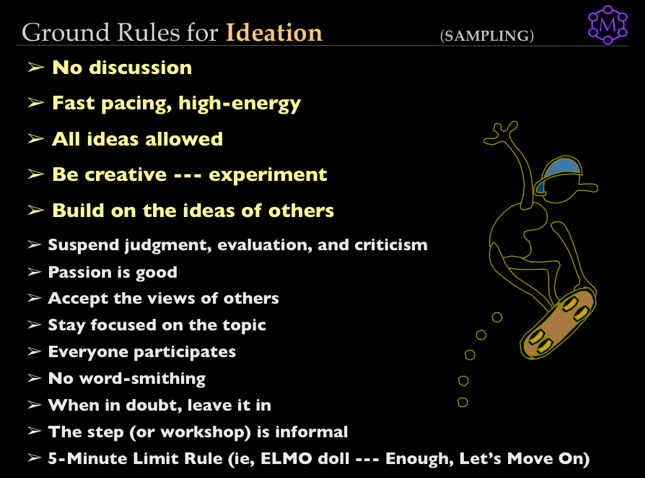
Ideation Ground Rules for Narrative Brainstorming
Keep in mind that the term “listing” may be more appropriate if you are collecting a known set of information. True ideation derives all future possibilities—anything goes. Beginning with the traditional, facilitator-led question-and-answer approach; consider the following to improve ideation:
Ideation Options to Consider for Narrative Brainstorming
- Facilitator-led questions—Keep in mind that you can use a support scribe(s) but if so, remind them of the importance of neutrality and capturing complete verbatim inputs.
- Pass the pen or marker—again having prepared the easel title/ banner, have participants walk up to the easel in the order of an assigned round-robin sequence to document their contribution(s). This approach is wise after lunch or when participants’ energy is low because it gets participants up and moving around. Help them with their penmanship or clarity if necessary.
- Pass the sheet or card—particularly appropriate if time is short, the group is large, or you have any questions requiring input (distribute a writing pad or index card for each question). Write the question or title on individual large cards or sturdy-stock pieces of paper and either sitting or standing have the participants pass them around until each person has had the opportunity to make a contribution to each question. This approach helps reduce redundant answers since participants see what prior people have written.
- Post-it Notes—Continue to use easels with sheet titles for posting the notes. Have individuals mount one idea per note. Allow as many notes as they want. Post them on the appropriate easel whose title/ question matches their answer. If there is more than one question, you can color coordinate the easel title/ banner with the Post-it note colors.
- Round-robin—again having prepared the easel title/ banner, and perhaps in consort with a scribe(s), create an assigned order by which the participants one at a time offer content, permitting any of them to say “pass” at any time.
Possible Time-boxing
Consider time boxing the ideation step if necessary, typically in the five to ten-minute range. Remember, the hard part is the analysis that occurs next. However, when you enforce High Energy and No Discussion, you will rarely extend beyond six to eight minutes on one question.
Analysis Drives Convergence

Brainstorming Requires Ideation AND Analysis
The difficult part of brainstorming, and frequently facilitating, is knowing what to do with the list—how to lead the group through analysis that is insightful. There is no “silver bullet” for the ill-prepared. Determine appropriate analysis methods before the meeting, with an alternative method in mind as a contingency or backup plan. Many of our other articles on Best Practices are about HOW TO analyze input.
For example, there are numerous ways to help groups prioritize, from the simple through the complicated to the complex. Purchasing stationery may be simple. Yet designing machinery (e.g., jet airplanes) is complicated. Creating artificial intelligence (think IBM’s Watson playing Jeopardy) and machine learning are truly complex. Each has a different and appropriate method for analysis and prioritization.
For example, one might use PowerBalls for a simple decision. To drive consensus around a complicated decision, something more robust is required such as a quantitative Scorecard approach that separates criteria into different types such as binary (i.e., Yes/ No), scalable (more is better), and fuzzy (subjective). Alternatively, qualitative Perceptual Maps may suit some groups better. MG RUSH’s proprietary quantitative SWOT analysis provides a hardy and robust tool.
We post responses based on our body of knowledge (BoK) supported by decades of experience leading groups to make higher-quality decisions. Therefore, Osborne’s Brainstorming tool comprises three discrete activities; diverge, analyze, and converge.
In a world where everyone can engage in decisions that affect them
______
Lead the Change—One Meeting at a Time
Are you ready to transform how decisions are made, problems are solved, and alignment is built in your organization?
True meeting leadership goes beyond setting an agenda. It requires a facilitator who can navigate complexity, balance voices, and drive toward outcomes with clarity and consensus. Our Professional Meeting Leadership Workshop and facilitation training equips you to do just that—blending human-centric methods with structured analytical tools to foster rigor, inclusivity, and results that stick.
- Practice live.
- Get expert feedback.
- Build confidence that lasts.
Whether your meetings suffer from unclear objectives, disengaged participants, or decision fatigue, this workshop will help you identify the root causes, apply proven facilitation techniques, and emerge as the leader every team needs.
Take the first step today—transform your meetings and magnify your impact.
👉 Click here to reserve your seat now.
#facilitationtraining #meetingdesign
Because every meeting should be a catalyst for change—not just another calendar event.
______
With Bookmarks no longer a feature in WordPress, we provide the following for your benefit and reference.
- 20 Prioritization Techniques = https://foldingburritos.com/product-prioritization-techniques/
- Creativity Techniques = https://www.mycoted.com/Category:Creativity_Techniques
- Facilitation Training Calendar = https://mgrush.com/public-facilitation-training-calendar/
- Liberating Structures = http://www.liberatingstructures.com/ls-menu
- Management Methods = https://www.valuebasedmanagement.net
- Newseum = https://www.freedomforum.org/todaysfrontpages/
- People Search = https://pudding.cool/2019/05/people-map/
- Project Gutenberg = http://www.gutenberg.org/wiki/Main_Page
- Scrum Events Agendas = https://mgrush.com/blog/scrum-facilitation/
- Speed test = https://www.speedtest.net/result/8715401342
- Teleconference call = https://youtu.be/DYu_bGbZiiQ
- The Size of Space = https://neal.fun/size-of-space/
- Thiagi/ 400 ready-to-use training games = http://thiagi.net/archive/www/games.html
- Visualization methods = http://www.visual-literacy.org/periodic_table/periodic_table.html#
______

Terrence Metz, president of MG RUSH Facilitation Training, was just 22-years-old and working as a Sales Engineer at Honeywell when he recognized a widespread problem—most meetings were ineffective and poorly led, wasting both time and company resources. However, he also observed meetings that worked. What set them apart? A well-prepared leader who structured the session to ensure participants contributed meaningfully and achieved clear outcomes.
Throughout his career, Metz, who earned an MBA from Kellogg (Northwestern University) experienced and also trained in various facilitation techniques. In 2004, he purchased MG RUSH where he shifted his focus toward improving established meeting designs and building a curriculum that would teach others how to lead, facilitate, and structure meetings that drive results. His expertise in training world-class facilitators led to the 2020 publication of Meetings That Get Results: A Guide to Building Better Meetings, a comprehensive resource on effectively building consensus.
Grounded in the principle that “nobody is smarter than everybody,” the book details the why, what, and how of building consensus when making decisions, planning, and solving problems. Along with a Participant’s Guide and supplemental workshops, it supports learning from foundational awareness to professional certification.
Metz’s first book, Change or Die: A Business Process Improvement Manual, tackled the challenges of process optimization. His upcoming book, Catalyst: Facilitating Innovation, focuses on meetings and workshops that don’t simply end when time runs out but conclude with actionable next steps and clear assignments—ensuring progress beyond discussions and ideas.
What’s up, all the time i check blog posts here in the early hours of day, as i love to learn more and more.
Great. Buy us a cup of coffee some time !!!