by Facilitation Expert | Apr 5, 2012 | Facilitation Skills
The Role of Session Leader
You have a multitude of tasks to perform during the workshop. The success of the facilitator’s effort is dependent upon your skill, knowledge, and abilities as a session leader. The role of session leader includes both the traditional role of “Facilitator” discussed below and the role of “Meeting Designer” discussed below.
You can complete a project without facilitation, but you could also cut your own hair.
—Various
Responsibilities in the Role of Session Leader

Role of Session Leader
Context represents the primary responsibility of the session leader, frequently called a facilitator—Responsibilities include:
- Actively listening to the discussion and challenging assumptions.
- Creating synergy by focusing on the group and using your facilitation skills to enhance communications.
- Ensuring that all participants have an opportunity to participate.
- Explaining and enforcing the roles.
- Keeping the group on track.
- Managing the documenters and the documentation process.
- Observing the group interactions and adjusting when necessary.
- Questioning to achieve clarity—aiding communication between participants and yourself.
- Recognizing disruptive behavior and creating positive corrections.
- Working to resolve conflicts that arise.
Key Success Element in the Role of Session Leader
Your role creates an environment where every participant has the opportunity to collaborate, innovate, and excel. Observing the team’s progress helps you understand the dynamics of the group and how your approach enhances or detracts from the final output.
The Group Dynamics
- Ask yourself the following questions while observing the group:
- How do they communicate? Eye-to-eye contact? Soft-spoken? Yelling? Gestures? etc.
- In what order do they speak? Primary, secondary, who backs who up? Who always gets interrupted?
- Which participant(s) appears to influence group direction the most?
- Who are these people talking to? Are they looking for supporters? Do they attack certain people or groups?
Meeting Designer in the Role of Session Leader
The meeting designer details the approach used by the meeting or workshop. Consequently, the meeting designer’s role typically changes throughout the project or product development. For example, in the planning phase, the meeting designer may be a strategic planner—someone who understands how to develop a consensual plan. In the analysis phase, the meeting designer may be a process expert, a business architect, or both. In the design phase, the meeting designer may be a workflow or design specialist.
Meeting or workshop responsibilities include:
- Helping the facilitator, business partner, and technical partner codify the deliverable and define the appropriate agenda steps to follow. Provides succinct questions to ask and the optimal order or sequence for the questions to be answered.
- Perhaps participating in workshops to ensure that the products produced satisfy the expected standards of quality and consistency—namely that others can act upon the deliverable effectively, such as the project team.
The meeting designer’s role is functional and not necessarily the role of an individual. The executive sponsor is sometimes the meeting designer with strategic planning. The session leader is frequently the meeting designer because they have MG RUSH structured facilitation training or experience. The facilitator can also fulfill this role because methods and approaches are generally neutral. Business or technical partners (i.e., project management) are sometimes methodologists. Therefore, look for the person or persons who is expert with the deliverable—who clearly understands the product to build and the approach to follow in building that product.
______
Don’t ruin your career by hosting bad meetings. Sign up for a workshop or send this to someone who should. MGRUSH workshops focus on meeting design and practice. Each person practices tools, methods, and activities every day during the week. Therefore, while some call this immersion, we call it the road to building high-value facilitation skills.
Related articles
by Facilitation Expert | Mar 29, 2012 | Leadership Skills, Meeting Support
Sometimes meetings that look promising before they begin, fail unexpectedly. Four primary causes of meeting failures deserve your attention. They sneak up on groups, ill-prepared to anticipate or mitigate them. Participants need your awareness about these meeting failures as their meeting leader and facilitator.
First Cause of Meeting Failures: The Problem with Solving
First, what is a “promising meeting”? When the session leader has confirmed a solid and necessary deliverable from the meeting participants but fails to develop an appropriate method or agenda, most meetings will flounder or fail. North Americans, in particular, are subject to an “over-confidence” bias. They show up expecting to develop the right method, ask the right questions, or conduct the appropriate analysis “on the fly”. Some have called this meeting syndrome, “solving”. “Solving” dominates the causes of meeting failures.
Second Cause of Meeting Failures: Over-confidence bias
Meeting Failure Causes
The same over-confidence bias causes many to skip the analysis and jump immediately from the problem to the solution. As a result, they frequently ask pertinent but impossible questions akin to “How do you solve global hunger?” or “How do you boil the ocean?”. While the participants may have a vested interest in solving the hunger issue or resolving a technical issue, the session leader has not made it easy for them to arrive at a consensual solution because the method has failed to break it down into manageable pieces.
Third Cause of Meeting Failures: Question Precision
One of the surest ways to get a group of vested participants to go silent is to ask a meaningful question that is so broad as to be unanswerable.
Participants become numb about how to respond. Note the “hunger” problem as an example. Hunger remains a function of food development, food distribution, food storage, nutrition absorption, etc. By narrowing the scope a bit and providing a focused question, a facilitator can make it a lot easier for a group to respond, such as “How could we improve food storage capacity in Somalia?” With a precise question, and narrower scope (i.e., Somalia versus the entire world), it becomes much easier to provide answers such as “converts those old rail cars” or “use the abandoned mine shafts”.
Fourth Cause of Meeting Failures: Question Sequencing
Not only should the overriding question be broken into discrete questions, but the questions need to be sequenced as well. For example, the big question “So, what is the marketing plan for 20xx?” is better served with discrete discussions around segmentation, targeting, positioning, messaging, media, etc. Most marketing experts suggest identifying the target audience before going further into the analysis or plan development.
Likewise, when building a home, a residential architect needs to know “What color do you want the grout to be in the secondary bathroom?” That type of question, however, while demanding an answer, is probably best saved for the end of development, after agreeing on the purpose of the home, location, size, traffic flow, etc. These additional topical areas become natural agenda steps that increase the robustness of the method behind the meeting, also known as an agenda.
No one wants another meeting, especially a non-productive session.
To ensure that your meetings are anticipated, respected, and more productive than the meeting your participants came from or the meeting they are headed to next, embrace the following suggestions to correct why meetings fail.
Meetings Fail — Here’s How to Stop It
Start on Time
Do not penalize people who are on time by waiting for people who are late. Few irritants get a meeting started poorly than a wavering start time. Ask participants to notify you in advance if they might be late. If they arrive late, do NOT consume others’ time by reviewing what has transpired. Instead, pair them off with someone else and ask them to go in the hallway to provide an update.
Document
If it was not documented then it did not happen. Meetings without documentation suggest that nothing worthwhile happened. Optimally, add context and rationale for all topics and decisions made. Take any decision to a steering team or decision review board and their first challenge will be “Why?” Carefully leave a paper trail for the reasons.
Time Sensitivity
While participants should typically share a few laughs, real meeting success is judged by finishing on time, or better yet, ahead of schedule. Be careful about taking on strategic issues during a brief meeting, they should be logged and set aside for a longer forum. Do not allow participants to go into too much detail, that others find irrelevant. They can build and provide concrete details on their own. Remember too, that ‘standing’ meetings (i.e., meetings held regularly at the same time every week) were originally intended for participants to stand and not sit. By the way, ‘standing’ meetings are completed much faster than ‘sitting’ meetings.
Agenda Control
Stay vigilant about following the agenda. In other words, stay in scope. Sometimes arguments about the project, the organization, or other issues beyond control dominate a meeting. Participants talk about what they want to give rise to the concept of people “who have their own agenda.” Stick to your agenda and monitor progress carefully.
Visual Support
Stimulate participants and discussion with the proper use of easels and supplementary visuals. Do not however rely on a deck of slides. People can read and challenge slide decks on their own, they do not need a meeting for that. Build slides that share causal links and supplement them with visuals that stimulate. A visually dynamic meeting offers ‘sex appeal’ compared to others.
Secure Feedback
Get an audible agreement, beginning with ground rules. Document decision points, preferably on large-scale poster-size paper or whiteboards. As you build consensus, emphasize that consensus implies a quality decision that ALL participants can support, but NOT one that necessarily makes everyone happy. Consensus is something they can live with, and not disrupt in the hallways after the meeting.
Careful Review
Upon conclusion, carefully review and confirm that everyone understands the next steps. If the meeting changes nothing, why meet? Make the change or assignments visible and consider using a RASI chart for support. For any and all follow-up meeting(s), confirm future dates, times, and locations. Most importantly, conclude on time, or preferably, early. Before they depart, secure additional feedback on what you could have done to make the meeting even more successful. For solid and anonymous feedback, use our Post-it© note approach combined with the T-chart called Plus-Delta. They provide more meaningful input than offered openly in public. Participants do not want to “embarrass” you with their criticism.
Why do meetings fail? By following the suggestions above you can circumvent the three most common complaints about meetings, namely:
- Disorganized (i.e., uncertain output or outcome)
- Length (ie, wasted time)
- Predetermined decisions (meetings are a poor form of persuasion)
Convert Why Meetings Fail Into Meeting Success
The lesson to be learned? Break it down. Speak with experts and study additional reference material. Take any significant reason or question behind a meeting and determine the various questions that could be answered in support. Find the natural groupings and create a topical flow. Now you have at least a basic agenda that will help prevent you from asking such a broad question that it could lead to meeting silence or even failure.
______
Don’t ruin your career by hosting bad meetings. Sign up for a workshop or send this to someone who should. MGRUSH workshops focus on meeting design and practice. Each person practices tools, methods, and activities every day during the week. Therefore, while some call this immersion, we call it the road to building high-value facilitation skills.
by Facilitation Expert | Mar 22, 2012 | Leadership Skills, Managing Conflict
A leopard cannot change their spots. In the same vein, you are never going to convert quiet people into extroverts who continuously contribute and dominate your meeting. There are, however, a few simple steps for you to increase the velocity and depth of contributions from quiet people, both in person and online.
Quiet people, when they are paid professional adults, still have a duty (fiduciary responsibility). That means, if they have pertinent content that should be considered, meetings are NOT an opportunity for them to speak up. Rather, meetings are an obligation for them to earn their pay, to contribute. Well-paid professional adults must add value when possible. Meeting participation is part of the job, their duty.
Interview Your Participants, Especially Quiet People
It is so important, especially with quiet people, to establish a connection before the meeting. When you speak with participants in advance, transfer ownership of the meeting deliverable by establishing or re-confirming the importance of their contribution. Emphasize the various roles in a workshop, especially the protection provided to participants by the facilitator. Establishing one-on-one connections has become increasingly critical with online sessions. People who have been isolated seek connections, even quiet people.
No Secret, Yet Underused: Break-out Sessions
Using break-out sessions gives everyone permission to speak freely. As they assemble in smaller teams, participants are more comfortable having a conversation with fewer people. They are uncomfortable when they need to speak up in front of a larger group. Quiet people discover that they are not a “lone” voice, thus giving them increased confidence to speak on behalf of “our team,” when otherwise they might remain quiet. Of the numerous virtual tools, Zoom makes it easy to assign, creatively rename, and then manage Breakouts.
Non-verbal Solicitation Helps Quiet People Contribute
Increasing Meeting Input from Quiet People
Actively seek and beseech the input of quiet people with open hands and eye contact. With virtual meetings gently use their name only if you have previously agreed that they can say ‘pass’ when they feel ‘put on the spot.’ Let quiet people know in advance that you understand their meek nature. In-person, use your eyes and hands to solicit input, especially at critical and appropriate moments when you expect their contribution, as a subject matter expert.
Approach all participants when appropriate with non-verbal signals to encourage their participation. Ensure them in advance, with absolute confidence, that you will protect them by separating their message from the source. We care about WHAT and not WHO. Emphasize that the facilitator protects the people first and then secures participants’ input because the content gathered serves the people, not the other way around.
Reinforce During Breaks
Constantly remind quiet people (in private) that their input is important and valued. Reinforce your role as protector and remind them if they have avoided making a contribution when, perhaps, they should have spoken. Ask all of your participants if there is anything else that you can do, as the facilitator, to make it easier for them to provide input. In virtual sessions, you may send a private chat to quiet people reminding or prompting them to provide their input.
Other Procedures for Soliciting Quiet People
Consider other procedures when all else fails. Instead of a spoken round-robin, ask everyone to write down their ideas through an anonymous poll. If live and in person, use Post-It notes or other paper they can write on without disclosing the source. Therefore, they can contribute their ideas anonymously.
Finally, consider asking a confederate (i.e., another participant) to incite participation by specifically referring to the quiet person, stating that they “would like to hear ‘Meek’s opinion’.” Please add your discoveries and comments below for the benefit of others.
An elevated level of meeting participation in meetings indicates the likelihood of a great meeting. What else encourages participation? Here are some additional meeting participation tips worth reviewing.
Nobody wants more meetings. They want results. Presumably, the results they seek will have an impact on the quality of their lives. If the session leader can quantify the impact of the meeting on the personal wallets in the room, participation is guaranteed to increase. We find the following to rank among the most elevated items for inciting high levels of meeting participation and collaboration.
Knowing One Another
Biographic sketches of other meeting members can inspire empathy and understanding. With online meetings, include photographs that show the face behind the voice. If you provide supplemental reading material, customize a cover letter for each participant highlighting the pages or sections upon which they should focus. Thus suggesting they do not give equal attention to everything in the handout. Prompt each subject matter expert in advance with the questions that will be raised during the meeting most pertinent to them or their role. Ask them to focus on those questions since you will turn to them for the first response when the question is raised.
If the session leader and the participants show up prepared, the chances of meeting participation are highly amplified.
Beginning (aka Preparation) Phase
Learn to transfer meeting results and ownership to participants before the meeting starts. Optimally, participants should review the purpose, scope, and objectives (i.e., deliverables) before the meeting begins. Participants ought to confirm that they understand and find them acceptable. Or provide their input to change something before the meeting begins. Review the agenda and tools with participants to ensure that they find the approach sound. Always hold participants responsible for meeting output.
Meeting Participation
Include a glossary or lexicon in the pre-read or handout so that individuals can refer back to the operational definitions of terms as challenges arise. People frequently find themselves in violent agreement with each other. Ensure that all the participants agree on the terms used in the purpose, scope, and objectives statements. Typically, the glossary should be maintained by the project team, project management office, program office, or strategic center of excellence. Teams normally don’t argue about the difference between a vendor and a contractor or a bill and an invoice. Unless the definitions are part of the deliverable, they should be determined in advance.
When meetings or workshops support projects, the participants need to know and understand the purpose and objectives of the project, the reason for the project (i.e., program goals), and the goals and objectives of the mandating organization (i.e., the strategic plan of the business unit and/ or enterprise). Optimally, the meeting room should have large, visible copies of the enterprise’s mission, values, and vision. Handout material should include more detailed objectives and key results.
The Middle (aka During the Meeting) Phase
As with quiet people discussed above, everybody responds well to the following:
- Breakout Sessions
- Non-verbal Solicitation
- Reinforcement
Ending (aka Review and Wrap) Agenda Step
While meeting participation concludes with the wrap-up or close of each meeting, ownership needs to extend to the reasons for holding the meeting in the first place.
Review Results
Encouraging Participation — The Wrap
As session leader (i.e., frequently referred to as facilitator), conduct a thorough review of the agreed upon outputs. Simply focus on the final items of agreement, and not necessarily the rationale behind them. Ensure that everyone supports the outputs since this is their last chance to speak up. They need to now agree to support the outputs, even if not their favorite, in the hallways and meeting rooms after they leave. As professionals, you have every reason to expect them to either walk the talk or speak up. It’s not your responsibility to reach down their throat and pull it out of them. Ensure that they will both support the output, and not lose any sleep over it.
Refrigerator
Assign relevant items captured, beyond the scope of the meeting. North Americans frequently refer to this category as the ‘Parking Lot.’ We do NOT ask, “Who will be responsible for this (i.e., open item)?” Rather, ask “Who will take the point of communication and report back to this group on the status of this (i.e., open item)?” Again, if no one steps up, assign it as an ‘open issue’ and escalate it back to the executive sponsor or their equivalent.
Communications Plan
Ensure that your participants now sensibly and similarly communicate with others the results of the meeting. Make sure it sounds like they were in the same meeting together. Build consensus around “If you encounter your superior at lunch, and they ask you for an update, what will you tell them we accomplished in this meeting?” Secondarily, consider other stakeholders that may be affected by the meeting outputs. If you encounter a stakeholder in the hallway, and they ask you for an update, what will you tell them was accomplished in this meeting? Do not underestimate the value of this activity. Groups that claim to have consensus may discover based on their interpretation that significant differences remain. The best time to resolve these differences is right now before the meeting adjourns.
Self-Assessment
Ask them how you did and obtain their ownership over the fact that their input can help make you a better session leader. To allow for anonymity, ask them to jot down in separate Post-it Notes, at least one aspect they liked and one aspect they would have changed for the meeting. Have them mount their notes using Plus/ Delta as they exit the meeting, either using easel(s) or whiteboard to label your titles.
The term ‘facilitate’ means to ‘make easy’ and if you embrace the suggestions above, you will see meeting participation increase substantially. More importantly, you will have properly begun the transfer of ownership and responsibility from the solo session leader to the group or team, as it should be.
In a world where everyone can engage in decisions that affect them
______
Lead the Change—One Meeting at a Time
Are you ready to transform how decisions are made, problems are solved, and alignment is built in your organization?
True meeting leadership goes beyond setting an agenda. It requires a facilitator who can navigate complexity, balance voices, and drive toward outcomes with clarity and consensus. Our Professional Meeting Leadership Workshop and facilitation training equips you to do just that—blending human-centric methods with structured analytical tools to foster rigor, inclusivity, and results that stick.
- Practice live.
- Get expert feedback.
- Build confidence that lasts.
Whether your meetings suffer from unclear objectives, disengaged participants, or decision fatigue, this workshop will help you identify the root causes, apply proven facilitation techniques, and emerge as the leader every team needs.
Take the first step today—transform your meetings and magnify your impact.
👉 Click here to reserve your seat now.
#facilitationtraining #meetingdesign
Because every meeting should be a catalyst for change—not just another calendar event.
______
With Bookmarks no longer a feature in WordPress, we provide the following for your benefit and reference.
______
by Facilitation Expert | Feb 23, 2012 | Meeting Tools
To facilitate innovation for products or processes provides a significant life force and has become a strategic priority for most companies and organizations.
An IBM poll of fifteen hundred CEOs identified creativity as the number one “leadership competency” of the future. A new and remarkable discovery is that the ability to facilitate innovation and innovative ideas is not merely a function of the mind, but it is also a function of behaviors.
Product Innovation, a Mindset that Generates Profit
The Harvard Business Press book “The Innovator’s DNA: Mastering the Five Skills of Disruptive Innovators” provides compelling ways to stir product innovation. The work of authors Jeffrey Dyer, Hal Gregersen, and Clayton Christensen emerged from an eight-year collaborative study to uncover the origins of innovation. They were less concerned with the companies’ strategies and focused on understanding the people responsible for turning creativity into value propositions.
Five skills surfaced from their investigation including one cognitive (i.e., genetic) talent and four acquired behaviors. The cognitive skill is called “associational thinking” or the ability to make connections across seemingly unrelated fields, problems, or ideas. The other four skills are learned (i.e., behavioral) and include:
- Experimenting
- Networking
- Observing
- Questioning
Facilitate Innovation for Products or Processes
To our regular readers, perhaps not surprisingly, the required behaviors are virtually identical to the core skills of our professionally trained MGRUSH facilitators. The researchers discovered that innovators are much more likely to question, observe, network, and experiment than typical executives. They also discovered that innovative companies are always (ALWAYS) led by innovative leaders.
“ . . . Innovative people systematically engage in questioning, observing, networking, and experimenting behaviors to spark new ideas. Similarly, innovative organizations systematically develop processes that encourage questioning, observing, networking, and experimenting by new employees.”
How to Facilitate Innovation
In their discussion of innovative failures, the authors discovered that people did not ask all the right questions . . . thus they emphasize the value of the discovery skill. In other words, we must be willing to challenge our people to think clearly. According to the authors, the behavioral focus found in our facilitative leadership training could pay for the training in a matter of weeks.
Their book also provides details on how to calculate an innovation premium for companies; i.e., the proportion of a company’s market value that cannot be accounted for from cash flows of current products or markets. Investors take note. This factor alone could pay for the time you took to read this blog, many times over. The innovation advantage found in our curriculum can be converted into a premium for your organizational value by building the code (i.e., DNA) for innovation directly into your people, methods, and guiding philosophies—beginning with a facilitative and collaborative culture.
Encouraging and developing ideas is the easiest of the three activities required to operate the tool called “Brainstorming.” The other two activities include analysis and convergence (or, decision). Whether you use an easel or a spreadsheet, Post-it® notes, or illustrated drawings, the first principle of brainstorming, as intended by Alex Osborne, is to encourage capturing lots of ideas without constraint or judgment. Most novice facilitators become the first person in the meeting to violate this principle by asking for a definition or further explanation, such as “Tell us more about _____.” Facilitate innovation by . . .
Regardless of HOW you gather ideas, embrace the first principle we call “Ideation.” First, to facilitate innovation, begin by embracing a discrete set of ground rules during the ideation activity.
Ideation Ground Rules
- No discussion
Facilitate Innovation: Get Out of the Box
- Fast pacing, high-energy
- All ideas allowed
- Be creative—experiment
- Build on the ideas of others
- Suspend judgment, evaluation, and criticism
- Passion is good
- Accept the views of others
- Stay focused on the topic
- Everyone participates
- No word-smithing
- When in doubt, leave it in
- The ideation step is informal
- 5-Minute Limit Rule (i.e., ELMO doll — Enough, Let’s Move On)
What to Expect When You Facilitate Innovation
In our experience, having used all of these rules at one time or another, the first four (shown in bold font) consistently add value. For example, a few of the ideation rules suggest that someone has made a remark (e.g., No word-smithing). If the facilitator carefully polices the very first ground-rule (i.e., No discussion), then it obviates the need for some of the other ground rules. When you facilitate ideation, always stress the first two especially.
The ELMO rule is also not necessary if the activity is closely policed. How long can a group maintain “high energy”? If the group is working with high energy at the five-minute mark, do you really want to shut them down? It is likely that energy will begin to die down in the next few minutes anyway, so if closely monitored, the formal rule is not necessary. Typically the facilitator should expect to wind down the ideation activity within six to eight minutes anyway. Larger groups may keep up high energy for ten to twelve minutes, but it is most unlikely that any group will maintain true “high energy” for fifteen to twenty minutes when you facilitate ideation. Of course, you can always change their perspectives.
Once the ideation activity is complete, the real work begins. What are you going to do with the list? The first challenge is normally about definition and what something specifically means. Then comes the hard part, analysis. What are you going to do with that list?
______
Don’t ruin your career by hosting bad meetings. Sign up for a workshop or send this to someone who should. MGRUSH workshops focus on meeting design and practice. Each person practices tools, methods, and activities every day during the week. Therefore, while some call this immersion, we call it the road to building high-value facilitation skills.
- Yes, You Can Brainstorm Without Groupthink (blogs.hbr.org)
- 5 Idea Generators (& Idea Killers) (inc.com)
- Can Innovation Be a Structured Repeatable Process? (customerthink.com)
by Facilitation Expert | Feb 16, 2012 | Problem Solving
The term “brainstorming” is technically a gerund, a verb that wants to be a noun. A gerund implies more than one step or activity. Osborne’s original Applied Imagination, also known as Brainstorming, relies on separate Ideation and Analysis activities. Here’s how to facilitate brainstorming effectively.
To facilitate brainstorming properly use ideation rules and analysis tools. When done poorly, brainstorming leaves a bad taste in peoples’ mouths. Optimally, brainstorming includes three discrete activities:
- List (also known as diverge or ideate)
- Analyze (the hardest of the three activities and frequently omitted)
- Decide (also known as converge or document)
A facilitator or session leader must be conscious of where the group is and upon which activity the group should focus. Many people are confident in their facilitation skills because they can stand at an easel and capture ideas (or provide instructions and gather Post-it Notes®). Those same leaders then turn to their participants. They ask them to create categories, or worse, ask what they would like to do with the list. This type of leadership is NOT facilitation and does NOT make it easier for the group to make an informed decision.
Besides non-narrative methods of capturing participant input, consider the following ideation options when gathering narrative input from your participants.
With narrative brainstorming, first, remember to enforce the rules of ideation when diverging. Prevent discussion while you are capturing their ideas. At the end of ideation, consider one last round robin for final contributions, allowing participants to say “pass” if they have nothing to add.
Ideation Ground Rules for Narrative Brainstorming
Keep in mind that the term “listing” may be more appropriate if you are collecting a known set of information. True ideation derives all future possibilities—anything goes. Beginning with the traditional, facilitator-led question-and-answer approach; consider the following to improve ideation:
Ideation Options to Consider for Narrative Brainstorming
- Facilitator-led questions—Keep in mind that you can use a support scribe(s) but if so, remind them of the importance of neutrality and capturing complete verbatim inputs.
- Pass the pen or marker—again having prepared the easel title/ banner, have participants walk up to the easel in the order of an assigned round-robin sequence to document their contribution(s). This approach is wise after lunch or when participants’ energy is low because it gets participants up and moving around. Help them with their penmanship or clarity if necessary.
- Pass the sheet or card—particularly appropriate if time is short, the group is large, or you have any questions requiring input (distribute a writing pad or index card for each question). Write the question or title on individual large cards or sturdy-stock pieces of paper and either sitting or standing have the participants pass them around until each person has had the opportunity to make a contribution to each question. This approach helps reduce redundant answers since participants see what prior people have written.
- Post-it Notes—Continue to use easels with sheet titles for posting the notes. Have individuals mount one idea per note. Allow as many notes as they want. Post them on the appropriate easel whose title/ question matches their answer. If there is more than one question, you can color coordinate the easel title/ banner with the Post-it note colors.
- Round-robin—again having prepared the easel title/ banner, and perhaps in consort with a scribe(s), create an assigned order by which the participants one at a time offer content, permitting any of them to say “pass” at any time.
Possible Time-boxing
Consider time boxing the ideation step if necessary, typically in the five to ten-minute range. Remember, the hard part is the analysis that occurs next. However, when you enforce High Energy and No Discussion, you will rarely extend beyond six to eight minutes on one question.
Analysis Drives Convergence
Brainstorming Requires Ideation AND Analysis
The difficult part of brainstorming, and frequently facilitating, is knowing what to do with the list—how to lead the group through analysis that is insightful. There is no “silver bullet” for the ill-prepared. Determine appropriate analysis methods before the meeting, with an alternative method in mind as a contingency or backup plan. Many of our other articles on Best Practices are about HOW TO analyze input.
For example, there are numerous ways to help groups prioritize, from the simple through the complicated to the complex. Purchasing stationery may be simple. Yet designing machinery (e.g., jet airplanes) is complicated. Creating artificial intelligence (think IBM’s Watson playing Jeopardy) and machine learning are truly complex. Each has a different and appropriate method for analysis and prioritization.
For example, one might use PowerBalls for a simple decision. To drive consensus around a complicated decision, something more robust is required such as a quantitative Scorecard approach that separates criteria into different types such as binary (i.e., Yes/ No), scalable (more is better), and fuzzy (subjective). Alternatively, qualitative Perceptual Maps may suit some groups better. MG RUSH’s proprietary quantitative SWOT analysis provides a hardy and robust tool.
We post responses based on our body of knowledge (BoK) supported by decades of experience leading groups to make higher-quality decisions. Therefore, Osborne’s Brainstorming tool comprises three discrete activities; diverge, analyze, and converge.
In a world where everyone can engage in decisions that affect them
______
Lead the Change—One Meeting at a Time
Are you ready to transform how decisions are made, problems are solved, and alignment is built in your organization?
True meeting leadership goes beyond setting an agenda. It requires a facilitator who can navigate complexity, balance voices, and drive toward outcomes with clarity and consensus. Our Professional Meeting Leadership Workshop and facilitation training equips you to do just that—blending human-centric methods with structured analytical tools to foster rigor, inclusivity, and results that stick.
- Practice live.
- Get expert feedback.
- Build confidence that lasts.
Whether your meetings suffer from unclear objectives, disengaged participants, or decision fatigue, this workshop will help you identify the root causes, apply proven facilitation techniques, and emerge as the leader every team needs.
Take the first step today—transform your meetings and magnify your impact.
👉 Click here to reserve your seat now.
#facilitationtraining #meetingdesign
Because every meeting should be a catalyst for change—not just another calendar event.
______
With Bookmarks no longer a feature in WordPress, we provide the following for your benefit and reference.
______
by Facilitation Expert | Feb 2, 2012 | Communication Skills
One of the toughest tasks of a facilitator is to relinquish judgment and fully seek the intent behind the terms used in meetings. Therefore, facilitate meaning, not words. Structured workshops support the information revolution (as opposed to the 20th-century industrial revolution). Therefore, remind participants that their words provide instruments supporting the meaning being conveyed.
Facilitate Meaning, Not Words
The term ‘in-formation’ implies a sense of journey, rather than destination. Participants supporting in-formation technology discover that deliverables are transitory. The question is not whether a guiding principle or assumption will change, only when it changes—or perhaps more accurately, how quickly the change will occur since change is continuous. Therefore it behooves us to fully understand and facilitate the meaning behind the words being used.
FACILITATE MEANING AND INTENT, NOT WORDS
Meeting participants most frequently express and extract meaning from the world of words, which I refer to as “narrative.” Five common techniques, including narrative, express intent and meaning:
- Narrative
- Nonverbal
- Illustrative
- Iconic (symbols)
- Numeric
1. NARRATIVE
Oral and written (narrative) rhetoric relies on words, the primary means of communicating in meetings. However, non-narrative methods may be equally effective and sometimes preferred, especially when explaining complex topics and issues.
2. NONVERBAL
Substantial information during meetings transfers through body signals, openness (or closeness), shifting eyebrows, frowns of disapproval grins of approval, and the like. Hand gestures help explain the passion and intensity behind some meeting participants’ claims, along with cadence, tone, and other para-verbal traits.
3. ILLUSTRATIVE
Drawings, illustrations, and pictures reflect intent and meaning and are particularly effective in explaining complex relationships. Pictures of birds provide a much clearer understanding of birds than using words alone. Likewise, process flow and value stream diagrams may provide quick overviews more effectively and efficiently than verbal explanations.
4. ICONIC (OR SYMBOLIC)
Icons and symbols extend intent and meaning. Many icons are now universally acceptable and leapfrog the challenges associated with language challenges. Street signs, restroom symbols, and public transportation indicators do not leave much room for confusion or misunderstanding (take the stop sign, for example).
5. NUMERIC
Scorecards, spreadsheets, and other weighted ranking systems should be familiar. Additionally, I built my Quantitative TO-WS Analysis to describe the Current Situation numerically, thus avoiding some of the emotion and passion that can bog people down in searching for the right words. By using numbers instead of words, participants strive to understand in addition to trying to be understood.
OTHER TECHNIQUES
Dance, movies, music, storytelling, and other formats also communicate intent and meaning. Most of us, however, rarely employ other formats for expressing our intent when we are working with business groups.
Therefore, always be willing to challenge participants to make their thinking visible.
“Great minds like a think.”
Strive to help your speaker or participants to more fully explain the meaning behind the terms they use. Words rarely capture all of the intended meaning. However, additional challenge and facilitation improves robust understanding, making it easier to build valid and sustaining consensus.
Whether you are most familiar with the “Five Whys” or the inquisitive five-year-old, ask for proof, evidence, examples, and options to fortify participants’ thinking and their supporting arguments. Challenge adjectives and adverbs, such as ‘quick’ or ‘quality’. Ask about their meaning and intent. An excellent follow-up question is “What is the unit of measurement for insert adjective or adverb______?”
Many languages serve to build consensus, not simply English. True and valid consensus is not only an English term(s), rather it is also the meaning the participants intend to convey. The elusive nature of meaning was captured by Hafez (aka Hafiz) when he penned centuries ago:
If you think that the Truth can be known
From words,
If you think that the Sun and the Ocean
Can pass through that tiny opening called the mouth.
O someone should start laughing!
Someone should start wildly laughing—
Now!
______
Don’t ruin your career by hosting bad meetings. Sign up for a workshop or send this to someone who should. MGRUSH workshops focus on meeting design and practice. Each person practices tools, methods, and activities every day during the week. Therefore, while some call this immersion, we call it the road to building high-value facilitation skills.
by Facilitation Expert | Dec 1, 2011 | Leadership Skills
One of the biggest challenges with facilitation is to build consensus about a future state. Therefore, in a light-hearted sense as we approach the holiday season, here are some bad predictions that likely garnered some respect along the way—albeit short-lived.
Get Out of the Box
- An ancient bad prediction: “Inventions have long since reached their limit, and I see no hope for further developments.” Roman engineer Julius Sextus Frontinus, AD 10.
- “That’s an amazing invention, but who would ever want to use one of them?” President Rutherford B. Hayes to Alexander Graham Bell, 1876.
- “It doesn’t matter what he does, he will never amount to anything.” Albert Einstein’s teacher to his father, 1895.
- “I have anticipated [radio’s] complete disappearance — confident that the unfortunate people, who must now subdue themselves to ‘listening-in’ will soon find a better pastime for their leisure.” H.G. Wells, The Way the World is Going, 1925.
- “The problem with television is that the people must sit and keep their eyes glued on a screen; the average American family hasn’t time for it.” The New York Times, after a prototype television was demonstrated at the 1939 World’s Fair.
- “It would appear we have reached the limits of what it is possible to achieve with computer technology, although one should be careful with such statements; they tend to sound pretty silly in five years.” Computer scientist John von Neumann, 1949.
- “Man will never reach the moon, regardless of all future scientific advances.” Radio pioneer Lee De Forest, 1957.
- “Despite the trend to compactness and lower costs, it is unlikely everyone will have his own computer any time soon.” Reporter Stanley Penn, The Wall Street Journal, 1966.
- “But what is [the microchip] good for?” Engineer at the Advanced Computing Systems Division of IBM, 1968.
- “I predict the Internet…will go spectacularly supernova and in 1996 catastrophically collapse.” Bob Metcalfe, InfoWorld, 1995
Origin of Bad Predictions
In conclusion, these were first compiled by Laura Lee and published in The Futurist, September-October 2000. Finally, for structured facilitation support, see your FAST Facilitator Reference Manual or attend a FAST Professional Facilitative Leadership training session offered around the world (see http://www.mgrush.com/ for a current schedule).
______
Don’t ruin your career by hosting bad meetings. Sign up for a workshop or send this to someone who should. MGRUSH workshops focus on meeting design and practice. Each person practices tools, methods, and activities every day during the week. Therefore, while some call this immersion, we call it the road to building high-value facilitation skills.
- George Dyson’s history of the computer: Turing’s Cathedral (boingboing.net)
- Turing’s Cathedral by George Dyson (guardian.co.uk)
- Quantum Theory: von Neumann vs. Dirac (plato.stanford.edu)
- 5 Traits That Set Great Leaders Apart From The Pack (Cornerstone University)
by Facilitation Expert | Nov 10, 2011 | Communication Skills
Recently on a blog, an informal group of mathematicians solved a tough and long-standing mathematics problem in a few weeks. Additionally, an MGRUSH alumnae wrote about preparing for an executive workshop and how to facilitate Europeans and Asians between two different companies.
The following captures considerations on how to facilitate scientists, as well as considerations on how to facilitate Asians and Europeans.
First, How to Facilitate Scientists
The virtual session leader (Tom Gowers) used his blog to post ideas and progress. He encouraged others to contribute, expecting many minds to be more powerful than his alone. Within an hour of his first posting, three people scattered around North America commented, and six weeks later, the problem was solved. Here is an example of an ever-increasing body of scientists who have used networking to solve complex problems and to speed up the delivery of answers and options.
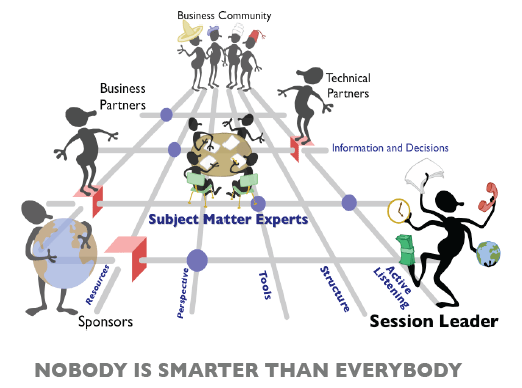
Value Derives When You Facilitate Scientist Because Nobody Is Smarter than Everybody
Whether you provide a structured workshop method or online tools to amplify collective intelligence, nobody is smarter than everybody. Linking scientists together, face-to-face or virtually, can dramatically speed up the rate of discovery. Empirical evidence shows that more options (ie, discovered) lead to higher-quality decisions. Some argue that crowdsourcing results are so profound that life as we know it will fundamentally change over the next few decades. When you facilitate scientists, more is clearly better. To facilitate scientists, provide them with a method and effective methods are dependent on neutral facilitation. They also need a deliverable that will not threaten their independent research, findings, and publications.
Why Wikis Fail
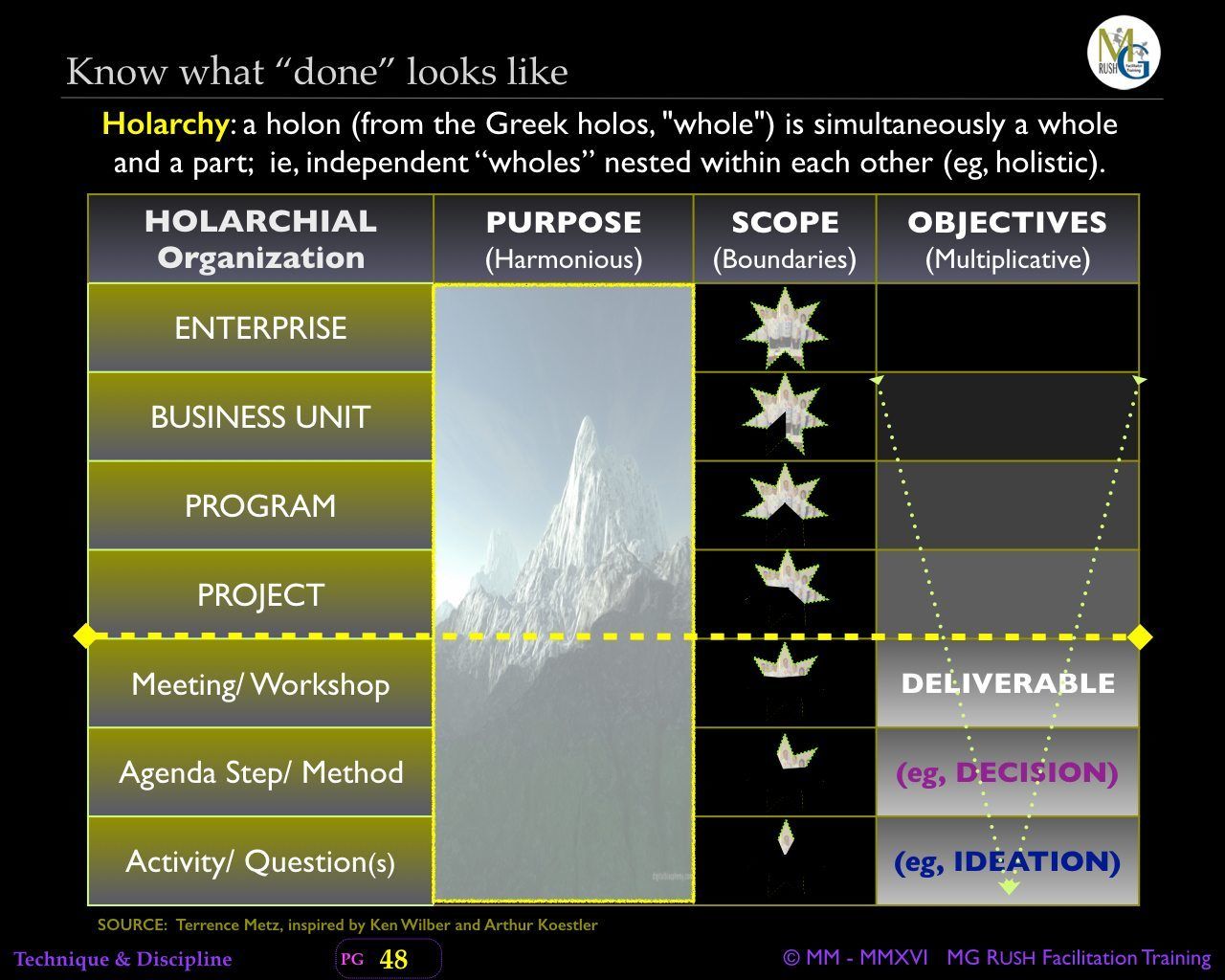
Corporate wikis rely on an environment of sharing and collaboration. When wikis fail, it is frequently attributable to weak or non-existent moderation (i.e., facilitation). In your organizational or corporate environments with a shared holarchy and sense of purpose, scope, and objectives, facilitation is frequently the only missing ingredient to breakthrough thinking and innovation.
To Facilitate Scientists, Provide Methods and Do Not Threaten Them
Eventually, we’ll come to realize that humanity sits atop our holarchy, and with an effective facilitator and collaborative environment, discover that no problem is too complex to solve. Keep in mind that there are only three reasons why groups fail:
- They don’t have the proper talent,
- They don’t have the right attitude (i.e., apathetic or don’t care),
- or, They don’t know how (to succeed as a group)
The professional MGRUSH technique leads the HOW TO effort. Combined with an appropriate method, our talented scientists are capable of “Reinventing Discovery: The New Era of Networked Science” (a book by Michael Nielsen, a pioneer in the field of quantum computing).
Next, Considerations to Facilitate Asians and Europeans
The alumnae’s two different companies required a strategy document of their alliance to work with each other in a common supply chain. Specifically, the alumnus inquired about anything in particular to avoid or encourage.
Facilitate Asians and Europeans
Specific Solution on How to Facilitate Asians and Europeans
Speak with the participants to confirm their explicit expectations and then manage accordingly. When conducting confidential, one-on-one interviews, participants will speak more openly about “anything in particular to avoid or encourage.”
Basic Considerations on How to Facilitate Asians and Europeans
- Icebreakers: Consider icebreaker activities that allow participants to share some of their social values, such as asking about a favorite childhood memory or describing their favorite holiday (i.e., vacation) destination and activities.
- Names: An effective facilitator will NOT use people’s names, but rather substitute open hands and eye contact to draw in participation and to pass the talking stick. During breaks and social times, or when discussing administrivia such as evening plans, strive to use people’s last names and titles, including respect toward academic and medical titles. During private introductions, handshakes are a reasonable default standard, perhaps with a slight bow—avoid hugging, arm humping, and shoulder thwacking as too much physical contact.
- Protocol: Emphasize the difference in roles. For example, we treat our parents differently than we treat our children. We may treat customers differently from suppliers. During the workshop, emphasize leaving titles and roles on the other side of the threshold so that everyone has permission to speak freely. When the Joint Chiefs meet, they may wear sweaters over their military stars, so that four-star generals do not claim superiority over three-star generals in a workshop environment. If the armed forces can encourage equality of voice, so can we.
- Punctuality: Punctuality is important. Keep your stated promises about when to start, including after breaks and meals. If not, your broken promise will frustrate participants and cause some to challenge the integrity of the session leader. If the session leader claims punctuality but permits a delayed starting time, they may be seen as someone who cannot be trusted. Be sure to use MGRUSH timers to get people to return from breaks and start on time. If necessary, offer a ten-minute break every fifty minutes, but start on time.
Additional Considerations on How to Facilitate Asians and Europeans
- Rhetoric: Avoid slang, colloquialisms, and American jargon. It is not uncommon for Europeans and Asians to speak in English and understand each other better than an American. While facilitating and providing reflection, stick closely to verbatim words and expressions rather than “interpreting.” If the participants felt there was a better term or expression, they would have used it the first time. Unless the participant asks for language assistance, be patient and avoid volunteering content, unless asked.
- Breakout Groups: Use breakout groups frequently during the agenda, especially during the ideation step within brainstorming. Plan your break-out sessions based on knowledge from interviews. Appoint a CEO (i.e., chief easel officer) for each group. Strive to creatively assign group titles or names that harmonize with the theme of the workshop (e.g., star constellations). Simply calling out 1,2, 3 indicates that the activity was not important enough to plan further. Understand methodologically that sometimes it is appropriate to create homogenous groups (i.e., think alike) and other times it may be advantageous to create heterogeneous groups (i.e., embrace pluralism).
Commonalities to Facilitate Scientists or to Facilitate Asians and Europeans
Be certain to secure pre-meeting buy-in about the purpose, scope, and deliverables of the workshop. Ideally, explain your agenda through a metaphor or analogy. Next, ensure that the method will engage the participants and not drag on and bore them. If you keep them engaged and focused, you will clearly have made it easier for them to build and decide. Do not discount the importance of a formal review and wrap-up. Plan on an approach the group accepts in advance to manage action steps or roles and responsibilities. Invest some time in the MGRUSH Guardian of Change so that they agree on their primary messaging to other executives and stakeholders at the conclusion of the workshop. Moreover, be sure to obtain some feedback on your performance, so that you may continuously improve your talents as an effective, facilitative leader.
______
Don’t ruin your career by hosting bad meetings. Sign up for a workshop or send this to someone who should. MGRUSH workshops focus on meeting design and practice. Each person practices tools, methods, and activities every day during the week. Therefore, while some call this immersion, we call it the road to building high-value facilitation skills.
by Facilitation Expert | Sep 29, 2011 | Analysis Methods, Meeting Tools
One of the worst questions a facilitator could ask is “How would you like to categorize these?” They don’t know how. That’s why they hired you.
Categorizing and creating clusters of related items (or processes) makes it easier for a group to focus on their subsequent analysis and decisions. Learn the logic behind the secret now, when the challenge is how to categorize when facilitating.
Rationale for How to Categorize
The purpose of categorizing is to eliminate redundancies by collapsing related items into clusters or chunks (a scientific term). A label or term that captures the title for each cluster can be more easily re-used in matrices and other visual displays. Frequently we refer to the labels as “triggers” because they rely on a a single term for triggering back to the meaning and definition behind it. For example, “budgeting” refers to the activities and resources required to project, track, and balance accounts. When focused on “budgeting” the group is less likely to focus on the details of “accounts payable” “accounts receivable” or other discrete clusters. Categorizing also makes it easier for the team to analyze complex relationships and their impact on each other.
How to Categorize
Method for How to Categorize
Categorizing can take little or much time, depending on how much precision is required, time available, and importance. The underscoring method suggested below is quick and effective. The other methods may also be effective, but probably not as quick.
Underscore Common Nouns
Take the raw input or lists created during the ideation step and underscore the common nouns (typically the object in a sentence that is preceded by a verb). Verbs typically precede the object in a sentence as in “pay bills”. Use a different color marker for each group of nouns. By pointing to the underscored terms, ask the team to offer up a term, simple phrase, or label that captures the meaning of each cluster.
(Optionally)
For verification or to manage items that are not underscored, ask “Why _____?” The logic and secret behind categorizing follows.
NOTE: Items that share a common purpose likely have a common objective and can be grouped together. Verify that each item is WHAT they are doing and not HOW it gets done. Ask “WHY do you do this?”. Write the purpose next to the item. Continue with the next pairing—if it has the same purpose, then it will group together. When a number of activities relate—due to common purpose—have the group name the cluster. Put a visual box around the name for the cluster.
Transpose
Ask for a volunteer to take the underscored items and create a new statement or gerund that combines, integrates, and reflects the sentiment of the commonly underscored items. Write the new statement or gerund expression that signifies a grouping on a new and separate page. The terms may be more fully defined and illustrated with the list of all items that belong to each cluster. Notice how salt, mustard, and chutney may be grouped as “condiments’ because they share a common purpose. Use the MGRUSH Definition tool to build a consensual and robust definition if required.
NOTE: Format clusters as “gerund-like phrases.” That is, a noun followed by a gerund (a verb acting as a noun and usually ending with “ing”, “ment”, “tion”, or “ble” including “able” and “ible”). Examples are “Order Processing” or “Account Management” or “Resource Generation” or “Accounts Payable”.
Avoid vague terms such as “Management Reporting”—that have no specific goal. If the group includes a number of challenging processes, write these as a side list of “concerns” and continue with additional activities. Revisit the problem areas or concerns later, after the group has developed some momentum.
Avoid letting the group simply define their organization. For example, insurance companies have a tendency to define their “processes” as Underwriting, Claim Adjusting, and Operations. What they do from a process perspective (regardless of how they are organized) is Risk Assessment, Claims Payment, Portfolio Balancing, etc.
Transposing requires artful patience. Remain highly fluid and flexible. Activities may move around and processes may be re-labeled. There is no universally correct answer. Seek the terms that work best for the group that you are serving. And as always, seek to understand rather than be understood.
Scrub
Go back to the original list and strike the items that now collapse into the new terms created for each cluster in the Transpose step above. Allow the group to contrast any remaining items that have not been eliminated and decide if they require unique terms, need further explanation, or can be deleted.
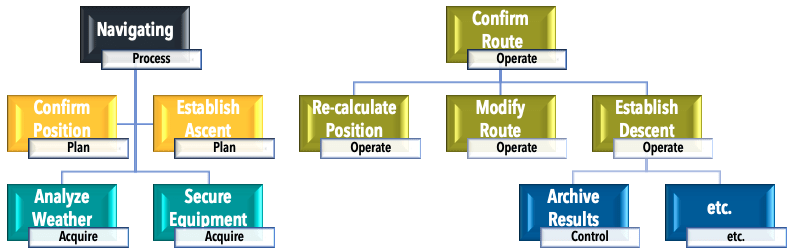
Here is another example of using activities for creating the processes that support the function of Mountaineering.
|
#
|
Support Activities
(verb-noun)
|
Result
|
|
1
|
Order supplies |
Perhaps part of the same process as Pack supplies such as Provisioning |
|
2
|
Make ascent |
Supports a process called Ascending |
|
3
|
Establish camp |
Supports a process called Sheltering |
|
4
|
Erect tent |
Determined to be HOW they support Sheltering because a tent is a concrete term and not an abstract concept |
|
5
|
Measure distance |
Supports a process called Navigating |
|
6
|
Determine altitude |
Supports process called Navigating number 5 from above |
|
7
|
Predict weather |
Deemed to best support the Navigating process, rather than a stand-alone activity |
|
8
|
Confirm location |
Supports process called Navigating numbers 5, 6, and 7 from above |
|
9
|
Make fire |
Also determined to be HOW they support Sheltering because fire is a concrete term and not an abstract |
|
10
|
Pack supplies |
Supports process called Provisioning, along with number 1 from above |
|
etc. |
|
Comparison Review
Before transitioning, review the final list of clusters and confirm that team members understand the terms and that they can support the operational definitions. Let the team members know that they can add additional terms to the clusters later, but if they are comfortable with them as is, to move on and do something with the list, as it was built for input to a subsequent step or activity.
“Decomposing”
Once clusters or processes have been created, you can then further decompose into the various activities required to support the process. For example, with the process or cluster of “Navigating” we might find the following activities:
Reversing the Categories
(In Conclusion, Other Grouping Themes)
Humans visually perceive items not in isolation but as part of a larger whole. The most frequent cause of categories is common purpose (e.g., gardening tools). However, the principles of perception include other human tendencies such as:
- Similarity—by their analogous characteristics
- Proximity—by their physical closeness to each other
- Continuity—when there is an identifiable pattern
- Closure—completing or filling in missing features
In a world where everyone can engage in decisions that affect them
______
Lead the Change—One Meeting at a Time
Are you ready to transform how decisions are made, problems are solved, and alignment is built in your organization?
True meeting leadership goes beyond setting an agenda. It requires a facilitator who can navigate complexity, balance voices, and drive toward outcomes with clarity and consensus. Our Professional Meeting Leadership Workshop and facilitation training equips you to do just that—blending human-centric methods with structured analytical tools to foster rigor, inclusivity, and results that stick.
- Practice live.
- Get expert feedback.
- Build confidence that lasts.
Whether your meetings suffer from unclear objectives, disengaged participants, or decision fatigue, this workshop will help you identify the root causes, apply proven facilitation techniques, and emerge as the leader every team needs.
Take the first step today—transform your meetings and magnify your impact.
👉 Click here to reserve your seat now.
#facilitationtraining #meetingdesign
Because every meeting should be a catalyst for change—not just another calendar event.
______
With Bookmarks no longer a feature in WordPress, we provide the following for your benefit and reference.
______
by Facilitation Expert | Jun 2, 2011 | Analysis Methods, Leadership Skills
Change or die? Most people do not change their minds—rather, they make a new decision based on new information. Sometimes the things they look at change as well.
Change or Die, The Business Process Improvement Manual
Every morning a gazelle wakes up. It knows it must run faster than the fastest lion or it will be killed.
Every morning a lion wakes up. It knows it must outrun the slowest gazelle or it will starve to death.
It doesn’t matter whether you are a lion or a gazelle when the sun comes up . . .
. . . you’d better be running.
Source: Unknown
Change or Die – Darwin
Change is stimulated by decisions. Groups make higher quality decisions than the smartest person in the group because groups create more options. Any group or individual presented with more options is known to make higher-quality decisions.
Most change is incremental or evolutionary rather than revolutionary. Yet, by harnessing one degree Fahrenheit, steam power ushered in the industrial revolution. Today’s revolution is both digital and dynamic, it is “in-formation”. With anything in formation, change is inevitable, only growth is optional.
“It is NOT the strongest of the species that survives, nor the most intelligent, but the one most responsive to change.” — Charles Darwin
Change or Die – The Tao
Some of the best books about facilitating change do not mention the term or role of a “facilitator”. Take Dr Wayne Dyer‘s book for example, “Change Your Thoughts, Change Your Life.”
We have always argued that effective facilitation begins with clear thinking, and that unclear speaking or imprecise writing is indicative of unclear thinking. Dr. Dyer’s transliteration of “The Tao”, is also called “Living the Wisdom of the Tao.”
The 17th verse begins and completes as follows:
Change Your Thoughts, Change Your Life
With the greatest leader above them,
people barely know one exists . . .
. . . The great leader speaks little,
He never speaks carelessly.
He works without self-interest
and leaves no trace.
When all is finished, the people say,
“We did it ourselves.”
Change or Die – Being Facilitative
One can easily substitute the term facilitator for a leader or include the adjective “facilitative” in front of the term, as in “facilitative leader.” Modern, facilitative leaders create an environment that is conducive to productivity, where all of the meeting participants feel that they have a personal responsibility to contribute and own the outputs, and the deliverables. Clear learnings that we can import from Dr. Dyer’s treatment of the 17th verse also include:
- Facilitators create an environment that helps everyone act responsibly.
- Effective facilitators are able to make themselves invisible when the group reaches high-performance mode. Although most groups do not reach this level, when they do, the facilitator becomes a scribe.
- When it is time for accolades, facilitators dissolve in the background, wanting the participants to feel that their accomplishments derive from their own talents.
- Instead of believing that they know what is best for a group, they trust the group participants and the method to generate what is best for them.
- The surest way to gain the trust and confidence of participants is to allow them to make as many decisions as possible. Avoid grabbing the low-hanging fruit by answering simple content. Put even the simplest items in the form of a question.
Try being more neutral as a business agent, friend, spouse, family member, parent, etc. and be surprised by the results of people who will live up to their own answers. Remember, there is usually more than one correct answer, the real question remains the taste for risk and reward.
______
Don’t ruin your career by hosting bad meetings. Sign up for a workshop or send this to someone who should. MGRUSH workshops focus on meeting design and practice. Each person practices tools, methods, and activities every day during the week. Therefore, while some call this immersion, we call it the road to building high-value facilitation skills.
by Facilitation Expert | May 26, 2011 | Analysis Methods, Leadership Skills
Leonardo da Vinci identified seven key traits or skills that one can cultivate to enhance intelligence and unlock the potential for genius.
Even after mastering these traits, one must overcome the fear of failure, which often prevents people from taking the first step. Likewise, da Vinci’s traits strongly align with the qualities of a facilitative leader, guiding others toward creativity and growth.
Therefore, da Vinci’s traits or skills or strengths include:
- Curiosita—an insatiable thirst for knowledge
- Dimostrzione—the ability to learn from experience
- Sensazione—the discipline of continuing to hone one’s senses
- Sfumato—the ability to cope with ambiguity
- Arte/ Scienza—holistic thinking
- Corporalita—what some people call sound mind and body
- Connessione—the ability to see deeply into the connection between things
More can be found in the book entitled “How to Think Like Leonardo da Vinci: Seven Steps to Genius Every Day” by Michael J. Gelb
Walter Isaacson
Subsequent to the original posting of this article, Walter Isaacson published a comprehensive and compelling biography, Leonardo da Vinci, that deserves a much higher ranking in a Google search. While nearly 600 pages in length, the well-researched and documented history of the polymath would provide an excellent return on your time and money. Isaacson identifies twenty Key Learnings. For more detail, you should turn to the original source. They include:
- Avoid silos.
- Be curious, relentlessly curious.
- Be open to mystery.
- Collaborate.
- Create for yourself, not just for patrons.
- Get distracted.
- Go down rabbit holes.
- Indulge fantasy.
- Let the perfect be the enemy of the good.
- Let your reach exceed your grasp.
- Make lists.*
- Observe.
- Procrastinate.
- Respect facts.
- Retain a childlike sense of wonder.
- See things unseen.
- Seek knowledge for its own sake.
- Start with the details.
- Take notes, on paper.
- Think visually.
- “Leonardo’s to-do lists may have been the greatest testament to pure curiosity the world has ever seen.” (pg. 523)
Finally, from a commercial perspective and in the spirit of radical innovation, here are some well-established “secrets”:
- Get intimate with your customers
- Make your own product obsolete
- Break the rules and be audacious
- Act small, think small—even nano small
- Celebrate failure—(see Thomas Alva Edison’s objectives)
______
In a world where everyone can engage in decisions that affect them
______
Lead the Change—One Meeting at a Time
Are you ready to transform how decisions are made, problems are solved, and alignment is built in your organization?
True meeting leadership goes beyond setting an agenda. It requires a facilitator who can navigate complexity, balance voices, and drive toward outcomes with clarity and consensus. Our Professional Meeting Leadership Workshop and facilitation training equips you to do just that—blending human-centric methods with structured analytical tools to foster rigor, inclusivity, and results that stick.
- Practice live.
- Get expert feedback.
- Build confidence that lasts.
Whether your meetings suffer from unclear objectives, disengaged participants, or decision fatigue, this workshop will help you identify the root causes, apply proven facilitation techniques, and emerge as the leader every team needs.
Take the first step today—transform your meetings and magnify your impact.
______
👉 Click here to reserve your seat now.
#facilitationtraining #meetingdesign
Because every meeting should be a catalyst for change—not just another calendar event.
______
With Bookmarks no longer a feature in WordPress, we provide the following for your benefit and reference.
______
by Facilitation Expert | Apr 21, 2011 | Leadership Skills
The Tao of Facilitation
10th Verse of the Tao
Can you love your people
and govern your domain
without self-importance?
. . .
working, yet not taking credit;
leading without controlling or dominating?
~~~~~~~~~~~~~~~~~~~~~~~~~~~~~~~~~~~
While it is not easy leaving the ego at the threshold, it is mandatory for modern and effective facilitative leadership. Meetings run best when the leader is NOT talking, but rather listening. There is an inverse relationship between the amount of air time consumed by the facilitator’s voice and the perceived success of the meeting. If the facilitator speaks 100 percent of the time, the meeting will be viewed as a complete failure. Participants will view meetings favorably when they speak most of the time during a meeting — guaranteed. That’s the tao of facilitation.
Most of us have attended a class on public speaking. Listening, we learn, is no less important (and perhaps even more important) than speaking. Listening also supports facilitating, which is why listening is one of the core skills we apply in our facilitation training.
According to the Dalai Lama:
“When you talk, you are only repeating what you already know; but when you listen, you may learn something new.”
______
Don’t ruin your career by hosting bad meetings. Sign up for a workshop or send this to someone who should. MGRUSH workshops focus on meeting design and practice. Each person practices tools, methods, and activities every day during the week. Therefore, while some call this immersion, we call it the road to building high-value facilitation skills.
by Facilitation Expert | Apr 14, 2011 | Leadership Skills
The MGRUSH technique encourages different approaches based on whether your project is seeking incremental gain or requires real breakthroughs. Blue Ocean Strategy promotes breakthrough thinking, justified by the higher profits such thinking generates among companies studied by its authors, Kim and Mauborgne.[1]
Blue Ocean Strategy by W. Chan Kim and Renée Mauborgne
The authors note the failures of companies over the past fifteen to twenty years—since the publishing of In Search of Excellence and Built to Last—including Atari, Data General, Fluor, and National Semiconductor. Therefore, the cornerstone of Blue Ocean Strategy is value innovation, defined as “the integrated and simultaneous pursuit of differentiation (i.e., buyer value) AND low-cost (i.e., supplier value).”
Their analytical toolset begins with a strategy canvas that identifies the principle of competitive and investment factors within your industry. With wine as an example (in brief), they might include price, distinction, marketing, aging, vineyard, complexity, and range. Their framework (called Four Actions) relies on facilitating consensual agreement around four questions. Participants’ answers suggest a new value curve that might enable your company to shift from traditional industry factors to uncontested market space. The four questions are:
1. ELIMINATE––Which factors that the industry takes for granted should be eliminated?
2. RAISE––Which factors should be raised well above the industry’s standard?
3. CREATE––Which factors should be created that the industry has never offered?
4. REDUCE––Which factors should be reduced well below the industry’s standard?
Illustrating Blue Ocean Strategy Four Actions Using Cirque du Soleil
For example, they suggest the success of Cirque du Soleil (compared to a traditional circus) accelerated with the following insights:
1. ELIMINATE––Star performers, animal shows, etc.
2. RAISE––Unique venue, type of concession sales, etc.
3. CREATE––Theme, artistic music, and dance, etc.
4. REDUCE––Multiple show arenas, thrill, and danger, etc.
Using the strategy canvas of Southwest Airlines they emphasized the factors of friendly service, speed, and frequent point-to-point departures. Both Cirque du Soleil and Southwest Airlines provide shared focus, divergence, and a compelling tagline. Overall, the authors’ steps for visualizing strategy draw upon group discussions and consensus—aka, excellent facilitation. They also suggest the use of a Pioneer-Migrator-Settler perceptual map that would seem to offer far less benefit than seeking consensus with answers to the Four Actions above.
Blue Ocean Strategy offers additional and valuable questions[2] that challenge each of the life-cycle steps (e.g., MGRUSH’s Plan-Acquire-Operate-Control). These questions seek to identify the biggest blocks faced by value drivers such as productivity, simplicity, convenience, risk, fun/ image, and environmental friendliness.
Blue Ocean Strategy Organizational Hurdles
The authors finish their discussion with four “organizational hurdles” including politics, motivation, resources, and groupthink (i.e., “cognitive”). However, like many academics, they complete their otherwise valuable book by discussing the importance of converting the strategy into execution—missing the importance and significance of building consensual analysis to pave the way. They jump from the WHY to the HOW without a complete understanding of WHAT is required—i.e., the consensual aspects that assure buy-in, confidence, and ownership. They talk about the importance of attitude and behavior but offer little insight into how to acquire a “fair process,”—something that MGRUSH alumni do regularly by building consensus around the analysis framework.
[1] See chart on page 7, “The Profit and Growth Consequences of Creating Blue Oceans.”
[2] See chart on page 123, “The Buyer Experience Cycle.”
______
Don’t ruin your career by hosting bad meetings. Sign up for a workshop or send this to someone who should. MGRUSH workshops focus on meeting design and practice. Each person practices tools, methods, and activities every day during the week. Therefore, while some call this immersion, we call it the road to building high-value facilitation skills.
by Facilitation Expert | Mar 17, 2011 | Communication Skills
“The term ‘strategy,’ much like ‘quality,’ is often overused and should be applied with precision. ‘The strategy’ should only be used unambiguously when it reflects a clearly defined and singular perspective.”
The Strategy
It’s important to carefully differentiate between the terms “the strategy,” “a strategy” (or “the strategies”), and “a strategic plan.” For a facilitator attuned to rhetorical precision, each of these terms carries distinct meanings. However, many people tend to use them interchangeably, often leading to confusion.
So, what distinguishes a strategic plan from a department plan, a product vision, a project plan, or a team plan? The primary difference lies in their scope. At its core, a “plan” can be succinctly defined with three words (or preferably five): “who does what” (by when). These components of every plan apply throughout every level of an organization (see Holarchy).
When planning, every group and individual need answers to the questions explained in our “Strategic Planning Agenda.”
- Mission (why are we here?)
- Values (who are we?)
- Vision (where are we going? how do we know if we get there or not?)
- Success Measures (what are our measurements of progress?)
- Current Situation (where are we now?)
- Actions (what should we do?—from strategy through tasks)
- Alignment (is this the right stuff to do?)
- Roles and Responsibilities (who does what, by when?)
- Communications Plan (what should we tell our stakeholders?)
The term “strategy” within an organization or division often refers to a set of initiatives, typically organized as either a program or a portfolio. These initiatives consist of approved projects that receive investment funds and help further define the overarching goals. The program’s “strategy” is shaped by the quantity and type of projects within the portfolio. At the project level, “strategies” focus on the specific tactics needed to ensure the project’s success. Meanwhile, the team’s “strategy” involves the tasks and operations necessary to implement the project and support its ongoing operation and improvement.
The meaning of “strategy” is highly dependent on the perspective it serves. Referring to “the strategy” without clarifying its context provides only a partial understanding. To gain deeper insight into operational differences and to facilitate better alignment, consider the organizational holarchy and how each level contributes to the overall strategic framework.
Holarchy of Who Does What
Alternative (upside down) View of the Holarchy (shared purpose, scope, and objectives)
______
Don’t ruin your career by hosting bad meetings. Sign up for a workshop or send this to someone who should. MGRUSH workshops focus on meeting design and practice. Each person practices tools and methods daily during the week. While some call this immersion, we call it the road that yields high-value facilitation skills.
Go to the Facilitation Training Store to access proven, in-house resources, including full agendas, break timers, forms, and templates. Also, take a moment to SHARE this article with others.
To Help You Unlock Your Facilitation Potential: Experience Results-Driven Training for Maximum Impact
#facilitationtraining #meeting design
______
With Bookmarks no longer a feature in WordPress, we need to append the following for your benefit and reference
by Facilitation Expert | Feb 24, 2011 | Communication Skills
With this initial blog, we have launched compelling content about the dynamic role of a facilitator in the interactive world of instant communications. This Best Practices site anchors feeds to Google+, Linked-In, Reddit, Twitter, and hundreds of other sites for seekers of improved servant leadership skills — to make easy.
facilius reddo — The Modern/ Facilitative Leadership Style to Make Easy
Facilius Reddo: Embracing the Modern Facilitative Leadership Style
The term “facilitaera” first appeared in France in 1611, during the Renaissance, originating from the Latin phrase facilius reddo, which means “easily accomplished” or “attained.” At its core, “facil” translates to “make easy.”
To Make Easy Using Dynamic Content: The Evolving Role of Facilitators in an Age of Instant Communication
We aim to make it easier for you to make it easier for others to explain issues and positions, create and understand options, and make more informed decisions. Our goal supports your facilitative efforts to simplify complex processes, empowering you to make it easier for others to articulate issues, explore and understand options, and make informed decisions.
Purpose: To Make It Easy
At MGRUSH we define “consensus” as a situation where everyone can support the outcome without losing sleep over it. Our mission is to equip you with the tools and techniques to help others achieve true consensus—not by taking the easy way out, but by fostering creativity, innovation, and overcoming barriers like miscommunication, politics, and perceived intolerance.
Your role and attitude are critical. By engaging with this Best Practices series, you’ll cultivate an attitude of continuous learning and improvement. In this millennium, learning and listening have emerged as the most effective attitudes for facilitators. We invite your comments, feedback, and challenges, and encourage you to share this content with session leaders—even those who aren’t MGRUSH-certified facilitators.
Upcoming Topics
In other articles, you can look forward to exploring topics such as:
- The Art of Precise Questioning
- Rhetorical Precision: The Impact of a Single Word
- Overcoming Speaker Challenges
- The Tao of Facilitation
- Transforming Your Responsibility Matrix into a GANTT Chart
- Reviews of Cutting-Edge Research and Empirical Studies
______
Meetings must rise above the tiny opening of words and embrace the fullness of human insight—through listening, visuals, stories, numbers, and symbols. The transformation begins not with tools, but in mindset. Leave your ego at the threshold, and step into the structures of meetings that get results.
In a world where everyone can engage in decisions that affect them
______
Lead the Change—One Meeting at a Time
Are you ready to transform how decisions are made, problems are solved, and alignment is built in your organization?
True meeting leadership goes beyond setting an agenda. It requires a facilitator who can navigate complexity, balance voices, and drive toward outcomes with clarity and consensus. Our Professional Meeting Leadership Workshop and facilitation training equips you to do just that—blending human-centric methods with structured analytical tools to foster rigor, inclusivity, and results that stick.
- Practice live.
- Get expert feedback.
- Build confidence that lasts.
Whether your meetings suffer from unclear objectives, disengaged participants, or decision fatigue, this workshop will help you identify the root causes, apply proven facilitation techniques, and emerge as the leader every team needs.
Take the first step today—transform your meetings and magnify your impact.
______
👉 Click here to reserve your seat now.
#facilitationtraining #meetingdesign
Because every meeting should be a catalyst for change—not just another calendar event.
______
With Bookmarks no longer a feature in WordPress, we provide the following for your benefit and reference.
______