by Facilitation Expert | Sep 12, 2019 | Communication Skills, Facilitation Skills, Leadership Skills, Managing Conflict, Meeting Support
We all have skills to perform many roles in life, such as switching quickly between parent and child when attending a family gathering, or switching quickly between friend and customer when shopping or dining with a significant other. Likewise, structured facilitator training enables facilitators to switch their consciousness quickly between the roles of facilitator and meeting designer.
NOTE: A facilitator can “show up” with someone else having performed the coordination, documentation, and meeting designer roles.
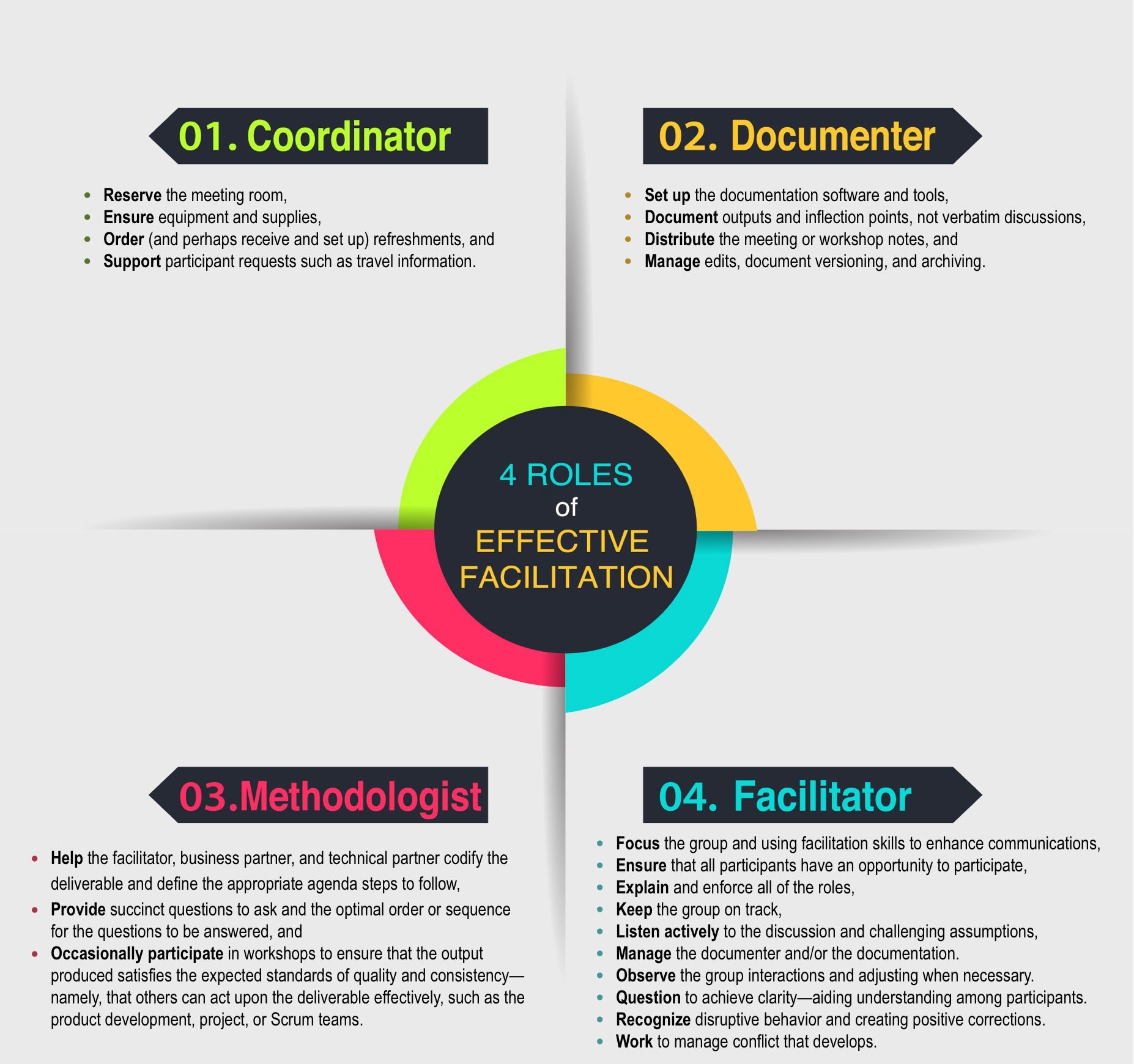
Four Roles of Effective Facilitation

-
Coordinator:
- This role is usually filled by admin support or by someone who will be the facilitator. The coordinator role is not always formal but must exist. Therefore, preparation responsibilities include:
-
-
- Reserve the meeting room,
- Ensure the arrival of equipment and supplies,
- Seeing to (and perhaps receiving and setting up) refreshments, and
- Giving support on participant requests such as logistics, timing, and travel information.
-
Documenter (or, Scribe):
- Occasionally this role is filled by an assigned scribe. But, frequently, the individual who is the facilitator performs this role alone. Regardless, the scribe must record the group’s ideas in an organized manner. However, documenters do not edit or change the content on their own. Responsibilities include:
-
-
- Set up the documentation software and tools,
- Capture outputs and inflection points, not verbatim discussions,
- Distribute the meeting or workshop notes, and
- Manage edits, document versions, and archives.
Neutrality
The scribe reacts to facilitator requests. Therefore, the role demands unbiased and neutral behavior during facilitated sessions. Any judgment, evaluation, or “improvement” of content potentially leads to a biased, distorted record of session output and must be avoided.
Deliverable
The meeting objective is not recording minutes, but writing down outcomes and outputs with a sufficient amount of detail to enable accurate review and understanding. The output must satisfy the session deliverable and provide information for the product or project it supports. After that, the document trail serves as the group record of what is agreed upon. The deliverable provides a sense of group accomplishment. Frequently, the document trail provides the only artifact of clear results from the group effort.
-
Methodologist (or, Meeting Designer):
- The meeting designer’s role details the approach or agenda steps used in a meeting. The source of the meeting design may change throughout the life cycle of a product or project. For example, in the planning phase, the meeting designer may be a strategic planner—someone who understands how to develop an action plan. In the analysis phase, the meeting designer may be an analyst, a process expert, a business architect, or some combination. In the design phase, the meeting designer may be a workflow or user experience specialist.
Responsibilities include:
-
-
- Help the facilitator, business partner, and technical partner codify the deliverable and define the appropriate agenda steps to follow,
- Provide succinct questions to ask and the optimal order for asking the questions,
- Occasionally participating in meetings to ensure that the meeting output meets the standards of quality and consistency—namely, that others can act upon the deliverable effectively, such as the product development, project, or Scrum teams. While meeting designers may suggest content, their most valuable input comes from raising additional questions for the group.
- The meeting designer’s role is not necessarily a single individual or even a person. For example, the executive sponsor could be the meeting designer in strategic planning. The meeting designer for buying travel tickets could be a system such as Expedia. The meeting designer could copy their design from a framework such as Scrum or SAFe. Business or technical partners (i.e., project management) frequently serve as meeting designers.
- The session leader is commonly the meeting designer. If that’s you, seek out the expert of the deliverable—one who clearly understands the questions to ask that will build the product needed, whether it’s planning, requirements gathering, prioritizing, “hot wash”, etc.
-
Facilitator:
- The session leader role demands many, many tasks. Thus, the success of the session depends on your real skills, knowledge, and abilities as a group leader. The facilitator’s role frequently includes ALL OF the traditional roles of “Facilitator” discussed below, along with the roles of “Coordinator”, “Documenter”, and “Methodologist”, discussed above. Therefore, managing context remains the key focus of the facilitator. Other responsibilities include:
-
-
- Create synergy by focusing the group and using your facilitation skills to enhance communications,
- Ensure that all participants have an opportunity to participate,
- Explain and enforce all of the roles,
- Keep the group on track,
- Listen actively to the discussion and challenge assumptions,
- Manage the scribe and/or the documents,
- Observe the group and adjust when necessary,
- Questions that achieve clarity—aiding understanding among participants,
- Recognize disruptive behavior and create positive corrections, and
- Work to manage conflict that develops.
Servant Leadership
The facilitator role creates an environment where every participant has the opportunity to collaborate, innovate, and excel. Listening to and observing the team’s progress will help you to better serve your participants. Above all, meeting leader skills reflect the core aspects of servant leadership.
NOTE:
Begin to sense how much easier and yet more effective you could be if someone else coordinated the room, participants, and supplies. If someone else provides a detailed agenda with the activities to launch and questions to ask. If someone else managed the documents at the end of it all.
In fact, as session leader, you could lead a planning workshop in the morning for one group, at one facility, and a user experience workshop, in a different facility, for another group in the afternoon. And you could do so easily if the responsibilities of the coordinator, meeting designer, and scribe are assignedy. Specialization of labor led to economical growth around the world, but few realize the same concept applies to the traditional role of a ‘facilitator.’
Facilitation Skills
The Project Management Institute (PMI):
PMI identified three key skills that needed to be improved in project managers. Specifically, they mention improvement that needs to be made in:
- Abstract thinking (i.e., pulling in multiple perspectives),
- Planning (i.e., upfront loading), and
- Facilitation
The principles and practice of facilitating, rather than preaching, provide the most effective means to create clear messaging. Therefore, listening and observing are core to the speaker’s success.
International Institute of Business Analysis™ (IIBA®):
The IIBA’s Guide to the Business Analyst Body of Knowledge® known as BABOK® Guide v3 stresses facilitation. When explaining disciplined and structured thinking, the term ‘facilitate’ appears 112 times over 514 pages. Statistically, approximately 25 percent of the BABOK‘s pages mention the need or link to the importance of facilitation.
The List Goes On . . .
Many sources sing the praise and importance of facilitation. Yet what real skills are required and are they shared equally across all meeting types?
For this unique assessment, we took our own Professional Facilitation curriculum and compared it with . . .
- International Association of Facilitators (IAF) 18 Core Competencies,
- International Institute for Facilitation (INIFAC) 30 Master Facilitator Competencies, and
- Institute of Cultural Affairs (ICA) 35 Certification Competencies
Facilitator skills are not equally important in every facilitated session or meme.
- Business Facilitation (or, formal organizations),
- Conflict Management (or, mediation),
- Community Facilitation (with a large stress on ‘helping’), and
- Instructional Facilitation (such as teaching, training, coaching, etc.)
The combined result below compares 25 facilitator skills and scores the importance of each against the four types of facilitation. Structured facilitator training best supports business facilitation, followed by conflict negotiation, and finally, community facilitation and instruction of various types as shown in the chart below.
For each skill, we force ranked from Low to High and to prevent repeating the same score. Next, we changed the PowerBalls symbols to numeric values from 5-High to 1-Low to create a total score that shows the impact of the skills across the four meeting types. Not surprisingly, structured facilitator training and skills are needed most for Business Facilitation followed by Community Facilitation, Conflict Mediation, and then Instructional meetings or training situations.
Facilitator Training Skills
NOTE: Some skills for mediation and instruction may not be included because they have little impact on structured facilitator training. For example:
- Curriculum Development
- Content Expertise
Bottom Line
Within consensus-building and decision-making situations, structured facilitator training proves to substantially help groups get more done, faster. For optimal facilitator training, begin with understanding the four roles of effective facilitation, namely coordinator, documenter, meeting designer, and facilitator.
Thus, if you are facilitating business meetings and want to improve your effectiveness, strive to improve your structured facilitator skills. Above all, your investment in facilitator training will pay for itself many times over.
______
In a world where everyone can engage in decisions that affect them
______
Lead the Change—One Meeting at a Time
Are you ready to transform how decisions are made, problems are solved, and alignment is built in your organization?
True meeting leadership goes beyond setting an agenda. It requires a facilitator who can navigate complexity, balance voices, and drive toward outcomes with clarity and consensus. Our Professional Meeting Leadership Workshop and facilitation training equips you to do just that—blending human-centric methods with structured analytical tools to foster rigor, inclusivity, and results that stick.
- Practice live.
- Get expert feedback.
- Build confidence that lasts.
Whether your meetings suffer from unclear objectives, disengaged participants, or decision fatigue, this workshop will help you identify the root causes, apply proven facilitation techniques, and emerge as the leader every team needs.
Take the first step today—transform your meetings and magnify your impact.
👉 Click here to reserve your seat now.
#facilitationtraining #meetingdesign
Because every meeting should be a catalyst for change—not just another calendar event.
______
With Bookmarks no longer a feature in WordPress, we provide the following for your benefit and reference.
______
Terrence Metz, president of MG RUSH Facilitation Training, was just 22-years-old and working as a Sales Engineer at Honeywell when he recognized a widespread problem—most meetings were ineffective and poorly led, wasting both time and company resources. However, he also observed meetings that worked. What set them apart? A well-prepared leader who structured the session to ensure participants contributed meaningfully and achieved clear outcomes.
Throughout his career, Metz, who earned an MBA from Kellogg (Northwestern University) experienced and also trained in various facilitation techniques. In 2004, he purchased MG RUSH where he shifted his focus toward improving established meeting designs and building a curriculum that would teach others how to lead, facilitate, and structure meetings that drive results. His expertise in training world-class facilitators led to the 2020 publication of Meetings That Get Results: A Guide to Building Better Meetings, a comprehensive resource on effectively building consensus.
Grounded in the principle that “nobody is smarter than everybody,” the book details the why, what, and how of building consensus when making decisions, planning, and solving problems. Along with a Participant’s Guide and supplemental workshops, it supports learning from foundational awareness to professional certification.
Metz’s first book, Change or Die: A Business Process Improvement Manual, tackled the challenges of process optimization. His upcoming book, Catalyst: Facilitating Innovation, focuses on meetings and workshops that don’t simply end when time runs out but conclude with actionable next steps and clear assignments—ensuring progress beyond discussions and ideas.
by Facilitation Expert | Aug 12, 2019 | Communication Skills, Facilitation Skills, Leadership Skills, Meeting Structure, Meeting Support, Meeting Tools
How often have you found yourself in the hallway after a meeting wondering what happened?
Daniel Pink’s newest research proves that the end of a meeting is more important than the beginning. Endings leave lasting impressions. Recency triumphs over primacy. And yet, how often have you found yourself in the hallway after a meeting wondering what happened? What did we agree to? Or worse, you disagree with someone who thinks the results are different if not diametrically opposed, to what you think. Enter, the Guardian of Change.
Nobody wants more meetings but we still meet a lot. We meet for a purpose. Successful meetings have an end in mind. Some call it “DONE”. Others call it a deliverable. Either way, the meeting purpose is satisfied once the objective is reached, once we have the object of the meeting. Notice that the deliverable of meetings is a noun, never a verb. You cannot hand off a ‘verb’ to someone else, but you may hand them a ‘noun’ or an object.
Even if the deliverable is a plan of actions (verbs) to take when the meeting is over, those actions need to be documented, and that document is called a plan. Any plan details WHO does WHAT. The plan is the object or deliverable, not the action itself. Meeting objectives sets plans in motion so that the real work begins after most meetings end.
If you ask a group of ten people, “What is a process?” or “What does a single requirement look like?”, you will assuredly get ten different responses. All of them are correct for their respective contributor. Indeed, there is more than one correct answer.
Frequently, however, it’s a good idea for participants to echo the same message so it sounds like they were in the same meeting together. The importance is critical when you have a multi-national organization where translation issues cause misunderstanding and turbulence.
For major initiatives such as strategic planning or project launches, it is wise to invest a few hours to build a robust communications plan, but most meetings do not afford that much time. Rather than skip the activity entirely, Use the MGRUSH Guardian of Change tool to consensually build quick and simple messages.
Guardian of Change
When your meeting or workshop is complete, take a moment to get participants to agree on what they will tell others they got DONE in the meeting. We call that activity the “Guardian of Change” and it should be included in the Review or Wrap agenda step of nearly every meeting you attend.
Here’s how it works for most meetings, and it only takes five minutes. For critical and public workshops such as strategic planning, this activity may be pulled out of the Review step and made an entirely discrete agenda step. Most would call that step a “Communications Plan.” More about that, later.
Before participants depart from a standard or even a standing meeting, facilitate their “water-cooler” “coffee pot” or elevator speech” with a simple T-Chart. Allowing for two stakeholder groups, usually, one that looks upward (eg., superiors) and another that looks across or downward such as “Employees”. Your appropriate group titles are placed at the top of each column in your T-Chart.
Two-column (T-chart) Guardian of Change Next, working one at a time, simply ask:
“When you walk into a Superior in the hallway and they ask you what was accomplished in this meeting, what are you going to tell them?”
Apply the Brainstorming principles of Ideation, and write down their input verbatim and without any discussion. When someone objects, politely shut them down and remind them that for the moment, there is no discussion. Analysis and agreement will follow once initial ideas have been written down.
Move to the second column and ask . . .
“When you walk into another employee in the hallway and they ask you what was accomplished in your meeting, what are you going to tell them?”
Common sense dictates that frequently the messages are different in each column. And you will discover that people will argue over the messages and even single terms suggested such as “complete” versus “substantial progress.” In fact, what your participants need now is a facilitator.
Through active listening, clear definitions, and an appeal to the organizational objectives, you will get the group to agree on what they are going to tell others. You will have them sounding like they were in the same meeting together.
True to Life Example
Guardian of Change Note in the following example from our pro bono effort with a 501(c)(3) organization, some initially wanted to tell parents that the organization was . . .
- “beefing up”
- “More support”
- “Expansion”
- “Enhancing”
After extensive, if not heated, discussion, the group agreed to downplay ‘promises’ to better manage expectations. Level-setting. Can you imagine the different messages going around the parental community if we had not facilitated the Guardian of Change?
Some parents would have heard they are “expanding, enhancing, etc…” and others would NOT have heard “about that.” As if the participants were coming from different meetings.
Rather, the participants agreed that . . .
“It was discussed that items in GREY (for parents) ought to be substituted with lighter rhetoric and general aspirations rather than concrete claims.”
The message that went out to parents was simple and unified . . .
“The P.A.P. program is our top priority and we’ve got good people working on it.”
Don’t let unmanaged messages circle around, get to “management”, and let you get bitten in the butt. Prevent disturbing turmoil with just a few minutes of structured activity. You’ll be all so glad you did, you’ll want to thank us later.
Comprehensive Communication Plans
Communications plans are complicated by the number of stakeholder groups that need to be messaged, the potential variety of the messages themselves, the manner of delivery (ranging from face-to-face to press release), and the frequency or timing of delivery as parts of the message may be offered up over a period of time.
Communications Planning Many cultures and methods today use the term “Champion” to signify someone who is leading or promoting. Be careful. Our experience with a Fortune 100 manufacturer discovered that their best new product ideas were not being commercialized. Rather, new product ideas that were receiving approvals and funding were highly correlated with the charisma, charm, and personality of the Champion, rather than the value of the idea itself.
Substitute the term “Guardian” for the term “Champion”.
As a stakeholder, you probably don’t want to hear that more attractive commercial opportunities are being passed up because of the persuasiveness of competing Champions. Therefore, we encourage organizations to substitute the term Guardian for the term Champion. Typically, you really want someone to guard and protect their concepts. You want assurance that they will adequately represent and accurately speak to the value of the concepts.
You don’t want your Guardians to let others eat away at the value, detract something from the value, or characterize the value as being worth less than it is. Nor do you want them to inflate the value to be worth more than it actually is. You would prefer they guard it, for what it’s worth, nothing less and nothing more. Therefore, we encourage the use of the term “Guardian” rather than a “Champion” who spearheads their idea at all costs.
Ever see an idea get approved because of the promoter, rather than the intrinsic value of the idea? We all have. Even worse, have you ever seen a valid idea lose out because the promoter was fearful, shy, or timid?
There’s a story about the relatively shy inventor of the Selectric® typewriter who first took their invention to the Underwood typewriter company, a “Company of the Year” award winner. Underwood executives said “no”, so the inventor went to another company known for its scientists and evidence-based thinking and they said “yes.” That company was the International Business Machine Company, more commonly known as IBM. The rest, of course, is history. Underwood Typewriter went out of business ten years later.
In a world where everyone can engage in decisions that affect them
______
Lead the Change—One Meeting at a Time
Are you ready to transform how decisions are made, problems are solved, and alignment is built in your organization?
True meeting leadership goes beyond setting an agenda. It requires a facilitator who can navigate complexity, balance voices, and drive toward outcomes with clarity and consensus. Our Professional Meeting Leadership Workshop and facilitation training equips you to do just that—blending human-centric methods with structured analytical tools to foster rigor, inclusivity, and results that stick.
- Practice live.
- Get expert feedback.
- Build confidence that lasts.
Whether your meetings suffer from unclear objectives, disengaged participants, or decision fatigue, this workshop will help you identify the root causes, apply proven facilitation techniques, and emerge as the leader every team needs.
Take the first step today—transform your meetings and magnify your impact.
👉 Click here to reserve your seat now.
#facilitationtraining #meetingdesign
Because every meeting should be a catalyst for change—not just another calendar event.
______
With Bookmarks no longer a feature in WordPress, we provide the following for your benefit and reference.
______
Terrence Metz, president of MG RUSH Facilitation Training, was just 22-years-old and working as a Sales Engineer at Honeywell when he recognized a widespread problem—most meetings were ineffective and poorly led, wasting both time and company resources. However, he also observed meetings that worked. What set them apart? A well-prepared leader who structured the session to ensure participants contributed meaningfully and achieved clear outcomes.
Throughout his career, Metz, who earned an MBA from Kellogg (Northwestern University) experienced and also trained in various facilitation techniques. In 2004, he purchased MG RUSH where he shifted his focus toward improving established meeting designs and building a curriculum that would teach others how to lead, facilitate, and structure meetings that drive results. His expertise in training world-class facilitators led to the 2020 publication of Meetings That Get Results: A Guide to Building Better Meetings, a comprehensive resource on effectively building consensus.
Grounded in the principle that “nobody is smarter than everybody,” the book details the why, what, and how of building consensus when making decisions, planning, and solving problems. Along with a Participant’s Guide and supplemental workshops, it supports learning from foundational awareness to professional certification.
Metz’s first book, Change or Die: A Business Process Improvement Manual, tackled the challenges of process optimization. His upcoming book, Catalyst: Facilitating Innovation, focuses on meetings and workshops that don’t simply end when time runs out but conclude with actionable next steps and clear assignments—ensuring progress beyond discussions and ideas.
by Facilitation Expert | Jul 25, 2019 | Facilitation Skills, Leadership Skills, Meeting Support, Scrum Events
The Global SCRUM GATHERING® Austin was kicked off on a warm Monday morning in May by Daniel Pink. Because his research focused on time and timing, Daniel compiled and published his results and findings in his newest book When: The Scientific Secrets of Perfect Timing. Additionally, his presentation averaged a five-star rating from the 224 of us who checked in live.
During the Global SCRUM GATHERING kickoff, Daniel stressed the importance of two findings, highly relevant to facilitators:
- Regardless of how much time is allotted, real work does not begin until the meeting or project reaches its midpoint. Consequently, in a four-hour meeting, at the two-hour mark, someone will remark that “half our time has expired” and suddenly participants get serious. Similarly, at the project level, once the project reaches its midway point, contributors develop a sense of urgency and step up their contributions. Half-way warnings. Additionally, it doesn’t matter if you allow one hour, one week, or one month—be on the lookout for the halfway point.
(Keeping this in mind, with a powerful Introduction, using our 6-Step Method, you will NEVER wait half-way to help a team become productive.)
- “Endings” are more important than beginnings when it comes to memory and recall. While smooth starts remain critical, participants will evaluate you and the value of the meeting by the last five minutes.
(ie. What did we accomplish? (Review) What has changed in my world? (Next Steps) Who is going to manage xxxxxx? (Assignments) Our professional Review and Wrap recommends a fourth step for a solid close, get some feedback on how you did. Click the links for a good refresher on solid Introduction and Review and Wrap activities that no meeting, even 50 minutes in duration, should be without.)
The Global SCRUM GATHERING conference progressed during the week with topics covered by this author including . . .
“Any foreign innovation in a corporation will stimulate the corporate immune system to create antibodies that destroy it.”
Global SCRUM GATHERING
The Global SCRUM GATHERING may be summarized by Peter Drucker’s quotations above and below referenced during the session:
“The greatest danger in times of turbulence is not the turbulence; it is to act with yesterday’s knowledge.”
- How to be Agile enough to reinvent yourself (Stacey Ackerman was wonderful).
- Roger Brown provided compelling evidence and financials to hire an Agile coach (or, we would argue, a meeting and facilitation coach).
- Using Customer Journeys to help prioritize Product Backlogs.
- Shu-Ha-Ri or mastering Scrum—“first learn, then detach, and finally transcend.”
- The difference between Machine Learning and Artificial Intelligence. (All M.L. is A.I. but not all A.I. is M.L.) Be sure to use a data scientist or A.I. engineer to help build a methodology for your A.I. or M.L. workshops.
- Chris Messina, creator of using hashtags (initially on Twitter and now everywhere) closed with refreshing material and the importance of wealth—defined as the quantity and quality of connections with others.
Control the Room
Control the Room
Terrence concluded a week in Austin TX as a speaker at Douglas Ferguson’s Voltage Control-sponsored “Control the Room 2019”—Austin’s 1st Annual Facilitator Summit. Douglas, an alumnus and a very smart and compassionate guy (and professional Design Sprint facilitator), used the conference to break down the silos of facilitation. Succinctly summarized, In his words:
“to move past the guilds and methodology-centric gatherings and convene facilitators of all kinds to build rapport, learn, and grow together.”
Priya Parker (“The Art of Gathering”) opened the day with remarkable personality and humaneness. As reported in the following article:
“Her 90-minute talk was a pure delight and received a standing ovation. She is a stratospherically talented facilitator.”
You may access summaries of all “Control the Room” presentations HERE. The “Control the Room 2019” artwork captures our presentation segment. It has been borrowed from Douglas’ report, so additional kudos to Patricia Selmo for the graphic recording. “Control the Room” generated high energy, and warm camaraderie, and will return to Austin on a regular basis. Therefore, anybody who facilitates meetings would benefit from attending.
After recently working with Julia Reich, the graphic recorder of Stone Soup Creative, we have developed a strong affinity for graphic recording. Julia should be applauded (and hired) because her Meeting Pathway to Success provides a simple-to-follow guide for complex events called meetings (or workshops). You can download your copy HERE, or visit our Facilitation Store to order a poster-size copy. Meanwhile, below is her delightful infographic based on the MGRUSH Professional Curriculum when she attended in Columbus OH.
MGRUSH‘s Professional Facilitation Meeting Pathway
______
Don’t ruin your career by hosting bad meetings. Sign up for a workshop or send this to someone who should. MGRUSH workshops focus on meeting design and practice. Each person practices tools, methods, and activities daily during the week. Therefore, while some call this immersion, we call it the road to building high-value facilitation skills.
______
With Bookmarks no longer a feature in WordPress, we need to append the following for your benefit and reference
Terrence Metz, president of MG RUSH Facilitation Training, was just 22-years-old and working as a Sales Engineer at Honeywell when he recognized a widespread problem—most meetings were ineffective and poorly led, wasting both time and company resources. However, he also observed meetings that worked. What set them apart? A well-prepared leader who structured the session to ensure participants contributed meaningfully and achieved clear outcomes.
Throughout his career, Metz, who earned an MBA from Kellogg (Northwestern University) experienced and also trained in various facilitation techniques. In 2004, he purchased MG RUSH where he shifted his focus toward improving established meeting designs and building a curriculum that would teach others how to lead, facilitate, and structure meetings that drive results. His expertise in training world-class facilitators led to the 2020 publication of Meetings That Get Results: A Guide to Building Better Meetings, a comprehensive resource on effectively building consensus.
Grounded in the principle that “nobody is smarter than everybody,” the book details the why, what, and how of building consensus when making decisions, planning, and solving problems. Along with a Participant’s Guide and supplemental workshops, it supports learning from foundational awareness to professional certification.
Metz’s first book, Change or Die: A Business Process Improvement Manual, tackled the challenges of process optimization. His upcoming book, Catalyst: Facilitating Innovation, focuses on meetings and workshops that don’t simply end when time runs out but conclude with actionable next steps and clear assignments—ensuring progress beyond discussions and ideas.
by Facilitation Expert | Jul 5, 2019 | Analysis Methods, Decision Making, Meeting Agendas, Meeting Structure, Meeting Tools, Planning Approach, Problem Solving
Over the years, students and alumni have clamored for a simple reference sheet of our curriculum and how to prepare for a meeting. Consequently, we think we have it now and hope you agree.
Meetings can be expensive and wasteful, especially when poorly prepared. Therefore, download a PDF of the Meeting Pathway guide and Workshop Canvas on our Facilitator Resources page. Alternatively, go to the Alumni section of our website. Additionally, posters are available for purchase in assorted sizes and formats at our Facilitation Store.
- Graphic Meeting Pathway to thoroughly prepare and ensure meeting success.
- The Workshop Canvas aligns expectations for meeting and workshop charters.
Meeting Pathway to Success
Meeting Pathway to Success
Julia Reich, graphic recorder of Stone Soup Creative, should be applauded (and hired) because her Meeting Pathway to Success provides a simple-to-follow guide for complex events called meetings (or workshops). Primarily intended for individuals working on their own, Meeting Pathway begins with the end in mind (DONE). Oddly, however, it concludes with your final preparatory activities. Therefore, follow the six steps in the Meeting Pathway to remember everything critical to the success of your meetings (or workshops).
The Meeting Pathway provides a color-coded, single-page reference sheet that stresses the significant components of an important meeting, and includes:
Workshop Canvas
We are also introducing the first and only structured Workshop Canvas. Primarily intended for teams coordinating critical workshops, it similarly includes:
Use the Workshop Canvas to supplement the Meeting Pathway to reinforce clarity and help build consensus around the components of a successful meeting from your group’s perspective. The Workshop Canvas establishes a consensual tone based on transparency and evidence-based decision-making. Consider ordering a large poster version for use with Post-It® Notes, then photograph your ongoing development, and share it with other stakeholders as appropriate.
The Workshop Canvas includes 37 preparatory considerations.
Review and adapt the 37 questions for each meeting or workshop. Note that the three vectors of leadership [WHY}, facilitation [WHAT], and methodology [HOW] are sequenced. Additionally, they cut across four primary dimensions including Deliverable, Culture, Commitment, and Logistics.
MGRUSH alumni have immediate access to a brochure that includes both the Meeting Pathway (11 x 17) and the Workshop Canvas.
Poster versions of both are also available in the Facilitation Store in paper quality from a simple matte finish to photographic glossy on foam mount. For more information and prices go to Meeting Pathway or Workshop Canvas.
______
Don’t ruin your career by hosting bad meetings. Sign up for a workshop or send this to someone who should. MGRUSH workshops focus on meeting design and practice. Each person practices tools, methods, and activities daily during the week. Therefore, while some call this immersion, we call it the road to building high-value facilitation skills.
______
With Bookmarks no longer a feature in WordPress, we need to append the following for your benefit and reference
Terrence Metz, president of MG RUSH Facilitation Training, was just 22-years-old and working as a Sales Engineer at Honeywell when he recognized a widespread problem—most meetings were ineffective and poorly led, wasting both time and company resources. However, he also observed meetings that worked. What set them apart? A well-prepared leader who structured the session to ensure participants contributed meaningfully and achieved clear outcomes.
Throughout his career, Metz, who earned an MBA from Kellogg (Northwestern University) experienced and also trained in various facilitation techniques. In 2004, he purchased MG RUSH where he shifted his focus toward improving established meeting designs and building a curriculum that would teach others how to lead, facilitate, and structure meetings that drive results. His expertise in training world-class facilitators led to the 2020 publication of Meetings That Get Results: A Guide to Building Better Meetings, a comprehensive resource on effectively building consensus.
Grounded in the principle that “nobody is smarter than everybody,” the book details the why, what, and how of building consensus when making decisions, planning, and solving problems. Along with a Participant’s Guide and supplemental workshops, it supports learning from foundational awareness to professional certification.
Metz’s first book, Change or Die: A Business Process Improvement Manual, tackled the challenges of process optimization. His upcoming book, Catalyst: Facilitating Innovation, focuses on meetings and workshops that don’t simply end when time runs out but conclude with actionable next steps and clear assignments—ensuring progress beyond discussions and ideas.
by Facilitation Expert | Jun 11, 2019 | Analysis Methods, Decision Making, Meeting Agendas, Meeting Structure, Meeting Tools, Planning Approach, Problem Solving
During a four-day conference, we facilitated more than 20 speakers and varying presentations, each citing distinctive topics ranging from embracing social responsibility to utilizing Google® Hangouts for small groups. Participants applauded our approach, and we decided to share it here to help you become a more effective facilitator.
Challenges Associated with Facilitating Speakers and Conference Presentations
As observed recently at a PMI (i.e., Project Management Institute) event, speakers are typically preachy and not facilitative. This means more moving of lips and less active listening, resulting in less audience response and interaction. Session challenges include:
- Lack of any conflict to resolve, which makes for a boring session
- Unclear deliverable (i.e. “increased understanding” doesn’t have enough urgency for most participants)
- Uncertain purpose (preach, Q&A, applause—nothing is compelling or consensual about this approach)
- Lack of a glossary and unclear use of terms
Begin with the End in Mind When You Facilitate Speakers and Conference Presentations
Begin with the conference purpose, scope, and objectives (i.e., deliverables) clearly stated and mounted on large format posters throughout the week for immediate reference. Two other preparatory sheets that should be mounted and visible to all are the Simple Agenda and appropriate Ground Rules (e.g., silence the electronic leashes).
Throughout multiple presentations, some speakers will encourage questions during their presentations and others will ask participants to defer questions until their presentations have been completed. In either case, insist that questions be directed through the facilitator with clear reflection back to both the audience and the speaker. This enables you to repeat the question to ensure that all participants have heard it. Also, verify with confirmation that you “got it right” as you distill questions into fewer words using less commentary. After each speaker’s response, reflect as required in Active Listening, and distill their response into the fewest words, using their terms, that directly address the question.
Focused Q & A for Speaker Presentations
During conference presentations, most Q&A (i.e., questions and answers) revolve around clarity, and, as facilitators, you must strive to ensure clear understanding. But don’t stop there. Further challenge the topic, as appropriate, with questions about “anything substantive” that may have been missing. If you ask a smart group of people “Is anything missing?”, the answer is invariably “yes” because there is ALWAYS something else. Therefore, stress the concept of “substantive” “critical” or “important” to prevent the discussion from drifting. Next, seek for general agreement to ensure the participants can support the primary takeaways from each of the conference presentations, and that no one insists that something is highly erroneous or blatantly wrong.
During Q&A, carefully document the Key Findings, as emphasized by participants. After each Q&A, transfer the focus back to the conference purpose and deliverables.
In one of the conferences we facilitated, the deliverables were to provide answers to three discrete questions. We asked participants to link their new knowledge and understanding from presentations back to the three questions and, one at a time, asked them what it meant by re-phrasing their input as a direct response to one of the originally posted questions. Two of the three primary questions demanded future recommendations or actions. Which brings us to…
For each session, capture actions that need to take place after the conference has ended in support of the conference’s purpose. Another way to phrase this question that works very effectively is . . .
“Now that we have heard or learned (summary of participants’ Key Findings), what will you do different tomorrow?” — Facilitator
Bad Habits Die Hard
Nearly everyone conducts a question-and-answer session when new evidence or information has been unveiled. Typically, we then give the speaker a round of applause and take a break or dismiss. The assumption is that we all heard the same thing or that our interpretation will automatically lead to consensual changes and coherent behavior. Such is not always the case. Sometimes meeting participants take off in opposite directions based on their interpretation of new content.
Structure of the Trivium (or, Taleb’s Triad)
The Trivium Helps Facilitate Speakers and Conference Presentations
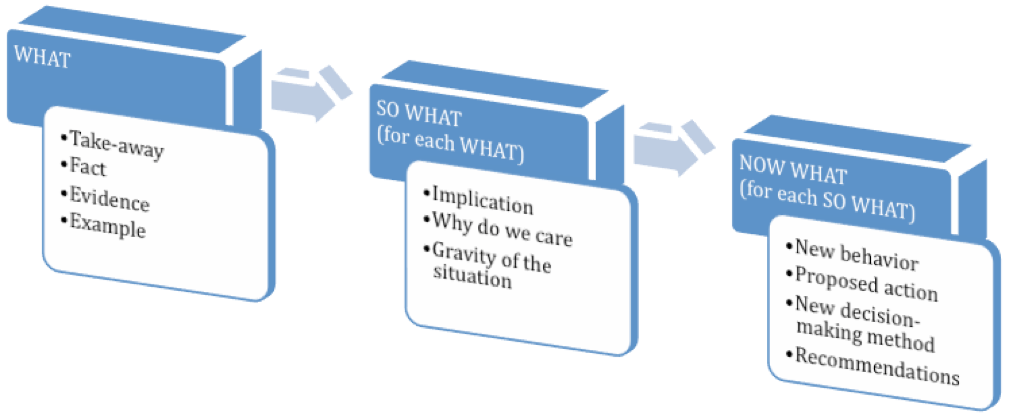
Some will note the basic structure below follows a strong sense of will, wisdom, and activity. Ranging from Plato’s Trivium (i.e., logic, rhetoric, and grammar) to a Use Case (i.e., input, process, output)—simple structure follows the basic flow of WHY before WHAT before HOW. To develop consensual understanding, deploy the following structure. Especially compel audience participation in steps 2 and 3 below; that is . . .
- FACT (or, evidence or example or something significant the speaker has contributed—the WHAT part)
- IMPLICATION (ask SO WHAT? from the audience separately for each FACT captured above)
- RECOMMENDATION (ask NOW WHAT? (we should do about it) from the audience separately for each IMPLICATION captured above.
The method begins optimally before the speaker’s presentation has begun. Namely, ask the listeners to be on the lookout for (takeaways), why we should care (implications), and what we may want to do differently that will make us more efficient or effective (recommendations). Speaker presentations should stimulate participants about what they can do differently. Therefore, conduct a review session with the same logic, breaking down the “many-to-many” into a clear path of manageable takeaways:
- Solicit the takeaways such as facts, evidence, or examples newly learned by the meeting participants. This list provides the WHAT factors.
- For each WHAT factor from above (i.e., one at a time), develop a consensual understanding of the implications and why we care. Strive to obtain objective measurements that properly scale the gravity of each implication. This list provides the SO WHAT factors.
- For each factor (i.e., one at a time), facilitate consensual understanding about what changes in our lives, and what we should do differently—develop recommendations based on the implications rather than the facts. This list of new behaviors is why we took the time and money to listen to the speaker—it comprises a list of NOW WHATs.
Wrap-up and Close Your Conference Presentations Effectively
Be disciplined about documenting their comments. Finish with MGRUSH‘s four steps of an effective close:
-
- Review and confirm documented findings and actions
- Manage the Parking Lot for any open issues
- Conduct FAST’s Guardian of Change to agree on what participants will tell others they accomplished during the conference
- At a minimum, lead a Plus/ Delta to find out what worked and what could be improved.
Additional Resources
https://presentationgeeks.com/blog/presentation-aids-enhance-presentation/
______
Don’t ruin your career by hosting bad meetings. Sign up for a workshop or send this to someone who should. MGRUSH workshops focus on meeting design and practice. Each person practices tools, methods, and activities daily during the week. Therefore, while some call this immersion, we call it the road to building high-value facilitation skills.
______
With Bookmarks no longer a feature in WordPress, we need to append the following for your benefit and reference
Terrence Metz, president of MG RUSH Facilitation Training, was just 22-years-old and working as a Sales Engineer at Honeywell when he recognized a widespread problem—most meetings were ineffective and poorly led, wasting both time and company resources. However, he also observed meetings that worked. What set them apart? A well-prepared leader who structured the session to ensure participants contributed meaningfully and achieved clear outcomes.
Throughout his career, Metz, who earned an MBA from Kellogg (Northwestern University) experienced and also trained in various facilitation techniques. In 2004, he purchased MG RUSH where he shifted his focus toward improving established meeting designs and building a curriculum that would teach others how to lead, facilitate, and structure meetings that drive results. His expertise in training world-class facilitators led to the 2020 publication of Meetings That Get Results: A Guide to Building Better Meetings, a comprehensive resource on effectively building consensus.
Grounded in the principle that “nobody is smarter than everybody,” the book details the why, what, and how of building consensus when making decisions, planning, and solving problems. Along with a Participant’s Guide and supplemental workshops, it supports learning from foundational awareness to professional certification.
Metz’s first book, Change or Die: A Business Process Improvement Manual, tackled the challenges of process optimization. His upcoming book, Catalyst: Facilitating Innovation, focuses on meetings and workshops that don’t simply end when time runs out but conclude with actionable next steps and clear assignments—ensuring progress beyond discussions and ideas.