by Facilitation Expert | Feb 18, 2020 | Communication Skills, Facilitation Skills, Leadership Skills, Managing Conflict, Meeting Support
Meetings capture a huge investment of time.
Unproductive meetings affect your cash flow, morale, and the potential growth of your biggest asset, your people. As frequent and important as we attend meetings, little (if any) structured training has been provided to help us become better meeting participants, and more importantly, meeting leaders. To build consensus, you and your teams are dependent on improving three areas of behavior.
1. CLEAR THINKING – WHY (Leadership)
Leadership training ensures that we begin with the end in mind. WHY do we meet equates with what DONE looks like? Highly effective facilitators know what DONE looks like before the meeting begins. They are able to clearly describe the deliverables from the meeting. Effective facilitators and meeting leaders can also explain what is at risk if the meeting fails. They prove value by the amount of money or FTP (i.e., full-time person) wasted if the group fails to deliver. Effective meetings begin with clear deliverables.
Even a lousy facilitator will succeed at building consensus when they draw line of sight from the meeting deliverable to the wallet (quality of life) of their meeting participants.
The best facilitators in the world will fail miserably if they don’t know where they are going. Poor facilitators still succeed when the deliverable is clear and impacts the quality of life of the meeting participants. When meeting output directly impacts participants, the meeting participants (aka subject matter experts) help the facilitator become more effective.

How to Build Consensus: Leadership (WHY), Facilitation (WHAT), and Meeting Design (HOW)
Knowing ‘where’ your group is going provides a keen sense of leadership. It is easy to follow a leader who knows where they are going. Conversely, when the leader is uncertain about what they need, what they are asking, or what they should be doing, it is easy to disengage from the session and disown the results.
An effective leader knows what DONE looks like for every step in the agenda. They know how each step relates to meeting deliverables and the logic that drives the sequence of steps in the agenda. They can effectively explain the white space, or the space between the lines on a simple agenda.
Before your meeting begins, you better know what each step looks like, in advance of asking for subject matter perspectives and content. We call this insight contextual control. Are you building a list, a statement, a matrix, a model, or something else? If crafting a policy, determine if the policy statement should be five words, five hundred words, or five pages long. The only wrong answer is when the meeting leader does not know what DONE looks like before the step begins.
2. CLEAR REFLECTIONS – WHAT (Facilitation)
Once it has been made clear where we are going, facilitation skills make it easier to know WHAT to do to make a meeting successful. Effective meeting leaders can become doubly effective when they combine their line of sight with facilitative skills.
Active listening while providing reflection of BOTH what participants are saying and why they are saying it, along with remaining neutral and non-judgmental, are the most critical skills to effective meeting management. Reflection does not always need to be verbal. Facilitators that use easels to write down participant input provide a visual reflection that is both immediate and easy to confirm.
Experienced facilitators know that more is better. They capture participant input verbatim which will never get them in trouble. You should also embrace the principles of Brainstorming at all times. Quickly gather all substantive input without discussion (diverge) and then go back to clarify, challenge, and modify the original input (analysis). Do NOT combine gathering and discussing at the same time in an unstructured discussion. After the analysis of the raw input, your refined output can be confirmed (converged) as content the group can support (professional test of consensus) and not lose any sleep over it (personal test of consensus).
Unfortunately, we have developed poor muscle memory over the years. Some behaviors need to be ‘unlearned’ before new behaviors are embraced. The only way to change such behaviors is through practice and immersion. Talking heads (ie, instructors’ lips are moving) won’t do it. Only active participation and practice will work at instilling effective and facilitative behaviors.
3. CLEAR MEETING DESIGN – HOW (Meeting Design)
Even a great facilitator who knows where they are going (ie, What DONE looks like) still needs help. They need to know HOW they are going to build consensus and get a group of people from the meeting Introduction to the Wrap. While the best meeting design (or methodology or approach, the agenda) has more than one right answer, there is one wrong answer — if the meeting leader does not know HOW they are going to do it.
Even when you know where you are going, having effectively described the deliverable, you will still be challenged with HOW are you going to lead a group from the Introduction to the Wrap. The sequence of steps, activities, and questions captures the meeting design (or method) you may use to lead your group. pathway implies more than one right answer but the WRONG answer is if you have no method or do not know how you are going to build your deliverable.
During MG RUSH Professional Facilitative Leadership classes, we provide clear instruction, demonstration, and student practice on six different methods of prioritization. Each applies at different points along a decision-making continuum ranging from simple to complicated through complex. Take time to build and document your method before your meeting begins, because once the meeting begins, you need your energy to focus on leading, listening, and overseeing your participants.
Consider these questions before any meeting or workshop.
Prompted by “Three (Incredibly Simple) Questions The Most Successful People Use To Change The World,” Forbes contributor Mike Maddock published an article that could have been cut and paste (figuratively) from the MGRUSH Professional Facilitation Reference Manual. Indeed, to lead a successful meeting, these three questions (slightly modified) should be considered for every meeting or workshop, that fully align with the preceding discussion on the WHY, the WHAT, and the HOW of incredible meetings.
Before the Meeting You Must Know — What is the deliverable?
(Forbes: What’s the outcome I want?)
For meetings, our focus is clearly on output (ie, a thing) rather than outcome (ie, a new condition) since we are typically unable to generate new outcomes before the meeting ends. We can however create the input required to catalyze new outcomes, and that is the purpose of the meeting.
You Should Know — What are the problems and challenges I foresee?
(Forbes: What stands in my way?)
Excellent facilitation depends on thorough preparation and interviewing your participants in advance. Especially stress preparatory time when collaboration and consensus become absolutely necessary. What people, issues, or components of the culture are going to get in the way of collaboration and consensus? Your answers yield insight necessary to build optimal agendas and activities for each specific meeting situation.
You Could Know — Who has already created this type of deliverable?
(Forbes: Who has figured it out already?)
You are not the first session leader in the history of mankind to confront your type of deliverable and situational challenges. Find others that have already done it. The manager of one MG RUSH alumnus calls it, “Once stolen, half done.” Focus on others within your own organization through formal networks like a Community of Practice (CoP) or Community of Excellence (CoE) and informal relationships and friendships. Learning from the experience of others will jumpstart your chances of success, so please do not be shy about asking for help.
Click on image above to view our video tutorial on YouTube Three Behaviors to Build Consensus
Remember, there are three clear and critical behaviors required to build consensus: Leadership, Facilitation, and Meeting Design. Embrace all three when you lead a group of people, and do the following:
- Articulate your meeting purpose, scope, and deliverable. Put them in writing. If you can’t effectively describe where you are going, you are not ready to lead. Know what DONE looks like before your meeting begins.
- Be more facilitative and exhibit less “command and control”. Take what you know and put it in the form of a question. And, STOP using the first person singular, especially the word “I.” If you already have the answer (as in, “I think . . .” or “I believe”), then don’t host a meeting. Meetings are an awful form of persuasion.
- Provide an agenda. Even if you deviate, at least have a planned road map that details how you expect to get us from the Introduction through the Wrap generating the deliverables your participants need to build consensus and label your meeting successful.
If you start embracing these three behaviors in every meeting you lead, you will be exponentially more successful. We guarantee it.
______
Don’t ruin your career by hosting bad meetings. Sign up for a workshop or send this to someone who should. MGRUSH workshops focus on meeting design and practice. Each person practices tools, methods, and activities daily during the week. Therefore, while some call this immersion, we call it the road to building high-value facilitation skills.
Go to the Facilitation Training Store to access proven, in-house resources, including fully annotated agendas, break timers, and templates. Finally, take a few seconds to buy us a cup of coffee and please SHARE with others.
In conclusion, we dare you to embrace the will, wisdom, and activities that amplify a facilitative leader. #facilitationtraining #MEETING DESIGN
______
With Bookmarks no longer a feature in WordPress, we need to append the following for your benefit and reference
Terrence Metz, president of MG RUSH Facilitation Training, was just 22-years-old and working as a Sales Engineer at Honeywell when he recognized a widespread problem—most meetings were ineffective and poorly led, wasting both time and company resources. However, he also observed meetings that worked. What set them apart? A well-prepared leader who structured the session to ensure participants contributed meaningfully and achieved clear outcomes.
Throughout his career, Metz, who earned an MBA from Kellogg (Northwestern University) experienced and also trained in various facilitation techniques. In 2004, he purchased MG RUSH where he shifted his focus toward improving established meeting designs and building a curriculum that would teach others how to lead, facilitate, and structure meetings that drive results. His expertise in training world-class facilitators led to the 2020 publication of Meetings That Get Results: A Guide to Building Better Meetings, a comprehensive resource on effectively building consensus.
Grounded in the principle that “nobody is smarter than everybody,” the book details the why, what, and how of building consensus when making decisions, planning, and solving problems. Along with a Participant’s Guide and supplemental workshops, it supports learning from foundational awareness to professional certification.
Metz’s first book, Change or Die: A Business Process Improvement Manual, tackled the challenges of process optimization. His upcoming book, Catalyst: Facilitating Innovation, focuses on meetings and workshops that don’t simply end when time runs out but conclude with actionable next steps and clear assignments—ensuring progress beyond discussions and ideas.
by Facilitation Expert | Feb 6, 2020 | Facilitation Skills, Leadership Skills, Meeting Structure, Meeting Support
“Should we use an internal or external facilitator?” Good question. Everyone has experienced good and not-so-good facilitators. All too frequently, the ‘poor’ experiences can be attributed to the selection of the facilitator. Break that down further, and you may discover you chose an internal facilitator when you should have hired someone from outside your organization (or an external facilitator). The next time you’re faced with this choice, rather than guess, use the twenty questions below to determine whether to use an internal or external facilitator.
Keep in mind that the topic of “change” drives the need for facilitation. Change makes many people uncomfortable. Some attribute the resistance to change to the FUD factor—Fear, Uncertainty, and Doubt. Therefore, this article will help remove the mystique of deciding which type of facilitator will be optimal, and more importantly, why.
Internal Facilitator Defined
Internal facilitation depends on people who are part of the organization, project, or community as meeting managers. In organizations, they frequently represent middle or upper-level staff members. We refer to those with skills in guiding group discussions, activities, and consensual decision-making. Internal facilitators may or may not have substantive knowledge or expertise in the technical/content issues that are being discussed. Above all, content knowledge is not critical, although facilitators must be conversant in the terms and language.
External Facilitator Defined
External facilitation depends on people from outside the organization, frequently in the form of a ‘consultant’. Facilitators external to the organization provide meeting design, activities, and decision-making tools. They assist the group in building consensus and taking action. Hence, external facilitators should have no vested interest or bias toward supporting a specific decision.
Justification and Logic for Internal or External Facilitators
Groups need meetings that make progress, and good facilitation makes this possible. A skilled facilitator and meeting designer develop an effective process that guides the discussion to get results. Facilitators can be either internal to your group, or external. Both types have advantages and disadvantages.
What is the logic of the decision? Following the discussion below you will find a tool with 20 simple questions. Using three to five minutes to answer them will help you quickly determine if you should keep it ‘inside’ or hire someone from ‘outside.’ And when the decision is not clear, the tool makes evident the risk factors to consider.
First, a brief discussion about twelve factors to consider.
Six Factors that Favor the Use of Internal Facilitators
| Reasons for Internal Facilitator |
Logic and Justification |
| Content Knowledge |
Internal facilitators often have detailed knowledge about the issue(s) being discussed. |
| Context Awareness |
They have knowledge of the history and context of the situation. Critically, they have knowledge and/ or relationships with many of the participants and stakeholders. |
| Life-cycle |
Presumably, internal facilitators will still be around after the workshop and perhaps must live with any projects or initiatives that result. |
| Out-of-Pocket Cost |
Likely less, probably much less |
| Quicker |
Internal facilitators don’t require as much time to become familiar with the issue, context, participants, and stakeholders involved. Therefore, by balancing their workload, internal facilitators can be made available almost instantly with management support. |
| Respect |
As a known agent, internal facilitators may be more respected than another ‘outsider’ or ‘consultant’ who may not be trusted. |
Six Factors that Favor the Use of External Facilitators
| Reasons for External Facilitators |
Logic and Justification |
| Better Agenda Design |
Professional external facilitators understand and rely on the importance of meeting design. Some call this methodology, but in a practical sense, it includes the agenda steps, activities, and tools that will be sequenced to create the deliverable, aka what DONE looks like. Additionally, experience and increased expertise working with other clients and industries create special expertise that helps bring in new ways of looking at problems and solutions. |
| Challenge the Moment |
One strength of external facilitators is the ability to spot important insights and redirect focus to ensure that important, yet tangential issues, get explored. Therefore, external facilitators may bring a fresh perspective and new questions. They should be willing to ask difficult questions and confront commonly held assumptions. |
| Challenge the Status Quo |
Coming from a broad range of industries, external facilitators are better skilled at challenging groupthink. They can use their external insights to challenge deep internal paradigms and assumptions.
On the contrary, internal facilitators may not be willing to risk their standing within the community and be fearful of retribution |
| Focused Preparation |
Full-time professional external facilitators know how to plan and run successful workshops to get the most out of the significant resource investment you have allocated or invested. External facilitators plan so they can deliver maximum value for the duration of the session. |
| Neutrality and Independence |
External facilitators help participants feel like they ‘own’ the outcomes.
On the contrary, internal facilitators may be perceived to lend bias, against participants, stakeholders, and decisions. |
| Sponsor Fully Participates |
By using external facilitators, the sponsor(s) or decision-maker(s) can be fully engaged and present during discussions. |
Scoring the Attractiveness of Using Internal or External Facilitators
Simply write to us if you prefer to receive the following as a quick and simple spreadsheet that you can modify or adapt. For example, you could weigh the questions and multiply the weights by your score to develop a weighted score. However, the simple approach suggested below will take you less than five minutes. It will generate a score that will be a positive integer between twenty and one hundred.
Scoring Interpretation
Higher numbers incline toward favoring external facilitators while lower numbers favorably encourage the use of internal facilitators. We recommend using either the numbers one (favors internal), three (equal ranking), or five (favors external). However, if you are stuck or need some flexibility, we’ve kept the door open for you to use the numbers two (slightly favors internal facilitators) or four (slightly favors external facilitators) if required.
Conclusion—Interpretation of Results
While not a statistically tested tool, we know the logic remains directionally correct. Smaller numbers (associated with less meeting risk) favor using internal facilitators. Hence, larger numbers (associated with greater meeting risk) favor the use of external facilitators.
Based on a sampling we conducted, scores of fifty and below favor the use of internal facilitators and also indicate less risky workshop sessions. Scores of seventy-five and above favor the use of external facilitators and also indicate more risky workshop sessions. Therefore, scoring provides a leading indication you can use to decide.
If you score between fifty and seventy-five, which direction does it favor? While it may not matter too much, look at the questions driving the scores and ask yourself which ones (s) are most important. If unable to develop clear insight, perhaps you should consider a combination with the external facilitator taking the lead, supported by an internal facilitator. Or, perhaps consider an internal facilitator taking the lead, mentored by an external facilitator.
NOTE: While the factors used are not independent variables, they all deserve consideration. For example, the scope could be narrow such as the acquisition of a single company but many stakeholders are required including finance, HR, legal, etc. Conversely, the scope could be wide such as the acquisition of a new product line but the stakeholder involvement might be restricted to customer contacts such as marketing, sales, and customer service.
“Facilitation represents an approach used by appointed individuals, which teams foster to build capacity and support practice change. Increased understanding of facilitation roles constitutes an asset in training practitioners such as organizational development experts, consultants, facilitators, and facilitation teams. It also helps decision makers become aware of the multiple roles and dynamics involved and the key competencies needed to recruit external facilitators or members of interprofessional facilitation teams.”[1]
______
[1] Implementation Science, “External facilitators and interprofessional facilitation teams: a qualitative study of their roles in supporting practice change”, Received 2015 Sep 15; Accepted 2016 Jun 16, Sylvie Lessard, Céline Bareil, Lyne Lalonde, Fabie Duhamel, Eveline Hudon, Johanne Goudreau, and Lise Lévesque, http://www.ncbi.nlm.nih.gov/pmc/articles/PMC4947272/
______
Don’t ruin your career by hosting bad meetings. Sign up for a workshop or send this to someone who should. MGRUSH workshops focus on meeting design and practice. Each person practices tools, methods, and activities daily during the week. Therefore, while some call this immersion, we call it the road to building high-value facilitation skills.
Go to the Facilitation Training Store to access proven, in-house resources, including fully annotated agendas, break timers, and templates. Finally, take a few seconds to buy us a cup of coffee and please SHARE with others.
In conclusion, we dare you to embrace the will, wisdom, and activities that amplify a facilitative leader. #facilitationtraining
Terrence Metz, president of MG RUSH Facilitation Training, was just 22-years-old and working as a Sales Engineer at Honeywell when he recognized a widespread problem—most meetings were ineffective and poorly led, wasting both time and company resources. However, he also observed meetings that worked. What set them apart? A well-prepared leader who structured the session to ensure participants contributed meaningfully and achieved clear outcomes.
Throughout his career, Metz, who earned an MBA from Kellogg (Northwestern University) experienced and also trained in various facilitation techniques. In 2004, he purchased MG RUSH where he shifted his focus toward improving established meeting designs and building a curriculum that would teach others how to lead, facilitate, and structure meetings that drive results. His expertise in training world-class facilitators led to the 2020 publication of Meetings That Get Results: A Guide to Building Better Meetings, a comprehensive resource on effectively building consensus.
Grounded in the principle that “nobody is smarter than everybody,” the book details the why, what, and how of building consensus when making decisions, planning, and solving problems. Along with a Participant’s Guide and supplemental workshops, it supports learning from foundational awareness to professional certification.
Metz’s first book, Change or Die: A Business Process Improvement Manual, tackled the challenges of process optimization. His upcoming book, Catalyst: Facilitating Innovation, focuses on meetings and workshops that don’t simply end when time runs out but conclude with actionable next steps and clear assignments—ensuring progress beyond discussions and ideas.
by Facilitation Expert | Jan 7, 2020 | Communication Skills, Meeting Agendas, Meeting Structure, Meeting Support, Meeting Tools
Clients frequently contact us about facilitating a meeting or workshop on behalf of an individual or organization. It might be a large, multi-national firm planning a complicated, and potentially expensive, deliverable. It could be a small, nonprofit organization seeking to get the most out of their busy board member’s time. While one organization seeks someone with the methodologies to lead their meeting, another seeks a meeting designer. In both cases, they want someone with the knowledge and skills necessary to make their meeting quicker and more impactful.
Methodologist or Meeting Designer? Since it’s not likely all groups use the same term, should we adjust? Given the nature of increasing diversity among participants, EFL (English as the fourth or fifth language) replaces ESL (English as a Second Language). Therefore, the clearest route keeps it simple. It may be tough to replace the term ‘deliverable’ with the term ‘goal.’ It may be even tougher to replace the term ‘methodologist’ with the phrase ‘meeting designer’. However, make the shift immediately.
Make Your Language “Grandma” Friendly
My grandmother might not understand the term “methodologist,” but she will think she understands meeting designers. Likewise, she would cast an evil eye at the term ‘deliverable’ while comfortably absorbing the expression–meeting goal.
Skills of a Meeting Designer
It Begins with a Meeting Designer Primarily, a meeting designer needs to know the meeting goal—WHAT to design, build, or agree upon that will thrill the executive sponsor and excite the other stakeholders (people in the meeting).
Once you clarify the DONE of your meeting, consider the participants, their areas of expertise, group dynamics, and potential dysfunction. The tools selected for use during the meeting reflect the needs and abilities of the participants, their level of cooperation, and other constraints such as time and space.
Progress or Breakthrough?
To what extent do creativity, breakthroughs, and innovation contribute? True design allows for inspiration that requires “empathetic thinking, human-centered activities, and getting people to work together.”* Remember, nobody can be smarter than everybody because participants leverage one another’s strengths to build a solution that did not walk into the room.
If simply getting the work done satisfies, use tried and proven tools such as DQ Spider, Power Balls, Perceptual Mapping, and Quantitative SWOT analysis. However, for the extra reach, get out of your comfort zone and experiment with the Creativity tool, Coat of Arms method, and many more tools such as may be found at Liberating Structures or Mycoted, both accessible through our “20 Worthwhile Bookmarks” found in our Best Practices articles.
Leverage Proven Structure — Decision-Making for Example
Assemble or sequence your tools and activities around a proven structure. For example, consensual decision-making requires at least three components that can be built any which way from using Post-it® Notes to submitting notes electronically, including:
- Purpose of the Object: (Note: NOT the purpose of the meeting. You better know the purpose of the meeting before you go any further). As a simple and concrete example, if the meeting intends to decide on a gift for someone retiring, what captures the purpose of the gift? (eg., gag gift, keepsake, memorable experience, etc.)
- Options: From which to choose. Amazon provides lots of options as well as competitors in brick stores such as Target® and CVS®.
- Decision Criteria: Factors that must be considered when selecting among the competing options. For gift-giving, to what extent it appeal to the recipient, provide a sense of reward and recognition, etc? Note that many groups fail to separate the options from the criteria and thus, prioritize their options. The way our minds operate, we prioritize our criteria and apply prioritized criteria against our options. For example, if you are selecting a new garment, size may be more important than fabric.
While your meeting design may call for various and creative means of generating gift ideas, eventually options must be compared with the prioritized decision criteria to build consensual agreement and understanding. Smashing your options and criteria together can also rely on various methods, for example:
Leverage Proven Structure — Problem-Solving for Example
For problem-solving or gap analysis, the tried and proven structure suggests:
- Purpose of the Object of the Meeting: If you build a plan to solve burnout in the IT service department, first determine the purpose of the IT service department. Since all plans reflect WHO does WHAT, to determine the value of the WHAT (or action), determine to what extent it supports the purpose. Always begin with the WHY (purpose and input) to generate consensual agreement about the WHAT (action and output).
- Current Situation: Where are we now? What does the problem look like? Describe the problem condition, etc.
- Optimal Situation: Where do we want to be? What does the solution state look like? Describe the ideal or optimal condition, etc.
- Symptoms: What are we observing that indicates a problem exists? For example, burnout among the IT Service Department — tardiness, wrong tools, red-eye, etc.
- Causes: For each symptom, there could be more than one cause. Since plans should be focused on causes rather than symptoms, develop a list of potential causes.
- Mitigation: Once the problems are understood, then ONE AT A TIME ask about potential solutions. You CANNOT ask, “What are the ALL the actions we should take to address ALL the causes?” Be prepared to sharpen the question even further. For example, if fatigue is a major cause of burnout, there are at least four questions to ask . . .
-
- What can the service technician do to help prevent fatigue? (e.g., diet)
- What can management do to help prevent fatigue? (e.g., ergonomics)
- What can the service technician do to help cure fatigue? (e.g., earlier to bed)
- What can management do to help cure fatigue? (e.g., hire more resources)
Meeting Designer Creativity
To obtain answers to the questions above, you can leverage numerous tools and methods, from individual Post-It Notes to group-built illustrations. When it comes to HOW you reach the group goal, there is more than one right answer. There is a wrong answer, however, and that is if you don’t know the HOW when your meeting starts.
“Being a meeting designer helps you push people beyond their conventional thought patterns by using human-centered design methods, playfulness and visualization.”*
Facilitating Meeting Design
Practically speaking, given a well-planned and scripted meeting design, I could facilitate the meeting for you. The role of facilitator differs from the role of meeting designer. Many link the facilitator to the metaphor of a referee.
Another analogy we frequently use involves a music conductor. Though they are responsible for all of the musical attributes of a composition or recording, they do not play the instruments. They depend on their musicians.
As the facilitator, you police the process. While the role of the facilitator demands neutrality, the facilitator should demand equality among participants. All must be treated fairly and with the same amount of deference. Participants should leave their egos and titles in the hallway. Whether on board for 22 days or 22 years, treat participants’ input equally.
We’ve learned from one of our alumni that, in some facilitated sessions, the Joint Chiefs of Staff wear sweaters to hide rank. Everyone receives permission and encouragement to speak freely. Removing distractions ensures that everyone gets heard and enables your group to build traction.
Start with Primary Form to Convey Meaning
While rhetoric relies primarily on the words communicated in meetings, other methods are equally satisfactory. Look at the various means of communicating the meaning behind the words used:
- Iconic (or, Symbolic) — Icons and symbols project intent and meaning, and many have become universal to leapfrog challenges associated with narrative approaches. Street signs, bathroom symbols, and public transportation indicators project meaning and intent, frequently without much room for misunderstanding (take the STOP sign for example).
- Illustrative — Drawings, illustrations, and other creative artwork reflect meaning, intent, and purpose. Note that a picture of a bird provides a more powerful way of understanding a bird than a narrative description.
- Non-verbal — Needless to say, much of the information in a meeting transfers through body signals, openness (or closeness), shifting eyebrows, frowns of disapproval grins of approval, etc. Hand gestures alone help explain the verve and passion or intensity behind some meeting participants’ claims.
- Numeric — We built our quantitative SW-OT analysis to describe the Current Situation numerically, thus avoiding initially some of the emotion and passion that can bog groups down. By starting with numbers, instead of words, participants strive to understand rather than trying to be understood.
- Others —Dance, music, and other forms of expression also communicate meaning and intent, although most of us rarely engage other methods for expressing intent beyond the first five mentioned above.
TODAY’s QUOTE
“The biggest communication problem: we don’t listen to understand, rather we listen to reply.”^
Meeting Design Structure Increases Flexibility
Without meeting design structure, we are not flexible, more like loosey-goosey. Meeting design structure enables us to take the scenic route with the understanding that if it dead ends, or becomes boring, we have a path wherewith to return.
Look at your normal meeting ‘discussion’ ( a term closely related to concussion and percussion). Without a facilitator or leader, people discuss relevant items and gather some useful information. But the meeting ends, not after building a resolution, but when the time runs out. Unfortunately, we don’t normally complete meetings, but we do end them.
______
Don’t ruin your career by hosting bad meetings. Sign up for a workshop or send this to someone who should. MGRUSH workshops focus on meeting design and practice. Each person practices tools, methods, and activities daily during the week. Therefore, while some call this immersion, we call it the road to building high-value facilitation skills.
______
* http://blog.prototypr.io/10-facilitation-lessons-to-use-in-your-next-workshop-652d90809881
^ source remains unconfirmed, including perhaps Yqbehen and Stephen Covey. Sometimes attributed to George Bernard Shaw who said, “The single biggest problem in communication: an illusion that it takes place.”
______
With Bookmarks no longer a feature in WordPress, we need to append the following for your benefit and reference
Terrence Metz, president of MG RUSH Facilitation Training, was just 22-years-old and working as a Sales Engineer at Honeywell when he recognized a widespread problem—most meetings were ineffective and poorly led, wasting both time and company resources. However, he also observed meetings that worked. What set them apart? A well-prepared leader who structured the session to ensure participants contributed meaningfully and achieved clear outcomes.
Throughout his career, Metz, who earned an MBA from Kellogg (Northwestern University) experienced and also trained in various facilitation techniques. In 2004, he purchased MG RUSH where he shifted his focus toward improving established meeting designs and building a curriculum that would teach others how to lead, facilitate, and structure meetings that drive results. His expertise in training world-class facilitators led to the 2020 publication of Meetings That Get Results: A Guide to Building Better Meetings, a comprehensive resource on effectively building consensus.
Grounded in the principle that “nobody is smarter than everybody,” the book details the why, what, and how of building consensus when making decisions, planning, and solving problems. Along with a Participant’s Guide and supplemental workshops, it supports learning from foundational awareness to professional certification.
Metz’s first book, Change or Die: A Business Process Improvement Manual, tackled the challenges of process optimization. His upcoming book, Catalyst: Facilitating Innovation, focuses on meetings and workshops that don’t simply end when time runs out but conclude with actionable next steps and clear assignments—ensuring progress beyond discussions and ideas.
by Facilitation Expert | Dec 10, 2019 | Leadership Skills, Managing Conflict, Meeting Structure, Meeting Tools
Think of a meeting break as a pressure relief valve. Under normal circumstances, a standard ten-minute break, every seventy-five minutes or so, allows participants to decompress so they can return to the meeting refreshed and on track. However, when a minor disagreement threatens to explode into a full-blown situation, you need more than a standard break. For such times, use one of the ‘special’ meeting break methods below.
When the pressure gets to be too much, take a ‘special’ meeting break.
Method: When THEY Need a Meeting Break
Whenever the group gets stuck on a subject, begins to go round and round in a circular argument, displays drowsiness, exhibits brain-dead comments or motions, etc, take a ‘special’ meeting break. Before you send them on a break, however, command the following:
- Instead of the standard 10-minute break, give them an additional five minutes (15 minutes total).
- Write down a question (visually) they need to answer when the break time has concluded.
- Tell them to use ten minutes for themselves (ie, phone, email, bathroom, etc.), but to take the additional five minutes and walk around, preferably getting some fresh air (outside, perhaps in an outdoor courtyard or near a fountain), and even doing some minor stretching.
- During the ‘special’ five minutes, tell them to develop their responses to the question you have posted visually (easel, projector, or whiteboard).
- When participants return, begin with input and new ideas they developed during the break.
Method: When YOU Need a Meeting Break
As the leader, perhaps you are stuck, saturated, or brain-dead—so, take a break. Before you begin this ‘special’ meeting break, however, repeat the five steps above. Note the following benefits that accrue from this approach:
- Participants remain productive for five minutes of the break while giving you a full, one-quarter hour to sort through your notes, phone home (if necessary), and better ascertain what you should do next.
- You also save face, while at the same time creating a win-win scenario. No one has ever been disappointed when asked to take a break.
Method: When EVERYONE Needs a Meeting Break
The cognitive benefits of exercise provide a positive benefit for people of all ages. Clinical proof exists that you learn twenty percent faster after exercise than after sitting still.
Why? Exercise improves the blood’s access to specific brain regions and stimulates learning cells to make brain-derived neurotrophic factors, or BDNF, which acts like a Miracle-Gro® for neurons.
Especially during full-day or multiple-day workshops, you will note around 3:00 PM everyone’s energy begins to lag. Biorhythms are actually lower mid-afternoon than at any point, even during our sleeping hours. Be prepared to take a quick, thirty- to sixty-second ergonomic break.
- Ask everyone to stand up.
- Either lead or have someone pre-selected to guide the group through a few, simple exercises. For example, have participants roll their heads, twist their torsos, bend their hips, rotate their arms, etc (Someone who takes or teaches yoga part-time is always a good choice.)
- Alternatively, consider some basic, deep-breathing exercises.
- Experiment, based on how many participants, how much space is available, and how much time is remaining. Everyone will benefit by feeling better and staying more awake and vibrant.
The ergonomic break, a simple device, has resulted in many issues being resolved, arguments ended, decisions being made, and participants waking up.
A ‘special’ meeting break allows time for evaporation with saturated participants, and space for new ideas to develop. For the facilitator or session leader, it also affords additional time to reorganize while the team remains productive and on task.
Method: An Immediate, Silent Meeting Break—Pause for Two Minutes of Silence
While it may seem counterintuitive to plan a silent period in a meeting, evidence supports the opposite. Alexander Kjerulf, author of “Happy Hour Is 9 to 5,” shows silence to be an ideal way to encourage deep thinking and robust ideas, during your ceremony, event, meeting or workshop.
The purpose of meetings is not to talk—the purpose of meetings is to arrive at ideas, solutions, plans, and decisions.
Since few of us can think deeply while we’re talking, two minutes of silence provides a chance to gestate over a decision, issue, or other topics.
MEETING BREAKOUT SESSIONS
How To Manage Breakout Sessions Similar to a meeting break, a breakout session provides a change of scenery (and reduces pressure) by creating a smaller, safer (feeling) environment for participants. Breaking participants up into smaller groups or teams overcomes the monotony of relying too much on individual speakers that contribute to narrative Brainstorming and enables quieter individuals, who may not speak up in a large group, a way to contribute. As an added benefit, Breakout sessions or breakout teams enable groups to capture more information in less time.
Rationale for Meeting Breakout Sessions
Typically the session leader (aka, facilitator) may take up to one-half of the total talk time by setting up context and providing a thorough reflection of participant input. With ten participants in an eight-hour session, each participant probably contributes less than fifteen minutes of individual airtime, unless you spice up your meetings with breakout sessions.
How To Manage Breakout Sessions
Additionally, a very strong benefit of breakout sessions, all members (especially quiet ones) are given permission to speak freely. Their perspective and contribution defend their entire team’s position, not necessarily their lone voice.
Here are important considerations for managing face-to-face or virtual breakout sessions:
- In advance, have breakout team assignments preselected and decide on the method for analyzing their input.
- Publish your assignment or questions to be answered on a screen or in a handout. Be crystal clear with your instructions and the format you expect each breakout team to provide or build when they are DONE.
- Keep the question or instructions posted (e.g., on an easel, projector, or whiteboard) or print it out and distribute it to each breakout team, as teams frequently assemble outside the main workshop room.
- Give breakout teams a precise amount of time and monitor them closely for dysfunction, progress, or questions. Five minutes is typically optimal. Amazing what a group of people can accomplish in three to five minutes when provided with clear and detailed instructions.
Notes on Meeting Breakout Sessions
- Make sure you have them document their findings and not simply report back using the “aether”. Large-format paper works great for providing input that consolidates into more refined output.
- Appoint a CEO or Chief Easel Officer for each team. People usually laugh at this description of CEO, and groups that laugh together statistically perform better together. The CEOs are your single point of contact for each team when asking for progress reports or providing them with commands such as bringing their worksheet forward.
- When teams return with their documents, you have already built consensus within each breakout team. Now you need to reconcile the voice of a few breakout teams rather than the voice of many individuals.
- Be creative when assigning members to breakout teams. Consider birth dates (e.g., months or days); birth position (e.g., last child); latitude or longitude of home, office, or birthplace; mountain peaks, constellations, cut-up cartoon strips (e.g., Dilbert® . . . ), etc. Thematically strive to align the names of teams with the project or product naming conventions.
Note of Caution
While breakout teams are exceptional at gathering ideas, you are usually better off analyzing their contributions as one large group. Build consensus around the cause, not the symptom. Frequently what teams bring back reflects WHAT they believe rather than WHY they believe it. The WHY needs to be shared with the entire group so that the consensus you build remains on solid footing.
In Conclusion — Getting People Back from a Meeting Break
Use MG RUSH countdown timers during breaks, even lunchtime, to provide immediate and visual feedback about the time remaining. Since our timers include bundled music, the stimulation works well for creating ambiance in the room. Alternatively, consider Brain Breaks that motivate participants who enjoy puzzles to return early as well.
______
Don’t ruin your career by hosting bad meetings. Sign up for a workshop or send this to someone who should. MGRUSH workshops focus on meeting design and practice. Each person practices tools, methods, and activities daily during the week. Therefore, while some call this immersion, we call it the road to building high-value facilitation skills.
______
With Bookmarks no longer a feature in WordPress, we need to append the following for your benefit and reference
Terrence Metz, president of MG RUSH Facilitation Training, was just 22-years-old and working as a Sales Engineer at Honeywell when he recognized a widespread problem—most meetings were ineffective and poorly led, wasting both time and company resources. However, he also observed meetings that worked. What set them apart? A well-prepared leader who structured the session to ensure participants contributed meaningfully and achieved clear outcomes.
Throughout his career, Metz, who earned an MBA from Kellogg (Northwestern University) experienced and also trained in various facilitation techniques. In 2004, he purchased MG RUSH where he shifted his focus toward improving established meeting designs and building a curriculum that would teach others how to lead, facilitate, and structure meetings that drive results. His expertise in training world-class facilitators led to the 2020 publication of Meetings That Get Results: A Guide to Building Better Meetings, a comprehensive resource on effectively building consensus.
Grounded in the principle that “nobody is smarter than everybody,” the book details the why, what, and how of building consensus when making decisions, planning, and solving problems. Along with a Participant’s Guide and supplemental workshops, it supports learning from foundational awareness to professional certification.
Metz’s first book, Change or Die: A Business Process Improvement Manual, tackled the challenges of process optimization. His upcoming book, Catalyst: Facilitating Innovation, focuses on meetings and workshops that don’t simply end when time runs out but conclude with actionable next steps and clear assignments—ensuring progress beyond discussions and ideas.
by Facilitation Expert | Nov 7, 2019 | Facilitation Skills, Leadership Skills, Meeting Structure, Meeting Support, Meeting Tools
Meetings are necessary. But not all meetings are good. To be more precise, not all meetings are run well. But how can you rescue a bad meeting if you’re not the one leading it?
While our workshops focus on creating better leaders, the truth is, that most of us spend the majority of our time as participants. While we’re not suggesting that you, as a participant, instantly take over a bad meeting, there are some actions you can take to improve a bad meeting without stepping on the toes of your meeting leader.
The Do’s and Don’ts—Starting with the DON’TS
We start with what NOT to do, as it is essential that you have four rules clearly in mind before you take any action:
- NEVER embarrass the leader
- NEVER challenge the leader’s capabilities
- It is NOT your meeting, you are only trying to help
- If the leader resists your efforts, stop
To put it simply: NEVER embarrass the person leading the meeting.
What can you, as a participant, DO to rescue a bad meeting?
Everyone is Sitting
If all participants, including the leader, are sitting down, take a marker and stand up. Suggest to the leader that you can assist by recording what is happening. Try to summarize what seems to be the purpose and direction (for lack of an agenda) of the meeting. Before rising, you may even draft and then suggest an agenda to help guide the meeting.
Unless you are told to sit down and shut up, you have become the facilitator. By standing up, recording on flip charts, whiteboards, or projector screens, and using facilitation skills to keep the discussion focused, you have effectively changed the course of a bad meeting by using a facilitative leadership style.
The Leader is Standing
If the meeting leader is standing up, start by using facilitator skills, such as asking sharp questions and using reflective active listening, to get the group focused. If the leader is not effective in knowing where to go, your effort to clarify will not be a problem. Once you gain a role as a “focuser”, you may then suggest that your agenda would help everyone make better contributions. Playing “dumb” is very effective in getting people to set directions without feeling threatened by you.
You may suggest to the leader that he or she has so much to contribute, that you would be willing to stand up and do the flip chart recording. Again, once you are standing with a marker in your hand, you subtly become the facilitator. In both cases, talk to the meeting leader after the meeting. In a non-threatening way, explain how the next meeting can be made more effective. You will begin to change the meeting culture in your organization.
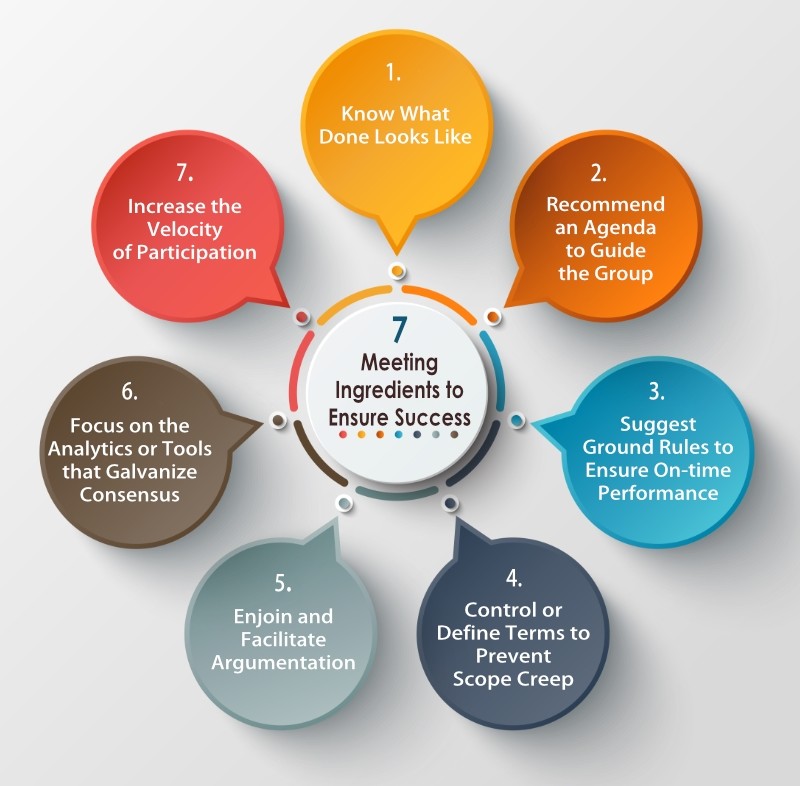
Seven Ingredients to Avoid a Bad Meeting
Seven Ingredients to Avoid a Bad Meeting
You want to avoid meeting killers. A “killer” would suggest the absence or void of much of the following. There is no set formula for subtly controlling bad meetings, but there are seven ingredients that suggest a strong likelihood of positive impact. Listed in order of importance, the seven ingredients include:
1. Know What Done Looks Like:
Any leader needs to know where they are going before they take off. Make the purpose and deliverable of the meeting clear immediately. People can follow a leader who knows where they are going. However, people are reticent to follow someone who does not know where they are going. And meeting participants ALWAYS know the difference.
2. Recommend an Agenda to Guide the Group:
Structure yields flexibility. If you draft a map for their journey, it is easy to take a detour or scenic route because you know where to go when the temporary path is no longer valuable. Plan your work and work your plan.
3. Suggest Ground Rules to Ensure On-time Performance:
The terms “concussion”, “percussion”, and “discussion” are all related. Avoid meeting headaches and get more done faster. While not required, ground rules help everyone get more done, sooner.
4. Control or Define Terms to Prevent Scope Creep:
Unless your deliverable calls for a definition or scoping boundaries, do not allow arguments about the meaning of terms. Bring your definition tool to the forefront and get participants level set on what key terms mean to everyone. You need consensus around the meaning of the terms being used, so prevent arguments about definitions by building them immediately, with the group. Scope creep kills projects, and it kills meetings as well.
5. Enjoin and Facilitate Argumentation:
The best return on investment of face-to-face meeting time (and costs) derives from resolving conflict. When two or more people (or teams) disagree, they need a meeting referee — a facilitator. Arguments do not get resolved with text messages, emails, decks of slides, and PDFs. See How to Manage Conflict for refreshing tips.
6. Focus on the Analytics or Tools that Galvanize Consensus:
There is more than one right answer or tool for nearly all circumstances. Given your participants, constraints, and personal experience suggest a tool that may be optimum for the situation. If required, recommend a backup approach, if something immediately goes awry.
7. Increase the Velocity of Participation:
Groups are smarter than the smartest person in the group because groups generate more options than individuals alone. Solicit and encourage a multiplicity of input. The human mind is empowered tremendously when it can compare and contrast options to influence decision-making.
In a world where everyone can engage in decisions that affect them
______
Lead the Change—One Meeting at a Time
Are you ready to transform how decisions are made, problems are solved, and alignment is built in your organization?
True meeting leadership goes beyond setting an agenda. It requires a facilitator who can navigate complexity, balance voices, and drive toward outcomes with clarity and consensus. Our Professional Meeting Leadership Workshop and facilitation training equips you to do just that—blending human-centric methods with structured analytical tools to foster rigor, inclusivity, and results that stick.
- Practice live.
- Get expert feedback.
- Build confidence that lasts.
Whether your meetings suffer from unclear objectives, disengaged participants, or decision fatigue, this workshop will help you identify the root causes, apply proven facilitation techniques, and emerge as the leader every team needs.
Take the first step today—transform your meetings and magnify your impact.
👉 Click here to reserve your seat now.
#facilitationtraining #meetingdesign
Because every meeting should be a catalyst for change—not just another calendar event.
______
With Bookmarks no longer a feature in WordPress, we provide the following for your benefit and reference.
______
Terrence Metz, president of MG RUSH Facilitation Training, was just 22-years-old and working as a Sales Engineer at Honeywell when he recognized a widespread problem—most meetings were ineffective and poorly led, wasting both time and company resources. However, he also observed meetings that worked. What set them apart? A well-prepared leader who structured the session to ensure participants contributed meaningfully and achieved clear outcomes.
Throughout his career, Metz, who earned an MBA from Kellogg (Northwestern University) experienced and also trained in various facilitation techniques. In 2004, he purchased MG RUSH where he shifted his focus toward improving established meeting designs and building a curriculum that would teach others how to lead, facilitate, and structure meetings that drive results. His expertise in training world-class facilitators led to the 2020 publication of Meetings That Get Results: A Guide to Building Better Meetings, a comprehensive resource on effectively building consensus.
Grounded in the principle that “nobody is smarter than everybody,” the book details the why, what, and how of building consensus when making decisions, planning, and solving problems. Along with a Participant’s Guide and supplemental workshops, it supports learning from foundational awareness to professional certification.
Metz’s first book, Change or Die: A Business Process Improvement Manual, tackled the challenges of process optimization. His upcoming book, Catalyst: Facilitating Innovation, focuses on meetings and workshops that don’t simply end when time runs out but conclude with actionable next steps and clear assignments—ensuring progress beyond discussions and ideas.