by Facilitation Expert | Apr 16, 2015 | Analysis Methods, Communication Skills, Decision Making
Smart vs Dumb?
According to experts in an emerging field called the Science of Choice, everyone can learn to make higher-quality decisions. In fact, smart people make dumb decisions with alarming regularity. Or, they speak using vague verbs that further confuse the situation. What are the differences between smart and dumb?
First, understand the primary cause of poor individual decisions—overconfidence. Then realize that one of the reasons groups make higher quality decisions than the smartest person in the group is the ability to force participants to think outside of their normal comfort zone. Vague verbs will also get in the way, as discussed below.
Objective or Subjective?
Natural decision-making for individuals relies on an “inside view”. Not surprisingly, we call our meeting participants “subject matter experts” because their inside view is also known as the subjective view. For example, two people eating from the same bowl of chili may arrive at different conclusions. One may find the chili excessively ‘hot” (as in spicy) and the other, not. Both are correct from their subjective points of view, so how do we as facilitators “objectify” their assessment?
Participants, especially when focused on specific situations, tend to use information that is cheap; i.e., costs little in terms of time to access and out-of-pocket costs. They make their judgments and predictions based on a narrow set of inputs. Perhaps, for example, there was only one habanero pepper in the chili, and it ended up in only one of the bowls. Participants do not consider the full range of possibilities. Frequently in planning modes, people paint a “too optimistic” view of the future, largely due to overconfidence.
Overconfidence is central to the inside view and leads to at least two illusions that can dramatically lower the quality of decisions:

Sometimes Smart People Make Dumb Decisions
- Illusion of Control
- Illusion of Superiority
1. Illusion of Control
People behave as if chance events are subject to their influence. Simply stated, people who believe that they have some control over the situation perceive their “odds of success” are higher, even when they are not. Numerous studies have proven the illusion of control, typically using random chance, such as the throw of the dice. Money managers, for example, behave as if they can beat the market when, in fact, very few outperform the major indices.
2. Illusion of Superiority
Most people consider themselves ‘above average’ drivers. Likewise, most professionals place themselves in the top half of performers. Clearly, these judgments are absurd, as at least half of all drivers would be considered ‘below average.’ Likewise for professionals, as people maintain an unrealistically positive view of themselves, not everyone can be above average. In fact, according to one large study, more than 80 percent of those surveyed considered themselves above average. Remarkably, and scary too, the least-capable people often have the largest gaps between their perception and reality. Those in the bottom quartile of various studies dramatically overstate their abilities, and nearly everyone tends to dismiss their shortcomings as inconsequential.
What is the Solution?
Various researchers have discovered that building consensus provides the best way to overcome individual biases. When building consensus, an outside view is brought into the decision-making process that improves the quality of individual decisions. Here is a methodological approach for facilitators:
-
Find a Surrogate (Diverge):
Ask the group to identify similar situations, comparable industries, and significant competitors, or even stir up the group by adding participants with competing points of view.
-
Assess the Distribution of Potential Outcomes (Analyze):
Treat the decision as conditional rather than fixed. Under what conditions might Decision A be more appropriate than Decision B, etc.?
-
Base decisions, especially predictions, on ranges of outcomes and probabilities, and not a fixed set. (Converge):
Consider scenario planning and build at least three decisions; perhaps the sunny, cloudy, and stormy perspectives. Study the outcomes including the most common, and the average, and check the extremes to help influence a group to consider an ‘outside view.’
-
Calibrate the decision or prediction as necessary (Document):
Remember the biases discussed earlier, as it remains likely that the justification of views may remain too optimistic and overconfident. Interesting research within the National Football League (NFL) about counter-intuitive decisions such as going for it on fourth down, two-point conversions, onside kicks, and the like shows that coaches who are willing to break from tradition are more successful by generating more points and victories than those who play it safe. See Antifragile: Things That Gain from Disorder for further discussion that expounds on Chaos Theory.
Some discrete words, here focused on vague verbs, also lend themselves to being DUMB.
DUMB stands for Dull, Ubiquitous, Myopic, and Broad—in other words, vague. Because the terms below carry multiple meanings, participants interpret them based on their individual biases and perspectives—the opposite of consensual understanding.
As you improve your meeting leadership skills, constantly endeavor to listen to yourself. We know about the importance of NOT NEVER EVER using the term “I” after the Introduction has been completed. After all, it is not about you, it is about them. It is OK to use the plural and integrative first person, however, including ‘we’ and ‘us.’
Additionally, keep in mind the following should be directed at participants and do not represent actions that are owned by the facilitator. These terms are typically put in the form of a challenge, such as an action plan for the participants. Limit your choice of using the following words and note the supporting rationale:
15 Vague Verbs to Avoid
Avoid Vague Verbs that are Abstract and DUMB
- Administer—Really? How are you going to do that?
- Assure—What is the action that provides the assurance?
- Consult—Here we have a contronym. Are you giving or receiving something?
- Develop—This requires an entire life cycle of discrete activities.
- Ensure—Given the many things we have no control over, how will you do this?
- Establish—An early process in most life cycles, requiring multiple steps or activities. What are they?
- Expedite—Simply substitute HOW are you going to do this?
- Follow-up—MGRUSH provides three tools for following up. Each tool requires multiple activities to complete the step effectively.
- Implement—Another life cycle term that begs for clear detail.
- Investigate—A life cycle by itself that will require multiple activities.
- Manage—Probably the most abused of all terms (outside of consult). Twelve people will interpret what ‘manage’ means, in a few dozen different ways.
- Monitor—Classic. Sounds good, but HOW are you going to do this?
- Observe—Face-to-face? Secondary information? Third-hand hearsay?
- Perform—Do you mean act? If so, what action will be taken?
We do not expect you to memorize these terms, so strive to integrate the logic. Verbs to avoid are typically vague because they are abstract. Participant-friendly terms are more active and tend towards the concrete. For example, it is easier to visualize someone “telling” someone else, rather than “collaborating.”
SMART vs DUMB Criteria?
The intent here is to illustrate the difference between clear, or SMART (Specific, Measurable, Adjustable, Relevant, and Time-based) definitions and criteria contrasted with unclear or DUMB (i.e., Dull, Ubiquitous, Myopic, and Broad) definitions and criteria.
An Unclear Business Definition
(Example of DUMB Customer ID)
“The ID of the customer”
A Clear Business Definition
(Example of SMART Customer ID)
“A twelve character code that uniquely identifies a customer for our business. The code will be displayed on all customer shipments and invoices. Customers and customer service representatives use this code to resolve shipping or invoicing issues. Finance uses this code to track customer sales performance. Marketing uses this code for determining customer segment and group performance. Sales uses this code to identify products purchases by customer.”
The code consists of the following Characters:
- One—either the letter “I” for customers internal to the company or the letter “E” for customers external to the company
- Two—either the letter “U” for United States customers or the letter “M” for multi-national customers without corporate headquarters in the United States
- Three and Four—two-letter state codes for the United States, Canada, and Mexico or two-letter country codes for other countries
- Five through Ten—system-generated numeric ID that is unique to each customer
- Eleven and Twelve—system-generated numeric ID that is unique to each customer distribution center
______
Don’t ruin your career by hosting bad meetings. Sign up for a workshop or send this to someone who should. MGRUSH workshops focus on meeting design and practice. Each person practices tools, methods, and activities every day during the week. Therefore, while some call this immersion, we call it the road to building high-value facilitation skills.
Terrence Metz, president of MG RUSH Facilitation Training, was just 22-years-old and working as a Sales Engineer at Honeywell when he recognized a widespread problem—most meetings were ineffective and poorly led, wasting both time and company resources. However, he also observed meetings that worked. What set them apart? A well-prepared leader who structured the session to ensure participants contributed meaningfully and achieved clear outcomes.
Throughout his career, Metz, who earned an MBA from Kellogg (Northwestern University) experienced and also trained in various facilitation techniques. In 2004, he purchased MG RUSH where he shifted his focus toward improving established meeting designs and building a curriculum that would teach others how to lead, facilitate, and structure meetings that drive results. His expertise in training world-class facilitators led to the 2020 publication of Meetings That Get Results: A Guide to Building Better Meetings, a comprehensive resource on effectively building consensus.
Grounded in the principle that “nobody is smarter than everybody,” the book details the why, what, and how of building consensus when making decisions, planning, and solving problems. Along with a Participant’s Guide and supplemental workshops, it supports learning from foundational awareness to professional certification.
Metz’s first book, Change or Die: A Business Process Improvement Manual, tackled the challenges of process optimization. His upcoming book, Catalyst: Facilitating Innovation, focuses on meetings and workshops that don’t simply end when time runs out but conclude with actionable next steps and clear assignments—ensuring progress beyond discussions and ideas.
by Facilitation Expert | Apr 2, 2015 | Decision Making, Prioritizing
Five principles of successful organizations emerged from Kaplan and Norton’s research on successful Balanced Scorecard adaptors. Hence, the five principles describe the key elements of building an organization that can focus on strategy while delivering breakthrough results. Additionally, high-performance groups depend heavily on effective facilitation and participant ownership.
The nineties are arguably the most worldwide productive in economic history. Because productivity accelerated, market values rose, and unemployment fell to record lows. However, in a Zook survey, only 13 percent of organizations achieved shareholder returns greater than the cost of capital. Therefore setting up the need for a return to strategy, such as the Balanced Scorecard. History will show a pattern of
“excessive exuberance”
to quote Alan Greenspan, and a shift from strategy to tactics, such as:
- First to market
- Operational excellence
- Customer relationship management
As companies abandoned strategy, they began to pay the price—proven by the implosion over the next fifteen years, leading us to, today. Compound that abandonment with a shift from a manufacturing era to the age of knowledge. Notice the transformation in the workplace . . .
| From |
To |
| Functional (silo) |
Process (integrated) |
| Incremental change |
Transformational change |
| Management |
Leadership |
| Production driven |
Customer-driven |
| Tangible assets |
Intangible assets |
| Top-down |
Bottom-up |
Five principles of Kaplan and Norton’s Balanced Scorecard include . . .
- Align the organization to the strategy—Nobody is smarter than everybody and robust alignment requires multiple perspectives. An effective, neutral facilitator is the best choice for securing alignment among a group of people.
- Make strategy a continual process—The journey is more important than the destination, and there is no better guide on a journey than a well-prepared facilitator using an appropriate methodology.
- Make strategy everyone’s job—Ownership is key and facilitated sessions can secure individual commitments that must be met to save face. The key output of any facilitated session is agreement on WHO does WHAT and WHEN.
- Mobilize change through executive leadership—Big egos demand great skill and facilitators earn their income over and over when forced to deal with executives, who many times embrace being rational as what is best for them, rather than the entire group. Facilitation helps avoid such a fallacy.
- Translate the strategy into operational terms—Requiring a life cycle of activities as ideas are transformed from the abstract to the concrete. Hence, no better leader can be found than one who manages context on behalf of the subject matter experts.
The message becomes clear. When you want to accelerate results, you better place a high value on the role of facilitator. They can pay for themselves many times over. They may generate more economic value for the organization than other roles, even the CEO. The CEO who has the answer but is unable to realize these five principles within their own organization will likely generate sub-optimal returns.
Balanced Scorecard
______
Don’t ruin your career by hosting bad meetings. Register for a workshop or forward this to someone who should. MGRUSH facilitation workshops focus on meeting design and practice. Each participant practices tools, methods, and activities every day during the week. Therefore, while some call this immersion, we call it the road to building high-value facilitation skills.
Terrence Metz, president of MG RUSH Facilitation Training, was just 22-years-old and working as a Sales Engineer at Honeywell when he recognized a widespread problem—most meetings were ineffective and poorly led, wasting both time and company resources. However, he also observed meetings that worked. What set them apart? A well-prepared leader who structured the session to ensure participants contributed meaningfully and achieved clear outcomes.
Throughout his career, Metz, who earned an MBA from Kellogg (Northwestern University) experienced and also trained in various facilitation techniques. In 2004, he purchased MG RUSH where he shifted his focus toward improving established meeting designs and building a curriculum that would teach others how to lead, facilitate, and structure meetings that drive results. His expertise in training world-class facilitators led to the 2020 publication of Meetings That Get Results: A Guide to Building Better Meetings, a comprehensive resource on effectively building consensus.
Grounded in the principle that “nobody is smarter than everybody,” the book details the why, what, and how of building consensus when making decisions, planning, and solving problems. Along with a Participant’s Guide and supplemental workshops, it supports learning from foundational awareness to professional certification.
Metz’s first book, Change or Die: A Business Process Improvement Manual, tackled the challenges of process optimization. His upcoming book, Catalyst: Facilitating Innovation, focuses on meetings and workshops that don’t simply end when time runs out but conclude with actionable next steps and clear assignments—ensuring progress beyond discussions and ideas.
by Facilitation Expert | Mar 26, 2015 | Decision Making, Meeting Structure, Prioritizing
Quick Wins are found in the Payoff Matrix shown in the “two by two” below provides the classic means of prioritizing your options. Using return (i.e., Impact of the Solution) and investment (i.e., Cost of Implementation, typically time or money) as the criteria dimensions, it sorts your options into one of four categories:
- Quick Win (aka, Quick Hit)
- Major Opportunity
- Special Effort
- Time Waster
Return on Investment Payoff Matrix
Alternative Payoff Matrix
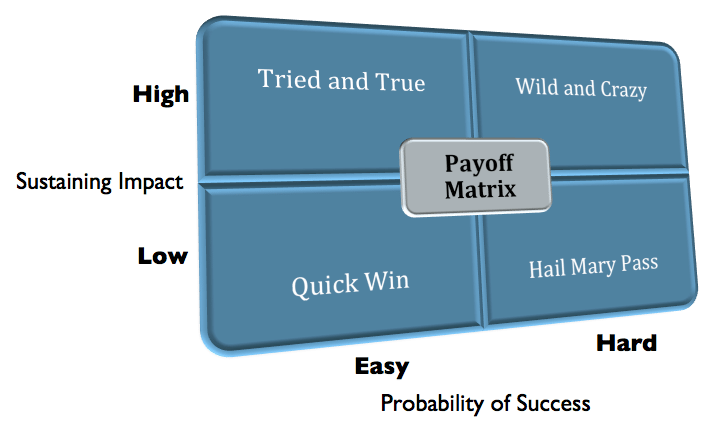
Perhaps a more engaging and stimulating way to frame the options with a Payoff Matrix substitutes the Probability of Success for the investment or cost dimension. If so, the alternative Payoff Matrix would include the following labels:
- Quick Win
- Tried and True
- Wild and Crazy
- Hail Mary Pass
Probability-Based Payoff Matrix
Method for Building a Payoff Matrix
Once you have built your options, code them onto small Post-It® notes. Alpha coding (i.e., A, B, C, etc.) is preferred to numeric coding (i.e., 1, 2, 3, etc.) because it denies subtle bias about relative importance that is implied when using numbers. Consider iconic coding as an alternative to strip away all possible bias (i.e., ✚, ♢, ✇, etc.).
Place your matrix criteria on a large whiteboard. Begin by facilitating from the zero point, or middle of the matrix. Then work one dimension (criteria) at a time, asking if it is more or less than other options previously posted. Complete when the group can support the entire array.
Alternative
Break your team into three groups and have each group complete their own coding, probably on a large sheet (i.e., 50cm * 75cm), and bring all three Payoff Matrices to the front. Create a fourth and final Payoff Matrix by merging the three, facilitating discussion about the differences until the group can support the final array.
Next Steps
Complete your prioritization effort with two more steps: assign roles and responsibilities for further development and conduct a Guardian of Change to agree on what participants will tell others after your meeting has concluded.
In a world where everyone can engage in decisions that affect them
______
Lead the Change—One Meeting at a Time
Are you ready to transform how decisions are made, problems are solved, and alignment is built in your organization?
True meeting leadership goes beyond setting an agenda. It requires a facilitator who can navigate complexity, balance voices, and drive toward outcomes with clarity and consensus. Our Professional Meeting Leadership Workshop and facilitation training equips you to do just that—blending human-centric methods with structured analytical tools to foster rigor, inclusivity, and results that stick.
- Practice live.
- Get expert feedback.
- Build confidence that lasts.
Whether your meetings suffer from unclear objectives, disengaged participants, or decision fatigue, this workshop will help you identify the root causes, apply proven facilitation techniques, and emerge as the leader every team needs.
Take the first step today—transform your meetings and magnify your impact.
👉 Click here to reserve your seat now.
#facilitationtraining #meetingdesign
Because every meeting should be a catalyst for change—not just another calendar event.
______
With Bookmarks no longer a feature in WordPress, we provide the following for your benefit and reference.
______
Related video
Terrence Metz, president of MG RUSH Facilitation Training, was just 22-years-old and working as a Sales Engineer at Honeywell when he recognized a widespread problem—most meetings were ineffective and poorly led, wasting both time and company resources. However, he also observed meetings that worked. What set them apart? A well-prepared leader who structured the session to ensure participants contributed meaningfully and achieved clear outcomes.
Throughout his career, Metz, who earned an MBA from Kellogg (Northwestern University) experienced and also trained in various facilitation techniques. In 2004, he purchased MG RUSH where he shifted his focus toward improving established meeting designs and building a curriculum that would teach others how to lead, facilitate, and structure meetings that drive results. His expertise in training world-class facilitators led to the 2020 publication of Meetings That Get Results: A Guide to Building Better Meetings, a comprehensive resource on effectively building consensus.
Grounded in the principle that “nobody is smarter than everybody,” the book details the why, what, and how of building consensus when making decisions, planning, and solving problems. Along with a Participant’s Guide and supplemental workshops, it supports learning from foundational awareness to professional certification.
Metz’s first book, Change or Die: A Business Process Improvement Manual, tackled the challenges of process optimization. His upcoming book, Catalyst: Facilitating Innovation, focuses on meetings and workshops that don’t simply end when time runs out but conclude with actionable next steps and clear assignments—ensuring progress beyond discussions and ideas.
by Facilitation Expert | Mar 19, 2015 | Meeting Agendas, Meeting Structure
If it seems that workshops are actually well-run meetings, that is true to a large degree. Well-run meetings and facilitated workshops share similarities. The primary differences between meetings and workshops become evident with the characteristics of each.
All workshops are meetings while most meetings are not workshops
Roughly speaking, meetings deliver up outcomes or conditions, such as “increased awareness,” while workshops document outputs such as strategic plans, decisions, and detailed solutions.
Meeting Characteristics
Workshop Characteristics
- A building method—a way to solve a problem, develop a plan, reach a decision, agree on analytics, design a flow, etc.
- Agenda steps are typically not time-boxed, since early output typically supports product development or process improvement and innovation
- Include formally defined roles and depend on a neutral facilitator
- Remain focused on one development at a time, lasting from a few hours to a few days
Different reasons for hosting workshops versus meetings
Meetings tend to follow one of three themes, to . . .
- Endorse or decide
- Inform
- Monitor and review
Workshops focus on singular topics and strive to build detailed outputs. Successful workshops depend on:
- Knowing clearly what DONE looks like, specific output or deliverables
- An agenda design that engages participants
- Sequencing information-gathering activities or agenda steps
- Monitoring the workshop method to accomplish those goals
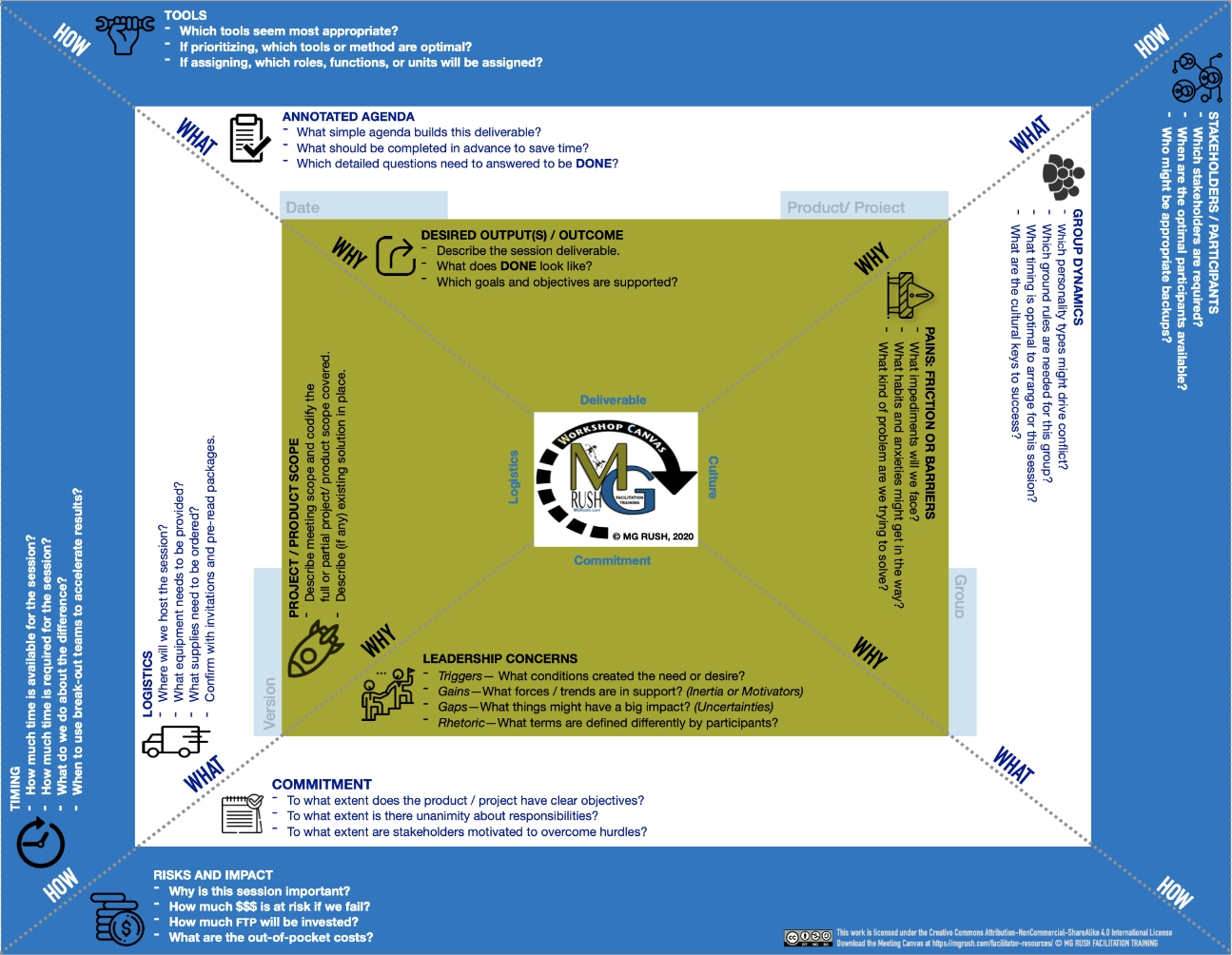
Difference Between Meetings and Workshops: The Workshop Canvas
Success for Both Meetings and Workshops
The critical elements necessary for the success of both meetings and workshops include:
- Availability and commitment from management, thus ensuring the availability of proper resources, personnel, time, and support
- A well-trained session leader with facilitation skills and meeting design skills
- Inflection points—gathering the information, making the decisions, and documenting the results
- Preparation—getting yourself and the participants ready to produce, quickly
- Review and resolution—distribute and integrate deliverable; into product, project, or other initiatives
Significant Differences of Meetings and Workshops
#1 Time Boxing
Meetings frequently limit the amount of time per agenda step. Therefore, with most workshop activities, front-end loading frequently makes it easier to complete the back-end steps and activities. Consequently, for most workshop activities, we estimate time but allow groups additional time to fully develop consensual assumptions up-front, when it matters most.
#2 Topic Dependency
Meetings consist of loosely related topics that serve to review and monitor, inform, and sometimes endorse (or decide). Participants during meetings are commonly passive while workshops demand activity and contributions. Meetings aim for an updated state of affairs or condition (outcome), while workshops create tangible deliverables or concrete ‘outputs.’ Contrasted to meetings, workshops create the ability to act upon clear workshop output.
#3 Concluding
Regularly held meetings (i.e., staff meetings or board meetings) end when time runs out, usually with an understanding that unfinished items will be picked up in the next meeting. When groups are building toward a workshop deliverable, the sequence of the steps is important and they cannot leap ahead or advance until the foundation work is complete.
#4 Facilitator Neutrality
Meeting leaders frequently do not exhibit neutrality. Effective meeting leaders learn to embrace the importance of neutrality and active listening. However, when required, participants force them to render an opinion or a decision. Workshop leaders should strive in every way possible to avoid suggesting content, knowing that the participants must own and live with their decisions. Similarly, workshop leaders risk total failure if they violate neutrality by offering up content. Participants do not expect complete neutrality from meeting leaders.
#5 Duration
Workshops tend to last longer than meetings. While the average meeting lasts from 30 minutes to two hours, the average workshop takes many hours or even a few sessions with multiple days. Complex deliverables such as a Project Charter or Requirements Gathering last multiple sessions that probably span many weeks.
Considerations about Meeting Workshop Differences
Due to time constraints, participant availability, and meeting space (real estate) options, much workshop activity gets spread across multiple weeks, turning a potentially natural, multiple-day workshop into multiple-week “meetings.” The structural difference between concurrent-day and concurrent-week approaches is that the break periods between activities are longer with the concurrent or multiple-week approach.
The session leader needs to be aware of workshop deliverables that are hidden in the term “meeting.” Simply because an event is being called a meeting or lasts for only an hour or two, does not give the session leader the right to show up unprepared or to become a judge of others, their input, and their opinions.
A Structured Technique Works with Both Meetings and Workshops Because . . .
- Assignments combine and finish timely.
- Clear tasks define outputs and directions.
- Consensus-derived information becomes input to subsequent activities.
- Groups make higher quality decisions than the smartest person
in the group.
- Meeting design may use existing agendas (meeting designs), such as structured analysis and prioritization methods.
- Ownership is clear.
- Participants have well-defined roles.
- Structured workshops provide well-defined deliverables.
- The group reaches a mutual understanding of business needs and priorities.
- The session leader stimulates participants with a toolkit of visual aids, documentation forms, and group dynamics skills.
- Structure and group dynamics provide more complete and accurate information.
Structured workshops conducted with workshop best practices are increasingly popular among among design sprints, requirements gathering, and business planning sessions that support business process improvement and product development.
Why? When properly conducted, workshops conducted with workshop best practices generate faster and more effective results than unstructured business discussions. Remember that the terms discussion, percussion, and concussion share a common suffix. Therefore, if you ever have a headache when departing a meeting, it is likely unstructured.
Common Reasons for Structured Workshops
Over the years we have catalogued the various workshops that we facilitated and share the reasons with you. Find them sequenced below in alphabetical order, rather than frequency, importance, or randomness:
- Any initiative requiring decision-making or consensual agreement between two or more people
- Business area analysis
- Business case development (including process optimization)
- Content management prioritization
- Executing your strategy, building action plans
- Gathering requirements
- Innovation, at least the creativity and ideation portion
- Key performance, measuring, and management indicators
- Knowledge management (including decision support)
- Maintenance activity to solve for missing descriptions of changes, precision with requirements, or problem identification
- New system or business development initiatives
- Performance management (including balanced scorecard and dashboards)
- Problem situation requiring arbitration or neutrality
- Process improvement—design or optimization
- Project management
- Problem-solving
- Product development processes
- Scientific inquiry or challenging paradigms
- Six Sigma® and Lean or other quality initiatives
- Strategic planning at any level in the organizational holarchy
- Team charters (including management perspectives and supporting strategic planning activities or tactical assignments)
- Virtual and online meetings and workshops
- Voice of the customer or advisory groups
Workshop Best Practices
Essential workshop best practices developed for facilitated sessions include:
- Defining consensus as a standard that can be supported rather than the ideal resolution that makes participants “happy”, helps set a better expectation that should prevent all participants from losing any sleep (a personal standard).
- Energize and engage participants by explaining the importance of the session in the beginning and strive to quantify the impact of the meeting on the project valued in cash assets at risk or FTP (full-time person) being deployed.
- Use a neutral facilitator. The facilitator must be neutral to the content discussed, allowing the participants freedom to edit and modify their own contributions. Neutrality provides trust that enables a higher level of participation and contribution by participants.
- Using a pre-defined deliverable, agenda, and participant list. Therefore, the deliverable and agenda for each session ought to be articulated in advance to transfer ownership to the session participants prior to the meeting. Thorough preparation helps the participants to focus on topics, questions, and activities that help the facilitator better control the context.
- Using a refrigerator (aka “parking lot” or “issue bin”) to store items out of scope or beyond reach for the time available helps separate the co-mingling of strategic issues, tactical maneuvers, and operational issues.
- Using a well-prepared deliverable and agenda, the facilitator can better control the scope of conversations, preventing circular and irrelevant discussions.
- Write it down. Because, if it is not written down, it never happens. Strive to capture verbatim comments and complete necessary edits after the meeting. Visual feedback builds more confidence among participants. Additionally, making the documentation immediately visible to participants minimizes one-on-one follow-ups and email conversations.
Benefits of Structured Workshops
- Organizations establish scalable, consistent processes that can be measured and continuously improved as a result of adopting a structured approach.
- Overall project life cycle can be shortened by weeks, thus helping business stakeholders realize project benefits early.
- Session participants demonstrate a high level of active engagement, claiming that structured sessions enable better use of their time.
- Structured approaches also produce higher quality outputs, allowing for issues and risks to be identified and resolved earlier in the life cycle when the cost to resolve them is smaller.
- Structured approaches enhance the value of the session leader’s role as a valuable provider of context rather than a mere producer of documentation.
- Workshop approaches result in an overall reduction of time and effort. In comparison studies, companies claim project life-cycle savings that exceed USD $100,000 and some exceeding one million dollars because they adopted a structured approach to meetings and workshops.
- Workshop approaches successfully shift project development activities from being template-driven to conversation-driven, thus helping build cohesive teams and collaboration amongst participants.
In a world where everyone can engage in decisions that affect them
______
Lead the Change—One Meeting at a Time
Are you ready to transform how decisions are made, problems are solved, and alignment is built in your organization?
True meeting leadership goes beyond setting an agenda. It requires a facilitator who can navigate complexity, balance voices, and drive toward outcomes with clarity and consensus. Our Professional Meeting Leadership Workshop and facilitation training equips you to do just that—blending human-centric methods with structured analytical tools to foster rigor, inclusivity, and results that stick.
- Practice live.
- Get expert feedback.
- Build confidence that lasts.
Whether your meetings suffer from unclear objectives, disengaged participants, or decision fatigue, this workshop will help you identify the root causes, apply proven facilitation techniques, and emerge as the leader every team needs.
Take the first step today—transform your meetings and magnify your impact.
______
👉 Click here to reserve your seat now.
#facilitationtraining #meetingdesign
Because every meeting should be a catalyst for change—not just another calendar event.
______
With Bookmarks no longer a feature in WordPress, we provide the following for your benefit and reference.
______
Terrence Metz, president of MG RUSH Facilitation Training, was just 22-years-old and working as a Sales Engineer at Honeywell when he recognized a widespread problem—most meetings were ineffective and poorly led, wasting both time and company resources. However, he also observed meetings that worked. What set them apart? A well-prepared leader who structured the session to ensure participants contributed meaningfully and achieved clear outcomes.
Throughout his career, Metz, who earned an MBA from Kellogg (Northwestern University) experienced and also trained in various facilitation techniques. In 2004, he purchased MG RUSH where he shifted his focus toward improving established meeting designs and building a curriculum that would teach others how to lead, facilitate, and structure meetings that drive results. His expertise in training world-class facilitators led to the 2020 publication of Meetings That Get Results: A Guide to Building Better Meetings, a comprehensive resource on effectively building consensus.
Grounded in the principle that “nobody is smarter than everybody,” the book details the why, what, and how of building consensus when making decisions, planning, and solving problems. Along with a Participant’s Guide and supplemental workshops, it supports learning from foundational awareness to professional certification.
Metz’s first book, Change or Die: A Business Process Improvement Manual, tackled the challenges of process optimization. His upcoming book, Catalyst: Facilitating Innovation, focuses on meetings and workshops that don’t simply end when time runs out but conclude with actionable next steps and clear assignments—ensuring progress beyond discussions and ideas.
by Facilitation Expert | Mar 12, 2015 | Facilitation Skills, Meeting Support
Some of the best facilitators are NOT Subject Matter Experts within the topic and scope of the discussion. However, they cannot afford to be subject matter ignorant. They need to be subject matter conversant and understand the terms being used. They must understand the relationship of content to the deliverable, but they do NOT have to have an ‘answer.’
Subject Matter Experts
For example, we facilitated sessions in North America, Europe, and Asia with radiologists and directors of radiology. We supported a manufacturer to help them design their next generation of CT (Computerized Tomography) scanners. While NOT a physicist or radiologist we prepared by understanding the basic and essential principles of operation. We were also highly effective at facilitating discussions around pain points and possible solutions.
Neutrality, curiosity, and willingness to challenge assumptions are far more important facilitator skills than being an expert on the topic. Without the humility that encourages one to ‘seek to understand rather than being understood’, participants will drop out, go quiet, and disengage because they are thinking: “If this person (the leader or facilitator) already has the answer, then why are they seeking out my opinion?”
The better challenge or question may be, “What is the unit of measurement for distinguishing between ‘subject matter expertise’ and ‘subject matter conversant’?” For us, the answer is simple.
Context Preparation
Before the session begins, the facilitator and participants ought to be properly prepared. Optimal preparation includes writing down the meeting purpose, scope, deliverables, and simple agenda before the meeting begins. Make sense? Hopefully, you understand that the facilitator, at minimum, better know the reason for the meeting, WHY it is important (i.e., purpose), WHAT will be covered and NOT covered during the meeting (i.e., scope—that is necessary to prevent meeting scope creep, the number one killer of meetings), WHERE the group is headed (ie, the deliverable or what DONE looks like), and HOW they are going to get there (ie, the agenda or prepared structure).
Therefore the unit of measurement becomes the glossary or lexicon. How much does the facilitator understand the terms being used in the prepared meeting purpose, scope, deliverables, and simple agenda? To what extent does the facilitator’s understanding of those terms harmonize with the understanding of the participants, their culture, and the project team or work that must occur after the meeting concludes? To what extent do the participants share the same or identical meaning of the terms used?
We illustrate this importance by challenging you to explain the difference between a ‘goal’ and an ‘objective’. To us, they are NOT the same thing. We prefer an operational definition suggesting that ‘goals’ are directional and somewhat fuzzy. For example, a mountain climber may have a ‘goal’ of getting some good photographs when they reach the summit. An ‘objective’ however is truly SMART—i.e., Specific, Measurable, Adjustable (our preferred deviation from Deming’s original definition of Achievable), Realistic, and Time-based. For example, a mountain climber may need to be sheltered in a tent and sleeping bag at 3,000 meters by 17:00 before a storm blows in or they risk freezing to death.
Cultural Considerations
Some cultures define ‘goals’ and ‘objectives’ as the opposite of our preference, defining ‘objectives’ as fuzzy and goals as SMART. A good facilitator is agnostic and can use either set of definitions. They also know the importance of determining the optimal definitions BEFORE the meeting begins. They are responsible for controlling the context (i.e., contextual expertise) and not the content (i.e., subject matter expertise).
______
Don’t ruin your career by hosting bad meetings. Sign up for a workshop or send this to someone who should. MGRUSH workshops focus on meeting design and practice. Each person practices tools, methods, and activities every day during the week. Therefore, while some call this immersion, we call it the road to building high-value facilitation skills.
Terrence Metz, president of MG RUSH Facilitation Training, was just 22-years-old and working as a Sales Engineer at Honeywell when he recognized a widespread problem—most meetings were ineffective and poorly led, wasting both time and company resources. However, he also observed meetings that worked. What set them apart? A well-prepared leader who structured the session to ensure participants contributed meaningfully and achieved clear outcomes.
Throughout his career, Metz, who earned an MBA from Kellogg (Northwestern University) experienced and also trained in various facilitation techniques. In 2004, he purchased MG RUSH where he shifted his focus toward improving established meeting designs and building a curriculum that would teach others how to lead, facilitate, and structure meetings that drive results. His expertise in training world-class facilitators led to the 2020 publication of Meetings That Get Results: A Guide to Building Better Meetings, a comprehensive resource on effectively building consensus.
Grounded in the principle that “nobody is smarter than everybody,” the book details the why, what, and how of building consensus when making decisions, planning, and solving problems. Along with a Participant’s Guide and supplemental workshops, it supports learning from foundational awareness to professional certification.
Metz’s first book, Change or Die: A Business Process Improvement Manual, tackled the challenges of process optimization. His upcoming book, Catalyst: Facilitating Innovation, focuses on meetings and workshops that don’t simply end when time runs out but conclude with actionable next steps and clear assignments—ensuring progress beyond discussions and ideas.