by Facilitation Expert | Aug 22, 2023 | Meeting Agendas, Meeting Structure
Successful meetings and workshops comprise three essential phases: a beginning, a middle, and an end. Yet, meetings often fail because leaders ignore the importance of one or more of these.
In this Best Practices article, we’ll focus on phase one, the beginning, or meeting introduction, by detailing seven consecutive activities that, easily mastered, ensure stronger meeting and workshop launches. Also, here is a link to four activities to command a professional wrap.
Start with the End in Mind
An effective meeting introduction relies on the leadership consciousness that knows what the result looks like. Yet describing the results of a successful meeting is not enough. The name for each agenda step needs to describe its result or deliverable. Remember, the objective for each agenda step or activity is an object—a noun. You cannot deliver a verb. Agenda steps are best described by answering the question, “What does DONE look like?”
We begin by detailing seven activities that you should command for every Launch (Introduction). In a separate Best Practices article you will find a detailed explanation of four activities that you should command for every Review and Wrap (Conclusion).
Launching — Your Meeting Introduction
Your launch sets the tone, confirms roles, clarifies boundaries (scope), and describes what results will be generated during the session. A meeting launch should last no longer than 5 minutes (excluding icebreakers or other special activities such as an executive kickoff or a product or project update).
Transfer Ownership
Make sure that your participants understand that this meeting has a clear purpose and impact. Use the integrative and plural first person of ‘we’ or ‘us’ and avoid the singular ‘I’ so that you begin to transfer responsibility and ownership to the participants who need to own the results.
Visual Confirmation
Before you start your meeting, have your in-person or online room set up to visually display the meeting purpose, meeting scope, and meeting deliverables. If you cannot simplify each statement into 25 words or less (for each), then you are not ready to launch your session. In particular, if you do not know what the deliverable looks like, then you do not know what success looks like, or when you will be DONE.
Display the meeting purpose, scope, and deliverable on a slide, screen, whiteboard, handheld artifact, or large Post-it® paper. Additionally, display the agenda and ground rules appropriate to your politics and situation. Use the following seven activities in sequence to launch every session, even a 50-minute meeting. Your meeting introduction is not an appropriate time to experiment. These seven activities (plus occasional Kick-off), in this sequence, have been stress-tested and proven to be most effective, assuring a clear and compelling launch.

Seven Meeting Launch Activities
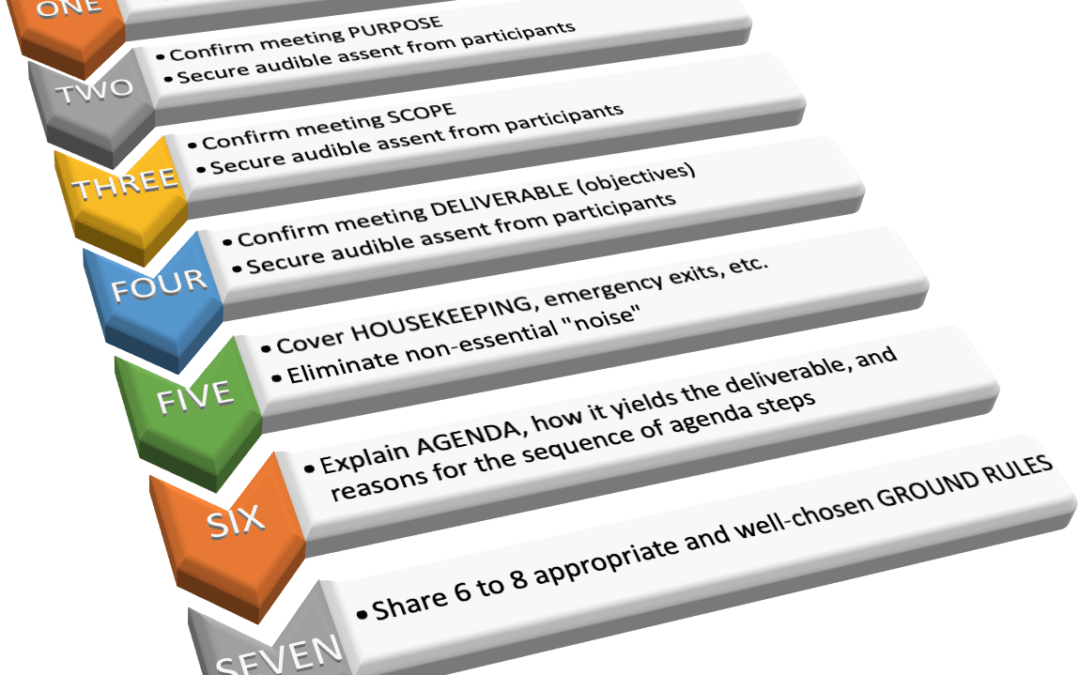
Seven Meeting Introduction (Launch) Activities
ONE — Roles and Impact
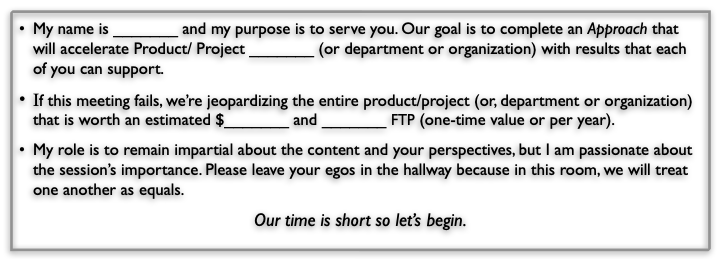
Introduce yourself in the role of facilitator as neutral and unbiased. Stress their roles of participants as equals. Remind them to leave egos and titles in the hallway. Stipulate how much money or time (FTP)[♠] is wasted or at risk if the meeting and thus the organization, product, or project fails. Complete this activity within 30 seconds. Avoid using the word “I” after this activity. It is tough to drop the ego but remain conscious whenever you use the first person singular. Complete this first activity within 30 seconds.
Time is Short, Let’s Begin
TWO — Meeting Purpose
Describe the meeting purpose, either on large-format paper, a handout, or a screen. Stress again that this session is important because… and seek audible confirmation from your participants. Frequently, for this first request, put your hands to your ears while saying “I can’t hear you” to force a louder audible response. Professional facilitators constantly strive to shift “airtime” to their participants, and participants’ vocal affirmation transfers ownership.
THREE — Meeting Scope
Describe the meeting scope, either on large-format paper, a handout, or a screen. The meeting scope is either the entire organization, department, product, or project, or part of them, but never more. Again, secure an audible assent from your participants that builds consensus and transfers ownership.
FOUR — Meeting Deliverable
Describe what DONE looks like by using your prepared statement. After securing audible assent here, you will have facilitated audible agreement three times within two minutes. If participants cannot agree on the meeting purpose, meeting scope, and meeting deliverables, then your agenda is at risk, and you have a more serious problem to address.
NOTE: This meeting purpose, scope, and deliverable should be provided to participants before the meeting as part of an invitation, pre-read, or read ahead. The prepared statements should not change at this point. If they do, the meeting may be challenged, and the agenda may no longer be valid. I have been asked to modify the scope a few times, but it was always sharpening and not broadening the prepared statement ( Who knew that Greenland and part of Iceland are in North America?).
I frequently put hands to my ears while saying “Can’t hear you” to force a louder audible response. Professional facilitators constantly strive to shift “airtime” to their participants, and their vocal affirmation transfers ownership.Be particularly careful to describe what DONE looks like (the deliverable). After securing audible assent here, you will have facilitated consensus three times within two minutes.
FIVE — Housekeeping
Explain that housekeeping or “administrivia” is any noise that might be causing a distraction. You want to clear participants’ heads from thinking about themselves, especially their creature comforts. For brief meetings, you might include where to locate emergency exits, fire extinguishers, lavatories, or coffee and tea. For workshops and longer meetings, you would also cover the frequency of breaks, break times for responding to emails, lunch arrangements, and any other “noise” that might prevent participants from staying focused. You may also conduct Icebreakers here, or after presenting the Ground Rules described as the seventh activity below.
SIX — Meeting Agenda
Describe each Agenda Step, including the reason for the sequence of the Agenda Steps and flow. Explain how the Agenda Steps relate to one another. Do not read them. Rather, explain why the Agenda Steps help us get DONE and why they are listed in the sequence provided. Link Agenda Steps back to the deliverable so that participants see how completing each Agenda Step helps us get DONE.
Fully explaining the Agenda Steps helps groups move out of “storming,” Stage 1 of the group life cycle. Again, do not read the Agenda Steps —explain them! Optimally, use a nonprofessional analogy to explain your Agenda Steps.[♣] You have heard that a picture is worth a thousand words; well, an analogy is worth a thousand pictures (and a story is worth a thousand analogies).
SEVEN — Ground Rules
Share appropriate Ground Rules. Most importantly, explain why they are being used. Supplement your narrative posting of Ground Rules with audiovisual support, including humorous clips, but keep it brief. After presenting your essential Ground Rules, solicit any additional ones from the group, if desired.
Explain each ground rule (not more than nine). For professional meetings, we treat ‘speaking up’ in a meeting, NOT as an opportunity, rather as an obligation. After all, they are being paid to be there. We stress that “consensus” does not mean that we’ll make everybody happy, rather we will find an answer that everyone can support. See the MGRUSH alumni site for some other examples and audio-visual support.
Optional or Occasional (Eighth) Activities
- Have everyone introduce themselves by providing a structured Icebreaker. Complete Icebreakers before moving out of your Launch agenda step. If you expect Icebreakers to take up a significant amount of time, more than a half-hour, consider sequencing this activity sooner and move it up to the fifth activity (“Housekeeping”).
- Product owners and project managers or sponsors may provide updates about progress or changes that have occurred. Have them remain brief by sticking to the vital information affecting the participants. Do not let them go too far “into the weeds,” providing details that bore everyone else. Keep them focused on WHAT has transpired (abstract), not HOW it is being done (concrete).
- You may need to conduct a review of open items from prior meetings. Preferably, have the product or project manager or sponsor read open items and share a status update while you document or record participants’ comments if needed.
- For multiple-day workshops, consider mounting a Plus-Delta in the back of the roofer participants to comment and request during the meeting. You don’t want to find out on the last day there is something you may have fixed on day one.
Kick-off During a Meeting Introduction
Do not modify the sequence of the seven activities for your meeting introduction sequence except, for any executive sponsor contributions. As soon as the sponsor enters the room, if the meeting has begun, stop and introduce that person. If the sponsor is present at the start, introduce him or her immediately. Have the sponsor up front and out of the room as soon as possible or practical, preferably without letting them sit down. If the sponsor insists on staying, seat him or her in the back or on the side as an observer, unless the sponsor is going to be an equal participant, like everyone else.
For a kick-off, have your executive sponsor explain the importance of participants’ contributions and what management intends to accomplish. Consider a quick project update. However, do not allow the update or executive sponsor to take more than five minutes. Your meeting is not a mini-Town Hall meeting (unless it actually is).
NOTE: For multiple-day workshops, cover the same items at the start of subsequent days (except kick-off). Additionally, review content built or agreed upon the day(s) before and how it relates to progress made in the agenda.
The Meeting Middle
After your meeting Introduction, the agenda steps between the Introduction and Wrap comprise the middle steps. Hundreds of our other Best Practices articles focus on what you can do between the introduction and wrap to plan, decide, and prioritize issues.
The Meeting Wrap
We also provide a detailed article that provides a structured approach to your meeting Wrap. See “Use a Professional Meeting Wrap-Up Because Most Meetings Don’t End, They Stop” for a quick but thorough explanation of four activities to manage at the conclusion of your meetings and workshops.
Daniel Pink, in his book “When” claims that the Wrap represents the most important part of any meeting because the Wrap is the “taste you leave in someone’s mouth out in the hallway” where your participants should sound like they were in the same meeting together.
NOTE: In a separate Best Practices article you will find detailed explanation of four activities that you should command for every Review and Wrap (Conclusion).
_______
[♠] FTP represents Full Time Person or Full-time equivalent (FTE), frequently viewed as around 2,000 hours per year.
[♣] For an example, see the section “Explanation via Analogy” in the Planning Approach (Chapter 6) of Meetings That Get Results.
In a world where everyone can engage in decisions that affect them
______
Lead the Change—One Meeting at a Time
Are you ready to transform how decisions are made, problems are solved, and alignment is built in your organization?
True meeting leadership goes beyond setting an agenda. It requires a facilitator who can navigate complexity, balance voices, and drive toward outcomes with clarity and consensus. Our Professional Meeting Leadership Workshop and facilitation training equips you to do just that—blending human-centric methods with structured analytical tools to foster rigor, inclusivity, and results that stick.
- Practice live.
- Get expert feedback.
- Build confidence that lasts.
Whether your meetings suffer from unclear objectives, disengaged participants, or decision fatigue, this workshop will help you identify the root causes, apply proven facilitation techniques, and emerge as the leader every team needs.
Take the first step today—transform your meetings and magnify your impact.
👉 Click here to reserve your seat now.
#facilitationtraining #meetingdesign
Because every meeting should be a catalyst for change—not just another calendar event.
______
With Bookmarks no longer a feature in WordPress, we provide the following for your benefit and reference.
______
Terrence Metz, president of MG RUSH Facilitation Training, was just 22-years-old and working as a Sales Engineer at Honeywell when he recognized a widespread problem—most meetings were ineffective and poorly led, wasting both time and company resources. However, he also observed meetings that worked. What set them apart? A well-prepared leader who structured the session to ensure participants contributed meaningfully and achieved clear outcomes.
Throughout his career, Metz, who earned an MBA from Kellogg (Northwestern University) experienced and also trained in various facilitation techniques. In 2004, he purchased MG RUSH where he shifted his focus toward improving established meeting designs and building a curriculum that would teach others how to lead, facilitate, and structure meetings that drive results. His expertise in training world-class facilitators led to the 2020 publication of Meetings That Get Results: A Guide to Building Better Meetings, a comprehensive resource on effectively building consensus.
Grounded in the principle that “nobody is smarter than everybody,” the book details the why, what, and how of building consensus when making decisions, planning, and solving problems. Along with a Participant’s Guide and supplemental workshops, it supports learning from foundational awareness to professional certification.
Metz’s first book, Change or Die: A Business Process Improvement Manual, tackled the challenges of process optimization. His upcoming book, Catalyst: Facilitating Innovation, focuses on meetings and workshops that don’t simply end when time runs out but conclude with actionable next steps and clear assignments—ensuring progress beyond discussions and ideas.
by Facilitation Expert | Aug 8, 2023 | Meeting Structure
Decision-making frequently considers fuzzy information, fuzzy implications, and fuzzy thinking. To reduce fuzziness, and improve decision quality, lead your group to focus on What is right, NOT Who is right.
By structuring your questions and meeting design, you minimize the risk of decisions made that are no more than educated gambles.
Decision Quality Results from Focusing On What is Right, NOT Who is Right
Some organizations rely on advocacy. As issues surface, people take sides[1]. Some participants win — while others lose. By depersonalizing the input required to support a decision, you create a win-win situation. In “majority win” cultures, the most powerful arguments do not necessarily win. Rather, the most persuasive and charismatic ‘champions’ are frequently victorious. Effective facilitation and structured meeting design mitigate risks associated with poor decision quality. After all, nobody is smarter than everybody[2].
Daniel Kahneman has proven that most people decide and then they justify their decision. A structured approach forces participants to delay their decision until available evidence has been provided. Unfortunately for most, once participants have decided, much of their deliberation focuses on finding support to justify their position. Structured facilitation can stop, or at least delay, premature decision-making. Tremendous risks arise if you don’t strive to identify the SMART (Specific, Measurable, Adjustable, Relevant, and Time-based) support that improves decision quality. We hope that you value and aspire to avoid the DUMB response (Dull, Ubiquitous, Myopic, and Broad).
Some meetings even lead to anger, resentment, or jealousy that can sabotage decisions and cultures. Reverse the flow of poor decision quality by first building consensus around the purpose of the decision. Next, develop and expose available options (actions). Then force the development of decision criteria based on evidence: facts, truths, and examples that support the claims. The structured approach helps groups focus one step at a time. Finally, have a method or tool(s) prepared for comparing the options against the criteria that support the originally stated purpose.
Structured Tools Focus on What is Right
For example, do you plan on using PowerBalls, Perceptual Map, Decision Matrix, Scorecard, etc.– or some combination thereof? Scrub (cleanse or clarify) that evidence to ensure clarity and shared understanding, so that the logic and arguments no longer belong to one person. Rather rationale for the decision quality becomes owned by the entire group. Visually displaying the comparison of the various options and supporting criteria additionally helps to depersonalize the analysis.
While many methods use a projected software tool, there are advantages to paper and whiteboards that include the transfer of ownership. The presenter or facilitator usually ends up owning PowerPoint®-type slides, regardless of group comments. If you create and visually display participant content with markers, the group retains ownership and not the keyboard operator.
Remember the 3-Question Approach when scrubbing:
- To what extent is the input clear and understood?
- What critical or substantive input appears to be missing?
- Will the participants support the input or does something need to be eliminated?
Professional facilitators understand the challenge and importance of focus. Groups cannot move coherently to consensus when starting from ‘many to many.’ With sharp questions, a group can be led from ‘one to many.’ The Content Management tool manages the transformation from the abstract to the concrete, from the WHY to the WHAT to the HOW. Note that a single fact (WHAT) can lead to multiple Implications (SO WHAT). Each Implication can lead to many Recommendations. And there is no way to focus a discussion from many facts to many recommendations effectively. However, the ‘many-to-many’ headache describes most unstructured meetings being held right now.
By structuring your decision-making, you minimize the personal bias that lowers decision quality. With focus, you eliminate much of the scope creep in meetings that results in wasted time. You may have heard that a ‘meeting’ is where minutes are kept and hours are lost. As a session leader, you can minimize confusion using a structure that documents the entire process. Therefore, all the participants can own it at the end.
Speed of Decision-making | When Quality Not Enough
According to the Chairman of the Joint Chiefs of Staff, Army General Martin Dempsey,
“Power is no longer simply the sum of capability and capacity but now, disproportionately, it includes speed—speed of action but especially speed of decision-making.” (source: WSJ, Voices on the Future)
Race Against Time: Speed of Decision-making
For any consensual and well-informed decision, please embrace at least seven agenda steps to ensure speed of decision-making:
- Introduction
- Purpose of (the scope or object of the situation)
- Options
- Criteria
- Decision
- Testing
- Review and wrap
Seven Agenda Steps Ensure Speed of Decision-making
Do not forget to begin with the purpose of the object of the decision. If not, you risk combative participants with competing purposes. Always begin with WHY the decision is valuable or important before you begin your analysis of WHAT decision appears best.
Do not forget the rules of ideation when capturing options — no discussion, high energy, etc. Set the options aside and immediately develop an understanding of the decision criteria. General Dempsey added that:
“Countering the need for speed is often the paralyzing volumes of information, which often create an illusion of control and optimal decision making.”
Here is why we rely on subject matter experts, to translate the volumes of information, into the most important factors.
Prepare in advance how you plan to scrub the criteria and what tool is most appropriate for your situation. In our MG RUSH Professional Facilitative Leadership workshops, we consider various tools that galvanize consensus around decisions including:
Technique to Ensure Speed of Decision-making
Throughout the decision step in your agenda, get the group to first deselect and agree to eliminate or delete sub-optimal options, thus reducing the number of viable options. The origin of the word ‘decide’ means to cut off, and that increases the likelihood that your group will focus on the best candidates. NEVER allow any tool to make your decision for you, but do allow tools to help you de-select.
For testing, take the decision and compare it with the purpose developed in the second step of the agenda. Determine “to what extent” the tentative decision supports that purpose. If the harmony is strong, the meeting is over. If there are disconnects, revisit both the purpose statement and tentative decision with questions about clarity, omissions, and deletions, until you have developed a decision that the participants can “live with” meaning they will support it and not lose sleep over it, even if it is not their ‘favorite.’
What is Right by Others
Although Aldous Huxley with first attributed with saying . . .
“It isn’t who is right, but what is right that counts.”
. . . we imagine others have said something similar, in various languages, long before the 20th century. After all, the risk of poor group decisions in the past frequently resulted in death.
Karl Albrecht[3], a pioneer of the structured-inquiry method, said it best:
“As we trade in the ‘who is right’ mind-set for the ‘what is right’ mind-set. We make our organizations collectively more intelligent and more capable of meeting the changing demands of the business environment.”
~~~~~~~
[1] Note the Type One Thinking in Daniel Kahneman’s book, “Thinking, Fast and Slow”
[2] Look at James Surowiecki’s book, “The Wisdom of Crowds”
[3] See www.KarlAlbrecht.com
In a world where everyone can engage in decisions that affect them
______
Lead the Change—One Meeting at a Time
Are you ready to transform how decisions are made, problems are solved, and alignment is built in your organization?
True meeting leadership goes beyond setting an agenda. It requires a facilitator who can navigate complexity, balance voices, and drive toward outcomes with clarity and consensus. Our Professional Meeting Leadership Workshop and facilitation training equips you to do just that—blending human-centric methods with structured analytical tools to foster rigor, inclusivity, and results that stick.
- Practice live.
- Get expert feedback.
- Build confidence that lasts.
Whether your meetings suffer from unclear objectives, disengaged participants, or decision fatigue, this workshop will help you identify the root causes, apply proven facilitation techniques, and emerge as the leader every team needs.
Take the first step today—transform your meetings and magnify your impact.
👉 Click here to reserve your seat now.
#facilitationtraining #meetingdesign
Because every meeting should be a catalyst for change—not just another calendar event.
______
With Bookmarks no longer a feature in WordPress, we provide the following for your benefit and reference.
______
Terrence Metz, president of MG RUSH Facilitation Training, was just 22-years-old and working as a Sales Engineer at Honeywell when he recognized a widespread problem—most meetings were ineffective and poorly led, wasting both time and company resources. However, he also observed meetings that worked. What set them apart? A well-prepared leader who structured the session to ensure participants contributed meaningfully and achieved clear outcomes.
Throughout his career, Metz, who earned an MBA from Kellogg (Northwestern University) experienced and also trained in various facilitation techniques. In 2004, he purchased MG RUSH where he shifted his focus toward improving established meeting designs and building a curriculum that would teach others how to lead, facilitate, and structure meetings that drive results. His expertise in training world-class facilitators led to the 2020 publication of Meetings That Get Results: A Guide to Building Better Meetings, a comprehensive resource on effectively building consensus.
Grounded in the principle that “nobody is smarter than everybody,” the book details the why, what, and how of building consensus when making decisions, planning, and solving problems. Along with a Participant’s Guide and supplemental workshops, it supports learning from foundational awareness to professional certification.
Metz’s first book, Change or Die: A Business Process Improvement Manual, tackled the challenges of process optimization. His upcoming book, Catalyst: Facilitating Innovation, focuses on meetings and workshops that don’t simply end when time runs out but conclude with actionable next steps and clear assignments—ensuring progress beyond discussions and ideas.
by Facilitation Expert | Jun 13, 2023 | Communication Skills, Facilitation Skills, Leadership Skills, Managing Conflict, Meeting Tools
No method anywhere can show you how to facilitate a resolution for ALL meeting conflicts.
Sometimes, people or parties refuse to agree simply because they dislike each other.
Sometimes, people or parties refuse to agree simply because they dislike each other. Yet while you may not be able to resolve all meeting conflicts, you can learn to manage all meeting conflicts. Below you will find four proven activities for managing conflicts in any group session or workshop.
Meeting conflicts present a serious distraction. Wisely, the International Association of Facilitators (IAF) aspires for facilitators to:
• “Help individuals identify and review underlying assumptions.
• Recognize conflict and its role within group learning/maturity.
• Provide a safe environment for conflict to surface.
• Manage disruptive group behavior.
• Support the group through the resolution of conflict.”
Four Proven Activities For Managing Meeting Conflicts
Fortunately, you can rely on this four-step method to manage ALL meeting conflicts:
1. Document consensual purpose.
2. Secure evidence in support of the purpose.
3. Align with the level of support for the objectives of the product, project, program, department, business unit, and enterprise.
4. Assemble documentation, then escalate.
I. Document consensual purpose
The burden on facilitators demands building consensus around the purpose of the decision and what the decision supports. You cannot afford to have a moving target if you want to build consensus. Make your group’s integrated purpose clear and concise. Use our Purpose Tool as a quick and effective means of galvanizing consensual purpose. When captured in writing, you supply instant visual feedback to all of your participants.
2. Secure evidence in support of the purpose
Most office professionals have been exposed to the concept of active listening. Distinguished from passive listening because active listening demands that the listener provide reflection and confirmation of what the speaker said. Reflecting the reasons to support the statement and WHY the evidence to support the purpose remains more important. Frequently understanding WHY requires additional challenge and reflection. Other participants may hear WHAT was said but they also need to understand WHY the claim was made, and under what conditions the claim remains valid.
Effective facilitators make participants’ thinking visible by challenging them with one word—“Because?” Consensus is not built around symptoms. Rather, consensus gets established around causes. Getting everyone to understand under what conditions certain claims may be valid can ease misunderstanding. Sometimes people are in violent agreement with each other but are doing a poor job of listening. A good facilitator provides robust reflection, not only on what was said but under what conditions the assertions hold true. Fortify your active listening with a comprehensive reflection of BOTH what was said and why it was said.
Active listening includes four separate activities:
- Establish contact with the speaker, eye contact ensures the speaker is engaged,
- Absorb what the speaker presents so that you can advance the group’s understanding of the participant’s contribution,
- Reflect on what was said to ensure the speaker understands what was offered up, but more importantly, REFLECT WHY their contribution claims to be valid as it relates to the question they were answering (frequently it is best to provide their reflection in writing whether on a whiteboard, large Post-It® paper, or on the screen), and
- Confirm that their content, as reflected, is complete and correct.
Meeting participants do not necessarily listen or even hear what other participants say. Some people fail to listen to themselves. Reflection provides an essential part of effective, active listening. But do not forget to confirm that your reflections are clear, complete, and correct.
3. Align with the level of support for the objectives of the product, project, program, department, business unit, and enterprise
Sometimes people understand each other and yet continue to disagree. Most arguments about future conditions cannot be proven one way or another. Learn to appeal to the objectives of the project or initiative your meeting supports. If needed, go further and appeal to the organizational values, as to which argument better harmonizes and supports the organization.
After two or more competing arguments have been clarified, and fully documented, ask the group to compare the positions by asking them to what extent each supports the organizational objectives; specifically:
- Project or product: To what extent does each position support the overall project (or product) objectives?
- Program or department: To what extent does each position support the program (or departmental) objectives (i.e., the reasons for approving the project or product)?
- Business unit: To what extent does each position support the business unit objectives (i.e., what would the executive sponsor say)?
- Enterprise or organization: To what extent does each position support the enterprise objectives (i.e., what would the chief executive officer say)?
In some company cultures, for example, safety is critical, and if one position can be viewed as ‘riskier,’ it loses. If necessary, look at the argument from the perspective of the executive sponsors or even the enterprise. If the CEO (Chief Executive Officer) attended the meeting, what would they say, and more importantly, WHY?
Appealing to objectives reconciles some disagreements, but not all of them. Use our holarchy to present a visual illustration of harmonizing objectives (available as a poster at https://mgrush.com/shop/product-category/posters/).
4. Assemble documentation, then escalate
Sometimes participants do not agree with each other based on irrational or irreconcilable terms. When the three steps above, in sequence, do not drive consensual resolution, prepare to escalate. Take the documented positions back to the executive sponsor, product owner, steering team, decision review board, or other authority for their decision.
First, carefully and fully document both positions (arguments) with their supporting claims, evidence, and examples. Then take the conflict off-line, back to the executive sponsor. Explain the method you followed above and provide them with a set of documentation. Tell them the group has reached an impasse and needs their help. Ask them to decide. More importantly, capture their rationale so that their reasons can be brought back to team members and fortify them to be more effective in subsequent decision-making situations.
Executives will also Appeal to Objectives, asking questions like:
- Why did we approve this product, project, or initiative?
- What were we trying to accomplish?
- How does this initiative serve as a foundation for our strategy and future planning?
Executive sponsors, product owners, steering teams, decision review boards, and other authorities supply better insight than team members because the authorities are more intimate with plans, shaping curves, and transitional and transformational efforts underway designed to ensure that your organization reaches its vision. When they share their understanding with you and your group, you empower your group to make higher-quality decisions in future meetings. No facilitator can build consensus around every issue, but having a method to follow provides the assurance that you have done your best.
Fortunately, you can rely on four proven activities for managing meeting conflicts
Don’t Run
Meeting conflicts reflect emotions that, when harnessed, enable innovative change. A facilitator sees conflict in a workshop as coming from the group and coming from within. We must understand our own internal conflict so that we can better serve others. A meeting without conflict is a boring meeting, and we’ve seen truly little value derived from predictable and unexciting meetings, sessions, and workshops.
Internal Conflict
Internal conflict drives fear. All people possess fears. When we allow these fears to control us, we lose our ability to perform. First, we must understand our fears. Once we do, then we can control them. Fears never go away—you simply learn to control your fears.
Once you identify your personal fears, you can find ways to make them work to your advantage. Adrenaline gives you an edge. Remember that the butterflies in your stomach will always be there. You don’t want to remove them. You want to teach them to fly in formation.
Summary
Resolving conflict begins by understanding, clarifying, and confirming the purpose of the object of discussion and argument. When that appeal fails, active listening coupled with extensive challenges will structure the discussion. Appeals are determined by the extent to which the purpose and objectives will be supported by the decision, especially the product, project, departmental, program, business unit, and enterprise objectives.
In a world where everyone can engage in decisions that affect them
______
Lead the Change—One Meeting at a Time
Are you ready to transform how decisions are made, problems are solved, and alignment is built in your organization?
True meeting leadership goes beyond setting an agenda. It requires a facilitator who can navigate complexity, balance voices, and drive toward outcomes with clarity and consensus. Our Professional Meeting Leadership Workshop and facilitation training equips you to do just that—blending human-centric methods with structured analytical tools to foster rigor, inclusivity, and results that stick.
- Practice live.
- Get expert feedback.
- Build confidence that lasts.
Whether your meetings suffer from unclear objectives, disengaged participants, or decision fatigue, this workshop will help you identify the root causes, apply proven facilitation techniques, and emerge as the leader every team needs.
Take the first step today—transform your meetings and magnify your impact.
👉 Click here to reserve your seat now.
#facilitationtraining #meetingdesign
Because every meeting should be a catalyst for change—not just another calendar event.
______
With Bookmarks no longer a feature in WordPress, we provide the following for your benefit and reference.
______
Terrence Metz, president of MG RUSH Facilitation Training, was just 22-years-old and working as a Sales Engineer at Honeywell when he recognized a widespread problem—most meetings were ineffective and poorly led, wasting both time and company resources. However, he also observed meetings that worked. What set them apart? A well-prepared leader who structured the session to ensure participants contributed meaningfully and achieved clear outcomes.
Throughout his career, Metz, who earned an MBA from Kellogg (Northwestern University) experienced and also trained in various facilitation techniques. In 2004, he purchased MG RUSH where he shifted his focus toward improving established meeting designs and building a curriculum that would teach others how to lead, facilitate, and structure meetings that drive results. His expertise in training world-class facilitators led to the 2020 publication of Meetings That Get Results: A Guide to Building Better Meetings, a comprehensive resource on effectively building consensus.
Grounded in the principle that “nobody is smarter than everybody,” the book details the why, what, and how of building consensus when making decisions, planning, and solving problems. Along with a Participant’s Guide and supplemental workshops, it supports learning from foundational awareness to professional certification.
Metz’s first book, Change or Die: A Business Process Improvement Manual, tackled the challenges of process optimization. His upcoming book, Catalyst: Facilitating Innovation, focuses on meetings and workshops that don’t simply end when time runs out but conclude with actionable next steps and clear assignments—ensuring progress beyond discussions and ideas.
by Facilitation Expert | Mar 23, 2023 | Facilitation Skills, Meeting Support, Meeting Tools
We’ve spoken about the power of questions. But while you know the right questions (in the right order) can lead to answers that stimulate learning, the exchange of ideas, and fuel innovation and performance improvement–HOW do you develop these questions?
Below we offer up three proven methods for developing questions that include conversations, brainstorming, and changing perspectives. Questions, that when applied properly, ensure Meetings That Get Results.
CONVERSATIONS
The quickest and simplest method of developing questions relies on having conversations with others, especially your meeting participants. Develop a list of questions that all stakeholders would like to answer by asking them what questions they would like to answer. Our conversations are considered CONFIDENTIAL so that no one is at risk when ‘speaking their mind.’
Use the following set of stress-tested questions to use during conversations with potential workshop participants, before the session. They are open-ended, precise, and optimally sequenced.
-
- “What do you expect from the session?”
- “What will make the workshop a complete failure?”
- “What should the output look like?”
- “What problems do you foresee?”
- “Who should attend the workshop? Who should not? Why?”
- “What is going to be our biggest obstacle?”
- “What questions do you think we should answer?”
- “What should I have asked that I didn’t ask?”
Example
During our preparation phase, we conducted conversations with meeting participants from a nationally recognized and respected client. After the conversations concluded and duplications were eliminated we developed a list of 39 discrete questions participants were hoping to answer throughout a two-day workshop.
By working with the executive sponsor (e.g., product owner), we developed nine distinct questions that needed to be answered during the workshop, in addition to standard activities like Introduction, Updates, and Conclusion. By distributing a Participant’s Package in advance, we were able to manage expectations. We shared the final questions that would be addressed while letting them know that other questions they raised would not be answered within the two-day timeframe.
The driving question for the session was to determine what could be done to improve client penetration. But we viewed that question as too broad and difficult to answer. The answers would be unstructured and difficult to prevent scope creep. Yet, from conversations in advance, we began to sense how ‘improving client penetration” (Y) was a function of many (Xs).
Nine Stakeholder-Driven Questions
Here are nine of the major questions that our conversations yielded:
- What can we do to improve insights on where clients need to improve? In response, what steps should both we and they take?
- What can we do to improve the quality of our presentation deck as a pre-read, presentation support, or as a stand-alone, leave-behind document?
- What can we do to improve client engagement and satisfaction during our presentation of insights and recommendations?
- What should we do to demonstrate the impact of improvements in customer experience on business results for individual clients?
- What is required to illustrate the impact of customer experience on stockholder value?
- What needs to be done to develop an approach for prioritizing clients with the highest potential for additional sales?
- What might a model of client interaction look like before, during, and after the presentation?
- What model might create thought leadership content for multi-channel distribution that identifies urgent and pervasive issues, risks/rewards of not taking/ taking action, and solutions?
- What should we do to create written stories that increase the perception of our expertise and solutions?
BRAINSTORMING FOR QUESTIONS
Hal Gregerson, Executive Director of the MIT Leadership Center and co-author of “The Innovator’s DNA” and four other books has his clients focus on questions for breakthrough insights.
“Brainstorming for questions rather than answers makes it easier to push past cognitive biases and venture into uncharted territory.”
Staging
Gregerson suggests a straightforward three-step approach that supports the tri-part approach we’ve always advised; i.e., diverge, analyze, and converge. Once a challenge has been identified and articulated, he suggests setting the stage with a heterogeneous group that offers unique perspectives.
Ideating
Leverage the various perspectives using at least two of our Ground Rules of Ideation, namely high energy and no discussion. Stress the latter to provide highly effective facilitation. Do NOT be the first one to violate the rule of no discussion by asking for clarification or additional information when you are in the listing or ideation mode.
Don’t forget to enforce the rules for all other participants as well. Stick to verbatim for the time being, that will probably not exceed six to eight minutes. Enforce participant contributions to come in the form of questions and prohibit answers and ALL discussion during this step. Do not permit framing or justifying the questions during the ideation mode. Strictly enforce contributions that are provided exclusively as questions.
Encouraging
Experience shows that not all questions offer equal value, therefore encourage participants with principles such as:
- Suggest divergent thinking by assigning different perspectives (more on this in the next section)
- Ask for open-ended questions keeping in mind that shorter may be better, but eventually understand that complex questions will yield richer insight than simple questions
- Encourage speculative questions (e.g., What might be?”) rather than simple descriptive questions (e.g., “What’s working?”)
- Strive for evidence-based angles meaning facts, examples, and objective characteristics rather than accusatory or based on WHO rather than WHAT
- Remove fear and any sense of reprisal, providing permission to speak freely
Analyzing
Facilitative tools that help sharpen the questions rely on challenging participants to make their thinking clear. Consider the Five WHYs and SCAMPER as immediate and appropriate challenges.
Keep your challenges focused on the WHY, WHAT, and HOW by de-emphasizing or prohibiting input about WHO, WHEN, and WHERE. Generously challenge modifiers such as adjectives and adverbs with the two best challenge questions:
- What is the unit of measurement of ________________ ?
- To what extent does ______________________________ ?
Consider multiple rounds by using the Perspectives approach explained in the next section. Remember that when a group is in the ideation phase, it is important to elicit ideas from all members of the group. Additionally, consider using break-out groups and mixing them up from round to round.
Testing
Here are some questions you might ask yourself as you develop powerful questions. They are modified from research done by the Public Conversations Project, a group that helps create constructive dialogue on divisive public issues (Adapted from Sally Ann Roth Public Conversations Project c. 1998)
- Is this question genuine—a question to which we don’t know the answer?
- To what extent is this question relevant to the real work of the people who will be exploring it?
- What assumptions or beliefs are reflected in the way this question is worded?
- To what extent is this question likely to invite fresh thinking/ feeling? Is it familiar enough to be recognizable and relevant—yet different enough to demand a new response?
- To what extent will this question generate hope, imagination, engagement, creative action, and new possibilities rather than increase a focus on past problems and obstacles?
- What “work” do we want this question to do? What type of conversation, meanings, and feelings will be evoked by those exploring it?
- To what extent does this question leave room for new and different questions to be raised as the initial question is explored?
CHANGE PERSPECTIVES
In addition to Conversations and Brainstorming, Change Perspectives to develop sharper questions. To prevent or refine questions that are too broad (e.g., “How do we solve global hunger?”), carefully manage the scope of the question. We can more easily develop solutions for hunger among children in coastal Somalia than addressing all of humanity at once. The following is based on the Perspectives Tool found in Chapter Eight of Meetings that Get Results.
Perspectives Tool
This approach to building questions is remarkably powerful and severely underused. When you ask your participants to “walk in someone else’s shoes” by embracing a new perspective, you stimulate participants to change their point of view. More perspectives create more ideas, and more ideas drive decision quality.
The inputs provided by shifting perspectives are not necessarily definitive. By challenging and exploring them, we can surface questions and problems that were not previously considered.
You may ask individuals or Breakout Teams (Chapter 6) to take on new perspectives. I’ve personally witnessed remarkable success using two specific Breakout Teams: monasteries and organized crime (it can be like night and day). I’m also aware of alumni who love contrasting the Apple, Linux, and Microsoft perspectives.
BREAK OUT TEAMS PERSPECTIVES
- WW_D: What Would
 Do? Insert analogs of famous people, organizations, or teams. Ask, “What questions would be asked from the perspective of ?” (fill in the blank using one of the items found later in this section).
- Use Breakout Teams to develop questions contrasted with other specific points of view, such as the following:
-
-
- A college or university compared with the military-industrial complex
- A monastery compared with the Mafia or organized crime
- Bill Gates (or Microsoft) compared with Steve Jobs (or Apple)
- Jeff Bezos (Amazon), Sergey Brin (Google), or Mark Zuckerberg (Meta)
- Genghis Khan (warlike) compared with Mohandas Gandhi (peaceful)
-
- Or create your own based on driving forces in your situation, such as antifragile technology (gets stronger), ants (collaborative), Drake or Lizzo (unrepresented voices), or weather (unpredictable yet returns to homeostasis)
NOTE: Use any of the perspectives suggested or make up your perspectives to help participants focus their input from a specific point of view.
INDIVIDUAL (OR TEAM PERSPECTIVES)
The 6-M’s, 7-P’s, or 5-S’s are frequently used as the main “bones” in an Ishikawa diagram. Take and choose from among the following 30 perspectives that are most germane and compelling to your situation to develop sharper questions, namely, what should be asked from each perspective? Take only the most pertinent perspectives related to your situation. For example, asking about machines may be irrelevant to a policy consulting firm, or packaging irrelevant to an organization that provides only services.
The 6-M’s perspectives:
-
- Machines
- Manpower
- Materials
- Measurements
- Methods
- Mother Nature
The 7-P’s perspectives:
-
- Packaging
- Place
- Policies
- Positioning
- Price
- Procedure
- Promotion
The 5-S’s perspectives:
-
- Safety
- Skills
- Suppliers
- Surroundings
- Systems
Perspectives (trends) from the World Future Society
-
Demographic perspectives:
-
-
- Family composition
- Public health issues
- Specific population groups (and so on)
-
-
- Business
- Careers
- Finance
- Management
- Employment (and so on)
-
Environmental perspectives:
-
-
- Ecosystems
- Habitats
- Resources
- Species (and so on)
-
Governmental perspectives:
-
-
- Laws
- Politics
- Public policy
- World affairs (and so on)
-
-
- Culture
- Education
- Leisure
- Lifestyle
- Religion
- Values (and so on)
- Technological perspectives:
-
-
- Discoveries and effects
- Innovation and effects
- Science and effects (and so on)
Six value or utility lever perspectives:
- Convenience
- Customer productivity
- Environmental friendliness
- Fun and image
- Risk
- Simplicity
By shaping your questions around the most appropriate of these 37 Perspectives, you are assured of narrowing scope creep and minimizing wasted time in your meetings.
In a world where everyone can engage in decisions that affect them
______
Lead the Change—One Meeting at a Time
Are you ready to transform how decisions are made, problems are solved, and alignment is built in your organization?
True meeting leadership goes beyond setting an agenda. It requires a facilitator who can navigate complexity, balance voices, and drive toward outcomes with clarity and consensus. Our Professional Meeting Leadership Workshop and facilitation training equips you to do just that—blending human-centric methods with structured analytical tools to foster rigor, inclusivity, and results that stick.
- Practice live.
- Get expert feedback.
- Build confidence that lasts.
Whether your meetings suffer from unclear objectives, disengaged participants, or decision fatigue, this workshop will help you identify the root causes, apply proven facilitation techniques, and emerge as the leader every team needs.
Take the first step today—transform your meetings and magnify your impact.
👉 Click here to reserve your seat now.
#facilitationtraining #meetingdesign
Because every meeting should be a catalyst for change—not just another calendar event.
______
With Bookmarks no longer a feature in WordPress, we provide the following for your benefit and reference.
______
Terrence Metz, president of MG RUSH Facilitation Training, was just 22-years-old and working as a Sales Engineer at Honeywell when he recognized a widespread problem—most meetings were ineffective and poorly led, wasting both time and company resources. However, he also observed meetings that worked. What set them apart? A well-prepared leader who structured the session to ensure participants contributed meaningfully and achieved clear outcomes.
Throughout his career, Metz, who earned an MBA from Kellogg (Northwestern University) experienced and also trained in various facilitation techniques. In 2004, he purchased MG RUSH where he shifted his focus toward improving established meeting designs and building a curriculum that would teach others how to lead, facilitate, and structure meetings that drive results. His expertise in training world-class facilitators led to the 2020 publication of Meetings That Get Results: A Guide to Building Better Meetings, a comprehensive resource on effectively building consensus.
Grounded in the principle that “nobody is smarter than everybody,” the book details the why, what, and how of building consensus when making decisions, planning, and solving problems. Along with a Participant’s Guide and supplemental workshops, it supports learning from foundational awareness to professional certification.
Metz’s first book, Change or Die: A Business Process Improvement Manual, tackled the challenges of process optimization. His upcoming book, Catalyst: Facilitating Innovation, focuses on meetings and workshops that don’t simply end when time runs out but conclude with actionable next steps and clear assignments—ensuring progress beyond discussions and ideas.
by Facilitation Expert | Feb 23, 2023 | Communication Skills, Facilitation Skills, Leadership Skills, Meeting Structure
The HBR (Harvard Business Review) article, The Surprising Power of Questions by Professors Alison Wood Brooks and Leslie K. John declares that “the secret to being more likable and improving interpersonal bonding isn’t being polite, helpful, or having a good sense of humor. It’s asking more questions.”
This is the first of 2 articles on the Power of Questions.
- FIRST, we’ll explain the power, importance, and special relevancy of using questions in meetings by either the role of facilitator or meeting designer.
- NEXT, in Part Two, we’ll help you build powerful questions by providing examples, perspectives, and tips.
“Question everything,” Euripides originally said.
Many consultants have realized that their value add derives less from providing clients answers and more by getting clients to focus on the right questions, in an optimal sequence. Drawing from the behavioral sciences and our research across more than 4,000 alumni who are certified facilitators (see additional evidence-based factors provided in Meetings That Get Results [pg 13] ), note that . . .
“The servant leader does not have answers but rather takes command of the questions. Optimal questions are scripted and properly sequenced. Today, leadership is about asking precise and properly sequenced questions while always providing a safe environment for everyone’s response.”
The Power of Questions
Professional facilitators understand that asking precise and sequenced questions can unlock value in organizations by providing a catalyst. Questions provide the basis for learning, stimulate the exchange of ideas, and fuel innovation and performance improvement. According to Brooks and John,
“Questions can mitigate business risk by uncovering unforeseen pitfalls and hazards . . . For some people, questioning comes easily. Their natural inquisitiveness, emotional intelligence, and ability to read people put the ideal question on the tip of their tongue. But most of us don’t ask enough questions, nor do we pose our inquiries in an optimal way.”
Most meeting time is invested in information exchange. The three most common meeting deliverables are:
- To decide
- To endorse
- To inform
Yet, “to inform” comprises 80 percent of the time invested in meetings. If the information addresses gaps or uncertainties, then the material being presented addresses or answers questions germane to the participants. By having answers to questions, we can presumably reduce the FUD factor caused by change initiatives (fear, uncertainty, and doubt).
After all, if nothing changes after sitting through a deck of slides, what good were they? Therefore, it helps in advance to know and articulate what questions are being addressed by the information exchange.
We can observe and know that for some people, questioning comes easily. Natural curiosity, emotional intelligence, and the ability to read people ease their ability to construct optimal questions. But many people don’t ask enough questions, nor do they pose their inquiries optimally.
A Guide on the Side, Not a Sage on the Stage
Questions and not edicts or mandates advance information exchange. Well-prepared and sequenced questions:
- Build group cohesion
- Create receptiveness to change and development
- Direct teams to look for similarities—for example, apples and oranges are both fruit and similar in shape, size, and weight; they both bruise easily and rot as well
- Help maintain focus within the scope
- Increase learning and innovative thinking
Questions are most effective when presented with an inquiring, probing, and neutral perspective. Effective questions are open-ended discoveries and not opinions disguised as questions. Superb questions convert subjective perspective into objective criteria, making it easier to build consensus:
- “What is the unit of measurement for _________?”
- “What examples have you discovered?”
- “What type of evidence can you provide?”
Ask More Questions
Ask More Questions
Asking a lot of questions unlocks learning and improves interpersonal bonding. Dale Carnegie recommends in How to Win Friends and Influence People to “Ask questions the other person will enjoy answering.” The Harvard research discovered that people simply don’t ask enough questions.
Most people don’t appreciate that asking a lot of questions unlocks improves interpersonal bonding. Presumably, if people understood how beneficial questions can be, “They would end far fewer sentences with a period—and more with a question mark.”
Our workshop curriculum has stressed for more than 15 years the importance of closing with a question such as “What should have I asked you that I did not ask?” Research by others indicates that questions of this nature, even during job interviews, “can signal competence, build rapport, and unlock key pieces of information about the position.”
Sequencing Questions
For optimal meeting design, we’ve stressed and continue to stress the importance of questions to cause meeting traction (i.e., progress or the opposite of distraction) and the equal importance of the sequencing of those questions. For example, when building a new home (residence), eventually you will need to answer “What color do you want the grout to be in the kids’ bathroom?” However, if that is the first question the architect poses, you will likely seek out a new architect.
Sequence is critical. For sequencing, a leader might begin with the least-sensitive questions to build rapport, and then escalate slowly. As a general rule, we should begin the WHY (purpose) first, then open up the world of options (WHAT might be done to support the purpose), and close with HOW we convert the new understanding into Next Steps or an action plan.
For politically charged situations such as business process improvement, consider asking the tougher questions first. Asking tough questions first can make participants more willing to open up. Leslie found that people are more willing to reveal sensitive information when questions are asked in decreasing order of intrusiveness.
When a question asker begins with a highly sensitive question—such as ‘Have you ever had a fantasy of doing something terrible to someone?’—subsequent questions, such as ‘Have you ever called in sick to work when you were perfectly healthy?’ feel, by comparison, less intrusive, and thus we tend to be more forthcoming.”
However, also note that when the intent is to strengthen relationships, opening with less sensitive questions and escalating slowly may be more effective.
Type and Tone of Questions
Brooks and John further mention type and tone as factors to consider. For question types, echoing our sentiments, they encourage the use of open-ended questions. Answers to close-ended questions hide the underlying rationale or reason and offer only three possible responses:
- Yes
- No
- Maybe (conditional)
Tone generally refers to those non-narrative aspects that are difficult to generalize, such as non-verbal clues, vocal intonations, and eye movement. Nevertheless, do not underestimate the power of the “right tone of voice” when asking questions. Note how the following sentence changes simply by shifting the emphasis of one of the three words: I Love You. The first-person emphasis of ‘I love you’ generates a different response than stressing the second word, as in ‘I love you’ and an additional difference is generated when stressing the third word as in ‘I love you.’ To improve your tone, strive to avoid using the first person singular “I” and especially avoid consuming too much air time by droning on and on.
In the words of Brooks and John, “Use energy, humor, and storytelling to engage your partners and avoid talking too much about yourself.” Additionally, participants are more forthcoming when casually asked questions, rather than using an official tone. In general, an overly formal tone will likely inhibit participants’ willingness to share information.
Favor Challenge Questions
“Because?” — my favorite ‘challenge’ question is used very frequently, and as soon as the speaker has uttered their last sound. The ‘Because’ (WHY) question stimulates the subject matter expert to provide some proof, evidence, or something objective, to support their argument. Remember, people typically speak about external observations that are indicative of symptoms and do not represent the true, underlying cause. Consensus is built around causes, not symptoms.
For example, someone may be exhibiting “red eye.” While we could jump to conclusions, we’d probably be wrong. Much easier to find out WHY? For this example, causes could be air quality, allergies, asthenia, etc., and those are only top-of-mind causes that begin with the letter ‘A.’
‘Challenge’ questions provide special power because they signal that you are listening, care, and want the group to explore further. Participants led by a facilitator who challenges frequently feel heard and respected. Additionally, ‘challenge’ questions do not require much preparation, and may become part of your natural style.
Leverage Group Dynamics
Willingness to participate and contribute can be contagious. Willingness to respond openly and innovatively affects other members of the group who tend to follow one another’s lead. Caution however because the opposite is true, as one participant withholds information, others may follow suit. Additionally, Alison’s research revealed that participants tend to like the people asking questions more than those who answer them.
Rhetorical Precision
Creativity and innovation rely on sharp questions that generate novel perspectives and new information. After all, people don’t change their minds, they simply make a new decision based on new information.
Detailed, sequenced questions foster richer interactions, strengthen rapport and trust, and lead to discovery. Brooks and John beautifully summarize the power of questions when they say:
“The wellspring of all questions is wonder and curiosity and a capacity for delight. We pose and respond to queries in the belief that the magic of a conversation will produce a whole that is greater than the sum of its parts . . . mindful of the transformative joy of asking and answering questions.”
In Summary
While we are interested in WHAT participants think, consensus is built around WHY they think that way, and unanimity occurs when your questions and challenges result in objective proof or evidence. Consider the following sequence that demonstrates increasing robustness, by questioning:
- What they know or believe to be true—good
- Why they believe something to be true—better
- Proof for their belief or claim—best
(And don’t forget to avoid DUMB questions—[Dull, Ubiquitous, Myopic, and Broad], by preparing yourself with scripting and rhetorical precision!)
In a world where everyone can engage in decisions that affect them
______
Lead the Change—One Meeting at a Time
Are you ready to transform how decisions are made, problems are solved, and alignment is built in your organization?
True meeting leadership goes beyond setting an agenda. It requires a facilitator who can navigate complexity, balance voices, and drive toward outcomes with clarity and consensus. Our Professional Meeting Leadership Workshop and facilitation training equips you to do just that—blending human-centric methods with structured analytical tools to foster rigor, inclusivity, and results that stick.
- Practice live.
- Get expert feedback.
- Build confidence that lasts.
Whether your meetings suffer from unclear objectives, disengaged participants, or decision fatigue, this workshop will help you identify the root causes, apply proven facilitation techniques, and emerge as the leader every team needs.
Take the first step today—transform your meetings and magnify your impact.
👉 Click here to reserve your seat now.
#facilitationtraining #meetingdesign
Because every meeting should be a catalyst for change—not just another calendar event.
______
With Bookmarks no longer a feature in WordPress, we provide the following for your benefit and reference.
______
Terrence Metz, president of MG RUSH Facilitation Training, was just 22-years-old and working as a Sales Engineer at Honeywell when he recognized a widespread problem—most meetings were ineffective and poorly led, wasting both time and company resources. However, he also observed meetings that worked. What set them apart? A well-prepared leader who structured the session to ensure participants contributed meaningfully and achieved clear outcomes.
Throughout his career, Metz, who earned an MBA from Kellogg (Northwestern University) experienced and also trained in various facilitation techniques. In 2004, he purchased MG RUSH where he shifted his focus toward improving established meeting designs and building a curriculum that would teach others how to lead, facilitate, and structure meetings that drive results. His expertise in training world-class facilitators led to the 2020 publication of Meetings That Get Results: A Guide to Building Better Meetings, a comprehensive resource on effectively building consensus.
Grounded in the principle that “nobody is smarter than everybody,” the book details the why, what, and how of building consensus when making decisions, planning, and solving problems. Along with a Participant’s Guide and supplemental workshops, it supports learning from foundational awareness to professional certification.
Metz’s first book, Change or Die: A Business Process Improvement Manual, tackled the challenges of process optimization. His upcoming book, Catalyst: Facilitating Innovation, focuses on meetings and workshops that don’t simply end when time runs out but conclude with actionable next steps and clear assignments—ensuring progress beyond discussions and ideas.