by Facilitation Expert | Sep 24, 2015 | Meeting Support
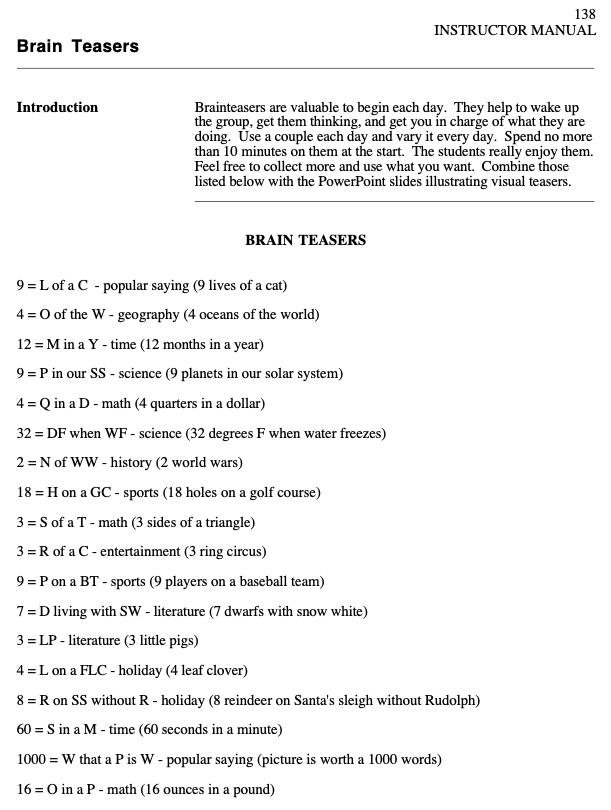
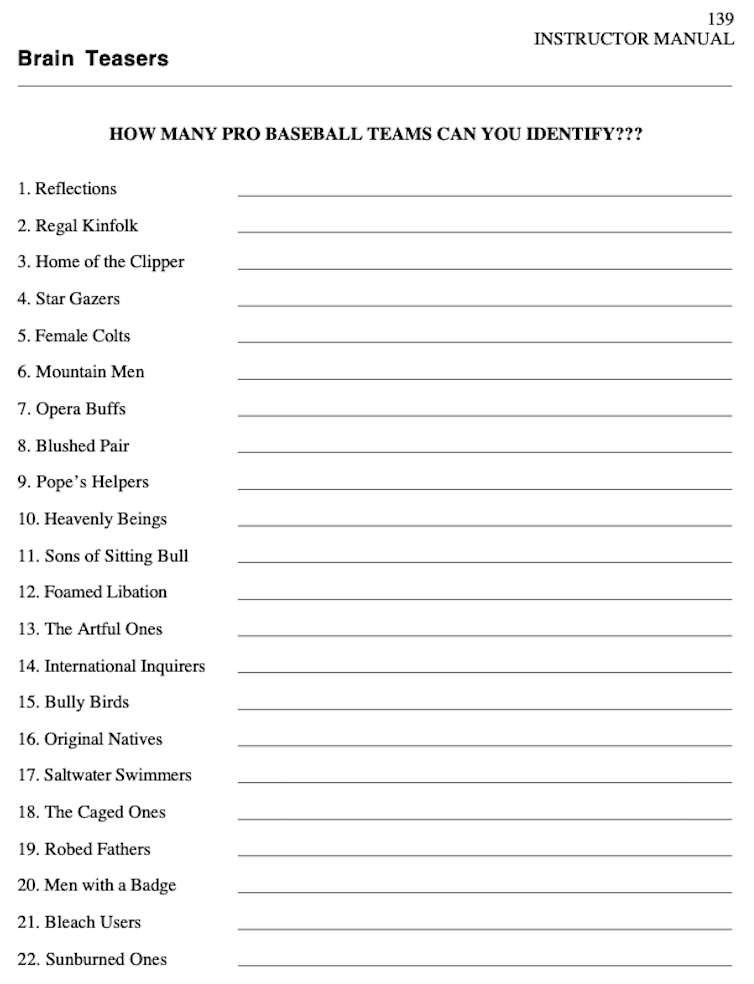
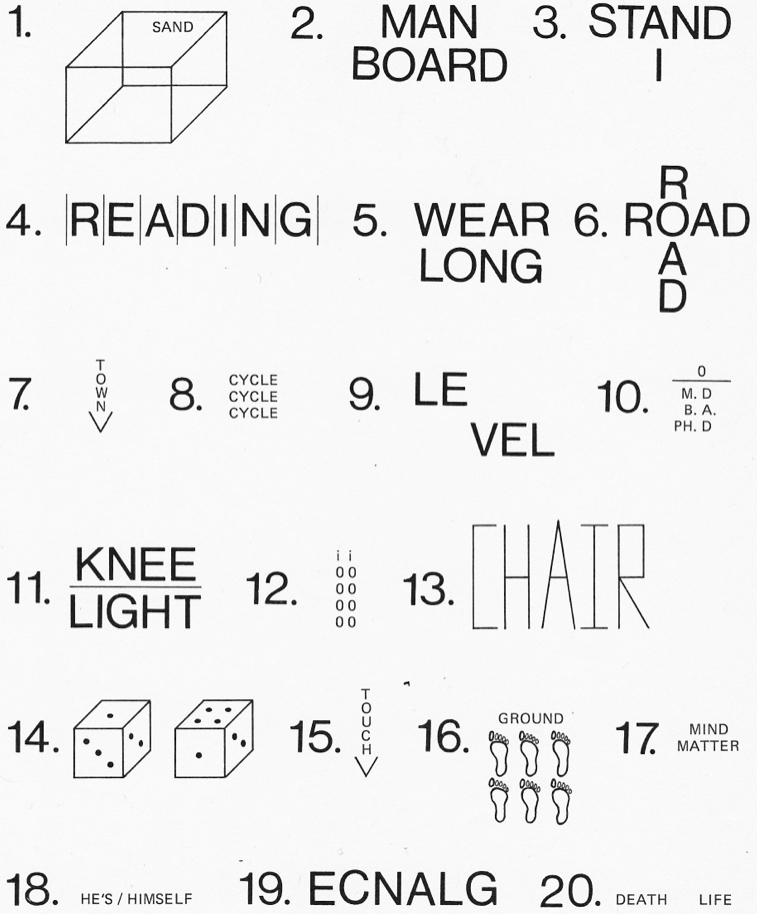
Here are twenty common examples of Brain Teasers followed by some narrative challenges and sports test.
Our MGRUSH Facilitative Leadership and Facilitator Workshop alumni have digital rights to access thousands of Brain Teasers (or, Brain Breaks/ Brakes as a double entendre). If you need help with the answers, simply reply with a comment or buy us a cup of coffee.
We like to use them at the end of a lunch period during full-day(s) workshops to get people seated on time, and having a little fun.

Twenty Popular Brain Breaks to Stimulate Your Meeting Participants
___
Narrative Brain Teasers
Baseball Teams Test
___
Lead the Change—One Meeting at a Time
Are you ready to transform how decisions are made, problems are solved, and alignment is built in your organization?
True meeting leadership goes beyond setting an agenda. It requires a facilitator who can navigate complexity, balance voices, and drive toward outcomes with clarity and consensus. Our Professional Meeting Leadership Workshop equips you to do just that—blending human-centric methods with structured analytical tools to foster rigor, inclusivity, and results that stick.
- Practice live.
- Get expert feedback.
- Build confidence that lasts.
Whether your meetings suffer from unclear objectives, disengaged participants, or decision fatigue, this workshop will help you identify the root causes, apply proven facilitation techniques, and emerge as the leader every team needs.
Take the first step today—transform your meetings and magnify your impact.
👉 Click here to reserve your seat now.
(Limited availability)
Because every meeting should be a catalyst for change—not just another calendar event.
______
With Bookmarks no longer a feature in WordPress, we provide the following for your benefit and reference.
______
Terrence Metz, president of MG RUSH Facilitation Training, was just 22-years-old and working as a Sales Engineer at Honeywell when he recognized a widespread problem—most meetings were ineffective and poorly led, wasting both time and company resources. However, he also observed meetings that worked. What set them apart? A well-prepared leader who structured the session to ensure participants contributed meaningfully and achieved clear outcomes.
Throughout his career, Metz, who earned an MBA from Kellogg (Northwestern University) experienced and also trained in various facilitation techniques. In 2004, he purchased MG RUSH where he shifted his focus toward improving established meeting designs and building a curriculum that would teach others how to lead, facilitate, and structure meetings that drive results. His expertise in training world-class facilitators led to the 2020 publication of Meetings That Get Results: A Guide to Building Better Meetings, a comprehensive resource on effectively building consensus.
Grounded in the principle that “nobody is smarter than everybody,” the book details the why, what, and how of building consensus when making decisions, planning, and solving problems. Along with a Participant’s Guide and supplemental workshops, it supports learning from foundational awareness to professional certification.
Metz’s first book, Change or Die: A Business Process Improvement Manual, tackled the challenges of process optimization. His upcoming book, Catalyst: Facilitating Innovation, focuses on meetings and workshops that don’t simply end when time runs out but conclude with actionable next steps and clear assignments—ensuring progress beyond discussions and ideas.
by Facilitation Expert | Sep 10, 2015 | Communication Skills, Facilitation Skills
The main reason for categorizing input relies on a common purpose. Most groups gather around a common purpose.
For example, treasury groups gather their departments around financial capital. While human resources gather their departments around human capital. Sales and marketing gather around customers’ needs for products and services. Force your participants to make thinking visible around their purpose and why they organize the way they do.
Evidence-based
Three forms of support for business argumentation include:
How to Make Thinking Visible
- Evidence,
- Values, and
- Credibility
When you challenge meeting participants to make their ‘thinking visible’, use active listening and reflect back on WHY they believe their claims to be true. Isolate the proof behind their claims, understanding that you will need to reflect on the facts and examples they provide to boost their claim. Let us take a closer look at the three forms.
Evidence
Much is written about evidence, and while the following is not all of it, business arguments rely on three types of evidence to support claims, namely:
- Surrogates
- Trends
- Vision
Surrogates
Surrogates provide examples and operate through analogy to support arguments. Meeting members might refer to competitors as surrogates for their own group. Examples might not even come from within the industry but may derive from an analogous situation. Some clothing dry cleaners introduced drive-up services, having viewed the success of a surrogate industry, the fast food industry.
Trends
Statistics are frequently used to support business arguments. Since proof about future conditions cannot be established, support is provided for likelihood and probabilities. As you know, historical performance does not prove future performance. The value of statistics derives from trend lines.
Historical performance and statistics provide a lagging indication when time has passed and nothing can be done to reverse the past. Linked together, however, tends to appear to support the likelihood or probability of future performance. As a facilitator, be prepared to further challenge the assumptions from historical performance that may be carried over to support future claims.
Vision
When leadership establishes visionary claims, such as establishing “world-class” or “best-of-breed” aspirations, meeting participants will use the vision to support their claims. Visionary arguments may be similar to arguments supported by values, in that they are likely to be more fuzzy than SMART.
Organizational goals and objectives capture measurements toward the vision and will be used to support many arguments. If participants can make clear claims for example, that their positions will generate the most profit, most will support them if their claims are clear and valid.
Values
Operating in a similar fashion to vision, values also drive “board room to boiler room” behavior and will be used to support arguments. An organization focused on “safety” for example, may defer to the argument that claims to be the safest approach if everything else is held constant.
As a facilitator, strive to have the organizational values (also called Guiding Principles, Tenets, Elements, etc.) handy, and preferably posted for all to see. Likewise, having a clear line of sight to enterprise, business unit, departmental, and project objectives can be leveraged to resolve arguments.
Credibility
Credibility is “the perception that the arguer is competent and trustworthy, and has good will” (see “Argumentation and Critical Decision Making” by Rieke, Sillars, and Peterson, pg 280) toward the other meeting participants. Participants naturally give stronger adherence to other participants with greater credibility. Extensive research and other books and journals speak to the power of credibility. From a facilitator’s perspective, challenge even the credible to make their thinking visible. Make sure everyone in the meeting understands WHY the credible participant has formed his or her belief or claim.
______
Lead the Change—One Meeting at a Time
Are you ready to transform how decisions are made, problems are solved, and alignment is built in your organization?
True meeting leadership goes beyond setting an agenda. It requires a facilitator who can navigate complexity, balance voices, and drive toward outcomes with clarity and consensus. Our Professional Meeting Leadership Workshop equips you to do just that—blending human-centric methods with structured analytical tools to foster rigor, inclusivity, and results that stick.
- Practice live.
- Get expert feedback.
- Build confidence that lasts.
Whether your meetings suffer from unclear objectives, disengaged participants, or decision fatigue, this workshop will help you identify the root causes, apply proven facilitation techniques, and emerge as the leader every team needs.
Take the first step today—transform your meetings and magnify your impact.
👉 Click here to reserve your seat now.
(Limited availability)
Because every meeting should be a catalyst for change—not just another calendar event.
______
With Bookmarks no longer a feature in WordPress, we provide the following for your benefit and reference.
______
Terrence Metz, president of MG RUSH Facilitation Training, was just 22-years-old and working as a Sales Engineer at Honeywell when he recognized a widespread problem—most meetings were ineffective and poorly led, wasting both time and company resources. However, he also observed meetings that worked. What set them apart? A well-prepared leader who structured the session to ensure participants contributed meaningfully and achieved clear outcomes.
Throughout his career, Metz, who earned an MBA from Kellogg (Northwestern University) experienced and also trained in various facilitation techniques. In 2004, he purchased MG RUSH where he shifted his focus toward improving established meeting designs and building a curriculum that would teach others how to lead, facilitate, and structure meetings that drive results. His expertise in training world-class facilitators led to the 2020 publication of Meetings That Get Results: A Guide to Building Better Meetings, a comprehensive resource on effectively building consensus.
Grounded in the principle that “nobody is smarter than everybody,” the book details the why, what, and how of building consensus when making decisions, planning, and solving problems. Along with a Participant’s Guide and supplemental workshops, it supports learning from foundational awareness to professional certification.
Metz’s first book, Change or Die: A Business Process Improvement Manual, tackled the challenges of process optimization. His upcoming book, Catalyst: Facilitating Innovation, focuses on meetings and workshops that don’t simply end when time runs out but conclude with actionable next steps and clear assignments—ensuring progress beyond discussions and ideas.
by Facilitation Expert | Aug 20, 2015 | Decision Making, Leadership Skills
Every minute somewhere, someone refers to Deming’s term SMART (i.e., Specific, Measurable, Achievable, Relevant, Time-Based).
Lesser known, however frequently copied, you will find his philosophy of continuous improvement. Therefore, true to his words, enjoy the phrasing of Deming’s 14 points of continuous improvement. You will discover an excellent discussion of them in Chapter 2 of Out of the Crisis, by W. Edwards Deming, MIT Press, 2000; originally published in 1982.
A few are counter-intuitive but you decide. Consequently, take what you like and leave the rest.
First-half
Deming’s 14 Points — Continuous Improvement Pays for Itself
- Provide for the long-range needs of the company; don’t focus on short-term profitability. The goal is to grow the business and add value.
- The world constantly changes, and managers need to adopt their way of thinking. Delays, mistakes, defective workmanship, and poor service are never acceptable.
- Quit depending on inspections to find defects, and build quality into products and processes as they are built. Use statistical process control to minimize biases.
- Do not choose suppliers on the basis of pricing (e.g., low bids) alone. Minimize total cost by establishing long-term relationships with suppliers that are based on loyalty and trust.
- Work continually to improve customer delivery and service. Improvement is not a one-time effort; every activity in the process must be continually improved to reduce waste and improve quality.
- Institute training because managers should know about modern leadership and be able to train workers to become future leaders. Managers also need training to understand the processes of production, delivery, and customer satisfaction.
- Institute leadership. Managers ought to help people do a better job and remove barriers that keep them from doing their job with pride. The greatest waste in America is failure to use the abilities of people.
Second-half
- Drive out fear. People need to feel secure in order to do their job well. There should never be a conflict between doing what is best for the company and meeting the expectations of their immediate job.
- Break down barriers between departments. Create cross-functional teams so everyone can understand the others’ perspectives. Do not undermine team cooperation by rewarding individual performance.
- Stop using slogans, exhortations, and targets. It is the process, not the workers, that creates defects and lowers productivity. Exhortations don’t change the system; that is management’s responsibility.
- Eliminate numerical quotas for workers and numerical goals for people in management. Also, eliminate arbitrary deadlines for development teams that are managed by fear. Embrace facilitative leadership.
- Eliminate barriers that rob people of their pride in workmanship. Stop treating hourly workers like a commodity. Eliminate annual performance ratings for salaried workers.
- Encourage education and self-improvement for everyone. An educated workforce and management will propel profits in the future.
- Take action to accomplish the transformation. A top management team must lead the effort with action, not simply ‘support’ it.
______
Lead the Change—One Meeting at a Time
Are you ready to transform how decisions are made, problems are solved, and alignment is built in your organization?
True meeting leadership goes beyond setting an agenda. It requires a facilitator who can navigate complexity, balance voices, and drive toward outcomes with clarity and consensus. Our Professional Meeting Leadership Workshop equips you to do just that—blending human-centric methods with structured analytical tools to foster rigor, inclusivity, and results that stick.
- Practice live.
- Get expert feedback.
- Build confidence that lasts.
Whether your meetings suffer from unclear objectives, disengaged participants, or decision fatigue, this workshop will help you identify the root causes, apply proven facilitation techniques, and emerge as the leader every team needs.
Take the first step today—transform your meetings and magnify your impact.
👉 Click here to reserve your seat now.
(Limited availability)
Because every meeting should be a catalyst for change—not just another calendar event.
______
With Bookmarks no longer a feature in WordPress, we provide the following for your benefit and reference.
______
Terrence Metz, president of MG RUSH Facilitation Training, was just 22-years-old and working as a Sales Engineer at Honeywell when he recognized a widespread problem—most meetings were ineffective and poorly led, wasting both time and company resources. However, he also observed meetings that worked. What set them apart? A well-prepared leader who structured the session to ensure participants contributed meaningfully and achieved clear outcomes.
Throughout his career, Metz, who earned an MBA from Kellogg (Northwestern University) experienced and also trained in various facilitation techniques. In 2004, he purchased MG RUSH where he shifted his focus toward improving established meeting designs and building a curriculum that would teach others how to lead, facilitate, and structure meetings that drive results. His expertise in training world-class facilitators led to the 2020 publication of Meetings That Get Results: A Guide to Building Better Meetings, a comprehensive resource on effectively building consensus.
Grounded in the principle that “nobody is smarter than everybody,” the book details the why, what, and how of building consensus when making decisions, planning, and solving problems. Along with a Participant’s Guide and supplemental workshops, it supports learning from foundational awareness to professional certification.
Metz’s first book, Change or Die: A Business Process Improvement Manual, tackled the challenges of process optimization. His upcoming book, Catalyst: Facilitating Innovation, focuses on meetings and workshops that don’t simply end when time runs out but conclude with actionable next steps and clear assignments—ensuring progress beyond discussions and ideas.
by Facilitation Expert | Aug 13, 2015 | Communication Skills, Decision Making, Facilitation Skills, Leadership Skills, Managing Conflict
A strong facilitator should understand and appreciate the value of argumentation, specifically meeting argumentation. She should understand the holarchial nature of business and align people organized around a common cause. Critical thinking helps structure discussions so that groups can get more done, faster.
Setting up our evidence-based approach that favors the value of argumentation and meeting argumentation, when Thomas Watson (CEO of IBM) was helping IBM reach their pinnacle, he said:
“I firmly believe that any organization, in order to survive and achieve success, must have a sound set of beliefs on which it premises all its policies and actions. I believe that the most important single factor in corporate success is faithful adherence to those beliefs. To meet the challenges of changing world, it must prepare to change everything about itself except those beliefs as it moves through corporate life.”
He asserted that beliefs for IBM included (illustrating the value of argumentation):
- Respect the individual.
- Provide the best customer service of any company in the world.
- Drive for superiority in all things.
While “beliefs” serves as a synonym for values or guiding principles, the value of argumentation suggests that answers to the four questions below drive consistent decision-making from “the board room to the boiler room” (METZ).
Do not build your guiding principles simply because MBA textbooks say so. Rather, they should be collaboratively built so that everyone in the organization can make appropriate trade-offs in daily decision-making.
Starting Points
Organizations, especially businesses, have developed elaborate processes around knowledge management. Accepted facts, presumptions, assumptions, and probabilities (listed in order of general acceptance) represent the most common spheres of knowledge. Without starting points, argumentation is not possible. Conversely, the greater the shared starting points, the easier it is to galvanize consensus. Starting points become foundations as support for further claims, normally claims that are associated with change and a call to action.
The Value of Argumentation Relies on Facts, Presumptions, Assumptions, and Probabilities
Facts
People refer to facts as observations, calculations, evidence, and other empirical knowledge derived from observation or experience over which there is no controversy. For example, the evening sunsets in the west. Chocolate truffles are more expensive than dirt. Yet acceptable facts will change from group to group.
Presumptions
With lesser certainty than facts, presumptions provide the basis for many claims. For example, children are less able to care for themselves than adults. Presumptions are subject to challenge and may be overthrown. Some people even begin their arguments with presumptions they know to be false, simply to get the conversation going. Presumptions are relied upon heavily in legal actions and frequently require an additional ‘burden of proof.’ A key value of group decision-making is the ability for groups to more thoroughly challenge and disrupt unsound presumptions by providing facts or observations of times and places when the presumptions are false.
Assumptions
While a presumption represents something you think is generally true, but not always true, an assumption is something believed to be true, with less certainty than a presumption. The difference can be subtle. When you have certain set ideas about some things, they are also presumptions. Keep in mind that presumptions are more authoritative than assumptions.
An excellent comparison from The Write Source by Liz Bureman follows:
“For example, since I just watched The Hunger Games for the first time (the original, not the sequel) , I presumed that I would enjoy it. I had never seen the movie before (I know, I know, I’m way behind the times), but I have read the books, and I enjoyed them. Since I enjoyed the books, the presumption that I would enjoy the movie was an easy one to make.
However, I assume that the actors read the books before starting work on the film. I have no idea if Jennifer Lawrence actually read the trilogy before taking on the role of Katniss, although I’m sure a Google search could clear that up, but right now, that is a pure assumption, since I have no proof or knowledge that would lead me to think that would be the case.”
Probabilities
With lesser certainty, probabilities are assembled with a combination of facts, presumptions, and assumptions about some future condition. Such beliefs are frequently held, whether clear or not, during most arguments. Probabilities may even be assigned percentages and are reflected when you hear words such as “Likely”, “Almost certainly”, “Probably”, and “Maybe”.
Summary
Since many business arguments involve probabilities, an effective facilitator needs to make the thinking visible behind modifiers such as “likely”. Discover conditions under which the probability increases or decreases to get a group more rapidly to accept an algorithm reflecting the probability or propensity. Seek to have them articulate a range of possibilities rather than fixed numbers. Consider capturing three placeholders such as best case, worst case, and most likely. Always use your critical thinking to examine the basis of facts, presumptions, assumptions, and probabilities and help the group understand what components may cause their arguments to fortify or to become frail.
______
Lead the Change—One Meeting at a Time
Are you ready to transform how decisions are made, problems are solved, and alignment is built in your organization?
True meeting leadership goes beyond setting an agenda. It requires a facilitator who can navigate complexity, balance voices, and drive toward outcomes with clarity and consensus. Our Professional Meeting Leadership Workshop equips you to do just that—blending human-centric methods with structured analytical tools to foster rigor, inclusivity, and results that stick.
- Practice live.
- Get expert feedback.
- Build confidence that lasts.
Whether your meetings suffer from unclear objectives, disengaged participants, or decision fatigue, this workshop will help you identify the root causes, apply proven facilitation techniques, and emerge as the leader every team needs.
Take the first step today—transform your meetings and magnify your impact.
👉 Click here to reserve your seat now.
(Limited availability)
Because every meeting should be a catalyst for change—not just another calendar event.
______
With Bookmarks no longer a feature in WordPress, we provide the following for your benefit and reference.
______
Terrence Metz, president of MG RUSH Facilitation Training, was just 22-years-old and working as a Sales Engineer at Honeywell when he recognized a widespread problem—most meetings were ineffective and poorly led, wasting both time and company resources. However, he also observed meetings that worked. What set them apart? A well-prepared leader who structured the session to ensure participants contributed meaningfully and achieved clear outcomes.
Throughout his career, Metz, who earned an MBA from Kellogg (Northwestern University) experienced and also trained in various facilitation techniques. In 2004, he purchased MG RUSH where he shifted his focus toward improving established meeting designs and building a curriculum that would teach others how to lead, facilitate, and structure meetings that drive results. His expertise in training world-class facilitators led to the 2020 publication of Meetings That Get Results: A Guide to Building Better Meetings, a comprehensive resource on effectively building consensus.
Grounded in the principle that “nobody is smarter than everybody,” the book details the why, what, and how of building consensus when making decisions, planning, and solving problems. Along with a Participant’s Guide and supplemental workshops, it supports learning from foundational awareness to professional certification.
Metz’s first book, Change or Die: A Business Process Improvement Manual, tackled the challenges of process optimization. His upcoming book, Catalyst: Facilitating Innovation, focuses on meetings and workshops that don’t simply end when time runs out but conclude with actionable next steps and clear assignments—ensuring progress beyond discussions and ideas.
by Facilitation Expert | Jul 30, 2015 | Meeting Support
All groups, especially very large groups, perform better when the participants know something about each other. Even though time constraints prohibit traditional, self-spoken icebreakers for large groups (e.g., 60 people for two minutes each burns two hours), some time for social bonding remains effective.
Getting to Know One Another, Icebreakers for Large Groups Embrace Icebreakers or Check-In activities to get everyone contributing sooner. Likewise, anticipate and plan for additional team-building activities later on as appropriate. Make it easier for your participants to enjoy and value one another. Similarly, prepare some quick exercises (such as “Lost on the Moon”)[1] that prove “nobody is smarter than everybody.”
Consider the following simple, easy, icebreakers for large groups, even hundreds of people, to instill a broader sense of group consciousness and networking. The simple rule requires participants to stand when they can answer ‘affirmative’ to one of your pre-determined questions. For example, “Stand up if you had to fly to get here.”
Other questions that capture but a small sliver of potential questions you might ask include:
- Stand up if you have worked for this organization for five years.
- Keep standing if ten years, twenty, etc.
- Stand up if you have one pet.
- Keep standing if you have two pets, three pets, etc.
- Stand up if you were born in another country (or state, or city).
- Stand up if you lived in another country for more than one year.
- Keep standing if five years, ten, etc.
- Stand up if you love music. Country? Jazz? Classical? Rap?
- Stand up if you have a tattoo
- Keep standing if you have two, three, five, etc.
- Stand up if you have ever broken a bone.
- Stand up if your favorite James Bond actor is Sean Connery.
- Roger Moore, Pierce Brosnan, Timothy Dalton, Daniel Craig . . .
- Stand up if you drive a Volvo.
- BMW, Ford, Mercedes, etc.
Additional Icebreakers for Large Groups
Also, using the stand/sit method described above creates some healthy tension. The “Would You Rather?” approach generates high energy, even among people who presumably know each other quite well. This approach can also be used with smaller groups. For example,
- Would you rather be able to be invisible, or
- Able to read others’ minds?
- Would you rather live without music, or
- Would you rather be four feet tall, or
- Would you rather have a Texan accent and live in New York City, or
- Have a New York accent and live in Texas?
- Would you rather marry your first boyfriend/ girlfriend, or
- Someone your parents choose for you?
- Would you rather be granted the answer to any three questions, or
- Be granted the ability to resurrect one person?
- Would you rather always show up 20 minutes late for everything, or
- Always show up 90 minutes early for everything?
- Would you rather work for your oldest sibling, or
- Live in a home without electricity, or
Have some fun and create your own. These work with large groups because the directions are short and simple, as long as everyone can hear the question for standing up. In our experience, everyone will quickly quiet down and pay attention so they know when they are supposed to stand. You can also interject some of your personality or a preview of the day’s events based on your questions. Write back to us about your experience and suggestions when using icebreakers with large groups.
FOR SMALLER GROUPS
To get your subject matter experts participatory sooner by having them introduce themselves beyond names and titles. Always use Icebreakers during online meetings, providing participants with a way of connecting with one another. Have participants share their responses with the group.
- An undemanding yet effective method begins, “If I were a . . .”—for example, “If I were a gem, I would be a ____,” or “If I were a bird, I would be a _____.”
- Describe your dream career as a child.
- Explain how you got one of your scars (and where it is).
- If you could change anything about your childhood, what would it be?
- If you could wake up tomorrow having gained any one quality or ability, what would it be?
- If you were an animal, you would be a ___________.
- If you had a yacht, what would you name it?
- “My hero is . . .”; “My collection is . . .”
- If limited to five items, what would you bring with you on a desert island?
- Name a talent that you have that no one here knows about.
- Name your favorite James Bond or Elizabeth Bennet actor and explain why.
- Tell two truths and a lie—participants guess the lie.
- What is the one word you would use to describe where you are at?
- What is your favorite sport to play? Why?
- What kitchen appliance or tool would you be and why?
- What was the first concert you attended?
- What was your strangest paying job or chore?
- What would be the title of your autobiography?
- What’s on your reading list or nightstand?
- Who is the most fascinating person in history?
~~~~~~~
[1]See the National Aeronautics and Space Administration (NASA) website for a public domain challenge of prioritizing 15 items that need to be carried a long distance by foot when stranded on the surface of the moon: https://www.nasa.gov/pdf/166504main_Survival.pdf.
______
______
Lead the Change—One Meeting at a Time
Are you ready to transform how decisions are made, problems are solved, and alignment is built in your organization?
True meeting leadership goes beyond setting an agenda. It requires a facilitator who can navigate complexity, balance voices, and drive toward outcomes with clarity and consensus. Our Professional Meeting Leadership Workshop equips you to do just that—blending human-centric methods with structured analytical tools to foster rigor, inclusivity, and results that stick.
- Practice live.
- Get expert feedback.
- Build confidence that lasts.
Whether your meetings suffer from unclear objectives, disengaged participants, or decision fatigue, this workshop will help you identify the root causes, apply proven facilitation techniques, and emerge as the leader every team needs.
Take the first step today—transform your meetings and magnify your impact.
👉 Click here to reserve your seat now.
(Limited availability)
Because every meeting should be a catalyst for change—not just another calendar event.
______
With Bookmarks no longer a feature in WordPress, we provide the following for your benefit and reference.
______
Terrence Metz, president of MG RUSH Facilitation Training, was just 22-years-old and working as a Sales Engineer at Honeywell when he recognized a widespread problem—most meetings were ineffective and poorly led, wasting both time and company resources. However, he also observed meetings that worked. What set them apart? A well-prepared leader who structured the session to ensure participants contributed meaningfully and achieved clear outcomes.
Throughout his career, Metz, who earned an MBA from Kellogg (Northwestern University) experienced and also trained in various facilitation techniques. In 2004, he purchased MG RUSH where he shifted his focus toward improving established meeting designs and building a curriculum that would teach others how to lead, facilitate, and structure meetings that drive results. His expertise in training world-class facilitators led to the 2020 publication of Meetings That Get Results: A Guide to Building Better Meetings, a comprehensive resource on effectively building consensus.
Grounded in the principle that “nobody is smarter than everybody,” the book details the why, what, and how of building consensus when making decisions, planning, and solving problems. Along with a Participant’s Guide and supplemental workshops, it supports learning from foundational awareness to professional certification.
Metz’s first book, Change or Die: A Business Process Improvement Manual, tackled the challenges of process optimization. His upcoming book, Catalyst: Facilitating Innovation, focuses on meetings and workshops that don’t simply end when time runs out but conclude with actionable next steps and clear assignments—ensuring progress beyond discussions and ideas.