by Facilitation Expert | Nov 26, 2015 | Communication Skills, Leadership Skills
The evidence is overwhelming—those who have more gratitude, or an attitude of gratitude — are happier individuals.
Although you won’t hear the term ‘happy’ very frequently in one of our meetings or workshops (because the word is both subjective and fuzzy), it seemed appropriate as people of the United States are celebrating their Thanksgiving period to provide a quick reflection.
Few, if any, would argue that gratitude is not a positive attitude. Positive attitudes, or an attitude of gratitude, provide a leading indication for the opportunity to galvanize consensus. Therefore, groups who have more gratitude are more likely to agree.
Mandate vs. Gratitude
Of interest are the following trend lines extracted from Google’s Ngram. As the use of the term ‘mandate’ has increased in recent decades, the use of the term ‘gratitude’ has decreased. While the relationship does not prove that people have less gratitude today than in the past, it does suggest that the frequency of the term and reference to its positive meaning has been on the decline.

Mandate vs Gratitude
Facilitation vs. Gratitude
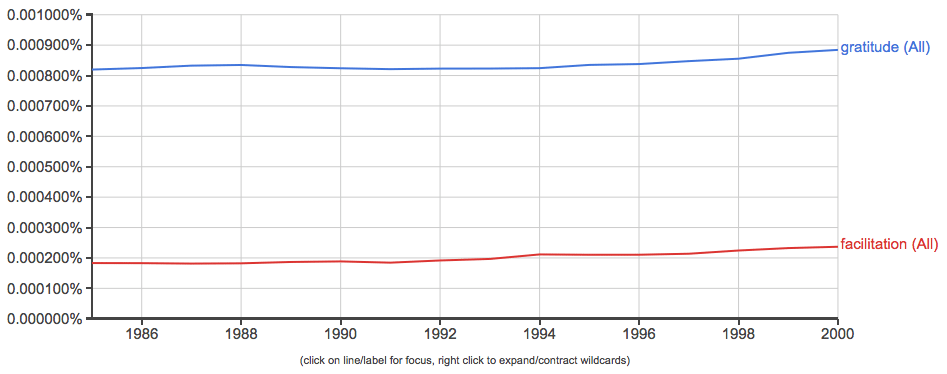
Although use of the ‘facilitation’ in a business sense is relatively new (over the past few decades), since we started teaching facilitation there has been a steady and positive slope increase in the use of gratitude. Not coincidentally, we would argue.
Gratitude vs Facilitation
Implications?
Get your group to be more thankful for what they have, rather than dwelling on what they do not have. Use what they have (e.g., skills, strengths, etc.) to focus on WHAT they could do to further extend what gives them gratitude.
You will benefit personally as well. Harvard Medical School reports that “In positive psychology research, gratitude is strongly and consistently associated with greater happiness. Gratitude helps people feel more positive emotions, relish good experiences, improve their health, deal with adversity, and build strong relationships.” (emphasis is ours)
People in the United States take so much for granted, it can make outsiders incredulous. Perhaps less than one percent of the people on this planet have some money in the bank, a few coins in their purse, a stocked refrigerator at home, the ability to read, at least one parent who remains alive, the skill to read, and the liberty to attend the place of worship at their choosing.
If you do, if your meeting participants do, then we suggest that you begin your meeting or workshop by first stressing the gratitude to have the opportunity to make things better for your business and its stakeholders. Most people are not so fortunate.
______
Lead the Change—One Meeting at a Time
Are you ready to transform how decisions are made, problems are solved, and alignment is built in your organization?
True meeting leadership goes beyond setting an agenda. It requires a facilitator who can navigate complexity, balance voices, and drive toward outcomes with clarity and consensus. Our Professional Meeting Leadership Workshop equips you to do just that—blending human-centric methods with structured analytical tools to foster rigor, inclusivity, and results that stick.
- Practice live.
- Get expert feedback.
- Build confidence that lasts.
Whether your meetings suffer from unclear objectives, disengaged participants, or decision fatigue, this workshop will help you identify the root causes, apply proven facilitation techniques, and emerge as the leader every team needs.
Take the first step today—transform your meetings and magnify your impact.
👉 Click here to reserve your seat now.
(Limited availability)
Because every meeting should be a catalyst for change—not just another calendar event.
______
With Bookmarks no longer a feature in WordPress, we provide the following for your benefit and reference.
______
Terrence Metz, president of MG RUSH Facilitation Training, was just 22-years-old and working as a Sales Engineer at Honeywell when he recognized a widespread problem—most meetings were ineffective and poorly led, wasting both time and company resources. However, he also observed meetings that worked. What set them apart? A well-prepared leader who structured the session to ensure participants contributed meaningfully and achieved clear outcomes.
Throughout his career, Metz, who earned an MBA from Kellogg (Northwestern University) experienced and also trained in various facilitation techniques. In 2004, he purchased MG RUSH where he shifted his focus toward improving established meeting designs and building a curriculum that would teach others how to lead, facilitate, and structure meetings that drive results. His expertise in training world-class facilitators led to the 2020 publication of Meetings That Get Results: A Guide to Building Better Meetings, a comprehensive resource on effectively building consensus.
Grounded in the principle that “nobody is smarter than everybody,” the book details the why, what, and how of building consensus when making decisions, planning, and solving problems. Along with a Participant’s Guide and supplemental workshops, it supports learning from foundational awareness to professional certification.
Metz’s first book, Change or Die: A Business Process Improvement Manual, tackled the challenges of process optimization. His upcoming book, Catalyst: Facilitating Innovation, focuses on meetings and workshops that don’t simply end when time runs out but conclude with actionable next steps and clear assignments—ensuring progress beyond discussions and ideas.
by Facilitation Expert | Nov 5, 2015 | Leadership Skills, Managing Conflict
We encourage professional facilitators to carry a toolbox. Include some intervention devices when you need to shake up your participants. Be prepared to challenge groupthink if you start hearing things like . . .
-
That will never change.
-
We don’t do things like that around here.
-
etc.
. . . then jolt your participants. We have covered other exercises in Best Practices articles such as “Four Dots” and “Bookworm”. Below is an example that is quick, simple, and effective. Some call it the “Spot.”
Groupthink: Your Goal
To shake up a paradigm, challenge groupthink. Otherwise, get your participants to focus on the CONTEXT of something in addition to the CONTENT.
Groupthink: One Halting Method
Using a large flip chart, or distributing white sheets of paper, place a small, colored spot or a few colored spots on the paper. Ask the participants to indicate what they see on the paper.
Most of them, and usually in sequence, will indicate they see a “Green Spot” (or any color you choose). Consider using the white space on the easel to tally the number of same or similar responses.
While confirming that you also see the spot(s), NOTE that most individuals overlooked a large amount of white space surrounding the dots. Participants frequently miss or under-appreciate the context around us or the deliverable (be it a decision, a plan, etc.). You may point to the importance of interpersonal relationships at work as an example.
Additionally, you may point out that customers tend to identify the blemishes in our products and services, and frequently have a reasonable expectation for them to be fixed. Likewise, management focuses on the “dots” of our projects or personal performance, failing to properly value the vastness of good, solid contributions and effort.
Conclude by sharing that while it may be appropriate to look for the “spots”, we should also force ourselves to consider the large white area of equal importance. If there is any unique contribution or answer besides “dots” emphasize how that voice may have been discounted when the rest of the group focused on the “dots”, when in fact that solo voice may have been speaking about something far more important than the rest of the group combined.
______
Lead the Change—One Meeting at a Time
Are you ready to transform how decisions are made, problems are solved, and alignment is built in your organization?
True meeting leadership goes beyond setting an agenda. It requires a facilitator who can navigate complexity, balance voices, and drive toward outcomes with clarity and consensus. Our Professional Meeting Leadership Workshop equips you to do just that—blending human-centric methods with structured analytical tools to foster rigor, inclusivity, and results that stick.
- Practice live.
- Get expert feedback.
- Build confidence that lasts.
Whether your meetings suffer from unclear objectives, disengaged participants, or decision fatigue, this workshop will help you identify the root causes, apply proven facilitation techniques, and emerge as the leader every team needs.
Take the first step today—transform your meetings and magnify your impact.
👉 Click here to reserve your seat now.
(Limited availability)
Because every meeting should be a catalyst for change—not just another calendar event.
______
With Bookmarks no longer a feature in WordPress, we provide the following for your benefit and reference.
______
Terrence Metz, president of MG RUSH Facilitation Training, was just 22-years-old and working as a Sales Engineer at Honeywell when he recognized a widespread problem—most meetings were ineffective and poorly led, wasting both time and company resources. However, he also observed meetings that worked. What set them apart? A well-prepared leader who structured the session to ensure participants contributed meaningfully and achieved clear outcomes.
Throughout his career, Metz, who earned an MBA from Kellogg (Northwestern University) experienced and also trained in various facilitation techniques. In 2004, he purchased MG RUSH where he shifted his focus toward improving established meeting designs and building a curriculum that would teach others how to lead, facilitate, and structure meetings that drive results. His expertise in training world-class facilitators led to the 2020 publication of Meetings That Get Results: A Guide to Building Better Meetings, a comprehensive resource on effectively building consensus.
Grounded in the principle that “nobody is smarter than everybody,” the book details the why, what, and how of building consensus when making decisions, planning, and solving problems. Along with a Participant’s Guide and supplemental workshops, it supports learning from foundational awareness to professional certification.
Metz’s first book, Change or Die: A Business Process Improvement Manual, tackled the challenges of process optimization. His upcoming book, Catalyst: Facilitating Innovation, focuses on meetings and workshops that don’t simply end when time runs out but conclude with actionable next steps and clear assignments—ensuring progress beyond discussions and ideas.
by Facilitation Expert | Oct 22, 2015 | Communication Skills
Organizational process improvement questions depend on the points of view.
From an executive perspective, fewer participants and lower costs indicate process improvement. However, from an employee or member point of view, getting more done quickly and easily, without losing people, indicates process improvement. Consensual answers to the process improvement questions below yield the type of improvement that everyone will support, from the board room to the boiler room.
Process Improvement Questions Lead to Coherence
Process Improvement Questions
- What input could be automated?
- What sources provide the inputs?
- Which inputs must be manually created and what is the source?
- What calculations need to be used?
- What are the discrete outputs and who do they go to?
Informational Needs
To better understand the term ‘in-formation’, add the hyphen. Now observe the dynamism of the term. As a result, rather than viewing the need as static data, see the active flow that results:
- What data supports each activity?
- Where does it come from?
- What does it look like (i.e., field, statement, table, etc.)?
- How does it apply?
- What data are we lacking?
- What data may have concerns around authenticity?
- Where is the missing data?
Display Format
Sensitize yourself on how to obtain the information. Thereby, noting potential inefficiencies when participants acquire the data:
- What screens, reports, or manual forms do you use to secure the data?
- Optimally, how should it look?
- Explain any flows or dialogs to obtain the data.
- What conditions dictate using it?
- What conditions dictate NOT using it?
- How is it used?
Environmental Considerations
Card access and ATMs provide examples of where ambient conditions affect optimal design. Therefore, consider the following:
- Describe and determine data generated and transactions performed
- What security requirements appear prudent?
- How frequently does it occur?
- What are the special considerations?
Relationships
Also, consider the dependent relationships on the process in scope. Therefore, do not optimize in a vacuum:
- Which relationships affected by the process require optimization?
- What starts, stops, or changes the relationships?
- What business policies affect them?
- Separately identify the one-to-one, one-to-many, many-to-one, or many-to-many relationships between them.
______
Lead the Change—One Meeting at a Time
Are you ready to transform how decisions are made, problems are solved, and alignment is built in your organization?
True meeting leadership goes beyond setting an agenda. It requires a facilitator who can navigate complexity, balance voices, and drive toward outcomes with clarity and consensus. Our Professional Meeting Leadership Workshop equips you to do just that—blending human-centric methods with structured analytical tools to foster rigor, inclusivity, and results that stick.
- Practice live.
- Get expert feedback.
- Build confidence that lasts.
Whether your meetings suffer from unclear objectives, disengaged participants, or decision fatigue, this workshop will help you identify the root causes, apply proven facilitation techniques, and emerge as the leader every team needs.
Take the first step today—transform your meetings and magnify your impact.
👉 Click here to reserve your seat now.
(Limited availability)
Because every meeting should be a catalyst for change—not just another calendar event.
______
With Bookmarks no longer a feature in WordPress, we provide the following for your benefit and reference.
______
Terrence Metz, president of MG RUSH Facilitation Training, was just 22-years-old and working as a Sales Engineer at Honeywell when he recognized a widespread problem—most meetings were ineffective and poorly led, wasting both time and company resources. However, he also observed meetings that worked. What set them apart? A well-prepared leader who structured the session to ensure participants contributed meaningfully and achieved clear outcomes.
Throughout his career, Metz, who earned an MBA from Kellogg (Northwestern University) experienced and also trained in various facilitation techniques. In 2004, he purchased MG RUSH where he shifted his focus toward improving established meeting designs and building a curriculum that would teach others how to lead, facilitate, and structure meetings that drive results. His expertise in training world-class facilitators led to the 2020 publication of Meetings That Get Results: A Guide to Building Better Meetings, a comprehensive resource on effectively building consensus.
Grounded in the principle that “nobody is smarter than everybody,” the book details the why, what, and how of building consensus when making decisions, planning, and solving problems. Along with a Participant’s Guide and supplemental workshops, it supports learning from foundational awareness to professional certification.
Metz’s first book, Change or Die: A Business Process Improvement Manual, tackled the challenges of process optimization. His upcoming book, Catalyst: Facilitating Innovation, focuses on meetings and workshops that don’t simply end when time runs out but conclude with actionable next steps and clear assignments—ensuring progress beyond discussions and ideas.
by Facilitation Expert | Oct 15, 2015 | Communication Skills, Leadership Skills
To effectively control your meetings and finish faster meetings (ahead of schedule) requires an effort that begins long before your meeting starts.
We call the preparation period 7:59 work, as in before 8:00 AM. After the meeting starts, you can further accelerate group performance by serving your group as an effective process police person. The role of the facilitator mandates core skills such as clear rhetoric, detailed questions, constant observance, and rigid neutrality. The facilitator’s role also demands control of the meeting agenda so that you lead faster meetings.
A Deliverable for Every Step
Lead Faster Meetings by Explaining the WHY and HOW Behind the WHAT
The agenda is the roadmap by which the team advances from the start of the meeting (ie., metaphorically “8:00 AM”) to the end (ie., metaphorically “5:00 PM”). Solid, simple agendas do not include verbs. Verbs are work and nobody wants more work (e.g., “identify”, “define”, etc.) any more than nobody wants more meetings. Yet we meet frequently because we need deliverables. Each agenda step has its own deliverable that adds up to help you finish meetings faster.
Describe the deliverable for each step as the object (i.e., a noun) or objective of the step. For example, use “Key Measurements” instead of “Identifying Key Measurements.” The verb “Identifying” describes HOW we get the objectives of the step, and HOW we do it has more than one right answer.
As the facilitator, explain HOW, and more importantly WHY, each step in the agenda contributes. Notice that the object of the step is WHAT DONE LOOKS LIKE. Meeting participants can read the agenda (best to keep it posted) and seldom need to be reminded WHAT we need, but do need to be reinforced WHY it is important and HOW we are going to get there. WHY objects are posted on the agenda captures the white space, or space between the lines, and demands further explanation.
Explain the White Space
We have all been in a meeting when someone, usually an outlier, asks “Now WHY are we doing this?” Ever feel the oxygen get sucked out of the room? An effective facilitator anticipates that question and slows down during agenda transitions, a maneuver that is counter-intuitive to most who state “Let me review this quickly.”
The Tuckman Model suggests that groups, even high-performance teams, are subject to regression when transitioning from one step in your agenda to another. Be forewarned, transitions are the best time to slow down and carefully explain the white space:
- WHY did we build the output from the prior agenda step?
- HOW does it help us get out of this meeting faster; i.e., how does it relate to the meeting deliverable?
- WHAT are we going to do next?
- WHY are we doing it and HOW does it help us get out of this meeting faster; i.e., how does it support the meeting deliverable?
- WHY are the agenda items in the sequence provided?
Carefully explain the white space by answering the questions above and you will discover that your meetings finish meetings faster than ever.
______
Lead the Change—One Meeting at a Time
Are you ready to transform how decisions are made, problems are solved, and alignment is built in your organization?
True meeting leadership goes beyond setting an agenda. It requires a facilitator who can navigate complexity, balance voices, and drive toward outcomes with clarity and consensus. Our Professional Meeting Leadership Workshop equips you to do just that—blending human-centric methods with structured analytical tools to foster rigor, inclusivity, and results that stick.
- Practice live.
- Get expert feedback.
- Build confidence that lasts.
Whether your meetings suffer from unclear objectives, disengaged participants, or decision fatigue, this workshop will help you identify the root causes, apply proven facilitation techniques, and emerge as the leader every team needs.
Take the first step today—transform your meetings and magnify your impact.
👉 Click here to reserve your seat now.
(Limited availability)
Because every meeting should be a catalyst for change—not just another calendar event.
______
With Bookmarks no longer a feature in WordPress, we provide the following for your benefit and reference.
______
Terrence Metz, president of MG RUSH Facilitation Training, was just 22-years-old and working as a Sales Engineer at Honeywell when he recognized a widespread problem—most meetings were ineffective and poorly led, wasting both time and company resources. However, he also observed meetings that worked. What set them apart? A well-prepared leader who structured the session to ensure participants contributed meaningfully and achieved clear outcomes.
Throughout his career, Metz, who earned an MBA from Kellogg (Northwestern University) experienced and also trained in various facilitation techniques. In 2004, he purchased MG RUSH where he shifted his focus toward improving established meeting designs and building a curriculum that would teach others how to lead, facilitate, and structure meetings that drive results. His expertise in training world-class facilitators led to the 2020 publication of Meetings That Get Results: A Guide to Building Better Meetings, a comprehensive resource on effectively building consensus.
Grounded in the principle that “nobody is smarter than everybody,” the book details the why, what, and how of building consensus when making decisions, planning, and solving problems. Along with a Participant’s Guide and supplemental workshops, it supports learning from foundational awareness to professional certification.
Metz’s first book, Change or Die: A Business Process Improvement Manual, tackled the challenges of process optimization. His upcoming book, Catalyst: Facilitating Innovation, focuses on meetings and workshops that don’t simply end when time runs out but conclude with actionable next steps and clear assignments—ensuring progress beyond discussions and ideas.
by Facilitation Expert | Oct 1, 2015 | Analysis Methods, Decision Making, Meeting Structure, Prioritizing
The Purpose of Olympic Scoring is to extract some consensually validated new product, process, or other innovative ideas or concepts while encouraging 100 percent participation. The following is particularly appropriate when facilitating Olympic scoring with larger groups of nine or more participants.
In advance, inform all of your participants to bring at least one idea or response to a prepared question. Immediately capture them during the meeting or workshop. While focused on a central theme (e.g., solution to a problem), break down your primary question into small, manageable pieces.
For example, do NOT ask what does the Marketing Plan look like. Understand that “Y” is a function of numerous large “X” and small “x” so ask solid, detailed questions such as: Who should be our target audience for _________? What should the message for target audience _____________?
Methodology of Olympic Scoring
Build three sets of flashcards with the numbers one through ten on each set. Consider using 4in * 6in index cards. In the meeting or workshop, consciously or randomly select three class members (“experts”) who will serve as judges rather than content providers.
Olympic Scoring Method
After meeting participants present each idea or concept, the judges flash their scores, with more being better (i.e., ten is the best). The facilitator captures the three scores and tabulates them on a large Post-It®. The highest score does not necessarily win, but the discussion will be minimized, if not eliminated, around the low-scoring options, thus encouraging the group to focus its discussion on the best candidates.
Deliverable from Olympic Scoring
Subsequently or concurrently the facilitator leads discussions about the reason(s) to support the higher scores and captures the reasons and rationale for their decision on large Post-Its. The reasons provide the criteria that can now be used to re-evaluate all the ideas or to create new ideas, that optimally satisfy the appropriate criteria.
Considerations when Olympic Scoring
Consider prioritizing or weighting the criteria since some will be more important than others. Traditionally the weighting system runs from one to five where more is better. You might use the Scorecard tool to calculate detailed scores or consider using the Perceptual Map tool and arraying your options against the most important criteria.
If you have your participants prepare responses to more than one question, and have additional time, start over again. Consider appointing new judges so that all voices are viewed as equal contributors.
______
Lead the Change—One Meeting at a Time
Are you ready to transform how decisions are made, problems are solved, and alignment is built in your organization?
True meeting leadership goes beyond setting an agenda. It requires a facilitator who can navigate complexity, balance voices, and drive toward outcomes with clarity and consensus. Our Professional Meeting Leadership Workshop equips you to do just that—blending human-centric methods with structured analytical tools to foster rigor, inclusivity, and results that stick.
- Practice live.
- Get expert feedback.
- Build confidence that lasts.
Whether your meetings suffer from unclear objectives, disengaged participants, or decision fatigue, this workshop will help you identify the root causes, apply proven facilitation techniques, and emerge as the leader every team needs.
Take the first step today—transform your meetings and magnify your impact.
👉 Click here to reserve your seat now.
(Limited availability)
Because every meeting should be a catalyst for change—not just another calendar event.
______
With Bookmarks no longer a feature in WordPress, we provide the following for your benefit and reference.
______
Terrence Metz, president of MG RUSH Facilitation Training, was just 22-years-old and working as a Sales Engineer at Honeywell when he recognized a widespread problem—most meetings were ineffective and poorly led, wasting both time and company resources. However, he also observed meetings that worked. What set them apart? A well-prepared leader who structured the session to ensure participants contributed meaningfully and achieved clear outcomes.
Throughout his career, Metz, who earned an MBA from Kellogg (Northwestern University) experienced and also trained in various facilitation techniques. In 2004, he purchased MG RUSH where he shifted his focus toward improving established meeting designs and building a curriculum that would teach others how to lead, facilitate, and structure meetings that drive results. His expertise in training world-class facilitators led to the 2020 publication of Meetings That Get Results: A Guide to Building Better Meetings, a comprehensive resource on effectively building consensus.
Grounded in the principle that “nobody is smarter than everybody,” the book details the why, what, and how of building consensus when making decisions, planning, and solving problems. Along with a Participant’s Guide and supplemental workshops, it supports learning from foundational awareness to professional certification.
Metz’s first book, Change or Die: A Business Process Improvement Manual, tackled the challenges of process optimization. His upcoming book, Catalyst: Facilitating Innovation, focuses on meetings and workshops that don’t simply end when time runs out but conclude with actionable next steps and clear assignments—ensuring progress beyond discussions and ideas.