by Facilitation Expert | Jul 16, 2015 | Meeting Agendas, Meeting Support
Here is how to develop the basis for a successful meeting framework in four easy steps.
To prepare your meeting framework write down the program purpose, project scope, meeting deliverables, and likely participants.

Develop the Basis for a Successful Meeting Framework in Four Easy Steps
Method
Finish the following:
- Write down your deliverable and strive to Get Examples! Outputs from the meeting represent the needed documentation and crucial information. What are we producing? Next, show participants examples from the past or from other projects if available. Align the output with the group’s strategic plan to help reconcile any trade-offs that may need to be made in the meeting.
- Measure the impact of the meeting on the program and write down the project scope. Identify the level of detail desired, the type of session (planning, problem-solving, design, etc.), and what must be DONE during the meeting. Furthermore, clarify what might be excluded (due to scope) or what the meeting purpose and meeting scope are NOT.
- Draft and compose the agenda steps that enable you to sequence the information that is needed. Identify the missing information that you need to produce the deliverables. Rely on your group’s meeting design or life cycle. The best sources and sequence for your draft agenda include the following:
- In-house life cycle (e.g., SAFe)
- Team charter, prior work, or MGRUSH agendas to plan, analyze, solve, or design.
- Experience—look at past meetings (or CoP; i.e., a community of practice), and ask, “What questions need to be answered to satisfy the purpose of the meeting?” Look at the questions built during the interviews.
- Talk to the project manager, other partners (i.e., the product owner), or other group experts.
- Go to a library or bookstore but do NOT rely on Google® alone for intellectual property.
THE THREE STEPS ABOVE YIELD A STRAW MODEL OR SIMPLE MEETING FRAMEWORK
For Lean or Agile also consider
– Existing enterprise systems or processes (life cycle)
– Architecture infrastructure (consider drafting a baseline architectural pattern)
– Scoping/ phasing (what high-level information is known)
– Consider existing process models, high-level ERD, and actors’ security/ policy
- Identify the most appropriate participants. Identify what knowledge or expertise each needs to bring to the workshop. Determine how much of the agenda the participants understand and can reasonably complete in a group environment. Identify what issues they have—do they need team-building or creativity or some management of behavior? Find someone who will provide resistance at the meeting so that you can learn to anticipate challenges that will develop. You may not want to avoid the issues because they need to surface; however, you do not want to be surprised or caught off guard.
Walk through the steps to see if you can produce the desired results with the proposed participants. Do the steps allow the group to build on prior work without jumping around? Are the steps logical? Will the deliverables be comprehensive?
NOTE: Identify the known information at the start of the proposed workshop. Because some information was probably built before this workshop. It may be output from prior workshops. It may be planning or scope documents. Therefore, this information should only be reviewed and not built from scratch, if acceptable.
______
Lead the Change—One Meeting at a Time
Are you ready to transform how decisions are made, problems are solved, and alignment is built in your organization?
True meeting leadership goes beyond setting an agenda. It requires a facilitator who can navigate complexity, balance voices, and drive toward outcomes with clarity and consensus. Our Professional Meeting Leadership Workshop equips you to do just that—blending human-centric methods with structured analytical tools to foster rigor, inclusivity, and results that stick.
- Practice live.
- Get expert feedback.
- Build confidence that lasts.
Whether your meetings suffer from unclear objectives, disengaged participants, or decision fatigue, this workshop will help you identify the root causes, apply proven facilitation techniques, and emerge as the leader every team needs.
Take the first step today—transform your meetings and magnify your impact.
👉 Click here to reserve your seat now.
(Limited availability)
Because every meeting should be a catalyst for change—not just another calendar event.
______
With Bookmarks no longer a feature in WordPress, we provide the following for your benefit and reference.
______
Related video
Terrence Metz, president of MG RUSH Facilitation Training, was just 22-years-old and working as a Sales Engineer at Honeywell when he recognized a widespread problem—most meetings were ineffective and poorly led, wasting both time and company resources. However, he also observed meetings that worked. What set them apart? A well-prepared leader who structured the session to ensure participants contributed meaningfully and achieved clear outcomes.
Throughout his career, Metz, who earned an MBA from Kellogg (Northwestern University) experienced and also trained in various facilitation techniques. In 2004, he purchased MG RUSH where he shifted his focus toward improving established meeting designs and building a curriculum that would teach others how to lead, facilitate, and structure meetings that drive results. His expertise in training world-class facilitators led to the 2020 publication of Meetings That Get Results: A Guide to Building Better Meetings, a comprehensive resource on effectively building consensus.
Grounded in the principle that “nobody is smarter than everybody,” the book details the why, what, and how of building consensus when making decisions, planning, and solving problems. Along with a Participant’s Guide and supplemental workshops, it supports learning from foundational awareness to professional certification.
Metz’s first book, Change or Die: A Business Process Improvement Manual, tackled the challenges of process optimization. His upcoming book, Catalyst: Facilitating Innovation, focuses on meetings and workshops that don’t simply end when time runs out but conclude with actionable next steps and clear assignments—ensuring progress beyond discussions and ideas.
by Facilitation Expert | Jul 9, 2015 | Planning Approach
Organizations seeking to change HOW they work use consider Appreciative Inquiry. The Appreciative Inquiry approach evaluates various viewpoints to create an evolutionary path for the future. It leverages brainstorming, prioritizing, sub-teams, and various other tools we’ve explained in other Best Practices articles, putting them in the context of:
“ . . . study and exploration of what gives life to human systems when they function at their best.”
(see Whitney, The Power of Appreciative Inquiry)
Appreciative Inquiry: Explore the Possibilities
Four Phase Method
First of all, the Appreciative Inquiry approach provides a detailed prescriptive method of information gathering and documentation. Therefore, it requires training and mentoring to learn it and conduct it well. Consider the Appreciative Inquiry approach when you have been properly trained—and your organization seeks far-reaching change.
Its four phases are known as the 4-D model. Consequently, once scope has been determined or is provided, as in the case of many non-governmental organizations (NGO), its phases include:
- Discovery—search and illuminate those factors that give life to the organization, the “best of what is” for the purpose of the organization.
- Dream—about what could be.
- Design—the future through dialogue, finding common ground by sharing discoveries and possibilities, and seeking a common purpose.
- Destiny—construct the future through discipline, innovation, and action.
Comments on Appreciative Inquiry
Because this method emphasizes an appreciative view of what has been true in the past (e.g., successes, assets, etc.), fundamental change demands a natural baseline. As a result, Appreciative Inquiry encourages a thorough, diligent, and open exploration of what could be true for the organization, once freed from judgment and prejudice.
This method values collaboration at the expense of command-control habits, making it highly amenable to technological change. Appreciative Inquiry workshops span from two days to two weeks, or longer. They rely on many of the tools we have discussed in other newsletters and found in the MGRUSH curriculum. However, consider using a professional who specializes in Appreciative Inquiry or can be made readily available as your mentor.
Appreciative Inquiry recognizes that inquiry and change are occurring simultaneously. Inquiry catalyzes change—the things people think and talk about, the things people discover and learn. Therefore, inquiry captures the things that inform dialogue and inspire action through the questions we ask. See the originators Whitney and Watkins for additional reading.
______
Lead the Change—One Meeting at a Time
Are you ready to transform how decisions are made, problems are solved, and alignment is built in your organization?
True meeting leadership goes beyond setting an agenda. It requires a facilitator who can navigate complexity, balance voices, and drive toward outcomes with clarity and consensus. Our Professional Meeting Leadership Workshop equips you to do just that—blending human-centric methods with structured analytical tools to foster rigor, inclusivity, and results that stick.
- Practice live.
- Get expert feedback.
- Build confidence that lasts.
Whether your meetings suffer from unclear objectives, disengaged participants, or decision fatigue, this workshop will help you identify the root causes, apply proven facilitation techniques, and emerge as the leader every team needs.
Take the first step today—transform your meetings and magnify your impact.
👉 Click here to reserve your seat now.
(Limited availability)
Because every meeting should be a catalyst for change—not just another calendar event.
______
With Bookmarks no longer a feature in WordPress, we provide the following for your benefit and reference.
______
Terrence Metz, president of MG RUSH Facilitation Training, was just 22-years-old and working as a Sales Engineer at Honeywell when he recognized a widespread problem—most meetings were ineffective and poorly led, wasting both time and company resources. However, he also observed meetings that worked. What set them apart? A well-prepared leader who structured the session to ensure participants contributed meaningfully and achieved clear outcomes.
Throughout his career, Metz, who earned an MBA from Kellogg (Northwestern University) experienced and also trained in various facilitation techniques. In 2004, he purchased MG RUSH where he shifted his focus toward improving established meeting designs and building a curriculum that would teach others how to lead, facilitate, and structure meetings that drive results. His expertise in training world-class facilitators led to the 2020 publication of Meetings That Get Results: A Guide to Building Better Meetings, a comprehensive resource on effectively building consensus.
Grounded in the principle that “nobody is smarter than everybody,” the book details the why, what, and how of building consensus when making decisions, planning, and solving problems. Along with a Participant’s Guide and supplemental workshops, it supports learning from foundational awareness to professional certification.
Metz’s first book, Change or Die: A Business Process Improvement Manual, tackled the challenges of process optimization. His upcoming book, Catalyst: Facilitating Innovation, focuses on meetings and workshops that don’t simply end when time runs out but conclude with actionable next steps and clear assignments—ensuring progress beyond discussions and ideas.
by Facilitation Expert | Jul 2, 2015 | Leadership Skills, Meeting Support
We always find it interesting that consulting firms promulgate their own, unique operational definitions.
For instance, the term ‘values’ can be found called many things including “Guiding Principles”, “Tenets of Operation”, “Virtues”, “Essential Elements”, etc. Consequently, values provide answers that describe Who are We. — Benjamin Franklin called them virtues.
Generally, they all describe answers to the basic questions:
- “Who are we?”
- “What do we value?”
- “How do we make trade-offs?”
- “What do we carry with us?”
- “What weighs us down?”
- “How will we treat each other?”
- “How will we work together (in support of our mission)?”
Methods of Conducting Business
Similarly, for our purpose, values are narrative descriptions of policies and philosophies. They provide one- or two-sentence descriptions about the principles or internal rules, laws, policies, and philosophies of the business. They tend to describe who we are.
“Values are ideals that give significance to our lives, that are reflected through the priorities we choose, and that we act on consistently and repeatedly.”
—Brian Hall, PhD, Author of the Hall-Tonna Values Inventory
However, many personal values are rarely reflected in corporate standards, temperance or cleanliness as examples. Therefore, here are the truncated values of one of the 18th-century people who strongly influenced the nature of his country, before it became a country.
Mr. Benjamin Franklin’s Virtues
Cleanliness as a Value
- TEMPERANCE: Eat not to dullness; drink not to elevation.
- SILENCE: Speak not but what may benefit others or yourself; avoid trifling conversation.
- ORDER: Let all your things have their places; let each part of your business have its time.
- RESOLUTION: Resolve to perform what you ought; perform without fail what you resolve.
- FRUGALITY: Make no expense but to do good to others or yourself; i.e., waste nothing.
- INDUSTRY: Lose no time; be always employed in something useful; cut off all unnecessary actions.
- SINCERITY: Use no hurtful deceit; think innocently and justly; and, if you speak, speak accordingly a method for progress.
- JUSTICE: Wrong none by doing injuries, or omitting the benefits that are your duty.
- MODERATION: Avoid extremes; forbear resenting injuries so much as you think they deserve.
- CLEANLINESS: Tolerate no uncleanliness in body, clothes, or habitation.
- TRANQUILLITY: Be not disturbed at trifles, or at accidents common or unavoidable.
- CHASTITY: Rarely use venery but for health or offspring, never to dullness, weakness, or the injury of your own or another’s peace or reputation.
- HUMILITY: Imitate Jesus and Socrates.
______
Don’t ruin your career by hosting bad meetings. Sign up for a workshop or send this to someone who should. MGRUSH workshops focus on meeting design and practice. Each person practices tools, methods, and activities every day during the week. Therefore, while some call this immersion, we call it the road to building high-value facilitation skills.
Terrence Metz, president of MG RUSH Facilitation Training, was just 22-years-old and working as a Sales Engineer at Honeywell when he recognized a widespread problem—most meetings were ineffective and poorly led, wasting both time and company resources. However, he also observed meetings that worked. What set them apart? A well-prepared leader who structured the session to ensure participants contributed meaningfully and achieved clear outcomes.
Throughout his career, Metz, who earned an MBA from Kellogg (Northwestern University) experienced and also trained in various facilitation techniques. In 2004, he purchased MG RUSH where he shifted his focus toward improving established meeting designs and building a curriculum that would teach others how to lead, facilitate, and structure meetings that drive results. His expertise in training world-class facilitators led to the 2020 publication of Meetings That Get Results: A Guide to Building Better Meetings, a comprehensive resource on effectively building consensus.
Grounded in the principle that “nobody is smarter than everybody,” the book details the why, what, and how of building consensus when making decisions, planning, and solving problems. Along with a Participant’s Guide and supplemental workshops, it supports learning from foundational awareness to professional certification.
Metz’s first book, Change or Die: A Business Process Improvement Manual, tackled the challenges of process optimization. His upcoming book, Catalyst: Facilitating Innovation, focuses on meetings and workshops that don’t simply end when time runs out but conclude with actionable next steps and clear assignments—ensuring progress beyond discussions and ideas.
by Facilitation Expert | Jun 18, 2015 | Leadership Skills, Managing Conflict, Meeting Support
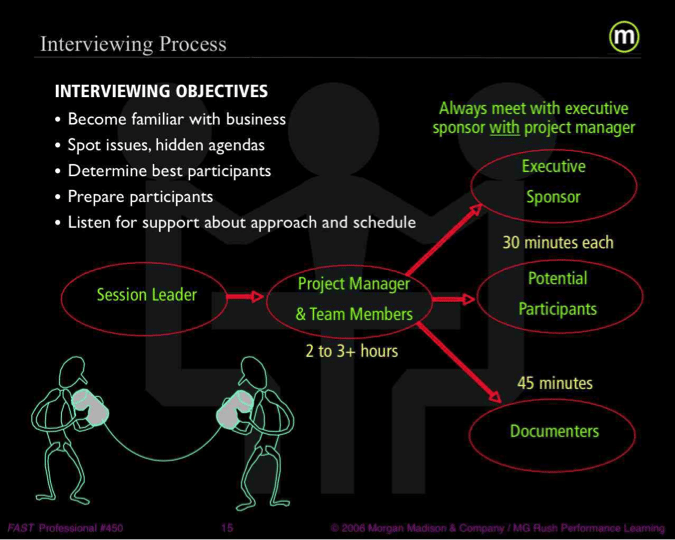
Interview participants to understand as much as possible about them, the people they work with, and their business.
To understand the political risks in meetings, speak with your participants. Preferably, sit with them one-on-one for about 30 minutes. Speak with each face-to-face, or at least by way of a teleconference.
Political Risks in Meetings — Interviewing Overview
Political Risks in Meetings — Interview Sequence
First meet the executive sponsor, the business partners, the project team, and then the participants. Keep your interviews around twenty to thirty minutes each. Conduct the interviews privately and assure participants that their responses will be kept CONFIDENTIAL. You want them to comfortably share the cultural dynamics, especially those who may not get along with each other. Because you will probably want to take notes, ASK FOR PERMISSION. It sends an incongruent signal to claim the conversation is confidential and then to take copious notes, so ask for permission. Only a few will say no. More will compliment you for the courtesy of asking.
Political Risks in Meetings — Interview Objectives
Interview the participants to understand:
- To become familiar with their job, their business, and their expectations
- To confirm who should, or should not, attend and why
- How to help them show up better prepared to contribute
- To identify potential issues, hidden agendas, and other obstacles
- To identify scheduling conflicts and other concerns
- How to transfer ownership of the purpose, scope, and deliverables
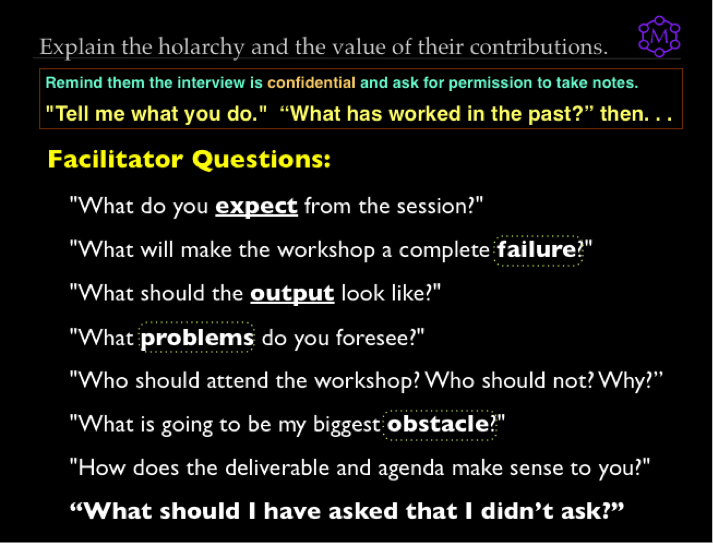
Political Risks in Meetings — INTERVIEWING QUESTIONS
The following are well-sequenced questions that you should ask. Begin each interview by explaining your role and the purpose of the interview. Don’t forget to ask for permission to take notes. Use open-ended questions, sit back, and listen to the person—discover their value and value add to the initiative you are supporting.
Facilitator Style Questions
Political Risks in Meetings — Interviewing Questions
Participant Selection
Optimally you should choose the best participants. The business and technical partners along with the executive sponsor should approve the list. The method works like this:
- Ask the partners who should participate—make a list.
- Have your executive sponsor detail who should participate—adjust
the list.
- Ask each participant who should participate—adjust the list.
When you have finished interviewing the participants, explain to the partners who you believe should participate and why. The partners will accept or modify the list. Once you both agree, have the partners get the executive sponsor to approve.
______
Don’t ruin your career by hosting bad meetings. Sign up for a workshop or send this to someone who should. MGRUSH workshops focus on meeting design and practice. Each person practices tools, methods, and activities every day during the week. Therefore, while some call this immersion, we call it the road to building high-value facilitation skills.
Terrence Metz, president of MG RUSH Facilitation Training, was just 22-years-old and working as a Sales Engineer at Honeywell when he recognized a widespread problem—most meetings were ineffective and poorly led, wasting both time and company resources. However, he also observed meetings that worked. What set them apart? A well-prepared leader who structured the session to ensure participants contributed meaningfully and achieved clear outcomes.
Throughout his career, Metz, who earned an MBA from Kellogg (Northwestern University) experienced and also trained in various facilitation techniques. In 2004, he purchased MG RUSH where he shifted his focus toward improving established meeting designs and building a curriculum that would teach others how to lead, facilitate, and structure meetings that drive results. His expertise in training world-class facilitators led to the 2020 publication of Meetings That Get Results: A Guide to Building Better Meetings, a comprehensive resource on effectively building consensus.
Grounded in the principle that “nobody is smarter than everybody,” the book details the why, what, and how of building consensus when making decisions, planning, and solving problems. Along with a Participant’s Guide and supplemental workshops, it supports learning from foundational awareness to professional certification.
Metz’s first book, Change or Die: A Business Process Improvement Manual, tackled the challenges of process optimization. His upcoming book, Catalyst: Facilitating Innovation, focuses on meetings and workshops that don’t simply end when time runs out but conclude with actionable next steps and clear assignments—ensuring progress beyond discussions and ideas.
by Facilitation Expert | Jun 4, 2015 | Facilitation Skills, Meeting Support
How to run a better meeting is like learning to be a better listener, easy to understand but hard to do.
Why? Poor muscle memory. What can we do about it? Change our muscle memory. While perfect practice remains the best way to overcome poor muscle memory, take a closer look at the International Institute of Business Analysis™ (IIBA®), in particular the newest edition of their Guide to the Business Analyst Body of Knowledge ® known as BABOK® Guide v3.
In the Business Analyst Body of Knowledge about disciplined and structured thinking, the term ‘facilitate’ appears 112 times over 514 pages. Statistically, ~25 percent of its pages indicate the need, reference, or link to the importance of facilitation.
Operational Definitions
Good and Bad Muscle Memory
Interestingly, and perhaps to avoid redundancy, the IIBA provides two different operational definitions for the term ‘facilitation.” In section (9.5.1) focused exclusively on facilitation, they state (pg 217) that:
Facilitation is the skill of moderating discussions within a group in order to enable all participants to effectively articulate their views on a topic under discussion and to ensure that participants in the discussion are able to recognize and appreciate the differing points of view that are articulated.
Later in the much-appreciated Glossary, they use the following definition (pg 456):
facilitation: The art of leading and encouraging people through systematic efforts toward agreed-upon objectives in a manner that enhances involvement, collaboration, productivity, and synergy.
In addition, we also humbly suggest that facilitation is both an art AND a science. Therefore, we use the term SMart, suggesting the combination of an objective scientific method (SM) combined with the subjective and adjustable features, the ‘art’ (ergo, SMart). To the extent possible, we aspire toward repeatable, consistent outputs by using the rigor of disciplined structure.
The Business Analyst Body of Knowledge further provides a reference to many of the opportunities for us to improve our muscle memory by becoming better facilitators, and although too many to list, here are a few samplings where you ought to focus your practice efforts to become more facilitative when leading groups of people:
Initially, facilitate . . .
- alignment of goals and objectives
- analysis and deep understanding of the organization’s processes
- articulation of the product vision statement
- consensus building and trade-offs and ensure that solution value is realized and initiative timelines are met
- coordinated and synchronized action across the organization by aligning action with the organization’s vision, goals, and strategy
- cost management and reduce duplication of work
- decision-making and conflict resolution, and ensure that all participants have an opportunity to be heard
- drawing and storing matrices and diagrams to represent requirements
- estimations of the value realized by a solution
- holistic and balanced planning and thinking
- identification of potential improvements by highlighting “pain points” in the process structure (i.e., process visualization)
- interactions between stakeholders in order to help them make a decision, solve a problem, exchange ideas and information, or reach an agreement regarding the priority and the nature of requirements
Furthermore, facilitate . . .
- approval process
- change assessment process
- knowledge transfer and understanding
- meetings with set agendas and meeting roles or informal working sessions
- organizational alignment, linking goals to objectives, supporting solutions, underlying tasks, and resources
- planning, analyzing, testing, and demonstrating activities
- prioritization
- recording, organizing, storing, and sharing requirements and designs
- release planning discussions
- requirements and design traceability
- review sessions, keep participants focused on the objectives of the review, and ensure that each relevant section of the work product is covered
- stakeholder collaboration, and decisions, and understand the relative importance of business analysis information
- understanding and decision-making, the value of proposed changes, and other complex ideas
- Workshops
Additionally,
They also provide some wonderful goals for effective facilitation including:
- encouraging participation from all attendees,
- ensuring that participants correctly understand each other’s positions,
- establishing ground rules such as being open to suggestions, building on what is there, not dismissing ideas, and allowing others to speak and express themselves,
- making it clear to the participants that the facilitator is a third party to the process and not a decision maker nor the owner of the topic,
- preventing discussions from being sidetracked onto irrelevant topics,
- remaining neutral and not taking sides, and
- using meeting management skills and tools to keep discussions focused and organized.
Finally,
it is interesting that in this third edition, within the Section called Interaction Skills, they broadened the scope of facilitation by:
- Facilitation and Negotiation—split competencies and renamed Facilitation
Particularly interesting to us since many times participants are in violent agreement with each other, but need a solid facilitator to arrive at a common understanding.
______
Don’t ruin your career by hosting bad meetings. Sign up for a workshop or send this to someone who should. MGRUSH workshops focus on meeting design and practice. Each person practices tools, methods, and activities every day during the week. Therefore, while some call this immersion, we call it the road to building high-value facilitation skills.
Terrence Metz, president of MG RUSH Facilitation Training, was just 22-years-old and working as a Sales Engineer at Honeywell when he recognized a widespread problem—most meetings were ineffective and poorly led, wasting both time and company resources. However, he also observed meetings that worked. What set them apart? A well-prepared leader who structured the session to ensure participants contributed meaningfully and achieved clear outcomes.
Throughout his career, Metz, who earned an MBA from Kellogg (Northwestern University) experienced and also trained in various facilitation techniques. In 2004, he purchased MG RUSH where he shifted his focus toward improving established meeting designs and building a curriculum that would teach others how to lead, facilitate, and structure meetings that drive results. His expertise in training world-class facilitators led to the 2020 publication of Meetings That Get Results: A Guide to Building Better Meetings, a comprehensive resource on effectively building consensus.
Grounded in the principle that “nobody is smarter than everybody,” the book details the why, what, and how of building consensus when making decisions, planning, and solving problems. Along with a Participant’s Guide and supplemental workshops, it supports learning from foundational awareness to professional certification.
Metz’s first book, Change or Die: A Business Process Improvement Manual, tackled the challenges of process optimization. His upcoming book, Catalyst: Facilitating Innovation, focuses on meetings and workshops that don’t simply end when time runs out but conclude with actionable next steps and clear assignments—ensuring progress beyond discussions and ideas.