by Facilitation Expert | Nov 10, 2011 | Communication Skills
Recently on a blog, an informal group of mathematicians solved a tough and long-standing mathematics problem in a few weeks. Additionally, an MGRUSH alumnae wrote about preparing for an executive workshop and how to facilitate Europeans and Asians between two different companies.
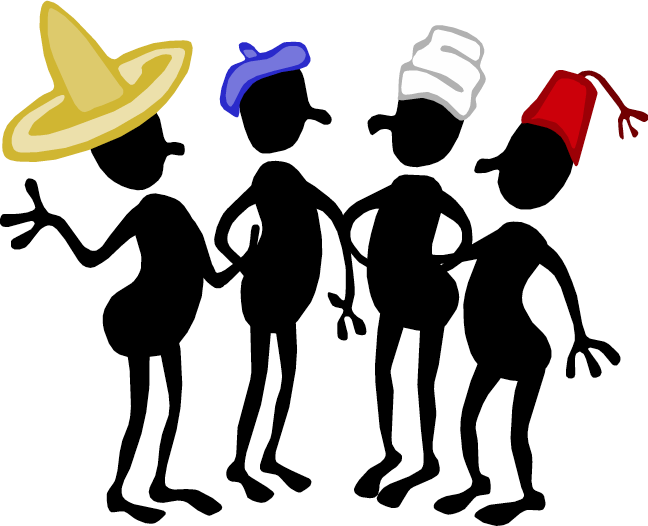
The following captures considerations on how to facilitate scientists, as well as considerations on how to facilitate Asians and Europeans.
First, How to Facilitate Scientists
The virtual session leader (Tom Gowers) used his blog to post ideas and progress. He encouraged others to contribute, expecting many minds to be more powerful than his alone. Within an hour of his first posting, three people scattered around North America commented, and six weeks later, the problem was solved. Here is an example of an ever-increasing body of scientists who have used networking to solve complex problems and to speed up the delivery of answers and options.
Value Derives When You Facilitate Scientist Because Nobody Is Smarter than Everybody
Whether you provide a structured workshop method or online tools to amplify collective intelligence, nobody is smarter than everybody. Linking scientists together, face-to-face or virtually, can dramatically speed up the rate of discovery. Empirical evidence shows that more options (ie, discovered) lead to higher-quality decisions. Some argue that crowdsourcing results are so profound that life as we know it will fundamentally change over the next few decades. When you facilitate scientists, more is clearly better. To facilitate scientists, provide them with a method and effective methods are dependent on neutral facilitation. They also need a deliverable that will not threaten their independent research, findings, and publications.
Why Wikis Fail
Corporate wikis rely on an environment of sharing and collaboration. When wikis fail, it is frequently attributable to weak or non-existent moderation (i.e., facilitation). In your organizational or corporate environments with a shared holarchy and sense of purpose, scope, and objectives, facilitation is frequently the only missing ingredient to breakthrough thinking and innovation.

To Facilitate Scientists, Provide Methods and Do Not Threaten Them
Eventually, we’ll come to realize that humanity sits atop our holarchy, and with an effective facilitator and collaborative environment, discover that no problem is too complex to solve. Keep in mind that there are only three reasons why groups fail:
- They don’t have the proper talent,
- They don’t have the right attitude (i.e., apathetic or don’t care),
- or, They don’t know how (to succeed as a group)
The professional MGRUSH technique leads the HOW TO effort. Combined with an appropriate method, our talented scientists are capable of “Reinventing Discovery: The New Era of Networked Science” (a book by Michael Nielsen, a pioneer in the field of quantum computing).
Next, Considerations to Facilitate Asians and Europeans
The alumnae’s two different companies required a strategy document of their alliance to work with each other in a common supply chain. Specifically, the alumnus inquired about anything in particular to avoid or encourage.
Facilitate Asians and Europeans
Specific Solution on How to Facilitate Asians and Europeans
Speak with the participants to confirm their explicit expectations and then manage accordingly. When conducting confidential, one-on-one interviews, participants will speak more openly about “anything in particular to avoid or encourage.”
Basic Considerations on How to Facilitate Asians and Europeans
- Icebreakers: Consider icebreaker activities that allow participants to share some of their social values, such as asking about a favorite childhood memory or describing their favorite holiday (i.e., vacation) destination and activities.
- Names: An effective facilitator will NOT use people’s names, but rather substitute open hands and eye contact to draw in participation and to pass the talking stick. During breaks and social times, or when discussing administrivia such as evening plans, strive to use people’s last names and titles, including respect toward academic and medical titles. During private introductions, handshakes are a reasonable default standard, perhaps with a slight bow—avoid hugging, arm humping, and shoulder thwacking as too much physical contact.
- Protocol: Emphasize the difference in roles. For example, we treat our parents differently than we treat our children. We may treat customers differently from suppliers. During the workshop, emphasize leaving titles and roles on the other side of the threshold so that everyone has permission to speak freely. When the Joint Chiefs meet, they may wear sweaters over their military stars, so that four-star generals do not claim superiority over three-star generals in a workshop environment. If the armed forces can encourage equality of voice, so can we.
- Punctuality: Punctuality is important. Keep your stated promises about when to start, including after breaks and meals. If not, your broken promise will frustrate participants and cause some to challenge the integrity of the session leader. If the session leader claims punctuality but permits a delayed starting time, they may be seen as someone who cannot be trusted. Be sure to use MGRUSH timers to get people to return from breaks and start on time. If necessary, offer a ten-minute break every fifty minutes, but start on time.
Additional Considerations on How to Facilitate Asians and Europeans
- Rhetoric: Avoid slang, colloquialisms, and American jargon. It is not uncommon for Europeans and Asians to speak in English and understand each other better than an American. While facilitating and providing reflection, stick closely to verbatim words and expressions rather than “interpreting.” If the participants felt there was a better term or expression, they would have used it the first time. Unless the participant asks for language assistance, be patient and avoid volunteering content, unless asked.
- Breakout Groups: Use breakout groups frequently during the agenda, especially during the ideation step within brainstorming. Plan your break-out sessions based on knowledge from interviews. Appoint a CEO (i.e., chief easel officer) for each group. Strive to creatively assign group titles or names that harmonize with the theme of the workshop (e.g., star constellations). Simply calling out 1,2, 3 indicates that the activity was not important enough to plan further. Understand methodologically that sometimes it is appropriate to create homogenous groups (i.e., think alike) and other times it may be advantageous to create heterogeneous groups (i.e., embrace pluralism).
Commonalities to Facilitate Scientists or to Facilitate Asians and Europeans
Be certain to secure pre-meeting buy-in about the purpose, scope, and deliverables of the workshop. Ideally, explain your agenda through a metaphor or analogy. Next, ensure that the method will engage the participants and not drag on and bore them. If you keep them engaged and focused, you will clearly have made it easier for them to build and decide. Do not discount the importance of a formal review and wrap-up. Plan on an approach the group accepts in advance to manage action steps or roles and responsibilities. Invest some time in the MGRUSH Guardian of Change so that they agree on their primary messaging to other executives and stakeholders at the conclusion of the workshop. Moreover, be sure to obtain some feedback on your performance, so that you may continuously improve your talents as an effective, facilitative leader.
______
Don’t ruin your career by hosting bad meetings. Sign up for a workshop or send this to someone who should. MGRUSH workshops focus on meeting design and practice. Each person practices tools, methods, and activities every day during the week. Therefore, while some call this immersion, we call it the road to building high-value facilitation skills.
Terrence Metz, president of MG RUSH Facilitation Training, was just 22-years-old and working as a Sales Engineer at Honeywell when he recognized a widespread problem—most meetings were ineffective and poorly led, wasting both time and company resources. However, he also observed meetings that worked. What set them apart? A well-prepared leader who structured the session to ensure participants contributed meaningfully and achieved clear outcomes.
Throughout his career, Metz, who earned an MBA from Kellogg (Northwestern University) experienced and also trained in various facilitation techniques. In 2004, he purchased MG RUSH where he shifted his focus toward improving established meeting designs and building a curriculum that would teach others how to lead, facilitate, and structure meetings that drive results. His expertise in training world-class facilitators led to the 2020 publication of Meetings That Get Results: A Guide to Building Better Meetings, a comprehensive resource on effectively building consensus.
Grounded in the principle that “nobody is smarter than everybody,” the book details the why, what, and how of building consensus when making decisions, planning, and solving problems. Along with a Participant’s Guide and supplemental workshops, it supports learning from foundational awareness to professional certification.
Metz’s first book, Change or Die: A Business Process Improvement Manual, tackled the challenges of process optimization. His upcoming book, Catalyst: Facilitating Innovation, focuses on meetings and workshops that don’t simply end when time runs out but conclude with actionable next steps and clear assignments—ensuring progress beyond discussions and ideas.
by Facilitation Expert | Sep 29, 2011 | Analysis Methods, Meeting Tools
One of the worst questions a facilitator could ask is “How would you like to categorize these?” They don’t know how. That’s why they hired you.
Categorizing and creating clusters of related items (or processes) makes it easier for a group to focus on their subsequent analysis and decisions. Learn the logic behind the secret now, when the challenge is how to categorize when facilitating.
Rationale for How to Categorize
The purpose of categorizing is to eliminate redundancies by collapsing related items into clusters or chunks (a scientific term). A label or term that captures the title for each cluster can be more easily re-used in matrices and other visual displays. Frequently we refer to the labels as “triggers” because they rely on a a single term for triggering back to the meaning and definition behind it. For example, “budgeting” refers to the activities and resources required to project, track, and balance accounts. When focused on “budgeting” the group is less likely to focus on the details of “accounts payable” “accounts receivable” or other discrete clusters. Categorizing also makes it easier for the team to analyze complex relationships and their impact on each other.
How to Categorize
Method for How to Categorize
Categorizing can take little or much time, depending on how much precision is required, time available, and importance. The underscoring method suggested below is quick and effective. The other methods may also be effective, but probably not as quick.
Underscore Common Nouns
Take the raw input or lists created during the ideation step and underscore the common nouns (typically the object in a sentence that is preceded by a verb). Verbs typically precede the object in a sentence as in “pay bills”. Use a different color marker for each group of nouns. By pointing to the underscored terms, ask the team to offer up a term, simple phrase, or label that captures the meaning of each cluster.
(Optionally)
For verification or to manage items that are not underscored, ask “Why _____?” The logic and secret behind categorizing follows.
NOTE: Items that share a common purpose likely have a common objective and can be grouped together. Verify that each item is WHAT they are doing and not HOW it gets done. Ask “WHY do you do this?”. Write the purpose next to the item. Continue with the next pairing—if it has the same purpose, then it will group together. When a number of activities relate—due to common purpose—have the group name the cluster. Put a visual box around the name for the cluster.
Transpose
Ask for a volunteer to take the underscored items and create a new statement or gerund that combines, integrates, and reflects the sentiment of the commonly underscored items. Write the new statement or gerund expression that signifies a grouping on a new and separate page. The terms may be more fully defined and illustrated with the list of all items that belong to each cluster. Notice how salt, mustard, and chutney may be grouped as “condiments’ because they share a common purpose. Use the MGRUSH Definition tool to build a consensual and robust definition if required.
NOTE: Format clusters as “gerund-like phrases.” That is, a noun followed by a gerund (a verb acting as a noun and usually ending with “ing”, “ment”, “tion”, or “ble” including “able” and “ible”). Examples are “Order Processing” or “Account Management” or “Resource Generation” or “Accounts Payable”.
Avoid vague terms such as “Management Reporting”—that have no specific goal. If the group includes a number of challenging processes, write these as a side list of “concerns” and continue with additional activities. Revisit the problem areas or concerns later, after the group has developed some momentum.
Avoid letting the group simply define their organization. For example, insurance companies have a tendency to define their “processes” as Underwriting, Claim Adjusting, and Operations. What they do from a process perspective (regardless of how they are organized) is Risk Assessment, Claims Payment, Portfolio Balancing, etc.
Transposing requires artful patience. Remain highly fluid and flexible. Activities may move around and processes may be re-labeled. There is no universally correct answer. Seek the terms that work best for the group that you are serving. And as always, seek to understand rather than be understood.
Scrub
Go back to the original list and strike the items that now collapse into the new terms created for each cluster in the Transpose step above. Allow the group to contrast any remaining items that have not been eliminated and decide if they require unique terms, need further explanation, or can be deleted.
Here is another example of using activities for creating the processes that support the function of Mountaineering.
|
#
|
Support Activities
(verb-noun)
|
Result
|
|
1
|
Order supplies |
Perhaps part of the same process as Pack supplies such as Provisioning |
|
2
|
Make ascent |
Supports a process called Ascending |
|
3
|
Establish camp |
Supports a process called Sheltering |
|
4
|
Erect tent |
Determined to be HOW they support Sheltering because a tent is a concrete term and not an abstract concept |
|
5
|
Measure distance |
Supports a process called Navigating |
|
6
|
Determine altitude |
Supports process called Navigating number 5 from above |
|
7
|
Predict weather |
Deemed to best support the Navigating process, rather than a stand-alone activity |
|
8
|
Confirm location |
Supports process called Navigating numbers 5, 6, and 7 from above |
|
9
|
Make fire |
Also determined to be HOW they support Sheltering because fire is a concrete term and not an abstract |
|
10
|
Pack supplies |
Supports process called Provisioning, along with number 1 from above |
|
etc. |
|
Comparison Review
Before transitioning, review the final list of clusters and confirm that team members understand the terms and that they can support the operational definitions. Let the team members know that they can add additional terms to the clusters later, but if they are comfortable with them as is, to move on and do something with the list, as it was built for input to a subsequent step or activity.
“Decomposing”
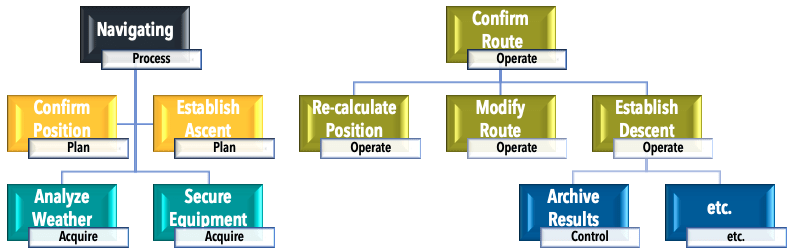
Once clusters or processes have been created, you can then further decompose into the various activities required to support the process. For example, with the process or cluster of “Navigating” we might find the following activities:
Reversing the Categories
(In Conclusion, Other Grouping Themes)
Humans visually perceive items not in isolation but as part of a larger whole. The most frequent cause of categories is common purpose (e.g., gardening tools). However, the principles of perception include other human tendencies such as:
- Similarity—by their analogous characteristics
- Proximity—by their physical closeness to each other
- Continuity—when there is an identifiable pattern
- Closure—completing or filling in missing features
In a world where everyone can engage in decisions that affect them
______
Lead the Change—One Meeting at a Time
Are you ready to transform how decisions are made, problems are solved, and alignment is built in your organization?
True meeting leadership goes beyond setting an agenda. It requires a facilitator who can navigate complexity, balance voices, and drive toward outcomes with clarity and consensus. Our Professional Meeting Leadership Workshop and facilitation training equips you to do just that—blending human-centric methods with structured analytical tools to foster rigor, inclusivity, and results that stick.
- Practice live.
- Get expert feedback.
- Build confidence that lasts.
Whether your meetings suffer from unclear objectives, disengaged participants, or decision fatigue, this workshop will help you identify the root causes, apply proven facilitation techniques, and emerge as the leader every team needs.
Take the first step today—transform your meetings and magnify your impact.
👉 Click here to reserve your seat now.
#facilitationtraining #meetingdesign
Because every meeting should be a catalyst for change—not just another calendar event.
______
With Bookmarks no longer a feature in WordPress, we provide the following for your benefit and reference.
______
Terrence Metz, president of MG RUSH Facilitation Training, was just 22-years-old and working as a Sales Engineer at Honeywell when he recognized a widespread problem—most meetings were ineffective and poorly led, wasting both time and company resources. However, he also observed meetings that worked. What set them apart? A well-prepared leader who structured the session to ensure participants contributed meaningfully and achieved clear outcomes.
Throughout his career, Metz, who earned an MBA from Kellogg (Northwestern University) experienced and also trained in various facilitation techniques. In 2004, he purchased MG RUSH where he shifted his focus toward improving established meeting designs and building a curriculum that would teach others how to lead, facilitate, and structure meetings that drive results. His expertise in training world-class facilitators led to the 2020 publication of Meetings That Get Results: A Guide to Building Better Meetings, a comprehensive resource on effectively building consensus.
Grounded in the principle that “nobody is smarter than everybody,” the book details the why, what, and how of building consensus when making decisions, planning, and solving problems. Along with a Participant’s Guide and supplemental workshops, it supports learning from foundational awareness to professional certification.
Metz’s first book, Change or Die: A Business Process Improvement Manual, tackled the challenges of process optimization. His upcoming book, Catalyst: Facilitating Innovation, focuses on meetings and workshops that don’t simply end when time runs out but conclude with actionable next steps and clear assignments—ensuring progress beyond discussions and ideas.
by Facilitation Expert | Jun 2, 2011 | Analysis Methods, Leadership Skills
Change or die? Most people do not change their minds—rather, they make a new decision based on new information. Sometimes the things they look at change as well.
Change or Die, The Business Process Improvement Manual
Every morning a gazelle wakes up. It knows it must run faster than the fastest lion or it will be killed.
Every morning a lion wakes up. It knows it must outrun the slowest gazelle or it will starve to death.
It doesn’t matter whether you are a lion or a gazelle when the sun comes up . . .
. . . you’d better be running.
Source: Unknown
Change or Die – Darwin
Change is stimulated by decisions. Groups make higher quality decisions than the smartest person in the group because groups create more options. Any group or individual presented with more options is known to make higher-quality decisions.
Most change is incremental or evolutionary rather than revolutionary. Yet, by harnessing one degree Fahrenheit, steam power ushered in the industrial revolution. Today’s revolution is both digital and dynamic, it is “in-formation”. With anything in formation, change is inevitable, only growth is optional.
“It is NOT the strongest of the species that survives, nor the most intelligent, but the one most responsive to change.” — Charles Darwin
Change or Die – The Tao
Some of the best books about facilitating change do not mention the term or role of a “facilitator”. Take Dr Wayne Dyer‘s book for example, “Change Your Thoughts, Change Your Life.”
We have always argued that effective facilitation begins with clear thinking, and that unclear speaking or imprecise writing is indicative of unclear thinking. Dr. Dyer’s transliteration of “The Tao”, is also called “Living the Wisdom of the Tao.”
The 17th verse begins and completes as follows:
Change Your Thoughts, Change Your Life
With the greatest leader above them,
people barely know one exists . . .
. . . The great leader speaks little,
He never speaks carelessly.
He works without self-interest
and leaves no trace.
When all is finished, the people say,
“We did it ourselves.”
Change or Die – Being Facilitative
One can easily substitute the term facilitator for a leader or include the adjective “facilitative” in front of the term, as in “facilitative leader.” Modern, facilitative leaders create an environment that is conducive to productivity, where all of the meeting participants feel that they have a personal responsibility to contribute and own the outputs, and the deliverables. Clear learnings that we can import from Dr. Dyer’s treatment of the 17th verse also include:
- Facilitators create an environment that helps everyone act responsibly.
- Effective facilitators are able to make themselves invisible when the group reaches high-performance mode. Although most groups do not reach this level, when they do, the facilitator becomes a scribe.
- When it is time for accolades, facilitators dissolve in the background, wanting the participants to feel that their accomplishments derive from their own talents.
- Instead of believing that they know what is best for a group, they trust the group participants and the method to generate what is best for them.
- The surest way to gain the trust and confidence of participants is to allow them to make as many decisions as possible. Avoid grabbing the low-hanging fruit by answering simple content. Put even the simplest items in the form of a question.
Try being more neutral as a business agent, friend, spouse, family member, parent, etc. and be surprised by the results of people who will live up to their own answers. Remember, there is usually more than one correct answer, the real question remains the taste for risk and reward.
______
Don’t ruin your career by hosting bad meetings. Sign up for a workshop or send this to someone who should. MGRUSH workshops focus on meeting design and practice. Each person practices tools, methods, and activities every day during the week. Therefore, while some call this immersion, we call it the road to building high-value facilitation skills.
Terrence Metz, president of MG RUSH Facilitation Training, was just 22-years-old and working as a Sales Engineer at Honeywell when he recognized a widespread problem—most meetings were ineffective and poorly led, wasting both time and company resources. However, he also observed meetings that worked. What set them apart? A well-prepared leader who structured the session to ensure participants contributed meaningfully and achieved clear outcomes.
Throughout his career, Metz, who earned an MBA from Kellogg (Northwestern University) experienced and also trained in various facilitation techniques. In 2004, he purchased MG RUSH where he shifted his focus toward improving established meeting designs and building a curriculum that would teach others how to lead, facilitate, and structure meetings that drive results. His expertise in training world-class facilitators led to the 2020 publication of Meetings That Get Results: A Guide to Building Better Meetings, a comprehensive resource on effectively building consensus.
Grounded in the principle that “nobody is smarter than everybody,” the book details the why, what, and how of building consensus when making decisions, planning, and solving problems. Along with a Participant’s Guide and supplemental workshops, it supports learning from foundational awareness to professional certification.
Metz’s first book, Change or Die: A Business Process Improvement Manual, tackled the challenges of process optimization. His upcoming book, Catalyst: Facilitating Innovation, focuses on meetings and workshops that don’t simply end when time runs out but conclude with actionable next steps and clear assignments—ensuring progress beyond discussions and ideas.
by Facilitation Expert | May 26, 2011 | Analysis Methods, Leadership Skills
Leonardo da Vinci identified seven key traits or skills that one can cultivate to enhance intelligence and unlock the potential for genius.
Even after mastering these traits, one must overcome the fear of failure, which often prevents people from taking the first step. Likewise, da Vinci’s traits strongly align with the qualities of a facilitative leader, guiding others toward creativity and growth.
Therefore, da Vinci’s traits or skills or strengths include:
- Curiosita—an insatiable thirst for knowledge
- Dimostrzione—the ability to learn from experience
- Sensazione—the discipline of continuing to hone one’s senses
- Sfumato—the ability to cope with ambiguity
- Arte/ Scienza—holistic thinking
- Corporalita—what some people call sound mind and body
- Connessione—the ability to see deeply into the connection between things
More can be found in the book entitled “How to Think Like Leonardo da Vinci: Seven Steps to Genius Every Day” by Michael J. Gelb
Walter Isaacson
Subsequent to the original posting of this article, Walter Isaacson published a comprehensive and compelling biography, Leonardo da Vinci, that deserves a much higher ranking in a Google search. While nearly 600 pages in length, the well-researched and documented history of the polymath would provide an excellent return on your time and money. Isaacson identifies twenty Key Learnings. For more detail, you should turn to the original source. They include:
- Avoid silos.
- Be curious, relentlessly curious.
- Be open to mystery.
- Collaborate.
- Create for yourself, not just for patrons.
- Get distracted.
- Go down rabbit holes.
- Indulge fantasy.
- Let the perfect be the enemy of the good.
- Let your reach exceed your grasp.
- Make lists.*
- Observe.
- Procrastinate.
- Respect facts.
- Retain a childlike sense of wonder.
- See things unseen.
- Seek knowledge for its own sake.
- Start with the details.
- Take notes, on paper.
- Think visually.
- “Leonardo’s to-do lists may have been the greatest testament to pure curiosity the world has ever seen.” (pg. 523)
Finally, from a commercial perspective and in the spirit of radical innovation, here are some well-established “secrets”:
- Get intimate with your customers
- Make your own product obsolete
- Break the rules and be audacious
- Act small, think small—even nano small
- Celebrate failure—(see Thomas Alva Edison’s objectives)
______
In a world where everyone can engage in decisions that affect them
______
Lead the Change—One Meeting at a Time
Are you ready to transform how decisions are made, problems are solved, and alignment is built in your organization?
True meeting leadership goes beyond setting an agenda. It requires a facilitator who can navigate complexity, balance voices, and drive toward outcomes with clarity and consensus. Our Professional Meeting Leadership Workshop and facilitation training equips you to do just that—blending human-centric methods with structured analytical tools to foster rigor, inclusivity, and results that stick.
- Practice live.
- Get expert feedback.
- Build confidence that lasts.
Whether your meetings suffer from unclear objectives, disengaged participants, or decision fatigue, this workshop will help you identify the root causes, apply proven facilitation techniques, and emerge as the leader every team needs.
Take the first step today—transform your meetings and magnify your impact.
______
👉 Click here to reserve your seat now.
#facilitationtraining #meetingdesign
Because every meeting should be a catalyst for change—not just another calendar event.
______
With Bookmarks no longer a feature in WordPress, we provide the following for your benefit and reference.
______
Terrence Metz, president of MG RUSH Facilitation Training, was just 22-years-old and working as a Sales Engineer at Honeywell when he recognized a widespread problem—most meetings were ineffective and poorly led, wasting both time and company resources. However, he also observed meetings that worked. What set them apart? A well-prepared leader who structured the session to ensure participants contributed meaningfully and achieved clear outcomes.
Throughout his career, Metz, who earned an MBA from Kellogg (Northwestern University) experienced and also trained in various facilitation techniques. In 2004, he purchased MG RUSH where he shifted his focus toward improving established meeting designs and building a curriculum that would teach others how to lead, facilitate, and structure meetings that drive results. His expertise in training world-class facilitators led to the 2020 publication of Meetings That Get Results: A Guide to Building Better Meetings, a comprehensive resource on effectively building consensus.
Grounded in the principle that “nobody is smarter than everybody,” the book details the why, what, and how of building consensus when making decisions, planning, and solving problems. Along with a Participant’s Guide and supplemental workshops, it supports learning from foundational awareness to professional certification.
Metz’s first book, Change or Die: A Business Process Improvement Manual, tackled the challenges of process optimization. His upcoming book, Catalyst: Facilitating Innovation, focuses on meetings and workshops that don’t simply end when time runs out but conclude with actionable next steps and clear assignments—ensuring progress beyond discussions and ideas.
by Facilitation Expert | Apr 21, 2011 | Leadership Skills
The Tao of Facilitation
10th Verse of the Tao
Can you love your people
and govern your domain
without self-importance?
. . .
working, yet not taking credit;
leading without controlling or dominating?
~~~~~~~~~~~~~~~~~~~~~~~~~~~~~~~~~~~
While it is not easy leaving the ego at the threshold, it is mandatory for modern and effective facilitative leadership. Meetings run best when the leader is NOT talking, but rather listening. There is an inverse relationship between the amount of air time consumed by the facilitator’s voice and the perceived success of the meeting. If the facilitator speaks 100 percent of the time, the meeting will be viewed as a complete failure. Participants will view meetings favorably when they speak most of the time during a meeting — guaranteed. That’s the tao of facilitation.
Most of us have attended a class on public speaking. Listening, we learn, is no less important (and perhaps even more important) than speaking. Listening also supports facilitating, which is why listening is one of the core skills we apply in our facilitation training.
According to the Dalai Lama:
“When you talk, you are only repeating what you already know; but when you listen, you may learn something new.”
______
Don’t ruin your career by hosting bad meetings. Sign up for a workshop or send this to someone who should. MGRUSH workshops focus on meeting design and practice. Each person practices tools, methods, and activities every day during the week. Therefore, while some call this immersion, we call it the road to building high-value facilitation skills.
Terrence Metz, president of MG RUSH Facilitation Training, was just 22-years-old and working as a Sales Engineer at Honeywell when he recognized a widespread problem—most meetings were ineffective and poorly led, wasting both time and company resources. However, he also observed meetings that worked. What set them apart? A well-prepared leader who structured the session to ensure participants contributed meaningfully and achieved clear outcomes.
Throughout his career, Metz, who earned an MBA from Kellogg (Northwestern University) experienced and also trained in various facilitation techniques. In 2004, he purchased MG RUSH where he shifted his focus toward improving established meeting designs and building a curriculum that would teach others how to lead, facilitate, and structure meetings that drive results. His expertise in training world-class facilitators led to the 2020 publication of Meetings That Get Results: A Guide to Building Better Meetings, a comprehensive resource on effectively building consensus.
Grounded in the principle that “nobody is smarter than everybody,” the book details the why, what, and how of building consensus when making decisions, planning, and solving problems. Along with a Participant’s Guide and supplemental workshops, it supports learning from foundational awareness to professional certification.
Metz’s first book, Change or Die: A Business Process Improvement Manual, tackled the challenges of process optimization. His upcoming book, Catalyst: Facilitating Innovation, focuses on meetings and workshops that don’t simply end when time runs out but conclude with actionable next steps and clear assignments—ensuring progress beyond discussions and ideas.