by Facilitation Expert | Apr 14, 2011 | Leadership Skills
The MGRUSH technique encourages different approaches based on whether your project is seeking incremental gain or requires real breakthroughs. Blue Ocean Strategy promotes breakthrough thinking, justified by the higher profits such thinking generates among companies studied by its authors, Kim and Mauborgne.[1]

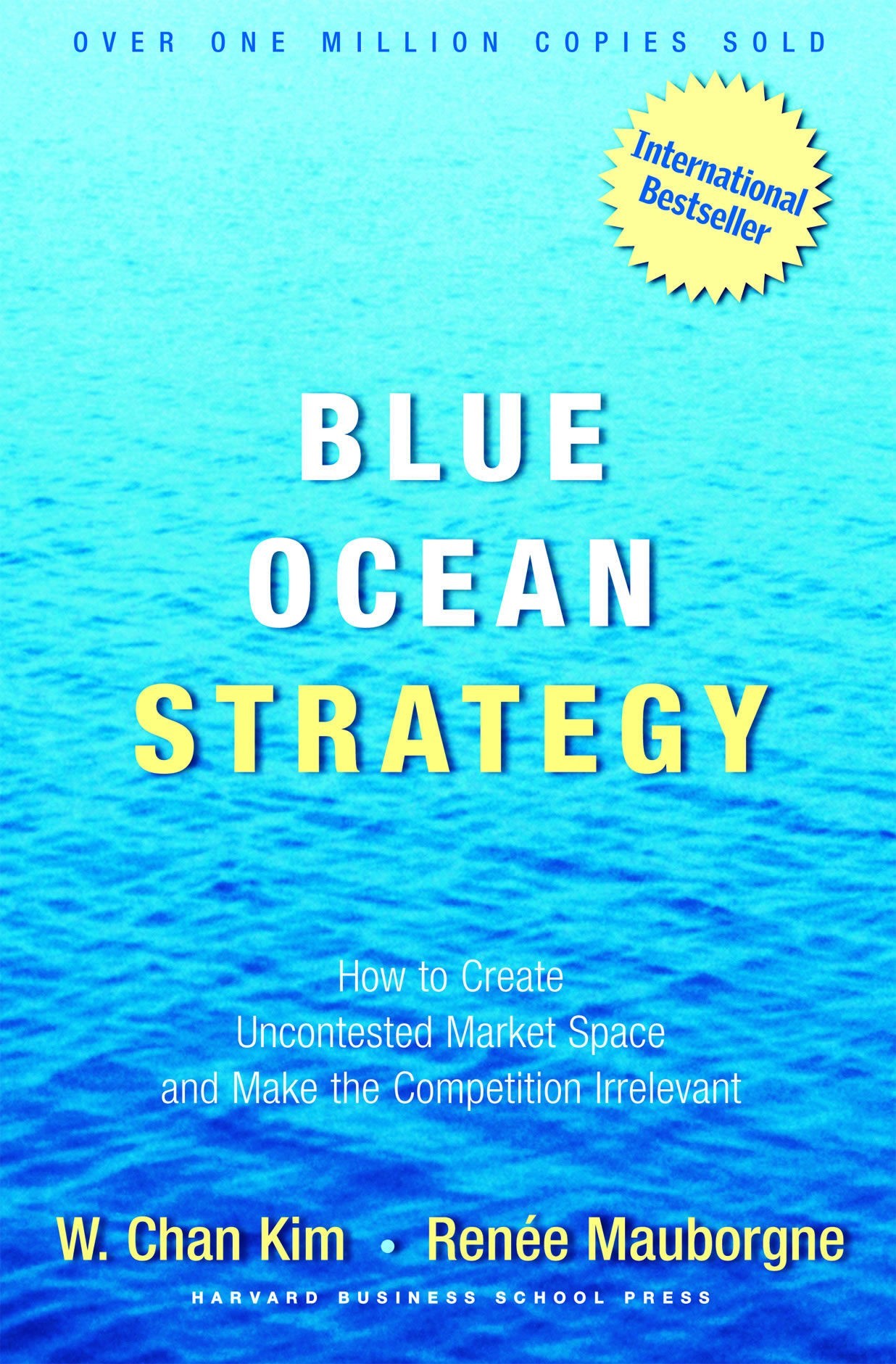
Blue Ocean Strategy by W. Chan Kim and Renée Mauborgne
The authors note the failures of companies over the past fifteen to twenty years—since the publishing of In Search of Excellence and Built to Last—including Atari, Data General, Fluor, and National Semiconductor. Therefore, the cornerstone of Blue Ocean Strategy is value innovation, defined as “the integrated and simultaneous pursuit of differentiation (i.e., buyer value) AND low-cost (i.e., supplier value).”
Their analytical toolset begins with a strategy canvas that identifies the principle of competitive and investment factors within your industry. With wine as an example (in brief), they might include price, distinction, marketing, aging, vineyard, complexity, and range. Their framework (called Four Actions) relies on facilitating consensual agreement around four questions. Participants’ answers suggest a new value curve that might enable your company to shift from traditional industry factors to uncontested market space. The four questions are:
1. ELIMINATE––Which factors that the industry takes for granted should be eliminated?
2. RAISE––Which factors should be raised well above the industry’s standard?
3. CREATE––Which factors should be created that the industry has never offered?
4. REDUCE––Which factors should be reduced well below the industry’s standard?
Illustrating Blue Ocean Strategy Four Actions Using Cirque du Soleil
For example, they suggest the success of Cirque du Soleil (compared to a traditional circus) accelerated with the following insights:
1. ELIMINATE––Star performers, animal shows, etc.
2. RAISE––Unique venue, type of concession sales, etc.
3. CREATE––Theme, artistic music, and dance, etc.
4. REDUCE––Multiple show arenas, thrill, and danger, etc.
Using the strategy canvas of Southwest Airlines they emphasized the factors of friendly service, speed, and frequent point-to-point departures. Both Cirque du Soleil and Southwest Airlines provide shared focus, divergence, and a compelling tagline. Overall, the authors’ steps for visualizing strategy draw upon group discussions and consensus—aka, excellent facilitation. They also suggest the use of a Pioneer-Migrator-Settler perceptual map that would seem to offer far less benefit than seeking consensus with answers to the Four Actions above.
Blue Ocean Strategy offers additional and valuable questions[2] that challenge each of the life-cycle steps (e.g., MGRUSH’s Plan-Acquire-Operate-Control). These questions seek to identify the biggest blocks faced by value drivers such as productivity, simplicity, convenience, risk, fun/ image, and environmental friendliness.
Blue Ocean Strategy Organizational Hurdles
The authors finish their discussion with four “organizational hurdles” including politics, motivation, resources, and groupthink (i.e., “cognitive”). However, like many academics, they complete their otherwise valuable book by discussing the importance of converting the strategy into execution—missing the importance and significance of building consensual analysis to pave the way. They jump from the WHY to the HOW without a complete understanding of WHAT is required—i.e., the consensual aspects that assure buy-in, confidence, and ownership. They talk about the importance of attitude and behavior but offer little insight into how to acquire a “fair process,”—something that MGRUSH alumni do regularly by building consensus around the analysis framework.
[1] See chart on page 7, “The Profit and Growth Consequences of Creating Blue Oceans.”
[2] See chart on page 123, “The Buyer Experience Cycle.”
______
Don’t ruin your career by hosting bad meetings. Sign up for a workshop or send this to someone who should. MGRUSH workshops focus on meeting design and practice. Each person practices tools, methods, and activities every day during the week. Therefore, while some call this immersion, we call it the road to building high-value facilitation skills.
Terrence Metz, president of MG RUSH Facilitation Training, was just 22-years-old and working as a Sales Engineer at Honeywell when he recognized a widespread problem—most meetings were ineffective and poorly led, wasting both time and company resources. However, he also observed meetings that worked. What set them apart? A well-prepared leader who structured the session to ensure participants contributed meaningfully and achieved clear outcomes.
Throughout his career, Metz, who earned an MBA from Kellogg (Northwestern University) experienced and also trained in various facilitation techniques. In 2004, he purchased MG RUSH where he shifted his focus toward improving established meeting designs and building a curriculum that would teach others how to lead, facilitate, and structure meetings that drive results. His expertise in training world-class facilitators led to the 2020 publication of Meetings That Get Results: A Guide to Building Better Meetings, a comprehensive resource on effectively building consensus.
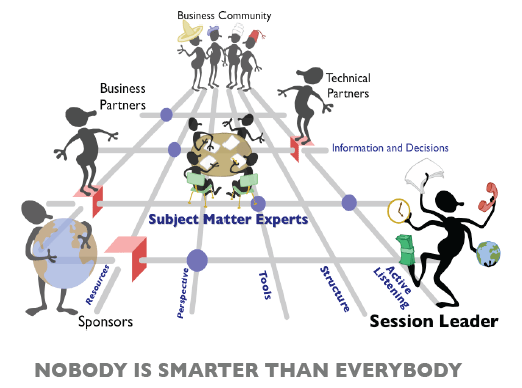
Grounded in the principle that “nobody is smarter than everybody,” the book details the why, what, and how of building consensus when making decisions, planning, and solving problems. Along with a Participant’s Guide and supplemental workshops, it supports learning from foundational awareness to professional certification.
Metz’s first book, Change or Die: A Business Process Improvement Manual, tackled the challenges of process optimization. His upcoming book, Catalyst: Facilitating Innovation, focuses on meetings and workshops that don’t simply end when time runs out but conclude with actionable next steps and clear assignments—ensuring progress beyond discussions and ideas.
by Facilitation Expert | Mar 17, 2011 | Communication Skills
“The term ‘strategy,’ much like ‘quality,’ is often overused and should be applied with precision. ‘The strategy’ should only be used unambiguously when it reflects a clearly defined and singular perspective.”
The Strategy
It’s important to carefully differentiate between the terms “the strategy,” “a strategy” (or “the strategies”), and “a strategic plan.” For a facilitator attuned to rhetorical precision, each of these terms carries distinct meanings. However, many people tend to use them interchangeably, often leading to confusion.
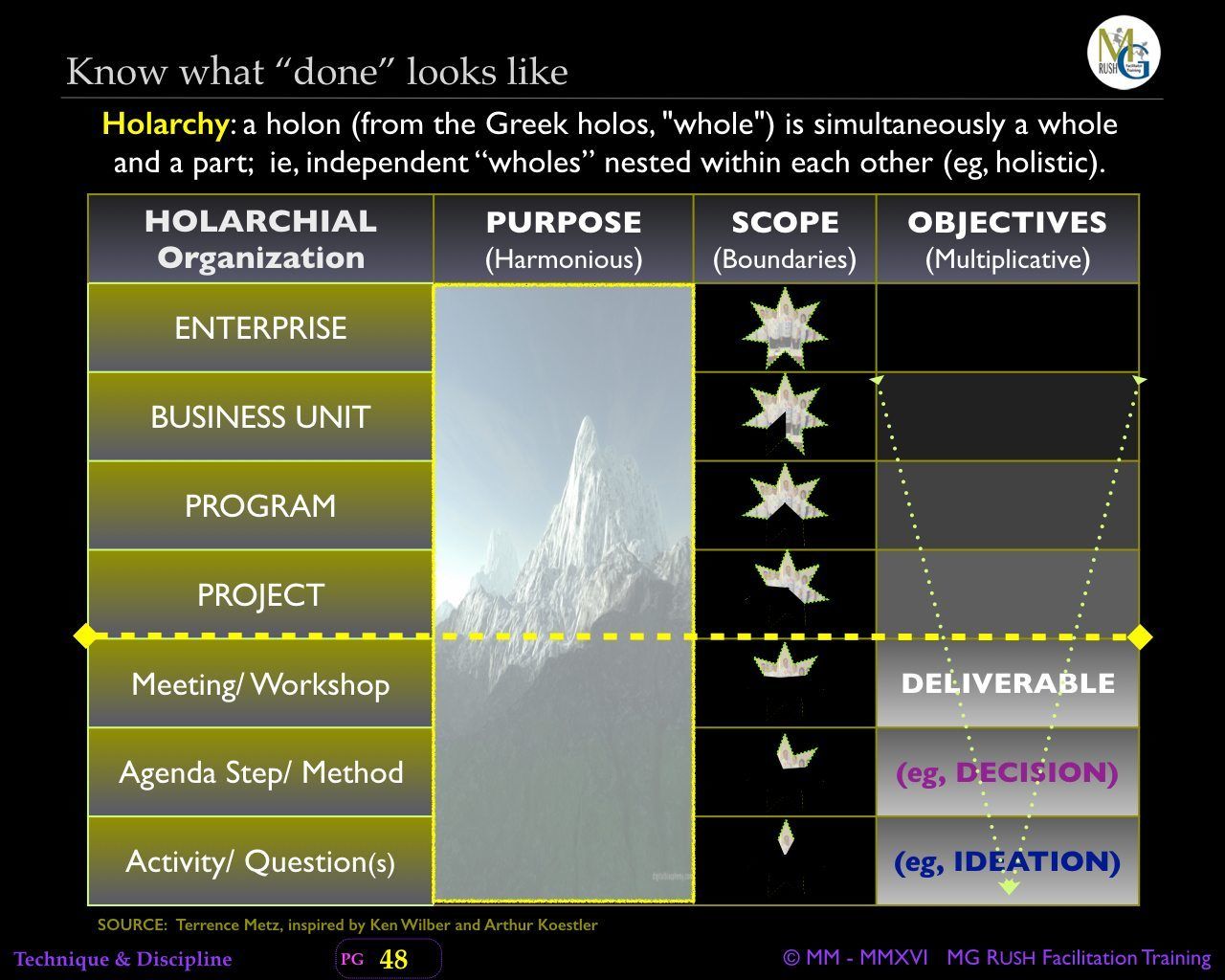
So, what distinguishes a strategic plan from a department plan, a product vision, a project plan, or a team plan? The primary difference lies in their scope. At its core, a “plan” can be succinctly defined with three words (or preferably five): “who does what” (by when). These components of every plan apply throughout every level of an organization (see Holarchy).
When planning, every group and individual need answers to the questions explained in our “Strategic Planning Agenda.”
- Mission (why are we here?)
- Values (who are we?)
- Vision (where are we going? how do we know if we get there or not?)
- Success Measures (what are our measurements of progress?)
- Current Situation (where are we now?)
- Actions (what should we do?—from strategy through tasks)
- Alignment (is this the right stuff to do?)
- Roles and Responsibilities (who does what, by when?)
- Communications Plan (what should we tell our stakeholders?)
The term “strategy” within an organization or division often refers to a set of initiatives, typically organized as either a program or a portfolio. These initiatives consist of approved projects that receive investment funds and help further define the overarching goals. The program’s “strategy” is shaped by the quantity and type of projects within the portfolio. At the project level, “strategies” focus on the specific tactics needed to ensure the project’s success. Meanwhile, the team’s “strategy” involves the tasks and operations necessary to implement the project and support its ongoing operation and improvement.
The meaning of “strategy” is highly dependent on the perspective it serves. Referring to “the strategy” without clarifying its context provides only a partial understanding. To gain deeper insight into operational differences and to facilitate better alignment, consider the organizational holarchy and how each level contributes to the overall strategic framework.
Holarchy of Who Does What
Alternative (upside down) View of the Holarchy (shared purpose, scope, and objectives)
______
Don’t ruin your career by hosting bad meetings. Sign up for a workshop or send this to someone who should. MGRUSH workshops focus on meeting design and practice. Each person practices tools and methods daily during the week. While some call this immersion, we call it the road that yields high-value facilitation skills.
Go to the Facilitation Training Store to access proven, in-house resources, including full agendas, break timers, forms, and templates. Also, take a moment to SHARE this article with others.
To Help You Unlock Your Facilitation Potential: Experience Results-Driven Training for Maximum Impact
#facilitationtraining #meeting design
______
With Bookmarks no longer a feature in WordPress, we need to append the following for your benefit and reference
Terrence Metz, president of MG RUSH Facilitation Training, was just 22-years-old and working as a Sales Engineer at Honeywell when he recognized a widespread problem—most meetings were ineffective and poorly led, wasting both time and company resources. However, he also observed meetings that worked. What set them apart? A well-prepared leader who structured the session to ensure participants contributed meaningfully and achieved clear outcomes.
Throughout his career, Metz, who earned an MBA from Kellogg (Northwestern University) experienced and also trained in various facilitation techniques. In 2004, he purchased MG RUSH where he shifted his focus toward improving established meeting designs and building a curriculum that would teach others how to lead, facilitate, and structure meetings that drive results. His expertise in training world-class facilitators led to the 2020 publication of Meetings That Get Results: A Guide to Building Better Meetings, a comprehensive resource on effectively building consensus.
Grounded in the principle that “nobody is smarter than everybody,” the book details the why, what, and how of building consensus when making decisions, planning, and solving problems. Along with a Participant’s Guide and supplemental workshops, it supports learning from foundational awareness to professional certification.
Metz’s first book, Change or Die: A Business Process Improvement Manual, tackled the challenges of process optimization. His upcoming book, Catalyst: Facilitating Innovation, focuses on meetings and workshops that don’t simply end when time runs out but conclude with actionable next steps and clear assignments—ensuring progress beyond discussions and ideas.
by Facilitation Expert | Feb 24, 2011 | Communication Skills
With this initial blog, we have launched compelling content about the dynamic role of a facilitator in the interactive world of instant communications. This Best Practices site anchors feeds to Google+, Linked-In, Reddit, Twitter, and hundreds of other sites for seekers of improved servant leadership skills — to make easy.
facilius reddo — The Modern/ Facilitative Leadership Style to Make Easy
Facilius Reddo: Embracing the Modern Facilitative Leadership Style
The term “facilitaera” first appeared in France in 1611, during the Renaissance, originating from the Latin phrase facilius reddo, which means “easily accomplished” or “attained.” At its core, “facil” translates to “make easy.”
To Make Easy Using Dynamic Content: The Evolving Role of Facilitators in an Age of Instant Communication
We aim to make it easier for you to make it easier for others to explain issues and positions, create and understand options, and make more informed decisions. Our goal supports your facilitative efforts to simplify complex processes, empowering you to make it easier for others to articulate issues, explore and understand options, and make informed decisions.
Purpose: To Make It Easy
At MGRUSH we define “consensus” as a situation where everyone can support the outcome without losing sleep over it. Our mission is to equip you with the tools and techniques to help others achieve true consensus—not by taking the easy way out, but by fostering creativity, innovation, and overcoming barriers like miscommunication, politics, and perceived intolerance.
Your role and attitude are critical. By engaging with this Best Practices series, you’ll cultivate an attitude of continuous learning and improvement. In this millennium, learning and listening have emerged as the most effective attitudes for facilitators. We invite your comments, feedback, and challenges, and encourage you to share this content with session leaders—even those who aren’t MGRUSH-certified facilitators.
Upcoming Topics
In other articles, you can look forward to exploring topics such as:
- The Art of Precise Questioning
- Rhetorical Precision: The Impact of a Single Word
- Overcoming Speaker Challenges
- The Tao of Facilitation
- Transforming Your Responsibility Matrix into a GANTT Chart
- Reviews of Cutting-Edge Research and Empirical Studies
______
Meetings must rise above the tiny opening of words and embrace the fullness of human insight—through listening, visuals, stories, numbers, and symbols. The transformation begins not with tools, but in mindset. Leave your ego at the threshold, and step into the structures of meetings that get results.
In a world where everyone can engage in decisions that affect them
______
Lead the Change—One Meeting at a Time
Are you ready to transform how decisions are made, problems are solved, and alignment is built in your organization?
True meeting leadership goes beyond setting an agenda. It requires a facilitator who can navigate complexity, balance voices, and drive toward outcomes with clarity and consensus. Our Professional Meeting Leadership Workshop and facilitation training equips you to do just that—blending human-centric methods with structured analytical tools to foster rigor, inclusivity, and results that stick.
- Practice live.
- Get expert feedback.
- Build confidence that lasts.
Whether your meetings suffer from unclear objectives, disengaged participants, or decision fatigue, this workshop will help you identify the root causes, apply proven facilitation techniques, and emerge as the leader every team needs.
Take the first step today—transform your meetings and magnify your impact.
______
👉 Click here to reserve your seat now.
#facilitationtraining #meetingdesign
Because every meeting should be a catalyst for change—not just another calendar event.
______
With Bookmarks no longer a feature in WordPress, we provide the following for your benefit and reference.
______
Terrence Metz, president of MG RUSH Facilitation Training, was just 22-years-old and working as a Sales Engineer at Honeywell when he recognized a widespread problem—most meetings were ineffective and poorly led, wasting both time and company resources. However, he also observed meetings that worked. What set them apart? A well-prepared leader who structured the session to ensure participants contributed meaningfully and achieved clear outcomes.
Throughout his career, Metz, who earned an MBA from Kellogg (Northwestern University) experienced and also trained in various facilitation techniques. In 2004, he purchased MG RUSH where he shifted his focus toward improving established meeting designs and building a curriculum that would teach others how to lead, facilitate, and structure meetings that drive results. His expertise in training world-class facilitators led to the 2020 publication of Meetings That Get Results: A Guide to Building Better Meetings, a comprehensive resource on effectively building consensus.
Grounded in the principle that “nobody is smarter than everybody,” the book details the why, what, and how of building consensus when making decisions, planning, and solving problems. Along with a Participant’s Guide and supplemental workshops, it supports learning from foundational awareness to professional certification.
Metz’s first book, Change or Die: A Business Process Improvement Manual, tackled the challenges of process optimization. His upcoming book, Catalyst: Facilitating Innovation, focuses on meetings and workshops that don’t simply end when time runs out but conclude with actionable next steps and clear assignments—ensuring progress beyond discussions and ideas.