by Facilitation Expert | Mar 20, 2014 | Analysis Methods
To build an operational and consensual definition that your group can live with, in their own words, and with their understanding, use the following Definition tool. Since narrative descriptions alone may fall short of expressing the complete meaning, we also want to fortify the consensual definition with an illustration and examples.
Use this robust method for consensual definitions of terms, phrases, or expressions with a group of meeting or workshop participants. Keep in mind that the standards expected below are demanding. They include five effective activities. Keep this tool in your hip pocket and use it whenever you encounter serious discord over the meaning of something. You may also need this tool when you manage open issues (i.e., Parking Lot) and your participants do not agree or cannot remember what something meant.
Additionally, the analysis activity of brainstorming begins when the ideation energy begins to wane. An indicator that it may be time to transition to analysis could be a question raised about what a term means, or someone raising an argumentative point that something can or cannot satisfy a specified condition or requirement.
Session leaders are faced with groups and participants (who may be in violent agreement with each other) who need to develop a consensual understanding of what a particular term, phrase, or expression means. The most underutilized tool in the sphere of facilitation is a robust definition tool. Therefore the first step frequently required to support effective analysis requires properly defining something.
Purpose of Consensual Definitions
To build a consensual definition of a term or phrase that the group can live with, in its own words, and with its own understanding. Since narrative descriptions alone may fall short, support your consensual definition with an illustration and examples.
Rationale Behind Consensual Definitions

Consensual Tool for Definitions
This MGRUSH tool supports a consensual understanding of terms and phrases. Use something more robust to develop rich definitions for complex ideas like processes. Hence, for an entire workshop(s) Activity Flows may be more useful.
Method to Build Consensual Definitions
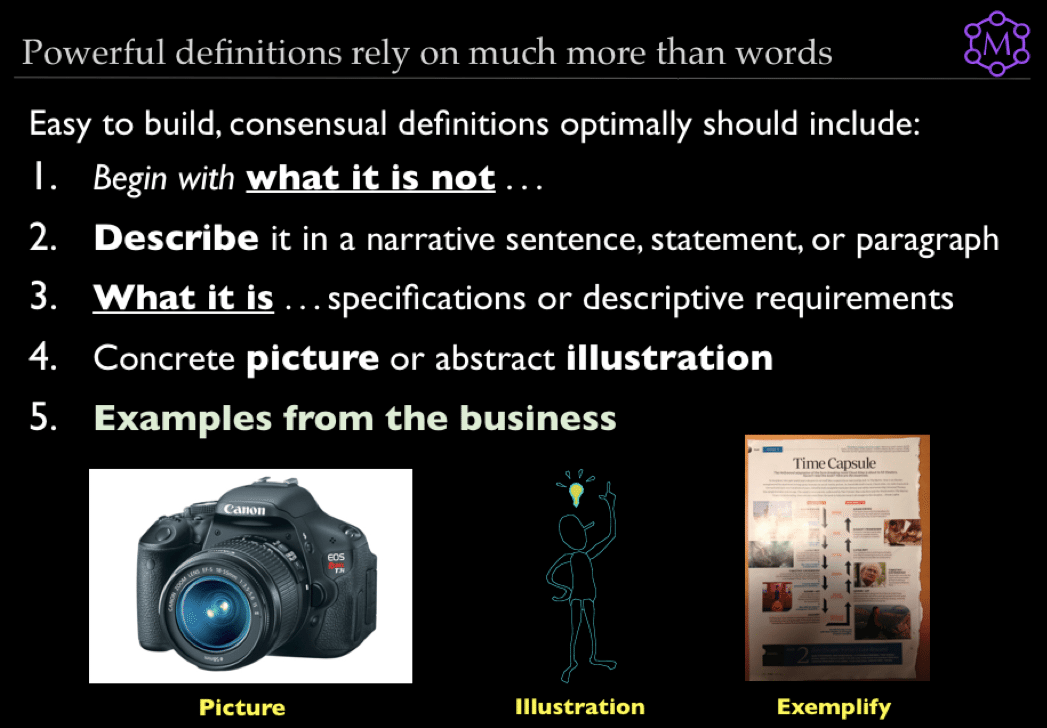
When a term or phrase requires further definition or understanding, it may be best to compare it to a dictionary definition(s). However, do not begin with dictionary definitions. Rather, offer them as a stimulus for the group after drafting their own definition. The five additional activities include:
- First, identify “WHAT THE TERM OR PHRASE IS NOT”.
- Next, compile a narrative sentence or paragraph that generally describes it. Compare later to a dictionary or other professional definitions and support.
- Then list the detailed bullets that capture the specific characteristics or specifications of the term or phrase as intended by the participants. For example, with a camera, we might detail requirements for the number of megapixels, zoom range, etc.
- Obtain or build a picture of concrete items or create an illustration of the item if it is abstract or dynamic (e.g., process flow).
- Provide at least two actual, real-life examples from the participants’ experience that vivify the term or phrase. For example, a utility bill can be defined, but it is helpful to show an actual invoice (e.g., electricity for the period 15JAN20xx to 14FEB20xx).
______
Lead the Change—One Meeting at a Time
Are you ready to transform how decisions are made, problems are solved, and alignment is built in your organization?
True meeting leadership goes beyond setting an agenda. It requires a facilitator who can navigate complexity, balance voices, and drive toward outcomes with clarity and consensus. Our Professional Meeting Leadership Workshop and facilitation training equips you to do just that—blending human-centric methods with structured analytical tools to foster rigor, inclusivity, and results that stick.
- Practice live.
- Get expert feedback.
- Build confidence that lasts.
Whether your meetings suffer from unclear objectives, disengaged participants, or decision fatigue, this workshop will help you identify the root causes, apply proven facilitation techniques, and emerge as the leader every team needs.
Take the first step today—transform your meetings and magnify your impact.
👉 Click here to reserve your seat now.
(Limited availability) #facilitationtraining #meetingdesign
Because every meeting should be a catalyst for change—not just another calendar event.
______
With Bookmarks no longer a feature in WordPress, we provide the following for your benefit and reference.
______
Terrence Metz, president of MG RUSH Facilitation Training, was just 22-years-old and working as a Sales Engineer at Honeywell when he recognized a widespread problem—most meetings were ineffective and poorly led, wasting both time and company resources. However, he also observed meetings that worked. What set them apart? A well-prepared leader who structured the session to ensure participants contributed meaningfully and achieved clear outcomes.
Throughout his career, Metz, who earned an MBA from Kellogg (Northwestern University) experienced and also trained in various facilitation techniques. In 2004, he purchased MG RUSH where he shifted his focus toward improving established meeting designs and building a curriculum that would teach others how to lead, facilitate, and structure meetings that drive results. His expertise in training world-class facilitators led to the 2020 publication of Meetings That Get Results: A Guide to Building Better Meetings, a comprehensive resource on effectively building consensus.
Grounded in the principle that “nobody is smarter than everybody,” the book details the why, what, and how of building consensus when making decisions, planning, and solving problems. Along with a Participant’s Guide and supplemental workshops, it supports learning from foundational awareness to professional certification.
Metz’s first book, Change or Die: A Business Process Improvement Manual, tackled the challenges of process optimization. His upcoming book, Catalyst: Facilitating Innovation, focuses on meetings and workshops that don’t simply end when time runs out but conclude with actionable next steps and clear assignments—ensuring progress beyond discussions and ideas.
by Facilitation Expert | Mar 13, 2014 | Meeting Tools, Planning Approach, Problem Solving
Assuredly, organizational executives are known to go off-site to conduct strategic planning sessions, building consensus around vision and strategy to lead an organization to the future it seeks.
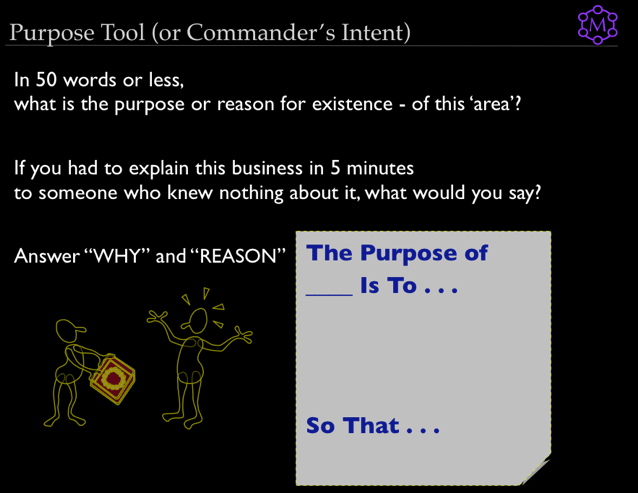
Yet infrequently, if ever, the Account Payable Department (or, some other function, process, activity, or product) justifies off-site strategic planning sessions. They still need consensus around why that department (or, some other function, process, activity, or product) exists, where they are going, and how they are going to measure their progress. To build consensual understanding around WHY something exists or WHY it is important, consider using our meeting Purpose Tool. If used appropriately, Commander’s Intent (aka, the meeting Purpose Tool) may be the second most frequently used workshop tool, after Brainstorming.
Meeting Purpose Tool (aka Commander’s Intent)
The Purpose Tool (or, Commander’s Intent)
This activity yields a wonderful, group-constructed statement that captures the integrated reason, plan, scope, and benefits of a business area.
Meeting Purpose Tool Rationale
Provides the group with a consensually built backdrop that can be appealed to. Helps galvanize consensus around analytical methods and decision-making that follow.
Meeting Purpose Tool Method
Either on one easel or two separate easels, in advance, you should build out the visual prompt (preferably in a separate color), that “The Purpose of ____ is to . . . (ellipsis) So that . . . (ellipsis).”
- Prompt your participants with “The Purpose of ____ is to . . .”
- While scribing, print the last word from the previous input, and prompt them audibly with “So that . . .” because you want to keep the energy high.
- Do not use hyphens as you capture, rather use commas as you are helping them build one, long run-on sentence.
- Do not wordsmith the results but be certain to reread, review, and confirm that they have created a statement that everyone can live with. Basically, you have created a strategic plan at the level of a business area or activity—why it is important.
- Review during the workshop as an appeal to ensure that the discussion stays on topic. If necessary, either take off-topic discussion and ask that it be placed in the Issue Bin or go back and modify this statement to allow for its inclusion.
______
Don’t ruin your career by hosting bad meetings. Sign up for a workshop or send this to someone who should. MGRUSH workshops focus on meeting design and practice. Each person practices tools, methods, and activities every day during the week. Therefore, while some call this immersion, we call it the road to building high-value facilitation skills.
Terrence Metz, president of MG RUSH Facilitation Training, was just 22-years-old and working as a Sales Engineer at Honeywell when he recognized a widespread problem—most meetings were ineffective and poorly led, wasting both time and company resources. However, he also observed meetings that worked. What set them apart? A well-prepared leader who structured the session to ensure participants contributed meaningfully and achieved clear outcomes.
Throughout his career, Metz, who earned an MBA from Kellogg (Northwestern University) experienced and also trained in various facilitation techniques. In 2004, he purchased MG RUSH where he shifted his focus toward improving established meeting designs and building a curriculum that would teach others how to lead, facilitate, and structure meetings that drive results. His expertise in training world-class facilitators led to the 2020 publication of Meetings That Get Results: A Guide to Building Better Meetings, a comprehensive resource on effectively building consensus.
Grounded in the principle that “nobody is smarter than everybody,” the book details the why, what, and how of building consensus when making decisions, planning, and solving problems. Along with a Participant’s Guide and supplemental workshops, it supports learning from foundational awareness to professional certification.
Metz’s first book, Change or Die: A Business Process Improvement Manual, tackled the challenges of process optimization. His upcoming book, Catalyst: Facilitating Innovation, focuses on meetings and workshops that don’t simply end when time runs out but conclude with actionable next steps and clear assignments—ensuring progress beyond discussions and ideas.
by Facilitation Expert | Mar 6, 2014 | Meeting Tools, Problem Solving
The following Creativity tool stimulates the ideation activity of Brainstorming and enables people to express ideas and beliefs non-verbally, even if they cannot or will not do it orally. This is especially beneficial for developing visions of the business, system, or organization. The Creativity tool should also be used when defining, especially complex products or processes.
Creativity Tool Method
Creativity Tool Example
The Creativity tool allows each team to draw pictorial answers to a specific question or to provide solutions for a specific scenario. Additionally, the Creativity tool frequently takes less time than narrative capture. If you use the Creativity tool early during the workshop, you can mount visually stimulating wallpaper that participants will refer to later. Since teams rather than individuals generate the results, you provide timid participants permission to speak freely by enabling them to defend or explain what their teams created. Complete the following:
- Divide the group into smaller teams of three to five people. Watch the mix of people—plan how you want to mix them.
- Explain what they will be doing and provide a visual prompt of the question(s) that need to be answered. Examples:
- Draw a picture of how the organization looks today.
- Illustrate how you would like the organization or system to look in the future.
- Draw your vision of where you are going with the business or system.
- (illustrative) Provide answers to the question, “What do you expect to get out of this workshop?”
- You can use one or more of the above examples or your own. Therefore, if you have the teams draw pictures of both today and the future, you empower them with the ability to compare and contrast.
- Provide a time limit, flip chart paper, and colored markers.
- When finished, have each team present their drawing(s). Consider using the Bookend tool for identifying commonalities and items that may be extremely unique. Keep the drawings mounted on the wall and do NOT mark on them.
- Separately, capture their narrative explanations and feedback and confirm that the narrative reflections are accurate and complete.
Creativity Tool Notes
The Creativity tool is powerful in drawing out beliefs and ideas. Use it effectively by knowing how you are going to use the output.
______
Don’t ruin your career by hosting bad meetings. Sign up for a workshop or send this to someone who should. MGRUSH workshops focus on meeting design and practice. Each person practices tools, methods, and activities every day during the week. Therefore, while some call this immersion, we call it the road to building high-value facilitation skills.
Terrence Metz, president of MG RUSH Facilitation Training, was just 22-years-old and working as a Sales Engineer at Honeywell when he recognized a widespread problem—most meetings were ineffective and poorly led, wasting both time and company resources. However, he also observed meetings that worked. What set them apart? A well-prepared leader who structured the session to ensure participants contributed meaningfully and achieved clear outcomes.
Throughout his career, Metz, who earned an MBA from Kellogg (Northwestern University) experienced and also trained in various facilitation techniques. In 2004, he purchased MG RUSH where he shifted his focus toward improving established meeting designs and building a curriculum that would teach others how to lead, facilitate, and structure meetings that drive results. His expertise in training world-class facilitators led to the 2020 publication of Meetings That Get Results: A Guide to Building Better Meetings, a comprehensive resource on effectively building consensus.
Grounded in the principle that “nobody is smarter than everybody,” the book details the why, what, and how of building consensus when making decisions, planning, and solving problems. Along with a Participant’s Guide and supplemental workshops, it supports learning from foundational awareness to professional certification.
Metz’s first book, Change or Die: A Business Process Improvement Manual, tackled the challenges of process optimization. His upcoming book, Catalyst: Facilitating Innovation, focuses on meetings and workshops that don’t simply end when time runs out but conclude with actionable next steps and clear assignments—ensuring progress beyond discussions and ideas.
by Facilitation Expert | Feb 27, 2014 | Meeting Support
Use icebreakers to get participants vocal and more participatory sooner by introducing themselves beyond name and title. The following examples can be used by virtual participants as well. When virtual, make sure all participants identify themselves before speaking.
Questions to Launch Effective Icebreakers (aka Meeting Sparks)
Effective Icebreakers (aka Meeting Sparks)
- A simple yet effective method: “If I were a . . . “ approach such as—“If I were a gem, I would be a ____” or “If I were a flower, I would be a ____” or “If I were a bird, I would be a _____” or “If I were a vehicle, I would be a _____”
- Describe your dream career as a child.
- Describe the first event you remember vividly in life.
- Explain how you got one of your scars (and where it is).
- Explain your strangest paying job or chore.
- If you could change anything about the way you were raised, what would it be?
- If you were a room in a house, which room are you and why?
- “My hero is . . .”
- Name a talent that you have and no one here knows about it.
- Name the last song you sang out loud by yourself.
- Sound out or act out your high school mascot.
- Tell us an animal you would like to be, and why.
- Tell us your favorite James Bond actor and explain why.
- The title of your autobiography?
- Two truths and a lie—participants guess the lie.
- Use one word to describe where you are right now.
- What kitchen appliance or tool would you be and why?
- What would you bring with you on a desert island?
- What’s on your reading list or nightstand?
- When wake up tomorrow having gained any one quality or ability, what would it be?
- Which model and type of automobile would you be and why?
- “Would you rather?” questions; e.g., Would you rather be invisible or be able to read minds? Would you rather live without music or live without television? Would you rather be 4 feet tall or 8 feet tall?
- Your favorite ice cream?
Meeting Sparks – another phrase for icebreakers
- Based on a project theme, create new surnames for participants; e.g., Lori Aconcagua (i.e., the highest mountain in South America).
- Begin with a “Fun Fact” sharing by each individual of something previously unknown to everyone.
- On a rotating basis, have an assignee bring in a joke.
- Start the meeting with a song and award a prize to the first person who correctly identifies the name artist or both.
______
Don’t ruin your career by hosting bad meetings. Sign up for a workshop or send this to someone who should. MGRUSH workshops focus on meeting design and practice. Each person practices tools, methods, and activities every day during the week. Therefore, while some call this immersion, we call it the road to building high-value facilitation skills.
Terrence Metz, president of MG RUSH Facilitation Training, was just 22-years-old and working as a Sales Engineer at Honeywell when he recognized a widespread problem—most meetings were ineffective and poorly led, wasting both time and company resources. However, he also observed meetings that worked. What set them apart? A well-prepared leader who structured the session to ensure participants contributed meaningfully and achieved clear outcomes.
Throughout his career, Metz, who earned an MBA from Kellogg (Northwestern University) experienced and also trained in various facilitation techniques. In 2004, he purchased MG RUSH where he shifted his focus toward improving established meeting designs and building a curriculum that would teach others how to lead, facilitate, and structure meetings that drive results. His expertise in training world-class facilitators led to the 2020 publication of Meetings That Get Results: A Guide to Building Better Meetings, a comprehensive resource on effectively building consensus.
Grounded in the principle that “nobody is smarter than everybody,” the book details the why, what, and how of building consensus when making decisions, planning, and solving problems. Along with a Participant’s Guide and supplemental workshops, it supports learning from foundational awareness to professional certification.
Metz’s first book, Change or Die: A Business Process Improvement Manual, tackled the challenges of process optimization. His upcoming book, Catalyst: Facilitating Innovation, focuses on meetings and workshops that don’t simply end when time runs out but conclude with actionable next steps and clear assignments—ensuring progress beyond discussions and ideas.
by Facilitation Expert | Feb 20, 2014 | Leadership Skills, Meeting Agendas, Meeting Support
The rule of thirds helps guide the facilitator and meeting designer. The Project Management Institute (PMI) refers to planning, analysis, and design as separate stages across a project or product development.
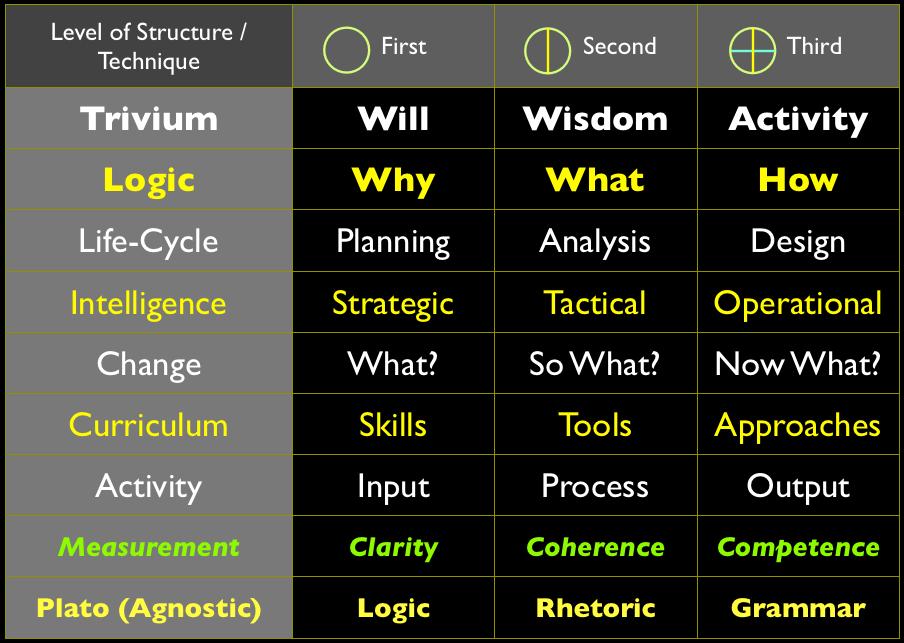
At ground level, the basic Use Case refers to Input>Process>Output as the basis for understanding requirements. Many of the world’s great religions of philosophy embrace the concept of a trinity. From Shiva, Vishnu, and Brahma of Hinduism to the great agnostic Plato, who referred to logic, rhetoric, and grammar as the trivium; testing of which allowed citizens to vote.
The Trivium
As elementary students, we learned the importance and proper sequencing of WHY before WHAT before HOW.
The Trivium: source Terrence Metz
Let’s look at two components of Goldblatt’s Theory of Constraints (aka Triple Constraint Theory), namely time and quality.
Time
Optimally allow at least one hour of preparation time for each hour of meeting or workshop time. Early in the role of facilitator, as you develop your experience, competencies, and body of knowledge, the ratio can be much higher. Many suggest a practical ratio of two hours of preparation to every one hour of meeting or workshop time. The less familiar you are with the agenda and the tools you plan to use, the larger the ratio you can estimate.
Unfortunately, people forget the importance of the back-end as well; namely, what to do and invest after the meeting or workshop. Please make certain that your documentation is complete, and that it sizzles. Frequently the only residue of value left after a meeting or workshop is the document, and if it was not documented, it did not happen.
Take time to add context, typically cut and paste from your annotated agenda if thoroughly constructed. Context provides the background and rationale, the WHY, behind WHAT gets done during the meeting.
For example, take a decision made by a group to the executive sponsor or decision review board and their first question is WHY. Why did you make that decision? Let us be careful to document the rationale, the BECAUSE, behind the various components within a deliverable. Explain why they were built, how they relate to each other, and how they accelerate the project your meeting supports.
Quality
PMI refers to it as “front-end loading”, in other words, do not underinvest in the planning and building consensus around WHY something is important. For example, why do perform this function, process, or activity? Why we do something dramatically affects what we will do to support it.
Note the difference between a primary residence to raise a family and a beach house or camp hut used for family vacations. The purpose alone dictates different decisions and designs. A family vacation house for example may emphasize more beds than privacy, or give the family room more space while minimizing the study or library.
Even during a meeting, make sure you include a beginning, a middle, and an end. All too frequently, meetings fail to include one of them. Most people would rather go to a movie than a meeting because even a poor movie has a beginning, a middle, and an end. Do not discount the value of an effective review and wrap, and see Four Activities to Efficiently and Effectively Wrap-up a Meeting to manage the end, better than most.
______
Don’t ruin your career by hosting bad meetings. Sign up for a workshop or send this to someone who should. MGRUSH workshops focus on meeting design and practice. Each person practices tools, methods, and activities every day during the week. Therefore, while some call this immersion, we call it the road to building high-value facilitation skills.
Terrence Metz, president of MG RUSH Facilitation Training, was just 22-years-old and working as a Sales Engineer at Honeywell when he recognized a widespread problem—most meetings were ineffective and poorly led, wasting both time and company resources. However, he also observed meetings that worked. What set them apart? A well-prepared leader who structured the session to ensure participants contributed meaningfully and achieved clear outcomes.
Throughout his career, Metz, who earned an MBA from Kellogg (Northwestern University) experienced and also trained in various facilitation techniques. In 2004, he purchased MG RUSH where he shifted his focus toward improving established meeting designs and building a curriculum that would teach others how to lead, facilitate, and structure meetings that drive results. His expertise in training world-class facilitators led to the 2020 publication of Meetings That Get Results: A Guide to Building Better Meetings, a comprehensive resource on effectively building consensus.
Grounded in the principle that “nobody is smarter than everybody,” the book details the why, what, and how of building consensus when making decisions, planning, and solving problems. Along with a Participant’s Guide and supplemental workshops, it supports learning from foundational awareness to professional certification.
Metz’s first book, Change or Die: A Business Process Improvement Manual, tackled the challenges of process optimization. His upcoming book, Catalyst: Facilitating Innovation, focuses on meetings and workshops that don’t simply end when time runs out but conclude with actionable next steps and clear assignments—ensuring progress beyond discussions and ideas.