by Facilitation Expert | May 8, 2014 | Communication Skills, Leadership Skills, Meeting Support
We have argued for years that unclear speaking (or writing) is indicative of unclear thinking and will impact shared project team values.
For example, most people do not distinguish between the meaning of a “group” or a “team.” Conversely, we find the difference so important, that it could represent the difference between “life” and “death.” Note the following impact on shared project team values.
Groups of people assemble. Teams get assembled.
With groups, members strive to arrive at a deliverable that satisfies each member. Therefore, people define “satisfaction” with respect to their individual interests. The primary challenge is building a deliverable (or decision) that satisfies the interests of all members who are acting on their own as individuals (or potentially as representatives of larger stakeholder interests). Individual reactions vary, even when attending a concert together and hoping to be satisfied by the music or entertainment.

Pushing in the Same Direction
The presence of teams suggests an overriding shared goal that sits independent of the interests of the individual members. With high-functioning teams, members emphasize the importance of the shared goal and make their personal interests subservient to the shared goal. Successful teams share a reaction, typically positive in nature. They will push or pull in the same direction to support a common cause.
Distinguishing Attributes
Some of the variables you need to consider when optimizing facilitated methods for teams include understanding the following questions:
- How effective and trusted has group decision-making been in the past for the organization?
- How much effort has been invested in understanding the quality of decision-making?
- To what extent will the formal leader of the team share the same or similar perspective?
- How much do the individuals share perspectives or derive from a similar level within the organization?
- To what extent does the culture promulgate distributed decision-making, where individuals are trusted to take a course of action that supports both the organization and the individual?
- To what extent is the group an actual unit in the organizational structure (e.g., reporting to the same leadership) or diversely representing many functional or geographic areas?
Be Conscious
As a leader stress the difference between groups and teams. Expect high performance, or you might not get it. Answer the questions above to support your selection of tools along the MGRUSH decision-making continuum that best serve your team and organizational situation.
______
Don’t ruin your career by hosting bad meetings. Sign up for a workshop or send this to someone who should. MGRUSH workshops focus on meeting design and practice. Each person practices tools, methods, and activities every day during the week. Therefore, while some call this immersion, we call it the road to building high-value facilitation skills.
Terrence Metz, president of MG RUSH Facilitation Training, was just 22-years-old and working as a Sales Engineer at Honeywell when he recognized a widespread problem—most meetings were ineffective and poorly led, wasting both time and company resources. However, he also observed meetings that worked. What set them apart? A well-prepared leader who structured the session to ensure participants contributed meaningfully and achieved clear outcomes.
Throughout his career, Metz, who earned an MBA from Kellogg (Northwestern University) experienced and also trained in various facilitation techniques. In 2004, he purchased MG RUSH where he shifted his focus toward improving established meeting designs and building a curriculum that would teach others how to lead, facilitate, and structure meetings that drive results. His expertise in training world-class facilitators led to the 2020 publication of Meetings That Get Results: A Guide to Building Better Meetings, a comprehensive resource on effectively building consensus.
Grounded in the principle that “nobody is smarter than everybody,” the book details the why, what, and how of building consensus when making decisions, planning, and solving problems. Along with a Participant’s Guide and supplemental workshops, it supports learning from foundational awareness to professional certification.
Metz’s first book, Change or Die: A Business Process Improvement Manual, tackled the challenges of process optimization. His upcoming book, Catalyst: Facilitating Innovation, focuses on meetings and workshops that don’t simply end when time runs out but conclude with actionable next steps and clear assignments—ensuring progress beyond discussions and ideas.
by Facilitation Expert | May 1, 2014 | Decision Making, Meeting Structure, Meeting Tools, Prioritizing
After reviewing some material about the optimal methodology (i.e., approach) for distribution planning, related to an ERP (Enterprise Resource Planning) project, it became quickly evident that the expert’s recommendation followed the core principles for building consensus.
The three indisputable components when building consensus around decision-making building include:
- Purpose (or, intent)
- Options
- Criteria
Since not all criteria are of equal value, the author suggested weighting the criterion, referred to as “service outputs.” Even when you make a simple decision about buying new underwear, you consider the purpose (e.g.; workout, daily, formalwear, etc.), your options (typically stuff on the shelf at the store), and your criteria (i.e.; style, price, size, etc.). Not surprisingly, you also weigh the criteria, as size is probably the most important criterion, followed closely by price. All three components add value when building consensus.
In their model, they suggest the following:
- Identify which channels you are seeking to penetrate
- Isolate the most important segments within each channel
- Identify their “service outputs” and then to . . .
- List clearly
- Rank
- Prioritize
- Eliminate
By arraying your options against your decision criteria, you can display decisions on a single page. We call the visual array a decision matrix. Compare your options to your criteria.
Consensus Building – Decision Support Matrix
CAUTION
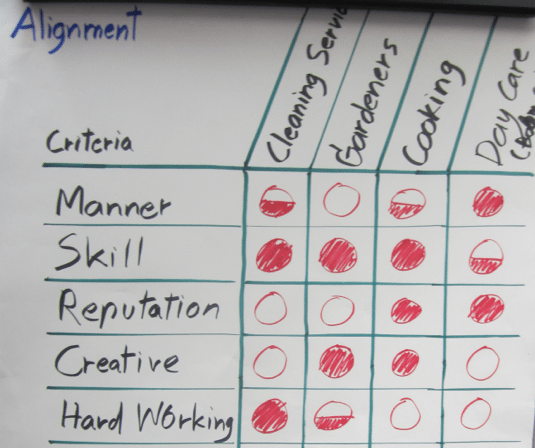
Do not ask a close-ended question such as “Does this criteria affect this option?” Rather, ask the open-ended question that yields a powerful visual; namely, “To what extent does this criterion impact this option (i.e., High, Low, or Medium). It’s easier to build consensual understanding when taking a non-narrative approach as shown below.
The example suggests the important attributes sought when hiring domestic staff for a wealthy household. Note for example that “Reputation” is less important when hiring a new Gardener than when hiring someone for Day Care support of the children. Again, note that “Creativity” is more important when hiring a chef than when hiring Cleaning Support. The group can easily evaluate the importance of the options by the extent they are supported by the criteria. The group can also see the relative importance of an individual criterion by evaluating its impact across all of the options.
Remember, the secret is to ask the open-ended question, “To what extent . . .” Additionally, since the example is a simple, “plain vanilla” illustration, modify it to your own situation, and consider using the Bookend tool to force-fit an even distribution of Highs, Lows, and Moderates across the options or within each option. See the link that follows for further explanation on the use of Bookends.
By the way, some of the criteria used in the distribution channels example might include:
- Adaptability (e.g., to economic upheaval, competitive forces, etc.)
- Effectiveness (e.g., return on investment, market share, etc.)
- Efficiency (e.g., expense to revenue, cost of doing business, etc.)
- Quality (e.g., customer satisfaction, on-time performance, etc.)
______
Don’t ruin your career by hosting bad meetings. Register for a workshop or forward this to someone who should. MGRUSH facilitation workshops focus on meeting design and practice. Each participant practices tools, methods, and activities every day during the week. Therefore, while some call this immersion, we call it the road to building high-value facilitation skills.
Related articles
Terrence Metz, president of MG RUSH Facilitation Training, was just 22-years-old and working as a Sales Engineer at Honeywell when he recognized a widespread problem—most meetings were ineffective and poorly led, wasting both time and company resources. However, he also observed meetings that worked. What set them apart? A well-prepared leader who structured the session to ensure participants contributed meaningfully and achieved clear outcomes.
Throughout his career, Metz, who earned an MBA from Kellogg (Northwestern University) experienced and also trained in various facilitation techniques. In 2004, he purchased MG RUSH where he shifted his focus toward improving established meeting designs and building a curriculum that would teach others how to lead, facilitate, and structure meetings that drive results. His expertise in training world-class facilitators led to the 2020 publication of Meetings That Get Results: A Guide to Building Better Meetings, a comprehensive resource on effectively building consensus.
Grounded in the principle that “nobody is smarter than everybody,” the book details the why, what, and how of building consensus when making decisions, planning, and solving problems. Along with a Participant’s Guide and supplemental workshops, it supports learning from foundational awareness to professional certification.
Metz’s first book, Change or Die: A Business Process Improvement Manual, tackled the challenges of process optimization. His upcoming book, Catalyst: Facilitating Innovation, focuses on meetings and workshops that don’t simply end when time runs out but conclude with actionable next steps and clear assignments—ensuring progress beyond discussions and ideas.
by Facilitation Expert | Apr 17, 2014 | Communication Skills, Leadership Skills
You and I have been victims of numerous false, urban legends. So please beware of the overconfidence effect among subject matter experts. For example:
- The Great Wall of China is NOT visible from outer space
- You use a lot more than ten percent of your brain
- Relatively speaking, it’s much safer to take candy from strangers than from family members. Statistically, family members are more likely than strangers to poison others.
Cognitive biases receive much press because they negatively impact decision quality. Subject matter experts (i.e., SMEs) are frequent victims of an “availability” bias that causes them to exhibit an overconfidence effect — and they may be wrong. Challenge the overconfidence effect of your subject matter experts with a “hip-pocket” tool, something you carry with you at all times.
Background
When delivered face-to-face, people treat information as more credible and will more likely refer to it. Participants are frequently impressed by the charisma of the deliverer rather than the value of the information.
Subject matter experts tend to overestimate their contributions that are produced jointly with others. Thus, they overestimate the importance of their contributions and close themselves off from the possibility of other “right” answers.
For example, two people eating the same bowl of chili will react differently. One may claim the chili is “hot” (i.e., spicy) while the other claims it is “not”. Both are right, so we might appeal to Scoville Units to “objectify” their claims.
Solution
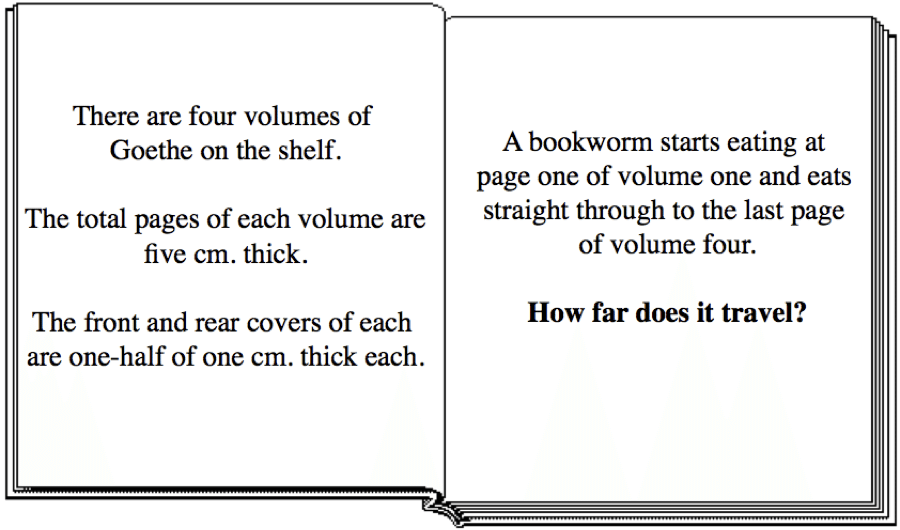
Be prepared to demonstrate that SMEs may have “an” answer, but not the only answer. Humble overconfident subject matter experts with a host of “hip-pocket” challenges. Demonstrate that their answer may be sub-optimal (or even wrong) and that voting is a poor method of decision-making. The Bookworm’s Travels, one of our personal favorites, represents one of hundreds of similar exercises used to shake paradigms.
Solve the question yourself. You will need to write us for the correct answer but we can assure you that the correct answer is not “23.” Keep in mind that these are English books, written from left to right, and stacked in proper sequence, from Volume One through Volume Four, vertically.
Test Overconfident Subject Matter Experts with a Bookworm’s Travels
______
Don’t ruin your career by hosting bad meetings. Register for a workshop or forward this to someone who should. MGRUSH facilitation workshops focus on meeting design and practice. Each participant practices tools, methods, and activities every day during the week. Therefore, while some call this immersion, we call it the road to building high-value facilitation skills.
Terrence Metz, president of MG RUSH Facilitation Training, was just 22-years-old and working as a Sales Engineer at Honeywell when he recognized a widespread problem—most meetings were ineffective and poorly led, wasting both time and company resources. However, he also observed meetings that worked. What set them apart? A well-prepared leader who structured the session to ensure participants contributed meaningfully and achieved clear outcomes.
Throughout his career, Metz, who earned an MBA from Kellogg (Northwestern University) experienced and also trained in various facilitation techniques. In 2004, he purchased MG RUSH where he shifted his focus toward improving established meeting designs and building a curriculum that would teach others how to lead, facilitate, and structure meetings that drive results. His expertise in training world-class facilitators led to the 2020 publication of Meetings That Get Results: A Guide to Building Better Meetings, a comprehensive resource on effectively building consensus.
Grounded in the principle that “nobody is smarter than everybody,” the book details the why, what, and how of building consensus when making decisions, planning, and solving problems. Along with a Participant’s Guide and supplemental workshops, it supports learning from foundational awareness to professional certification.
Metz’s first book, Change or Die: A Business Process Improvement Manual, tackled the challenges of process optimization. His upcoming book, Catalyst: Facilitating Innovation, focuses on meetings and workshops that don’t simply end when time runs out but conclude with actionable next steps and clear assignments—ensuring progress beyond discussions and ideas.
by Facilitation Expert | Apr 10, 2014 | Facilitation Skills, Meeting Support
Meeting participant preparation differs high-performance groups from normal or underperforming groups. Many people attend sessions with concern over What is in it for me.
Meeting participant preparation suggests that is neither the right attitude nor the right question. What they should ask is “What do you need or want from me (so that we can get done faster)?” What you should be encouraging is participant preparation.
Meeting Participant Preparation — What Do You Need from Me?
As a facilitator or session leader, it is virtually impossible to shift their attitude at the start of a meeting. To cause a shift in participant thinking, attitude, and behavior requires clear and two-way communication before the meeting begins.
Meeting Participant Preparation — What Does DONE Look Like!
Most meetings (at least the good ones) typically result in Action Plans and agreed-upon roles and responsibilities for making things happen. We expect to hold the participants accountable for their follow-up and get them involved before the meeting starts to understand and agree to the Purpose, Scope, Deliverables, and Simple Agenda for the meeting.
As the facilitator, you should expect participants to show up prepared. It is your responsibility to define “prepared.” How can participants arrive prepared if they do not know the purpose of the meeting before it starts? How can participants stay focused and complete on time if they do not understand the scope of the meeting (as discrete from the scope of the project the meeting may be supporting)? What can you do to get your participants prepared faster? Do they know “what done looks like (i.e., deliverable)”? How can participants agree to follow-up assignments if they are not permitted to provide their input, clarifications, and calibrations about HOW they are going to get done on time (i.e., the Agenda)?
Meeting Participant Preparation — If It Was Simple, We Wouldn’t Meet
Ultimately the reason for most meetings and workshops is that we need consensual answers to relatively complex questions. If the questions are simple, typically we do not need a meeting nor are there consensual challenges. Knowing that effective meetings develop consensual answers to questions and problems, the session leader must prepare and know in advance of the meeting, the questions that need to be answered.
Once developed and understood, do not hide the questions to be asked in a meeting. Share them in advance. Since select subject matter experts (i.e., participants) likely provide input on questions that are ‘closer to home.’ You can highlight the questions on an individual basis and explain to each participant that you expect them to think in advance about their responses. Explain that when the questions(s) are asked that you have highlighted, they need to take the lead. You expect them to take the lead and be among the first to offer up their subject matter expertise.
It’s not easy to run a successful meeting. That is why many meetings fail or frail. Your job is to make sure the meeting or workshop is off and running the moment you start. The only way to ensure that level of productivity is to prepare your participants in advance.
______
Don’t ruin your career by hosting bad meetings. Sign up for a workshop or send this to someone who should. MGRUSH workshops focus on meeting design and practice. Each person practices tools, methods, and activities every day during the week. Therefore, while some call this immersion, we call it the road to building high-value facilitation skills.
Terrence Metz, president of MG RUSH Facilitation Training, was just 22-years-old and working as a Sales Engineer at Honeywell when he recognized a widespread problem—most meetings were ineffective and poorly led, wasting both time and company resources. However, he also observed meetings that worked. What set them apart? A well-prepared leader who structured the session to ensure participants contributed meaningfully and achieved clear outcomes.
Throughout his career, Metz, who earned an MBA from Kellogg (Northwestern University) experienced and also trained in various facilitation techniques. In 2004, he purchased MG RUSH where he shifted his focus toward improving established meeting designs and building a curriculum that would teach others how to lead, facilitate, and structure meetings that drive results. His expertise in training world-class facilitators led to the 2020 publication of Meetings That Get Results: A Guide to Building Better Meetings, a comprehensive resource on effectively building consensus.
Grounded in the principle that “nobody is smarter than everybody,” the book details the why, what, and how of building consensus when making decisions, planning, and solving problems. Along with a Participant’s Guide and supplemental workshops, it supports learning from foundational awareness to professional certification.
Metz’s first book, Change or Die: A Business Process Improvement Manual, tackled the challenges of process optimization. His upcoming book, Catalyst: Facilitating Innovation, focuses on meetings and workshops that don’t simply end when time runs out but conclude with actionable next steps and clear assignments—ensuring progress beyond discussions and ideas.
by Facilitation Expert | Apr 3, 2014 | Meeting Structure, Meeting Tools, Prioritizing
In managing capital projects or leading teams, facilitators often grapple with prioritization, where every item can feel equally important. However, allowing everything to be “most important” dilutes focus and slows down decision-making. This is where our Bookend method and accompanying rhetorical techniques come into play, offering a strategic solution to rank priorities efficiently and meaningfully.
Why the Bookend Method Works
The primary challenge with traditional, linear approaches to prioritization is that they encourage discussions around gray areas—those items that fall into moderate categories (e.g., “moderately important,” “reasonable cost”). Unfortunately, these middle-ground discussions often lead to drawn-out debates that add little to decision quality.
Instead, experience shows that extreme criteria—the highest and lowest importance factors—drive impactful decision-making. By focusing on these extremes, the Bookend method bypasses fruitless arguments and identifies the most crucial factors first.
The Problem with Traditional Prioritization
Untrained facilitators often begin with a linear approach, asking whether an item is high, medium, or low in importance. The result? Most items end up in the “high” category, diluting the overall value of the list. While each item on the list may indeed be important, the method fails to differentiate clearly between them.
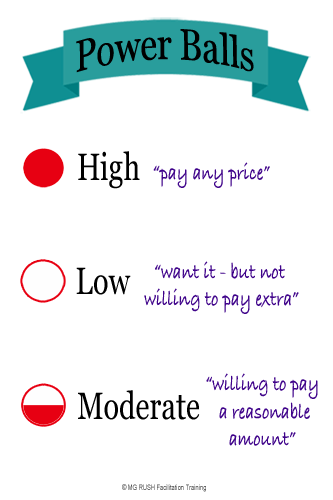
By using the Bookend method, facilitators avoid these pitfalls and achieve better balance across categories. PowerBallls make this easy as demonstrated below.
How the Bookend Method Works
- Identify the Extremes: Start by asking, “Which item is the most important?” and mark it using the filled circle PowerBall icon. Then ask, “Which is the least important?” and mark it with the empty circle PowerBall icon.
- Work Toward the Middle: Repeat the process, alternating between the next most important and least important items, until two-thirds of the list is scored.
- Address the Middle: For the remaining one-third, ask the group, “Will you lose any sleep over categorizing these as moderate?”
- Consistent Language: Always ask in singular terms—“which is”—to focus discussions. Be ready to take multiple inputs if participants speak simultaneously.
- Bucket Distribution: Divide the total list into three categories (high, moderate, low) while ensuring balance. If necessary, adjust by adding or removing an item from a category, maintaining overall distribution.
- Force-Ranking Alternative: For a more granular ranking, apply the highest available number for the most important, the lowest for the least important, and alternate until all items are ranked.
Use the Bookend Method to Avoid Wasting Time with Lists
Use Cases and Flexibility
When comparing illustrations or scenarios, ask questions like:
- Which is most similar?
- Which is least similar?
Repeat the process until one-third of the items remain uncategorized, placing them in the moderate bucket.
For discussions around personal or group strengths and weaknesses:
- What is your greatest strength?
- What is your greatest weakness?
Again, repeat this process until the list is reduced to one-third, placing the remainder into the moderate category.
We discourage overly complex breakdowns (e.g., one-quarter or three-quarter categories) unless they help avoid unnecessary debates. Flexibility is key—apply this method pragmatically to keep the group focused on progress, not arguments.
Numeric Alternative (Six Levels)
For more complex scenarios where finer gradations are needed, consider this six-level system:
- Low Importance
- Moderately Low Importance (if needed)
- Moderate Importance
- Moderately High Importance (if needed)
- High Importance
- Null (Will not have)
By guiding groups to focus on extremes and avoid gray areas, the Bookend method enables efficient, impactful decision-making. It saves time, reduces frustration, and enhances the clarity of priorities.
_____
In a world where everyone can engage in decisions that affect them,
_____
With Bookmarks no longer a feature in WordPress, we need to append the following for your benefit and reference
Terrence Metz, president of MG RUSH Facilitation Training, was just 22-years-old and working as a Sales Engineer at Honeywell when he recognized a widespread problem—most meetings were ineffective and poorly led, wasting both time and company resources. However, he also observed meetings that worked. What set them apart? A well-prepared leader who structured the session to ensure participants contributed meaningfully and achieved clear outcomes.
Throughout his career, Metz, who earned an MBA from Kellogg (Northwestern University) experienced and also trained in various facilitation techniques. In 2004, he purchased MG RUSH where he shifted his focus toward improving established meeting designs and building a curriculum that would teach others how to lead, facilitate, and structure meetings that drive results. His expertise in training world-class facilitators led to the 2020 publication of Meetings That Get Results: A Guide to Building Better Meetings, a comprehensive resource on effectively building consensus.
Grounded in the principle that “nobody is smarter than everybody,” the book details the why, what, and how of building consensus when making decisions, planning, and solving problems. Along with a Participant’s Guide and supplemental workshops, it supports learning from foundational awareness to professional certification.
Metz’s first book, Change or Die: A Business Process Improvement Manual, tackled the challenges of process optimization. His upcoming book, Catalyst: Facilitating Innovation, focuses on meetings and workshops that don’t simply end when time runs out but conclude with actionable next steps and clear assignments—ensuring progress beyond discussions and ideas.