by Facilitation Expert | Jun 26, 2014 | Managing Conflict, Meeting Support
Paradigms
Paradigms are established accepted norms, patterns of behavior, or a shared set of assumptions. Shaking them causes fear, uncertainty, and doubt; also known as the FUD Factor. Paradigms provide models that establish boundaries or rules for success. Paradigms may present structural barriers to creativity based on psychological, cultural, and environmental factors. Examples include:
- Flow charts, diagrams, and other conventions for presenting information (e.g., swim lane diagrams)

More Similarities Than Differences
- Stereotypes about men and women and their roles in business, family, and society
- Where people sit in meetings—once they find a seat it becomes their seat for the rest of the meeting
Not All Bad
There are many more paradigms in life. Paradigms are not bad unless they become barriers to progress. People either understand paradigms or risk being left behind. What is impossible with one paradigm is easy with another—because “I didn’t know any better.” When paradigms change, everyone starts over.
Changing Paradigms
To cause groups to challenge and possibly modify their paradigms, do the following:
- Ask the “Paradigm Shift” question—“What is impossible today, but if made possible . . . What would you do?”
- Force the group to look at a familiar object or idea in a new way.
- Use the “Five-year Old” routine—ask—“But why?” frequently, or until the group thoroughly discusses an issue, its assumptions, and implications.
- Develop a clear problem statement or use a problem such as the example provided below).
“An automobile traveling on a deserted road blows a tire. The occupants discover that there is no jack in the trunk. They define the problem as “finding a jack” and decide to walk to a station for a jack. Another automobile on the same road also blows a tire. The occupants also discover that there is no jack. They define the problem as “raising the automobile.” They see an old barn, push the auto there, raise it on a pulley, change the tire, and drive off while the occupants of the first car are still trudging towards the service station.”
Getzels, J.W., Problem-finding and the inventiveness of solutions,
Journal of Creative Behavior, 1975, 9(1), pp 12-18.
Shifting perspectives will frequently help “shake” paradigms. Consider using Edward de Bono’s Thinking Hats or imposing some other perspective or comparison such as:
- A monastery compared to the “mafia”
- Steve Jobs compared to Bill Gates
- Ant colony compared to a penal colony
- A weather system compared to a gambling system
- Mother Teresa of Calcutta compared to Genghis Khan
- Etcetera
FUD Factor: People DO Change
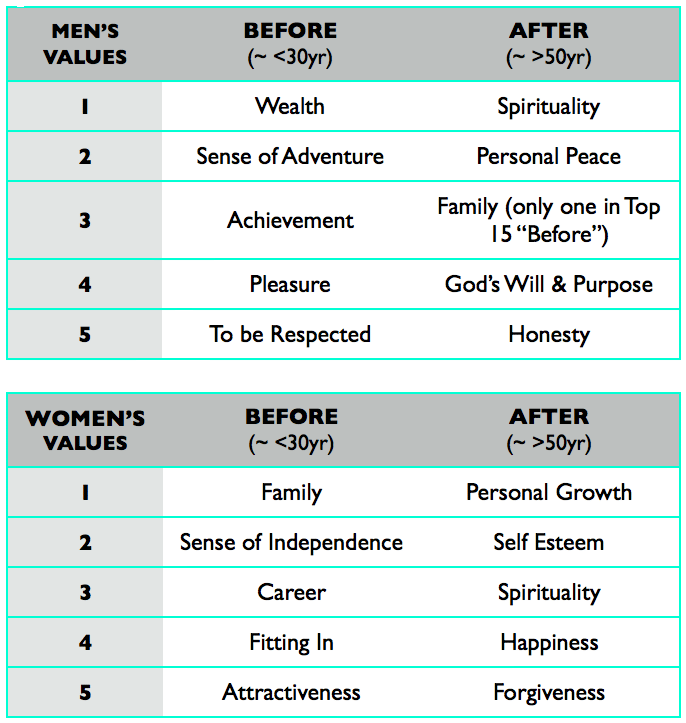
Research by Dyer (2007), has proven that people do change. There is a quantum shift of values after twenty to thirty years of life.
Change occurs across both men and women, although their before and after values remain different. The shifts shown below occur after a relatively significant change in maturity, such as we find today with “empty nesters” or people who find themselves no longer hosting others, in particular, their children.
Note the implications for a facilitated session with people coming from all four categories shown below.
The FUD Factor: Men and Women Do Change
______
Don’t ruin your career by hosting bad meetings. Sign up for a workshop or send this to someone who should. MGRUSH workshops focus on meeting design and practice. Each person practices tools, methods, and activities every day during the week. Therefore, while some call this immersion, we call it the road to building high-value facilitation skills.
Terrence Metz, president of MG RUSH Facilitation Training, was just 22-years-old and working as a Sales Engineer at Honeywell when he recognized a widespread problem—most meetings were ineffective and poorly led, wasting both time and company resources. However, he also observed meetings that worked. What set them apart? A well-prepared leader who structured the session to ensure participants contributed meaningfully and achieved clear outcomes.
Throughout his career, Metz, who earned an MBA from Kellogg (Northwestern University) experienced and also trained in various facilitation techniques. In 2004, he purchased MG RUSH where he shifted his focus toward improving established meeting designs and building a curriculum that would teach others how to lead, facilitate, and structure meetings that drive results. His expertise in training world-class facilitators led to the 2020 publication of Meetings That Get Results: A Guide to Building Better Meetings, a comprehensive resource on effectively building consensus.
Grounded in the principle that “nobody is smarter than everybody,” the book details the why, what, and how of building consensus when making decisions, planning, and solving problems. Along with a Participant’s Guide and supplemental workshops, it supports learning from foundational awareness to professional certification.
Metz’s first book, Change or Die: A Business Process Improvement Manual, tackled the challenges of process optimization. His upcoming book, Catalyst: Facilitating Innovation, focuses on meetings and workshops that don’t simply end when time runs out but conclude with actionable next steps and clear assignments—ensuring progress beyond discussions and ideas.
by Facilitation Expert | Jun 19, 2014 | Managing Conflict, Meeting Support
Differences — People think differently.
As session leader, you empower participants and their ability to understand and communicate with each other. Additionally, you enable them to think creatively about their business. Hence, the following two subjects deal with the way people think—horizontal/ vertical thinking and paradigms.
People Also Learn Differently
Horizontal/ Vertical
Participants in a workshop argue over a seemingly simple issue. Consequently, two people hear the same thing and react as if they were in different meetings. Why? Because people interpret information differently. Meanwhile, there are many theories about how people process information.
One theory states that the two spheres of the brain, the right and the left, govern our thinking with right brain or left brain thinking.
However, another theory that explains the differences more clearly is Communicoding. This theory states that there are two modes of thinking for processing information, vertical and horizontal. These two modes of thinking may have a difficult time communicating with each other because the way that each perceives the world is different. What are they?
Vertical Thinker
A vertical thinker is often described as very logical, organized, and detail-oriented. Therefore, vertical thinkers:
- Easily discern the immediate dynamics of a problem.
- Identify specific details and relate issues to reality.
- Know what can be accomplished within a given time.
- See barriers and obstacles to be removed.
- Take the likely paths to reach results.
- Work well in structured environments.
The vertical thinker’s main characteristic is that they find differences. Vertical thinkers can decompose something and design something new from the pieces. They work from exclusion.
Horizontal Thinker
A horizontal thinker is often described as far-sighted, innovative, and conceptual. Therefore, horizontal thinkers:
- Easily discern the underlying dynamics of a problem.
- Identify contextual details—relating issues to a larger perspective.
- Know what impact can be achieved within a given context.
- See possibilities and benefits to strive for.
- Take the unlikely paths to reach results.
- Work well in unstructured environments.
Horizontal thinkers’ main characteristic is that they find similarities. They are able to find the common thread—to make new associations among unrelated items. They work from inclusion.
To Identify
As a facilitator, you cannot change the way people think—and never label participants. You do help the participants in a workshop learn to hear each other and to better understand their communication challenges. Clues that thinking differences are causing problems are:
- One person argues about the problems while another is focused on the benefits.
- One person trying to get to the details while the other is trying to focus on the ideas.
- People use the same words yet meaning something different or arguing as if they are saying something different.
- Using different words that seem to be saying the same thing.
To Fix
When you hear communication problems consider the following:
- Capture what each person is saying—write it on the flip charts without putting their names by the ideas.
- Draw pictures using visual aids, flip charts, and models. By using visual support or other exercises, participants learn about their business.
- Get the group to see both similarities and differences.
- Move the focus of the group away from people and onto the
issue(s) at hand.
- Summarize both similarities and differences and get the group to decide what to do with them or move along to the next step.
Register for a class or forward this to someone who should. MGRUSH‘s professional facilitation curriculum focuses on practicing methodology. Each student thoroughly practices and rehearses tools before class concludes. While some call this immersion, we call it the road to building impactful facilitation skills.
______
Don’t ruin your career by hosting bad meetings. Sign up for a workshop or send this to someone who should. MGRUSH workshops focus on meeting design and practice. Each person practices tools, methods, and activities every day during the week. Therefore, while some call this immersion, we call it the road to building high-value facilitation skills.
Terrence Metz, president of MG RUSH Facilitation Training, was just 22-years-old and working as a Sales Engineer at Honeywell when he recognized a widespread problem—most meetings were ineffective and poorly led, wasting both time and company resources. However, he also observed meetings that worked. What set them apart? A well-prepared leader who structured the session to ensure participants contributed meaningfully and achieved clear outcomes.
Throughout his career, Metz, who earned an MBA from Kellogg (Northwestern University) experienced and also trained in various facilitation techniques. In 2004, he purchased MG RUSH where he shifted his focus toward improving established meeting designs and building a curriculum that would teach others how to lead, facilitate, and structure meetings that drive results. His expertise in training world-class facilitators led to the 2020 publication of Meetings That Get Results: A Guide to Building Better Meetings, a comprehensive resource on effectively building consensus.
Grounded in the principle that “nobody is smarter than everybody,” the book details the why, what, and how of building consensus when making decisions, planning, and solving problems. Along with a Participant’s Guide and supplemental workshops, it supports learning from foundational awareness to professional certification.
Metz’s first book, Change or Die: A Business Process Improvement Manual, tackled the challenges of process optimization. His upcoming book, Catalyst: Facilitating Innovation, focuses on meetings and workshops that don’t simply end when time runs out but conclude with actionable next steps and clear assignments—ensuring progress beyond discussions and ideas.
by Facilitation Expert | Jun 12, 2014 | Leadership Skills, Meeting Support
There are four workshop documents each facilitator must provide or ensure:
- Pre-Read
- Annotated Agenda
- Slide Deck
- Output Notes (Deliverables)
Workshop Documents — Pre-Read
Your participants need to show up at your workshop prepared and ready to contribute. Do not assume they will. Lead them. Provide them with a compelling pre-read. First of all, the pre-read should include at least the components shown below. If your pre-read is a large document, provide a personalized cover letter asking each subject matter expert to focus on topics and pages that you have highlighted. Consequently, your courtesy encourages them the obligation to take time to read their parts.
One of Four Workshop Documents: Participants’ Package, (Pre-read)
Workshop Purpose, Scope, Deliverables, and Simple Agenda
EVERY meeting, even a fifty-minute session, needs to have an articulate purpose, boundaries (i.e., scope), and either well-codified outputs or a generally described outcome document. The deliverables (or output/ outcome) describe what DONE looks like when the session ends. A description of the deliverables describes ‘DONE’ and what the group delivers during the meeting. The agenda, hopefully structured (NOT simply a ‘discussion’; a term closely related to ‘percussion’ and ‘concussion’), shows the group how it is going to get to the deliverable or the end of the session.
Questions to be Addressed
Since you want your participants to show up prepared, help them. Agree in advance (optimally through private interviews) on what questions ought to be raised during their session and have them prepare responses before the meeting begins. Confirm with them the validity of the questions and obtain their feedback about questions they may wish to add, deemed important, and perhaps missing from your original list of questions. Consider the most important reason for meetings—building consensual answers to questions important to the group.
Mission, Value, and Vision
When arguments arise, active listening should be used first to avoid people, who unknowingly, may be in violent agreement with each other. When active listening fails, sometimes due to the stubbornness of participants, an appeal must be made to WHY the meeting is being held. Because no one wants more meetings. They only want results that accelerate projects and activities that occur after the meeting. To reconcile arguments, be prepared to appeal to the objectives of the project/ product, program, business unit, or enterprise that your meeting supports.
Glossary of Terms
You cannot afford to allow arguments about the meaning of terms you use and build into your preparatory efforts. For example, some consider Goals as fuzzy statements and Objectives are SMART. To others, the opposite is true. For some people, Mission is why they show up and Vision is where they are going. To others, it is the opposite. Standardize your operational definitions, share them, and enforce consistent use and interpretation.
Space for Participants’ Note-taking
As a kind gesture, provide some extra space for them to take notes. It will be appreciated.
Workshop Documents — Your Personal, Annotated Agenda
Your detailed methods should be built as if you were there visualizing every step in advance. Include breakout teams, team names and members, and CEOs (i.e., Chief Easel Operators), but most importantly, detail how you will analyze their input (i.e., the second activity of Brainstorming). Our typical annotated agenda runs 20 pages long, even for a three-hour session.
Workshop Documents — Slide Deck
Provide the participants copies of the slides you use, and do not forget to include operational definitions. You don’t need our help here since this is what you do best; i.e., create decks.
Workshop Documents — Output Notes
Your effort to create a solid pre-read, annotated agenda, and slide deck makes meeting notes a snap. Simply drop in the content developed during the meeting alongside the content provided by your pre-read, annotated agenda, and slides. As a result, you are ready to call it good. Congratulations on completing your four essential meeting documents.
NOTE: Which of these four meeting documents can you afford to skip? None of them of course, unless you avoid death by PowerPoint and spare them the deck by referring to content you already provided in the pre-read.
In a world where everyone can engage in decisions that affect them
______
Lead the Change—One Meeting at a Time
Are you ready to transform how decisions are made, problems are solved, and alignment is built in your organization?
True meeting leadership goes beyond setting an agenda. It requires a facilitator who can navigate complexity, balance voices, and drive toward outcomes with clarity and consensus. Our Professional Meeting Leadership Workshop and facilitation training equips you to do just that—blending human-centric methods with structured analytical tools to foster rigor, inclusivity, and results that stick.
- Practice live.
- Get expert feedback.
- Build confidence that lasts.
Whether your meetings suffer from unclear objectives, disengaged participants, or decision fatigue, this workshop will help you identify the root causes, apply proven facilitation techniques, and emerge as the leader every team needs.
Take the first step today—transform your meetings and magnify your impact.
👉 Click here to reserve your seat now.
#facilitationtraining #meetingdesign
Because every meeting should be a catalyst for change—not just another calendar event.
______
With Bookmarks no longer a feature in WordPress, we provide the following for your benefit and reference.
______
Terrence Metz, president of MG RUSH Facilitation Training, was just 22-years-old and working as a Sales Engineer at Honeywell when he recognized a widespread problem—most meetings were ineffective and poorly led, wasting both time and company resources. However, he also observed meetings that worked. What set them apart? A well-prepared leader who structured the session to ensure participants contributed meaningfully and achieved clear outcomes.
Throughout his career, Metz, who earned an MBA from Kellogg (Northwestern University) experienced and also trained in various facilitation techniques. In 2004, he purchased MG RUSH where he shifted his focus toward improving established meeting designs and building a curriculum that would teach others how to lead, facilitate, and structure meetings that drive results. His expertise in training world-class facilitators led to the 2020 publication of Meetings That Get Results: A Guide to Building Better Meetings, a comprehensive resource on effectively building consensus.
Grounded in the principle that “nobody is smarter than everybody,” the book details the why, what, and how of building consensus when making decisions, planning, and solving problems. Along with a Participant’s Guide and supplemental workshops, it supports learning from foundational awareness to professional certification.
Metz’s first book, Change or Die: A Business Process Improvement Manual, tackled the challenges of process optimization. His upcoming book, Catalyst: Facilitating Innovation, focuses on meetings and workshops that don’t simply end when time runs out but conclude with actionable next steps and clear assignments—ensuring progress beyond discussions and ideas.
by Facilitation Expert | May 29, 2014 | Communication Skills, Meeting Support
Meeting and workshop participants by definition ought to be participatory. To get and stay involved, subject matter experts (i.e., SMEs or participants) need motivation to both show up (or attend) and to actively contribute over the course of a meeting.
The role of facilitator or session leader mandates the need to link value from their participation to the greater good, and in return HOW the individuals will benefit, also known as persuasion.
Avoid a Gun to the Head as Motivation
The three classic forms of persuasion include:
- Internalization (indicative of the will or the WHY of a meeting),
- Identification (indicative of the wisdom or the WHAT of a meeting), and
- Forced Compliance (indicative of the activity or the HOW of a meeting)
Persuasion via Internalization
The most powerful, long-lasting, and effective form of motivation occurs when their meeting contributions result in personal gain. To internalize suggests an individual that can associate their input with the meeting output. And the meeting output ultimately generates a return on their investment of time and energy.
When the facilitator can demonstrate that the meeting output (i.e., deliverable) demonstrably affects the quality of life of a participant, how much money they will make, who they will work for, who will work for them, or equally powerful factors, they have internalized the need for participation.
Participants who can link the group goal back to their own lives, such as developing a line of sight toward some extrinsic gain such as increased income or a more balanced workload, view their existing competencies and potential contributions as a validation of their time and energy. To the extent that their contributions positively impact the deliverable, their participation in meetings increases dramatically.
The facilitator ought to make clear the value of their contributions and strive to quantify the financial risk if the meeting fails. Typically risk may be expressed in financial units (e.g., dollars) or labor values (i.e., FTE or full-time equivalent). If the facilitator cannot link individual contributions to some measurable value, meeting participation will likely be dominated by the participants who can internalize the value of their contributions, at the expense of other participants who remain less clear about how they will be impacted by the meeting deliverable. One could view internalization as the ability to apply SMART principles by quantifying value and creating valid objectives for subject matter experts.
Persuasion via Identification
A less effective and less sustaining form of motivation or persuasion develops from a fuzzier or qualitative form of motivation. In modern society, the analogy is advertising. To the extent that participants identify with meeting goals, the more likely they contribute. They also make their contribution more frequent and robust.
Charismatic session leaders can frequently persuade with their personality styles because participants can identify with their passion and exuberance. Identification represents an extrinsic form of motivation, rather than the intrinsic form obtained through internalization.
Successful persuasion occurs when the larger group (e.g., the entire organization) links back to the smaller team (i.e., meeting participants). When the team is viewed as successful by the organization, they are also viewed as successful individuals. Participants feel or believe that the organization will positively view their personal competencies based on the performance of the team.
Persuasion via Forced Compliance
A valid analogy to understand forced compliance develops when one views a “gun to their head.” In other words, do it or you will be harmed. Forced Compliance best describes the motivation of most people attending “staff” meetings. They really don’t want to go, but risk penalty or even termination if they fail to appear.
While a powerful motivator to attend, forced compliance does little to increase participation. In fact, most people with a gun to their head will say or contribute little. Strive to avoid this form of motivation, because if it is required to get people to attend, most likely the meeting is not necessary in the first place.
Leaders who rely on forced compliance are not thinking clearly. They need to revisit internalization and establish a line of sight for the participants so that each participant can approximate the true value of their attendance and contributions.
______
Don’t ruin your career by hosting bad meetings. Sign up for a workshop or send this to someone who should. MGRUSH workshops focus on meeting design and practice. Each person practices tools, methods, and activities every day during the week. Therefore, while some call this immersion, we call it the road to building high-value facilitation skills.
Terrence Metz, president of MG RUSH Facilitation Training, was just 22-years-old and working as a Sales Engineer at Honeywell when he recognized a widespread problem—most meetings were ineffective and poorly led, wasting both time and company resources. However, he also observed meetings that worked. What set them apart? A well-prepared leader who structured the session to ensure participants contributed meaningfully and achieved clear outcomes.
Throughout his career, Metz, who earned an MBA from Kellogg (Northwestern University) experienced and also trained in various facilitation techniques. In 2004, he purchased MG RUSH where he shifted his focus toward improving established meeting designs and building a curriculum that would teach others how to lead, facilitate, and structure meetings that drive results. His expertise in training world-class facilitators led to the 2020 publication of Meetings That Get Results: A Guide to Building Better Meetings, a comprehensive resource on effectively building consensus.
Grounded in the principle that “nobody is smarter than everybody,” the book details the why, what, and how of building consensus when making decisions, planning, and solving problems. Along with a Participant’s Guide and supplemental workshops, it supports learning from foundational awareness to professional certification.
Metz’s first book, Change or Die: A Business Process Improvement Manual, tackled the challenges of process optimization. His upcoming book, Catalyst: Facilitating Innovation, focuses on meetings and workshops that don’t simply end when time runs out but conclude with actionable next steps and clear assignments—ensuring progress beyond discussions and ideas.
by Facilitation Expert | May 22, 2014 | Planning Approach, Prioritizing
Scope creep wreaks havoc on projects and group decision-making. Meetings also spin out of control because the leader allows the co-mingling of strategic, operational, AND tactical issues. Each deserves a different approach, preparation, and decision-making. Do NOT allow your meetings to jump back and forth between different issue types.
Many people spend a large portion of the workday attending meetings. Strive to understand the clear purpose of the meeting and what it needs to deliver. All meetings have an effect on group decision-making, or they should not be held. While many meetings appear innocuous, such as staff meetings, people take their learnings and make new decisions based on new information. All meetings should impact group decision-making and the power of choice.
Group Decision-making and Strategy (Planning) Issues
Control Decision-making Method
The input of a strategy session makes clear WHY something is important and the output becomes WHAT we are going to do about it. Most planning sessions are “strategic” to the needs of the group attending because the output is WHO does WHAT.
Most academic approaches strongly encourage a TO-WS (SWOT) analysis to lead to a consensual understanding of WHAT a group of people needs to do to reach their goals (fuzzy) and objectives (SMART). A thorough TO-WS (SWOT) analysis takes hours, not minutes.
Do NOT allow for a discussion of strategic issues during operational updates and other meetings that are organized primarily to share information. Take the strategy issues that arise, document them clearly, and set them aside for discussion during a true planning session when enough time is allowed to digest complex topics.
Likewise, do NOT allow the group to dive into too many details if you are completing strategy or analysis work. Keep the discussion in the abstract (e.g., accelerate vehicle). If the discussion becomes too concrete (e.g., foot on the pedal), you risk incomplete planning or analysis. Do not allow discussions about HOW activities will be performed when the purpose of the meeting is to establish WHAT needs to be done (e.g., acceleration).
Group Decision-making and Operational (Analysis) Issues
Problem-solving might be separated into problems requiring immediate attention and long-range problems that require a complex and perhaps cultural change. Most “immediate” problems focus on satisfying stakeholders at the expense of the supplier or supply chain. Long-term problems lack a sense of urgency resulting in lengthy discussions that remain on topic but lead to shallow or unclear deliverables. The structure provides help for analysis meetings.
Most operational support meetings lack structure. Problem-solving provides a decent example. Participants frequently commit the bias of “solving”. They jump from the problem to the solution and skip the critical step of analysis. For example, if we jump from symptoms to cures, there is a likelihood we will miss something. If however, we structure the meeting to understand all of the possible causes of the symptom and focus discussion on the cause and not the symptom, we will not likely miss something significant. In requirements gathering for example, “poor requirements” are not typically gathered as wrong requirements; rather, they are “poor” because of the things we missed.
Group Decision-making and Tactical (Design) Issues
When pushed into the concrete details of staffing, purchasing, or other work methods, separate the decision criteria from the options. Groups are capable of making higher quality decisions than the smartest person in the group because:
- Representing diverse stakeholder interests generates more robust criteria
- By using diverse subject matter experts, we increase the likelihood that their understanding of causal relationships (i.e., cause and effect) will be captured,
- Groups create more options than aggregating individuals and more options are directly linked to higher quality decisions.
Group Decision-making and Leadership Role
Do not forget to understand your role, style, and relationship when using groups to support decision-making. When you intend to advocate for a specific decision, have someone else facilitate the session. If you are untrained professionally, and the issue is complicated, complex, or politically charged, someone else should facilitate it. If you begin as the facilitator, but someone else emerges as commanding group respect (typically because they exude neutrality), consider turning the session over to them.
Be prudent, no one wants more meetings. They only want results.
______
Meetings must rise above the tiny opening of words and embrace the fullness of human insight—through listening, visuals, stories, numbers, and symbols. The transformation begins not with tools, but in mindset. Leave your ego at the threshold, and step into the structures of meetings that get results.
In a world where everyone can engage in decisions that affect them
______
Lead the Change—One Meeting at a Time
Are you ready to transform how decisions are made, problems are solved, and alignment is built in your organization?
True meeting leadership goes beyond setting an agenda. It requires a facilitator who can navigate complexity, balance voices, and drive toward outcomes with clarity and consensus. Our Professional Meeting Leadership Workshop and facilitation training equips you to do just that—blending human-centric methods with structured analytical tools to foster rigor, inclusivity, and results that stick.
- Practice live.
- Get expert feedback.
- Build confidence that lasts.
Whether your meetings suffer from unclear objectives, disengaged participants, or decision fatigue, this workshop will help you identify the root causes, apply proven facilitation techniques, and emerge as the leader every team needs.
Take the first step today—transform your meetings and magnify your impact.
______
👉 Click here to reserve your seat now.
#facilitationtraining #meetingdesign
Because every meeting should be a catalyst for change—not just another calendar event.
______
With Bookmarks no longer a feature in WordPress, we provide the following for your benefit and reference.
______
Terrence Metz, president of MG RUSH Facilitation Training, was just 22-years-old and working as a Sales Engineer at Honeywell when he recognized a widespread problem—most meetings were ineffective and poorly led, wasting both time and company resources. However, he also observed meetings that worked. What set them apart? A well-prepared leader who structured the session to ensure participants contributed meaningfully and achieved clear outcomes.
Throughout his career, Metz, who earned an MBA from Kellogg (Northwestern University) experienced and also trained in various facilitation techniques. In 2004, he purchased MG RUSH where he shifted his focus toward improving established meeting designs and building a curriculum that would teach others how to lead, facilitate, and structure meetings that drive results. His expertise in training world-class facilitators led to the 2020 publication of Meetings That Get Results: A Guide to Building Better Meetings, a comprehensive resource on effectively building consensus.
Grounded in the principle that “nobody is smarter than everybody,” the book details the why, what, and how of building consensus when making decisions, planning, and solving problems. Along with a Participant’s Guide and supplemental workshops, it supports learning from foundational awareness to professional certification.
Metz’s first book, Change or Die: A Business Process Improvement Manual, tackled the challenges of process optimization. His upcoming book, Catalyst: Facilitating Innovation, focuses on meetings and workshops that don’t simply end when time runs out but conclude with actionable next steps and clear assignments—ensuring progress beyond discussions and ideas.