by Facilitation Expert | Sep 11, 2014 | Communication Skills, Leadership Skills
Nonverbal expressions, like words (see Facilitate Meaning, Not Words), connote multiple messages.
After you finish this article, you will be strongly tempted to embrace the MGRUSH recommendations. Keep your elbows tucked in, your hands below your heart, and keep them open, facing up. Some would call this approach, keeping your hands to yourself.
 For example, extending the index and little fingers upward, with a fist, shaped like a “V” (with the middle and ring fingers tucked down into the palm, along with the thumb) can signify victory or good luck in the Americas. The same non-beral gesture represents a vulgar insult in Italy.
A single thumb up, commonly used to express “all right” in the United States, counts as the number one in Germany, the number five in Japan, and is seen as a vulgar insult in Afghanistan, among other places (akin to the middle finger prone upward in the United States).
Scuba divers universally acknowledge the clasping of the thumb and index finger into a circle (or, “AOK”) as the buddy signal that all is fine. The circle will be perceived as a vulgar insult in Russia and Italy. However, it signifies “pay me” in Japan and displays a sense of “worthless” in France.
Yes or No?
Even a simple nod of the head from side to side typically signifies “no” or “I’m not in agreement” in the United States. However, it may signify “yes” or “no problem” in India and elsewhere. The slight vertical nod of the head up and down signifies “I’m OK with it” in the United States. But it may signify “no” or “I don’t see it” in Greece and elsewhere.
While nonverbal cues are intended to simplify understanding, it is rather apparent that they can obfuscate consensus in a multicultural setting. As with everything, context is critical to understanding, and the role of the facilitator is to police context on behalf of the participants—so be careful, and keep your hands to yourself.
______
Don’t ruin your career by hosting bad meetings. Sign up for a workshop or send this to someone who should. MGRUSH workshops focus on meeting design and practice. Each person practices tools, methods, and activities every day during the week. Therefore, while some call this immersion, we call it the road to building high-value facilitation skills.
Related articles
Terrence Metz, president of MG RUSH Facilitation Training, was just 22-years-old and working as a Sales Engineer at Honeywell when he recognized a widespread problem—most meetings were ineffective and poorly led, wasting both time and company resources. However, he also observed meetings that worked. What set them apart? A well-prepared leader who structured the session to ensure participants contributed meaningfully and achieved clear outcomes.
Throughout his career, Metz, who earned an MBA from Kellogg (Northwestern University) experienced and also trained in various facilitation techniques. In 2004, he purchased MG RUSH where he shifted his focus toward improving established meeting designs and building a curriculum that would teach others how to lead, facilitate, and structure meetings that drive results. His expertise in training world-class facilitators led to the 2020 publication of Meetings That Get Results: A Guide to Building Better Meetings, a comprehensive resource on effectively building consensus.
Grounded in the principle that “nobody is smarter than everybody,” the book details the why, what, and how of building consensus when making decisions, planning, and solving problems. Along with a Participant’s Guide and supplemental workshops, it supports learning from foundational awareness to professional certification.
Metz’s first book, Change or Die: A Business Process Improvement Manual, tackled the challenges of process optimization. His upcoming book, Catalyst: Facilitating Innovation, focuses on meetings and workshops that don’t simply end when time runs out but conclude with actionable next steps and clear assignments—ensuring progress beyond discussions and ideas.
by Facilitation Expert | Sep 4, 2014 | Leadership Skills, Meeting Support
You’ve heard plenty about what to do, but the Seven Deadly Sins of Facilitating also suggest what NOT to do.
The following are real, powerful, and sequenced alphabetically.
Simply because the facilitator hears what was said does not imply everyone heard what was said. The key to active listening is thorough reflection. Whether it’s audio (i.e., spoken) or visual (i.e., written down), the facilitator’s role is to ensure common understanding, not assume that common understanding exists simply because something was spoken.
-
Modifiers:
Deadly Sins of Facilitating
Nouns and verbs are a facilitator’s friend. Modifiers such as adjectives and adverbs cause dissent. For example, we may all be eating the same bowl of chili, but it may be both hot (i.e., spicy) and not so hot to different people, both correct in their assessment. Most arguments are caused by how spicy the chili is, not by whether or not it is chili.
-
Neutrality (or lack thereof):
A session leader who offers content and judgment appears to the participants to have the “answer”. They will go quiet as they listen to what the leader believes to be true, comparing and contrasting the espoused point of view with their own truth. In the role of facilitator, do not offer up or evaluate content during the session.
Ask one question at a time. Do not try to facilitate more than one issue at once. Close it out before moving on to the next issue. Most groups will succeed if they are facilitated to a position where the issue is clear and properly managed, one issue at a time.
Prefer substance to style. Avoid impersonal pronouns such as it, this, and those. Speak clearly and substitute words like “bunch” or “lots” for consultese like “plethora.” Strive to speak in a manner that would be understood by your grandmothers.
Session leaders who analyze the content fill their minds with analysis that places a large stress on their ability to hear what others are saying. Analyzing participant input makes it very difficult to provide a comprehensive reflection of what was said.
There is no secret or “silver bullet” to effective facilitation if the session leader shows up ill-prepared. Aside from active listening, with a strong emphasis on reflection, there aren’t any skills to help a facilitator during a session who shows up unprepared.
______
Don’t ruin your career by hosting bad meetings. Sign up for a workshop or send this to someone who should. MGRUSH workshops focus on meeting design and practice. Each person practices tools, methods, and activities every day during the week. Therefore, while some call this immersion, we call it the road to building high-value facilitation skills.
Terrence Metz, president of MG RUSH Facilitation Training, was just 22-years-old and working as a Sales Engineer at Honeywell when he recognized a widespread problem—most meetings were ineffective and poorly led, wasting both time and company resources. However, he also observed meetings that worked. What set them apart? A well-prepared leader who structured the session to ensure participants contributed meaningfully and achieved clear outcomes.
Throughout his career, Metz, who earned an MBA from Kellogg (Northwestern University) experienced and also trained in various facilitation techniques. In 2004, he purchased MG RUSH where he shifted his focus toward improving established meeting designs and building a curriculum that would teach others how to lead, facilitate, and structure meetings that drive results. His expertise in training world-class facilitators led to the 2020 publication of Meetings That Get Results: A Guide to Building Better Meetings, a comprehensive resource on effectively building consensus.
Grounded in the principle that “nobody is smarter than everybody,” the book details the why, what, and how of building consensus when making decisions, planning, and solving problems. Along with a Participant’s Guide and supplemental workshops, it supports learning from foundational awareness to professional certification.
Metz’s first book, Change or Die: A Business Process Improvement Manual, tackled the challenges of process optimization. His upcoming book, Catalyst: Facilitating Innovation, focuses on meetings and workshops that don’t simply end when time runs out but conclude with actionable next steps and clear assignments—ensuring progress beyond discussions and ideas.
by Facilitation Expert | Aug 28, 2014 | Analysis Methods, Planning Approach
Any type of descriptive or prescriptive plan, process, or series of activities can then be illustrated with a simple process flow diagram. A process flow diagram describes WHO does WHAT by WHEN, in support of some agreed-upon purpose. Therefore, here is a simple method you can use as your planning agenda.
Rationale for Agreeing on a Simple Planning Agenda
Groups have a tendency to forget activities or events that occur less frequently, particularly infrequent or irregular activities that support planning and control. The following helps to squeeze out potential and costly omissions.
Your Simple Planning Agenda for Agreeing on WHO Does WHAT by WHEN
You may consider using this simple agenda with a brief discussion of the supporting method that follows:
- Introduction
- Purpose of __________ (topic, sphere, or business area)
- Activities
(NOTE: Take each “thing” from the purpose statement above and ask—“What do you do with this thing ?”—forcing “Verb-Noun”)
- Sequencing
(NOTE: Test for omissions using the Plan ➺ Acquire ➺ Operate ➺ Control prompting)
- Value-Add
(NOTE: e.g., SIPOC)
- Swimlanes
(NOTE: e.g., process flow diagram)
- Wrap
A Planning Agenda Method Builds Agreement on WHO Does WHAT by WHEN
The MGRUSH Professional Facilitative Leadership manual provides additional developmental support on the steps below.
- Determine the business purpose of the planning area, product feature, process topic, or functional sphere. Use the “Purpose is to . . . So that . . . “ tool.
- Next, use the brainstorming method—List. Label the top of the flip chart with “VERB-NOUN” and ask the group to identify all the activities required to support the business purpose created in the prior step. Enforce the capture as verb-noun pairings only.
- Use the Plan➠Acquire➠Operate➠Control life cycle prompt to stimulate discussion about missing activities.
- Demand at least one to two planning, one to two acquiring, bunches of operating, and at least one to two controlling activities for each business topic.
- After identifying the various activities, convert the verb-noun pairings into “use cases” or some form of input-process-output. Build one use case for each pairing.
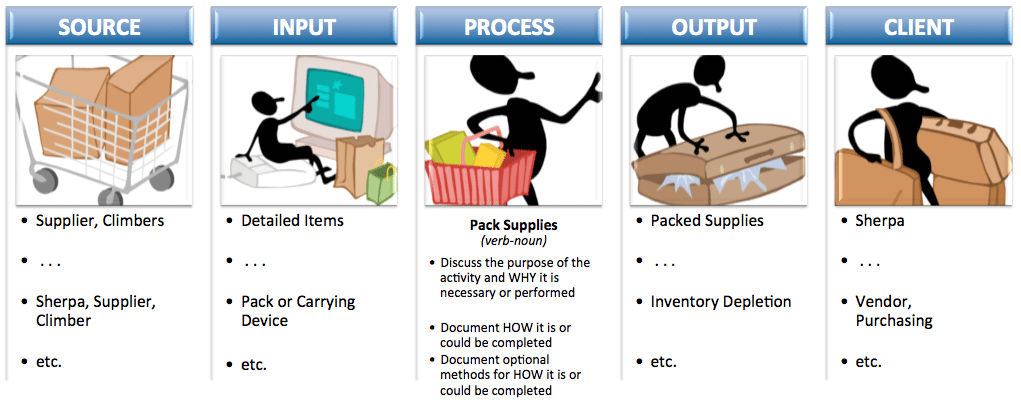
- Continue assigning SIPOC tables to sub-teams. SIPOC stands for the Source of the input, Input(s) required to complete the activity, Process (i.e., our activity), Output resulting from the activity, and Customer or client of the output. Demonstrate one or two in entirety with the whole group and then separate the participants into two or three groups.
- For each activity (i.e., verb-noun pairing), build a narrative statement that captures the purpose of the activity (i.e., WHY) and HOW it is being performed, then:
- Identify the specific outputs or what changes as a result of having completed the activity.
- Link each output with the customer or client of each; i.e., who is using each output.
- Next, identify the inputs required to support the activity.
- Finally, identify the sources for each input.
Illustrative SIPOC: Planning Agenda Yielding WHO Does WHAT by WHEN
Summary of steps to be included in this sequence
An illustrative SIPOC chart is shown below based on a mountain climbing metaphor. The focal verb-noun pairing is “pack supplies”.
- First, identify the activity (i.e., process) and its purpose and discuss WHY it is performed.
- Next, detail HOW it is or should be performed.
- List the outputs from the completed activity.
- Link the outputs to the respective clients or customers.
- List the inputs needed to complete the activity.
- Identify the source(s) for each of the inputs.
Planning Agenda Success Keys for Agreeing on WHO Does WHAT by WHEN
Therefore, to build a clear definition of “requirements”, provide a visual illustration or template. Additionally,
- Have the group pre-build all the potential sources and customers of the process and code them so that when you build the SIPOC tables, the group can refer to the code letter/ number instead of the full name (thus substantially speeding up the method). As you discover new sources or customers, simply add them.
- Learn to ‘shut up’ after asking questions and seek to understand rather than be understood.
- Write down participant responses immediately and fully.
- Provide visual feedback, preferably through modeling.
- Advance from activity identification to the inputs and outputs required to support the activity; then associate each with its sources and clients (SIPOC).
- Separate the WHAT (i.e., abstract) from the HOW (i.e., concrete).
______
Don’t ruin your career by hosting bad meetings. Sign up for a workshop or send this to someone who should. MGRUSH workshops focus on meeting design and practice. Each person practices tools, methods, and activities every day during the week. Therefore, while some call this immersion, we call it the road to building high-value facilitation skills.
Terrence Metz, president of MG RUSH Facilitation Training, was just 22-years-old and working as a Sales Engineer at Honeywell when he recognized a widespread problem—most meetings were ineffective and poorly led, wasting both time and company resources. However, he also observed meetings that worked. What set them apart? A well-prepared leader who structured the session to ensure participants contributed meaningfully and achieved clear outcomes.
Throughout his career, Metz, who earned an MBA from Kellogg (Northwestern University) experienced and also trained in various facilitation techniques. In 2004, he purchased MG RUSH where he shifted his focus toward improving established meeting designs and building a curriculum that would teach others how to lead, facilitate, and structure meetings that drive results. His expertise in training world-class facilitators led to the 2020 publication of Meetings That Get Results: A Guide to Building Better Meetings, a comprehensive resource on effectively building consensus.
Grounded in the principle that “nobody is smarter than everybody,” the book details the why, what, and how of building consensus when making decisions, planning, and solving problems. Along with a Participant’s Guide and supplemental workshops, it supports learning from foundational awareness to professional certification.
Metz’s first book, Change or Die: A Business Process Improvement Manual, tackled the challenges of process optimization. His upcoming book, Catalyst: Facilitating Innovation, focuses on meetings and workshops that don’t simply end when time runs out but conclude with actionable next steps and clear assignments—ensuring progress beyond discussions and ideas.
by Facilitation Expert | Aug 14, 2014 | Leadership Skills, Meeting Support
Charter for Compassion
Ultimately, consensus-building requires intuition and a higher self to overcome the selfishness of physical and emotional demands.
We became signatories with over 100,000 other people who have “Liked” the Charter for Compassion. We encourage you to do the same.
For a quick and light reading, take a look at what they are aspiring towards Charter Members. Use the hot links embedded in this post to seek out further support and involvement on your behalf or the behalf of your organization.
The Charter for Compassion is a document that transcends religious, ideological, and national differences. Supported by leading thinkers from many traditions, the Charter calls on people to activate the Golden Rule around the world.
Text of the Charter for Compassion:
The principle of compassion lies at the heart of all religious, ethical and spiritual traditions, calling us to treat all others as we wish to be treated ourselves. Compassion impels us to work tirelessly to alleviate suffering of our fellow creatures, to dethrone ourselves from the centre of our world, and to honour the inviolable sanctity of every single human being, treating everybody, without exception, with absolute justice, equity and respect.
It is also necessary in both public and private life to refrain consistently and empathically from inflicting pain. To act or speak violently out of spite, chauvinism, or self-interest, to impoverish, exploit or deny basic rights to anybody, and to incite hatred by denigrating others—even our enemies is a denial of our common humanity. We acknowledge that we have failed to live compassionately and that some have even increased the sum of human misery in the name of religion.
Therefore we call upon all men and women~to restore compassion to the centre of morality and religion~to return to the ancient principle that any interpretation of scripture that breeds violence, hatred or disdain is illegitimate~to ensure that youth are given accurate and respectful information about other traditions, religions and cultures ~ to encourage a positive appreciation of cultural and religious diversity~to cultivate an informed empathy with the suffering of all human beings—even those regarded as enemies.
We urgently need to make compassion a clear, luminous and dynamic force in our polarized world. Rooted in a principled determination to transcend selfishness, compassion can break down political, dogmatic, ideological and religious boundaries. Born of our deep interdependence, compassion is essential to human relationships and to a fulfilled humanity. It is the path to enlightenment, and indispensable to the creation of a just economy and a peaceful global community.
The Charter has been translated into over 30 languages.
______
Don’t ruin your career by hosting bad meetings. Sign up for a workshop or send this to someone who should. MGRUSH workshops focus on meeting design and practice. Each person practices tools, methods, and activities every day during the week. Therefore, while some call this immersion, we call it the road to building high-value facilitation skills.
Terrence Metz, president of MG RUSH Facilitation Training, was just 22-years-old and working as a Sales Engineer at Honeywell when he recognized a widespread problem—most meetings were ineffective and poorly led, wasting both time and company resources. However, he also observed meetings that worked. What set them apart? A well-prepared leader who structured the session to ensure participants contributed meaningfully and achieved clear outcomes.
Throughout his career, Metz, who earned an MBA from Kellogg (Northwestern University) experienced and also trained in various facilitation techniques. In 2004, he purchased MG RUSH where he shifted his focus toward improving established meeting designs and building a curriculum that would teach others how to lead, facilitate, and structure meetings that drive results. His expertise in training world-class facilitators led to the 2020 publication of Meetings That Get Results: A Guide to Building Better Meetings, a comprehensive resource on effectively building consensus.
Grounded in the principle that “nobody is smarter than everybody,” the book details the why, what, and how of building consensus when making decisions, planning, and solving problems. Along with a Participant’s Guide and supplemental workshops, it supports learning from foundational awareness to professional certification.
Metz’s first book, Change or Die: A Business Process Improvement Manual, tackled the challenges of process optimization. His upcoming book, Catalyst: Facilitating Innovation, focuses on meetings and workshops that don’t simply end when time runs out but conclude with actionable next steps and clear assignments—ensuring progress beyond discussions and ideas.
by Facilitation Expert | Jul 17, 2014 | Communication Skills, Decision Making, Prioritizing
Most meeting participants embrace a set of similar values with different priorities. The difference lies in their relative strength, or ranking of the values.
Participants’ rankings however are not static. Their ranking changes based on their perspective at the moment.
Hiring Characteristics as an Example
When selecting, interviewing, and hiring associates, most human relations experts would agree that five of the core characteristics that are sought in new hires include (listed alphabetically):
- Capacity (mental)
- Integrity (moral)
- Knowledge and Experience (physical)
- Motivation (emotional)
- Understanding (intellectual)
Traditional Prioritization
Facilitating Different Priorities
Frequently, Knowledge and Experience filter out and disqualify potential hiring candidates. Next Understanding, typically reflected by educational degrees, may be used to filter more desirable from less desirable candidates. Next, Capacity is tested, frequently using actual test instruments about personality, cognitivity, and comprehension. Integrity is then considered, including perhaps, background checks to verify information and uncover undisclosed facts. Finally, Motivation is considered, but generally accepted, since it is assumed that those seeking employment are motivated by monetary gain, at minimum. Arranged in a sequence of priority, the characteristics line up as follows:
- Knowledge and Experience (physical)
- Understanding (intellectual)
- Capacity (mental)
- Integrity (moral)
- Motivation (emotional)
Potential Prioritization
Pretend you own the company, however. Contrary to the prioritization above, you would probably embrace the following prioritization when hiring a new employee:
- Integrity; because without integrity, all other actions are suspect at best, and dangerous at worst.
- Motivation; because without motivation, all other actions (or inactions) may be shallow.
- Capacity; because without mental capacity, actions may be blind.
- Understanding; because without understanding actions are impotent.
- Knowledge and Experience; Lastly without the attributes above, actions are misdirected or useless.
Note with the re-prioritization above, the complete reversal from Experience as number one to least important as number five. Participants with a bias toward the Traditional Prioritization will conflict, and make building consensus challenging when confronted by participants using the Potential Prioritization, or some other variation.
As a facilitator, what can you do about it? We discuss the proper sequence for building consensus around conflicting prioritization in other articles, The Three Steps to Conflict Resolution: Appeal to Purpose, Active Listening, and Enterprise Objectives.
______
Don’t ruin your career by hosting bad meetings. Sign up for a workshop or send this to someone who should. MGRUSH workshops focus on meeting design and practice. Each person practices tools, methods, and activities every day during the week. Therefore, while some call this immersion, we call it the road to building high-value facilitation skills.
Terrence Metz, president of MG RUSH Facilitation Training, was just 22-years-old and working as a Sales Engineer at Honeywell when he recognized a widespread problem—most meetings were ineffective and poorly led, wasting both time and company resources. However, he also observed meetings that worked. What set them apart? A well-prepared leader who structured the session to ensure participants contributed meaningfully and achieved clear outcomes.
Throughout his career, Metz, who earned an MBA from Kellogg (Northwestern University) experienced and also trained in various facilitation techniques. In 2004, he purchased MG RUSH where he shifted his focus toward improving established meeting designs and building a curriculum that would teach others how to lead, facilitate, and structure meetings that drive results. His expertise in training world-class facilitators led to the 2020 publication of Meetings That Get Results: A Guide to Building Better Meetings, a comprehensive resource on effectively building consensus.
Grounded in the principle that “nobody is smarter than everybody,” the book details the why, what, and how of building consensus when making decisions, planning, and solving problems. Along with a Participant’s Guide and supplemental workshops, it supports learning from foundational awareness to professional certification.
Metz’s first book, Change or Die: A Business Process Improvement Manual, tackled the challenges of process optimization. His upcoming book, Catalyst: Facilitating Innovation, focuses on meetings and workshops that don’t simply end when time runs out but conclude with actionable next steps and clear assignments—ensuring progress beyond discussions and ideas.
 For example, extending the index and little fingers upward, with a fist, shaped like a “V” (with the middle and ring fingers tucked down into the palm, along with the thumb) can signify victory or good luck in the Americas. The same non-beral gesture represents a vulgar insult in Italy.
 Scuba divers universally acknowledge the clasping of the thumb and index finger into a circle (or, “AOK”) as the buddy signal that all is fine. The circle will be perceived as a vulgar insult in Russia and Italy. However, it signifies “pay me” in Japan and displays a sense of “worthless” in France.