by Facilitation Expert | Oct 23, 2014 | Leadership Skills, Meeting Support
Before you send a meeting or workshop pre-read to participants, consider a formal meeting announcement rather than an informal calendar invite. If accepted, follow up the announcement with the invite, and then your pre-read package.

Meeting Announcement
While all of the following is not necessary, put yourself in the position of the participant. Therefore, ask yourself, “Would I be interested in knowing this _______?” Clearly, if the answer is ‘yes’, then consider putting it in your meeting announcement.
Therefore, some considerations include:
- Meeting facilitator contact information; including perhaps:
- Easy to cut and paste email
- URL for business group or division
- Primary telephone
- Mobile telephone
- URL for SharePoint or workgroup folder
- Meeting logistics; including perhaps:
- Date of meeting
- Time of meeting
- Duration of meeting
- Location of meeting (including a map if part of a large campus setting). Plus any hints about best access such as elevator banks to take or avoid
- Meeting participants; including perhaps:
- List of attendees
- Alternatively, consider adding their contact information as well
- Items that should or should NOT be brought with them
- Request for questions they would like answered during the meeting
- Meeting rationale; including:
- Purpose and scope of the meeting (50 words or less)
- Statement of meeting deliverables (i.e., output) or desired outcome
- DRAFT agenda items (knowing some minor changes may occur)
- Other miscellanies particular to your situation
While these considerations may appear burdensome, they are truly optimal. You can remove or subtract as you deem fit, but always make adjustments from the point of view of the participants, rather than what will make your life easier.
______
Don’t ruin your career by hosting bad meetings. Sign up for a workshop or send this to someone who should. MGRUSH workshops focus on meeting design and practice. Each person practices tools, methods, and activities every day during the week. Therefore, while some call this immersion, we call it the road to building high-value facilitation skills.
Terrence Metz, president of MG RUSH Facilitation Training, was just 22-years-old and working as a Sales Engineer at Honeywell when he recognized a widespread problem—most meetings were ineffective and poorly led, wasting both time and company resources. However, he also observed meetings that worked. What set them apart? A well-prepared leader who structured the session to ensure participants contributed meaningfully and achieved clear outcomes.
Throughout his career, Metz, who earned an MBA from Kellogg (Northwestern University) experienced and also trained in various facilitation techniques. In 2004, he purchased MG RUSH where he shifted his focus toward improving established meeting designs and building a curriculum that would teach others how to lead, facilitate, and structure meetings that drive results. His expertise in training world-class facilitators led to the 2020 publication of Meetings That Get Results: A Guide to Building Better Meetings, a comprehensive resource on effectively building consensus.
Grounded in the principle that “nobody is smarter than everybody,” the book details the why, what, and how of building consensus when making decisions, planning, and solving problems. Along with a Participant’s Guide and supplemental workshops, it supports learning from foundational awareness to professional certification.
Metz’s first book, Change or Die: A Business Process Improvement Manual, tackled the challenges of process optimization. His upcoming book, Catalyst: Facilitating Innovation, focuses on meetings and workshops that don’t simply end when time runs out but conclude with actionable next steps and clear assignments—ensuring progress beyond discussions and ideas.
by Facilitation Expert | Oct 9, 2014 | Decision Making, Prioritizing
World scientists strive to map activity in the human brain. Presumably, a map of neural activity will shed light on how the brain works and how choices get made.
Concurrently, there has been an upsurge in related fields seeking to understand human nature and behavior. One focus on change: neuro accounting, neuroeconomics, neurotics, neurofinance, neuro leadership, neurolinguistics, neuro management, neuromarketing, and now . . .neurofacilitation.
Neuroeconomics♦ developed over 50 research groups around the world, “exploring the brain processes that underlie decision-making.” Economics focuses on how people make choices, especially when they cannot get everything they want. Traditional theory asserts that rational decision-making maximizes utility, satisfaction, or well-being. Yet daily, people and groups generate sub-optimal decisions, so the question remains—why?
Science continues to advance our understanding of decision-making. Look no further for proof than proximity. Scientists now know where in the brain choosing occurs. They understand where preferences reside, and how choices happen physically. While they learn to model ‘how we choose our underwear” (or how monkeys choose their juice), we professional facilitators must be held accountable for mapping how complex group decisions are made. Business meetings could be referred to as a neural net of decision-making.
Traceability
Maintaining a diligent trail of challenge and documentation provides a benchmark to support neurofacilitation. Group decisions require traceability. Take any decision back to your supervisor, executive sponsor, or steering team and they will immediately respond with “Why?” Why did your group make the decision they made?
Data sets are making it much easier to make more informed decisions. Teo cites three relevant examples related to individual decision-making:
1) Electronic road pricing that helps predict the changing demographics, vehicle types, and density of traffic.
2) In New York City data is available on every taxicab: whether they are occupied or empty, when patrons are waiting (or not), the size of the tips, etc.
3) Equity stock selections where information abounds on whom, when, how much, etc.
Yet there is no comparable example offered to shed light on the most important decisions being made that affect all of humanity, not solely one individual. For example, should we go to war, fire a missile, build a new nuclear plant, construct a new highway (or conduct road repair), approve a major project, hire a key executive, etc..
Professional facilitators ought to sensitize themselves to the importance of neurofacilitation; i.e., challenging the underlying rationale and carefully documenting the support behind all of the options, not only the final choice. You may never want to see the term ‘neurofacilitation’ again, but you know that it oversimplifies the true nature and complexity of group decision-making, and how groups or teams define “utility.”
~~~~~~~
♦ Cited by Anna Teo (The Business Times, 01/03/13),
______
Don’t ruin your career by hosting bad meetings. Sign up for a workshop or send this to someone who should. MGRUSH workshops focus on meeting design and practice. Each person practices tools, methods, and activities every day during the week. Therefore, while some call this immersion, we call it the road to building high-value facilitation skills.
Terrence Metz, president of MG RUSH Facilitation Training, was just 22-years-old and working as a Sales Engineer at Honeywell when he recognized a widespread problem—most meetings were ineffective and poorly led, wasting both time and company resources. However, he also observed meetings that worked. What set them apart? A well-prepared leader who structured the session to ensure participants contributed meaningfully and achieved clear outcomes.
Throughout his career, Metz, who earned an MBA from Kellogg (Northwestern University) experienced and also trained in various facilitation techniques. In 2004, he purchased MG RUSH where he shifted his focus toward improving established meeting designs and building a curriculum that would teach others how to lead, facilitate, and structure meetings that drive results. His expertise in training world-class facilitators led to the 2020 publication of Meetings That Get Results: A Guide to Building Better Meetings, a comprehensive resource on effectively building consensus.
Grounded in the principle that “nobody is smarter than everybody,” the book details the why, what, and how of building consensus when making decisions, planning, and solving problems. Along with a Participant’s Guide and supplemental workshops, it supports learning from foundational awareness to professional certification.
Metz’s first book, Change or Die: A Business Process Improvement Manual, tackled the challenges of process optimization. His upcoming book, Catalyst: Facilitating Innovation, focuses on meetings and workshops that don’t simply end when time runs out but conclude with actionable next steps and clear assignments—ensuring progress beyond discussions and ideas.
by Facilitation Expert | Oct 2, 2014 | Decision Making, Managing Conflict, Prioritizing
A facilitator should typically avoid the term “happy”.
Our effort guides a group to a common or shared understanding that they can support and not lose any sleep over—something they can “live with.” Consensus does NOT mean that they are going to end up “happy.”
Look closely at the difference in meaning between the terms ‘objective’ and ‘subjective’. The ‘object’ is that outside of us that is being perceived. The ‘subject’ is the perceiver. In business, we frequently use the term ‘objective’ as something we intend to accomplish or realize. We use the term ‘subject’ when we are referring to meeting participants, or ‘subject matter experts’.
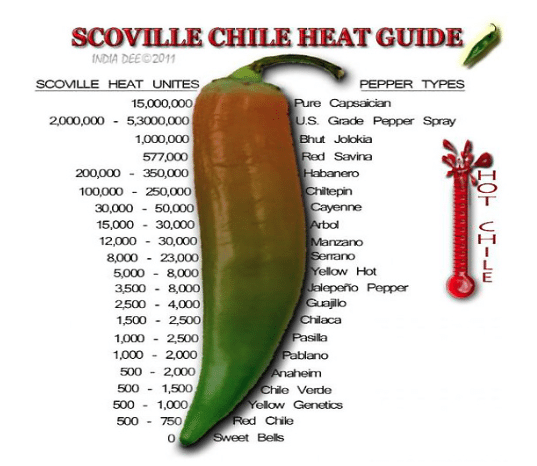
Subject matter experts, aka SMEs, express their preferences, requirements, needs, priorities, likes, dislikes, etc. about ‘objects’ or things outside of their immediate control. Two people eating chili for example may disagree on the chili’s level of spiciness. What is really hot to one person may be tepid to another. They are experiencing separate realities; they are reacting differently to the same object (the spiciness of the chili).
Scoville Units
No amount of argument will get them to agree on whether the chili is too spicy or not. Clearly, to one, it is, while to the other it is not. They are both right from their subjective points of view. The wrong approach would be to encourage them to meet halfway and call the chili semi-spicy. That would be like suggesting one with their left foot in a pail of hot water and their right foot in a pail of freezing water should on average, be comfortable.
Objectify the Subjective
Therefore a world-class facilitator strives to ‘objectify’ the subjective. Meaning, that they strive to find a common ground between both parties to which both parties agree without compromise. In the case of spiciness, we might be able to get both parties to agree that the chili is neither hot nor tepid, rather they might agree that it measures 3,000 Scoville units (i.e., the measure of pungency or the amount of capsaicin that makes peppers ‘hot’). The truly objective rating of the spiciness does not make either participant “happy” but it does give them a common ground about which they can argue for more or less in the specific, rather than the general.
While one may argue for more ‘heat’ and another argues for less ‘heat’ we can now more effectively facilitate precisely what is meant by heat, and wisely offer options such as offering two or three types of chili.
We are seeking agreement or consensus rather than making participants “happy” so please be careful when using the term, or similar terms that are “qualitative” by description but can be made “quantitative” through strong challenge, clear definitions, and excellent facilitation.
______
Don’t ruin your career by hosting bad meetings. Sign up for a workshop or send this to someone who should. MGRUSH workshops focus on meeting design and practice. Each person practices tools, methods, and activities every day during the week. Therefore, while some call this immersion, we call it the road to building high-value facilitation skills.
Terrence Metz, president of MG RUSH Facilitation Training, was just 22-years-old and working as a Sales Engineer at Honeywell when he recognized a widespread problem—most meetings were ineffective and poorly led, wasting both time and company resources. However, he also observed meetings that worked. What set them apart? A well-prepared leader who structured the session to ensure participants contributed meaningfully and achieved clear outcomes.
Throughout his career, Metz, who earned an MBA from Kellogg (Northwestern University) experienced and also trained in various facilitation techniques. In 2004, he purchased MG RUSH where he shifted his focus toward improving established meeting designs and building a curriculum that would teach others how to lead, facilitate, and structure meetings that drive results. His expertise in training world-class facilitators led to the 2020 publication of Meetings That Get Results: A Guide to Building Better Meetings, a comprehensive resource on effectively building consensus.
Grounded in the principle that “nobody is smarter than everybody,” the book details the why, what, and how of building consensus when making decisions, planning, and solving problems. Along with a Participant’s Guide and supplemental workshops, it supports learning from foundational awareness to professional certification.
Metz’s first book, Change or Die: A Business Process Improvement Manual, tackled the challenges of process optimization. His upcoming book, Catalyst: Facilitating Innovation, focuses on meetings and workshops that don’t simply end when time runs out but conclude with actionable next steps and clear assignments—ensuring progress beyond discussions and ideas.
by Facilitation Expert | Sep 25, 2014 | Meeting Support, Meeting Tools
Always remember, to ask WHY before WHAT before HOW when you want to lead a group of people to shared understanding.
Success begins with developing common ground as to WHY a group has come together to plan, analyze, or design. Use of our Purpose Tool quickly builds an integrated viewpoint that coalesces the intent and purpose behind anything—from a large organization to a small product or process. Appealing to WHY something exists leads to meaningful suggestions about WHAT to do to support the purpose.
Common Purpose
Create clear deliverables before your meeting, but start your meeting either building or confirming the purpose of the object of your deliverables. For example, if creating a simple decision about a gift for someone, determine the purpose of the gift first. Next prompt for gift ideas and decision criteria. Some in the group may be serious while others could treat the gift as a “gag” (i.e., comedic relief). Best to reach an understanding about the purpose of the gift before launching into gift ideas.
Support the Purpose
Contrasting the abstract with the concrete yields insight into the simple difference between WHAT and HOW. WHAT groups may need includes decisions, plans, and amplified understanding. Any discussion about deliverables such as decisions, plans, and prioritization should always appeal to WHAT is required to support WHY the common purpose exists and align with WHY it is important.
Likewise, detailed design and HOW things get done may also appeal to WHY it exists. In a safety-sensitive culture, for example, the risk of injury and potential damage to health, safety, or environment must be reconciled with WHY something exists. To prevent 100 percent risk abatement may be too expensive, so strive to reduce as much potential injury as common sense, timing, and budget allow.
______
Don’t ruin your career by hosting bad meetings. Sign up for a workshop or send this to someone who should. MGRUSH workshops focus on meeting design and practice. Each person practices tools, methods, and activities every day during the week. Therefore, while some call this immersion, we call it the road to building high-value facilitation skills.
Terrence Metz, president of MG RUSH Facilitation Training, was just 22-years-old and working as a Sales Engineer at Honeywell when he recognized a widespread problem—most meetings were ineffective and poorly led, wasting both time and company resources. However, he also observed meetings that worked. What set them apart? A well-prepared leader who structured the session to ensure participants contributed meaningfully and achieved clear outcomes.
Throughout his career, Metz, who earned an MBA from Kellogg (Northwestern University) experienced and also trained in various facilitation techniques. In 2004, he purchased MG RUSH where he shifted his focus toward improving established meeting designs and building a curriculum that would teach others how to lead, facilitate, and structure meetings that drive results. His expertise in training world-class facilitators led to the 2020 publication of Meetings That Get Results: A Guide to Building Better Meetings, a comprehensive resource on effectively building consensus.
Grounded in the principle that “nobody is smarter than everybody,” the book details the why, what, and how of building consensus when making decisions, planning, and solving problems. Along with a Participant’s Guide and supplemental workshops, it supports learning from foundational awareness to professional certification.
Metz’s first book, Change or Die: A Business Process Improvement Manual, tackled the challenges of process optimization. His upcoming book, Catalyst: Facilitating Innovation, focuses on meetings and workshops that don’t simply end when time runs out but conclude with actionable next steps and clear assignments—ensuring progress beyond discussions and ideas.
by Facilitation Expert | Sep 18, 2014 | Managing Conflict, Meeting Support
Those of you familiar with the MGRUSH curriculum remember the challenge of the “bookworm” exercise that only one or two participants get correct per year.
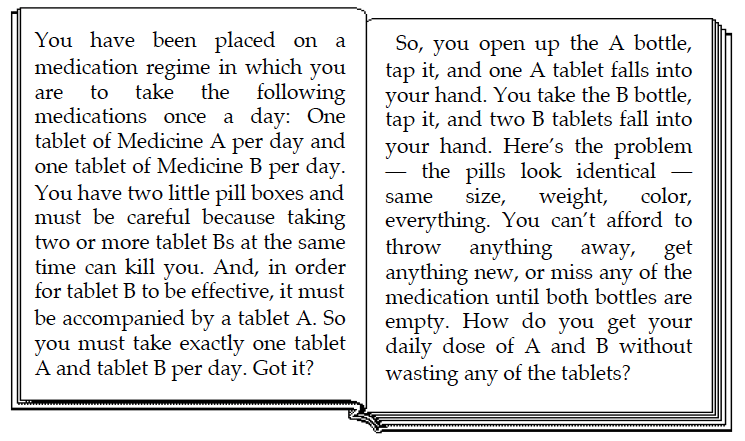
Here is another similar, quickly run challenge to test groups resistant to change or inclined to simply “vote on things.” Remember, Challenge the Status Quo.
Keeping Groups Mentally Sharp
Answer
Add an “A” tablet to the mix. Now you have two full tablets of each, not knowing which is “A” and which is “B”. Cut each tablet in half without mixing the halves. Then take one-half of each of the four tablets. The remainder will also provide the proper dosage for another treatment (e.g., tomorrow).
Application
Use our “bookworm” problem, this “medicine” example, or similar “tests” to stir things up, especially with groups that become too complacent. Remember as well to remind your participants shouting “We don’t do things that way around here.” That WHAT they do may rarely change, but HOW they do it changes constantly, whether they realize it or not.
Other participants are given an understanding of the value of stimulating thinking processes throughout the day. Creative thinking is the key to breakthrough, and innovation is a primary driver of profit.
______
Don’t ruin your career by hosting bad meetings. Sign up for a workshop or send this to someone who should. MGRUSH workshops focus on meeting design and practice. Each person practices tools, methods, and activities every day during the week. Therefore, while some call this immersion, we call it the road to building high-value facilitation skills.
Terrence Metz, president of MG RUSH Facilitation Training, was just 22-years-old and working as a Sales Engineer at Honeywell when he recognized a widespread problem—most meetings were ineffective and poorly led, wasting both time and company resources. However, he also observed meetings that worked. What set them apart? A well-prepared leader who structured the session to ensure participants contributed meaningfully and achieved clear outcomes.
Throughout his career, Metz, who earned an MBA from Kellogg (Northwestern University) experienced and also trained in various facilitation techniques. In 2004, he purchased MG RUSH where he shifted his focus toward improving established meeting designs and building a curriculum that would teach others how to lead, facilitate, and structure meetings that drive results. His expertise in training world-class facilitators led to the 2020 publication of Meetings That Get Results: A Guide to Building Better Meetings, a comprehensive resource on effectively building consensus.
Grounded in the principle that “nobody is smarter than everybody,” the book details the why, what, and how of building consensus when making decisions, planning, and solving problems. Along with a Participant’s Guide and supplemental workshops, it supports learning from foundational awareness to professional certification.
Metz’s first book, Change or Die: A Business Process Improvement Manual, tackled the challenges of process optimization. His upcoming book, Catalyst: Facilitating Innovation, focuses on meetings and workshops that don’t simply end when time runs out but conclude with actionable next steps and clear assignments—ensuring progress beyond discussions and ideas.