by Facilitation Expert | Feb 6, 2014 | Analysis Methods, Communication Skills
In the role of facilitator, you will discover a lot of power by using metaphors or analogies to explain your method. Avoid using the content and experience of the subject matter experts. In other words, a metaphor is worth a thousand pictures.
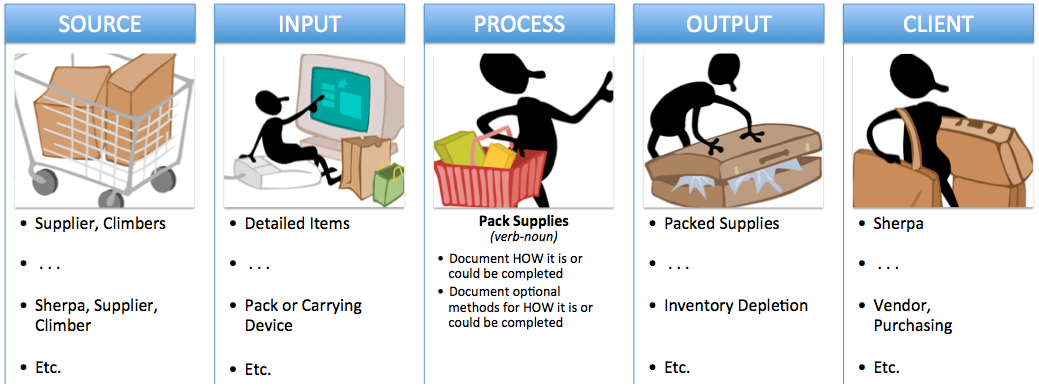
To use “their” content violates neutrality. Use a metaphor or analogy about which you have passion. A metaphor helps you to explain it to your great-grandmother, the test of ultimate clarity. In the following example, we use “Mountain Climbing” to explain one form of a USE CASE, called SIPOC (i.e., Source, Input, Process, Output, and Client/Customer).

Illustrative Analogy (SIPOC): A Metaphor is Worth a Thousand Pictures
Previously completed work that helped to identify some of the “requirements” could have led us to understand that one of the activities required to support the purpose of mountain climbing has been identified as “pack supplies” (note the simple verb-noun pairing). Rather than explain the SIPOC tool orally, we can provide a picture or illustration of the tool by using the metaphor or analogy of mountain climbing.
Right-to-Left Thinking
The phrase “right to left thinking” (similar to “start with the end in mind”) derives from SIPOC. There are five discrete activities, namely:
- Anchor the framework with the activity or process, here previously identified as “Pack Supplies”. Since subject matter experts (aka SMEs) perform similar tasks differently, socialize and document how the activity is or should be performed, allowing for multiple perspectives. Later, take this material and transpose or append it to process flow diagrams or swimlanes.
- Identify the outputs or things that result from the completed activity. A “thing” could be information, a transaction, or a tangible item. Think of a “thing” as a noun such as a person, place, or object about which we need more information to make an informed decision.
- For each discrete output, discuss where it goes or who is the client or customer of the output. Note there could be more than one client for each output. For example, information called “Inventory Depletion” is shared with both the purchasing role so that they can reorder and perhaps the vendor to enable auto-replenishment.
- Working to the left side, identify the things needed to complete the activity.
- Finally, identify the source(s) of each thing, noting again that there could be multiple sources for a single item. The “Pack” for example, might come from the sherpa, supplier, or even the climber.
By using an illustrative analogy you can now explain to your meeting participants where you are in the agenda and how the agenda steps support one another. Using an analogy reinforces that your role remains content-neutral. The analogy makes abstract terms such as “input” concrete or tangible and more easily understood. Remember, a metaphor is worth a thousand pictures.
______
Don’t ruin your career by hosting bad meetings. Sign up for a workshop or send this to someone who should. MGRUSH workshops focus on meeting design and practice. Each person practices tools, methods, and activities every day during the week. Therefore, while some call this immersion, we call it the road to building high-value facilitation skills.
Terrence Metz, president of MG RUSH Facilitation Training, was just 22-years-old and working as a Sales Engineer at Honeywell when he recognized a widespread problem—most meetings were ineffective and poorly led, wasting both time and company resources. However, he also observed meetings that worked. What set them apart? A well-prepared leader who structured the session to ensure participants contributed meaningfully and achieved clear outcomes.
Throughout his career, Metz, who earned an MBA from Kellogg (Northwestern University) experienced and also trained in various facilitation techniques. In 2004, he purchased MG RUSH where he shifted his focus toward improving established meeting designs and building a curriculum that would teach others how to lead, facilitate, and structure meetings that drive results. His expertise in training world-class facilitators led to the 2020 publication of Meetings That Get Results: A Guide to Building Better Meetings, a comprehensive resource on effectively building consensus.
Grounded in the principle that “nobody is smarter than everybody,” the book details the why, what, and how of building consensus when making decisions, planning, and solving problems. Along with a Participant’s Guide and supplemental workshops, it supports learning from foundational awareness to professional certification.
Metz’s first book, Change or Die: A Business Process Improvement Manual, tackled the challenges of process optimization. His upcoming book, Catalyst: Facilitating Innovation, focuses on meetings and workshops that don’t simply end when time runs out but conclude with actionable next steps and clear assignments—ensuring progress beyond discussions and ideas.
by Facilitation Expert | Jan 23, 2014 | Decision Making, Problem Solving
“Contrary to popular opinion, you don’t need weird shoes or a black turtleneck to be a design thinker . . .” so goes the article from Harvard Business Review♦. The author suggests five characteristics found in design thinkers (i.e., innovators) that relate directly to the core competencies required for effective facilitation. Included (in alphabetical order) are Collaboration, Empathy, Experimentalism, Integrative Thinking, and Optimism.
Design Thinker: Collaboration
The increasing complexity of options and decision-making demands the involvement of many, rather than one. Lone genius has been replaced with cross-disciplinary subject matter experts. Select subject matter experts have the talent to succeed, the initiative, and the motivation to succeed, but frequently do not know how to succeed in a group setting. Many are subject matters across disciplines with experience drawn upon multiple backgrounds and organizations. At IDEO for example, they engage engineers, marketers, anthropologists, industrial designers, architects, and psychologists, among others.
Design Thinker: Empathy
Understanding that there is more than one right answer, seeking the best among multiple perspectives lends itself to creating an answer that did not walk into the meeting; but rather one that is created during the meeting. To support creation, empathy in the form of active listening with a neutral session leader becomes critical.
Design Thinker: Experimentalism
Challenging subject matter experts to make their thinking visible, from the heart, can advance the rationale behind their thoughts that breed both consensual understanding and breakthrough solutions. Through observation and questioning, session leaders can inspire and transfer ownership of the meeting output.
Design Thinker: Integrative Thinking
While analytical methods are certainly helpful, integrative approaches support innovation. A neutral facilitator can help a group understand multiple perspectives and build a solution(s) to reconcile seemingly contradictory points of view. For example, one participant may prefer black and another prefers white. Instead of viewing them as opposing thoughts, how can we integrate both black and white? Immediate answers include options such as two-tone, plaid, polka dot, shades of grey, etc.
Design Thinker: Optimism
Successful session leaders rely on confidence in method rather than expertise around content to generate higher quality solutions. Practically speaking, however, optimism and confidence come from experience, so don’t forget to try, practice, and some more. There is usually more than one right answer. You may not be the best facilitator in the world, but you are the best facilitator your group can find.
Trust that in the role of session leader, they need you more than anything else, to lead with Collaboration, Empathy, Experimentalism, Integrative Thinking, and Optimism. With this technique, you can open the doors of perception that make it easier for your group to develop breakthrough solutions.
~~~~~~~
♦ June 2008 (pg 87)
______
Don’t ruin your career by hosting bad meetings. Sign up for a workshop or send this to someone who should. MGRUSH workshops focus on meeting design and practice. Each person practices tools, methods, and activities every day during the week. Therefore, while some call this immersion, we call it the road to building high-value facilitation skills.
Terrence Metz, president of MG RUSH Facilitation Training, was just 22-years-old and working as a Sales Engineer at Honeywell when he recognized a widespread problem—most meetings were ineffective and poorly led, wasting both time and company resources. However, he also observed meetings that worked. What set them apart? A well-prepared leader who structured the session to ensure participants contributed meaningfully and achieved clear outcomes.
Throughout his career, Metz, who earned an MBA from Kellogg (Northwestern University) experienced and also trained in various facilitation techniques. In 2004, he purchased MG RUSH where he shifted his focus toward improving established meeting designs and building a curriculum that would teach others how to lead, facilitate, and structure meetings that drive results. His expertise in training world-class facilitators led to the 2020 publication of Meetings That Get Results: A Guide to Building Better Meetings, a comprehensive resource on effectively building consensus.
Grounded in the principle that “nobody is smarter than everybody,” the book details the why, what, and how of building consensus when making decisions, planning, and solving problems. Along with a Participant’s Guide and supplemental workshops, it supports learning from foundational awareness to professional certification.
Metz’s first book, Change or Die: A Business Process Improvement Manual, tackled the challenges of process optimization. His upcoming book, Catalyst: Facilitating Innovation, focuses on meetings and workshops that don’t simply end when time runs out but conclude with actionable next steps and clear assignments—ensuring progress beyond discussions and ideas.
by Facilitation Expert | Jan 16, 2014 | Planning Approach
Research by Ana Guinote and Mario Weick shows that people in positions of power are particularly ineffective planners.
People who feel powerful focus on getting what they want and ignore the potential obstacles that stand in the way. The planning fallacy: the planning efforts of powerful people rely frequently on “best case scenarios” and lead to far shorter time estimates than more practical plans that take into account what may go wrong.
Overconfidence: The Fallacy of Planning
Good time management starts with the deliverable and breaks it into manageable pieces, understanding the activities required to support each, and an estimate based on multiple factors such as group size, functionality, and experience. However, most leaders are relatively poor at estimating the time they will need to complete any task. Psychologists refer to this as both the planning fallacy and the bias of overconfidence. Fallacies and biases put us at increasing risk of reaching our objectives on time.
The Overconfidence Bias Damages
You can learn more accurately how to predict the length of an activity and become a better estimator and planner if you consider the potential obstacles and two other factors.
- Reflect on your past experiences and how long similar activities have taken in the past, and
- Break the activity into smaller pieces or tasks (e.g., questions or steps) and factor in the time for each task.
For example, Brainstorming as an activity should be broken into three tasks, namely:
- Diverge or List—estimate time based on whether or not you are using break-out teams, ELMO rule (Enough, Let’s Move On), etc.
- Analyze—estimate based on the tool to be used (e.g., PowerBalls or Decision Matrix) and allow time for scrubbing the list. Estimate separately for some time for thorough definitions, capturing omissions, and deleting sub-optimal input.
- Converge or Decide—estimate based on providing substantial reflection (i.e., active listening) around the rationale for decisions made and allow extra time for testing the decision against the initial purpose of the decision.
______
Don’t ruin your career by hosting bad meetings. Sign up for a workshop or send this to someone who should. MGRUSH workshops focus on meeting design and practice. Each person practices tools, methods, and activities every day during the week. Therefore, while some call this immersion, we call it the road to building high-value facilitation skills.
Related articles
- Planning fallacy: why people suck at planning (sandglaz.com)
- Article: Estimating on agile projects: what’s the story, what’s the point? (infoq.com)
Terrence Metz, president of MG RUSH Facilitation Training, was just 22-years-old and working as a Sales Engineer at Honeywell when he recognized a widespread problem—most meetings were ineffective and poorly led, wasting both time and company resources. However, he also observed meetings that worked. What set them apart? A well-prepared leader who structured the session to ensure participants contributed meaningfully and achieved clear outcomes.
Throughout his career, Metz, who earned an MBA from Kellogg (Northwestern University) experienced and also trained in various facilitation techniques. In 2004, he purchased MG RUSH where he shifted his focus toward improving established meeting designs and building a curriculum that would teach others how to lead, facilitate, and structure meetings that drive results. His expertise in training world-class facilitators led to the 2020 publication of Meetings That Get Results: A Guide to Building Better Meetings, a comprehensive resource on effectively building consensus.
Grounded in the principle that “nobody is smarter than everybody,” the book details the why, what, and how of building consensus when making decisions, planning, and solving problems. Along with a Participant’s Guide and supplemental workshops, it supports learning from foundational awareness to professional certification.
Metz’s first book, Change or Die: A Business Process Improvement Manual, tackled the challenges of process optimization. His upcoming book, Catalyst: Facilitating Innovation, focuses on meetings and workshops that don’t simply end when time runs out but conclude with actionable next steps and clear assignments—ensuring progress beyond discussions and ideas.
by Facilitation Expert | Jan 9, 2014 | Meeting Support
If you seek innovation and breakthroughs during your group meetings or workshops, do not clone yourself.
Constantly strive to blend and mix various ingredients that stimulate participants, such as tactile stimulation. Prepare to keep all of your participants stimulated. We call it the “Zen” of the experience—that is appealing to all the senses to stimulate and maintain vibrancy, including chenille stems.
Stimulate the Senses
Tactile Stimulations Adds to the Zen of the Experience
As you know, moods and judgments can be influenced by unrelated experiences of sight and sound. For example, we typically feel happier on sunny days and perhaps more relaxed when listening to certain types of music. Research shows that heat and humidity provoke more fighting, violence, and even riots.
Visual Stimulation
You are encouraged to use multiple colors to break up the monotony of a single color hue. You are encouraged to use icons and illustrations to break up the monotony of recording notes purely in the narrative format. Likewise, use matrices, tables, and templates to stimulate your participants.
Music Helps a Lot
Our popular break timers blend a musical background that could best be described as eclectic—everything, from Frank to Frank as in Frank Sinatra to Frank Zappa. We even suggest the use of Purell®, citrus fruit, and fresh air to alert participants who may be dozing off. Likewise, we encourage the use of 30-30, or 30-second stand-up and stretch breaks every 30 minutes.
Tactile Stimulation Works
In a similar fashion, we have used chenille stems (aka pipe cleaners) and foam stickers for nearly twenty years now. While not all participants use them, research by Joshua Ackerman, Christopher Nocera, and John Bargh shows that the weight, texture, and hardness of the things we touch are unconsciously factored into decisions that have nothing to do with what is being touched. Tactile stimulation works.
Most people associate smoothness and roughness with ease and difficulty. Note the expressions “smooth sailing” and “rough seas ahead.” According to the researchers, people who completed a puzzle with pieces covered in sandpaper described their interaction as more difficult and awkward than those with smooth puzzles. Chenille stems offer both silky smoothness and flexibility, characteristics we seek from our participants and meetings. Let the chenille stems make everything seem better, they work, and research confirms why.
______
Don’t ruin your career by hosting bad meetings. Sign up for a workshop or send this to someone who should. MGRUSH workshops focus on meeting design and practice. Each person practices tools, methods, and activities every day during the week. Therefore, while some call this immersion, we call it the road to building high-value facilitation skills
Terrence Metz, president of MG RUSH Facilitation Training, was just 22-years-old and working as a Sales Engineer at Honeywell when he recognized a widespread problem—most meetings were ineffective and poorly led, wasting both time and company resources. However, he also observed meetings that worked. What set them apart? A well-prepared leader who structured the session to ensure participants contributed meaningfully and achieved clear outcomes.
Throughout his career, Metz, who earned an MBA from Kellogg (Northwestern University) experienced and also trained in various facilitation techniques. In 2004, he purchased MG RUSH where he shifted his focus toward improving established meeting designs and building a curriculum that would teach others how to lead, facilitate, and structure meetings that drive results. His expertise in training world-class facilitators led to the 2020 publication of Meetings That Get Results: A Guide to Building Better Meetings, a comprehensive resource on effectively building consensus.
Grounded in the principle that “nobody is smarter than everybody,” the book details the why, what, and how of building consensus when making decisions, planning, and solving problems. Along with a Participant’s Guide and supplemental workshops, it supports learning from foundational awareness to professional certification.
Metz’s first book, Change or Die: A Business Process Improvement Manual, tackled the challenges of process optimization. His upcoming book, Catalyst: Facilitating Innovation, focuses on meetings and workshops that don’t simply end when time runs out but conclude with actionable next steps and clear assignments—ensuring progress beyond discussions and ideas.
by Facilitation Expert | Dec 26, 2013 | Analysis Methods, Decision Making
Most of us have heard that a picture tells a thousand words. Consensually built pictures, especially those covering complex topics and interactions, can be used to help solve and resolve a thousand arguments.
We are reminded by the IIBA (International Institute of Business Analysis) Quick Tip Bulletin #58 about the value of one type of picture of the business, called a Context Diagram.
Illustrative Context Diagram
A Context Diagram, also known as a Scoping Picture or Picture of the Business (area) may look complicated and un-informing to the uninformed, but a picture of the business quickly enables a session leader to tighten the reign on scope creep issues that plague many meetings and workshops.
The Context Diagram on the right illustrates “who” the business interacts (here, an organization or business called “Home Finance”) with, “what” the business receives from them, and “what” the business gives to them. Many refer to the “whats” as inputs and outputs. Inputs and outputs are used in requirements gathering to narrow the scope of discovery and discussion. The picture helps both the participants and the facilitator focus on the deliverable.
How to Build a Context Diagram
Consider using the simple agenda shown below. It captures the answers to three simple questions to complete the modeling:
- WHO do we work with to support our purpose (e.g., Actors or Agents)?
- WHAT do we get from them (inputs)?
- WHAT do we give them (outputs)?
Consequently, modify this “plain vanilla” agenda for a Context Diagram as shown or as you see fit. Use the MGRUSH 7-step introductory sequence and 4-step review and wrap for the workshop bookends. Have an ample supply of Post-It® Notes available, in at least three different colors, sizes, or shapes to distinguish the WHO from the inputs and outputs. Once complete, and consensually validated, you can proceed further with follow-up meetings or workshops to further define and illustrate WHO the business uses to support its purpose, and what activities (Activity Flow or Functional Decomposition workshop, leading to use cases such as SIPOC) and information (Logical Modeling or Entity Relationship Diagram) are also required to support their business purpose.
The following shows the simple agenda that typically takes two to four hours to complete. Also, refer to your MG Rush Professional Facilitative Leadership manual for more details.
- INTRODUCTION
- PURPOSE OF THE BUSINESS AREA
- WHO INTERACTS (Actors)
- WHAT COMES IN (Inputs)
- WHAT GOES OUT (Outputs)
- MODEL AND VALIDATION (Walk-thru)
- THE SCOPE DEFINED (Narrative)
- REVIEW AND WRAP
______
Meetings must rise above the tiny opening of words and embrace the fullness of human insight—through listening, visuals, stories, numbers, and symbols. The transformation begins not in tools, but in mindset. Leave your ego at the threshold, and step into the structures of meetings that get results.
In a world where everyone can engage in decisions that affect them
______
Lead the Change—One Meeting at a Time
Are you ready to transform how decisions are made, problems are solved, and alignment is built in your organization?
True meeting leadership goes beyond setting an agenda. It requires a facilitator who can navigate complexity, balance voices, and drive toward outcomes with clarity and consensus. Our Professional Meeting Leadership Workshop and facilitation training equips you to do just that—blending human-centric methods with structured analytical tools to foster rigor, inclusivity, and results that stick.
- Practice live.
- Get expert feedback.
- Build confidence that lasts.
Whether your meetings suffer from unclear objectives, disengaged participants, or decision fatigue, this workshop will help you identify the root causes, apply proven facilitation techniques, and emerge as the leader every team needs.
Take the first step today—transform your meetings and magnify your impact.
______
👉 Click here to reserve your seat now.
#facilitationtraining #meetingdesign
Because every meeting should be a catalyst for change—not just another calendar event.
______
With Bookmarks no longer a feature in WordPress, we provide the following for your benefit and reference.
______
- Benefits and Best Practices Using Structured Facilitative Workshops (mgrush.com/blog)
- What is the Difference Between Structured Facilitation and Kum Ba Yah Facilitation? (mgrush.com/blog)
- Guidelines for Selecting Appropriate Structured Facilitation Tools (mgrush.com/blog)
- Phase One Results from a Facilitated Business Process Improvement Project (mgrush.com/blog)
- Why We Need Trained, Professional Facilitators Who Can Guard Against Bias (mgrush.com/blog)
Terrence Metz, president of MG RUSH Facilitation Training, was just 22-years-old and working as a Sales Engineer at Honeywell when he recognized a widespread problem—most meetings were ineffective and poorly led, wasting both time and company resources. However, he also observed meetings that worked. What set them apart? A well-prepared leader who structured the session to ensure participants contributed meaningfully and achieved clear outcomes.
Throughout his career, Metz, who earned an MBA from Kellogg (Northwestern University) experienced and also trained in various facilitation techniques. In 2004, he purchased MG RUSH where he shifted his focus toward improving established meeting designs and building a curriculum that would teach others how to lead, facilitate, and structure meetings that drive results. His expertise in training world-class facilitators led to the 2020 publication of Meetings That Get Results: A Guide to Building Better Meetings, a comprehensive resource on effectively building consensus.
Grounded in the principle that “nobody is smarter than everybody,” the book details the why, what, and how of building consensus when making decisions, planning, and solving problems. Along with a Participant’s Guide and supplemental workshops, it supports learning from foundational awareness to professional certification.
Metz’s first book, Change or Die: A Business Process Improvement Manual, tackled the challenges of process optimization. His upcoming book, Catalyst: Facilitating Innovation, focuses on meetings and workshops that don’t simply end when time runs out but conclude with actionable next steps and clear assignments—ensuring progress beyond discussions and ideas.