by Facilitation Expert | Dec 12, 2013 | Managing Conflict
Here is a quick and somewhat humorous listing of fourteen different facilitator typologies or “personalities” you might seek to avoid. Our favorite is “The Pretender.”

14 Facilitator Types
The “I Can’t Hear You” Guy—
The facilitator refuses to listen, probably because they are too busy analyzing, judging, and processing information.
The Blabber—
The facilitator who loves the sound of his or her own voice, and actually believes they are adding value when speaking about content rather than context.
The Centerpiece—
The facilitator makes him or her the real content of the workshop because, of course, it’s all about them.
The Drill Sergeant—
The facilitator is rigidly stuck on the agenda and puts the clock above quality content.
The Guardian—
The facilitator makes certain that all conversation goes through him or her and not from participant to participant, so as not to lose control.
The Ice Cube—
The distant and aloof facilitator is unwilling to personalize the experience, sometimes becoming accusatory.
The Know-it-all—
The facilitator always has the answer. The know-it-all who can’t say “I don’t know.”
The Marathon Man—
The facilitator piles activities on top of one another, doesn’t allow for breaks, and ignores the need for groups to pause, reflect, and absorb topics and ideas.
The Molasses Man—
The facilitator is painfully slow and doesn’t have an innate feel for pacing, variety, or style.
The Parrot—
The facilitator relentlessly recaps information, restates ideas, and summarizes the obvious (although sometimes justifiable for groups that are challenged to focus and “be here now.”)
The Passenger—
The facilitator lets people talk too long and gives up the reins of facilitation to whoever is speaking at the time.
The Pretender—
The facilitator doesn’t ask real questions but only “pretense questions” that are really designed to give the facilitator an excuse to pontificate.
The Storyteller—
The facilitator tells far too many cutesy stories or “war stories” and never gets deep into the content.
The Tunnel Driver—
The facilitator who keeps doing the same thing or uses the same method hour after hour.
______
Don’t ruin your career by hosting bad meetings. Sign up for a workshop or send this to someone who should. MGRUSH workshops focus on meeting design and practice. Each person practices tools, methods, and activities every day during the week. Therefore, while some call this immersion, we call it the road to building high-value facilitation skills.
Terrence Metz, president of MG RUSH Facilitation Training, was just 22-years-old and working as a Sales Engineer at Honeywell when he recognized a widespread problem—most meetings were ineffective and poorly led, wasting both time and company resources. However, he also observed meetings that worked. What set them apart? A well-prepared leader who structured the session to ensure participants contributed meaningfully and achieved clear outcomes.
Throughout his career, Metz, who earned an MBA from Kellogg (Northwestern University) experienced and also trained in various facilitation techniques. In 2004, he purchased MG RUSH where he shifted his focus toward improving established meeting designs and building a curriculum that would teach others how to lead, facilitate, and structure meetings that drive results. His expertise in training world-class facilitators led to the 2020 publication of Meetings That Get Results: A Guide to Building Better Meetings, a comprehensive resource on effectively building consensus.
Grounded in the principle that “nobody is smarter than everybody,” the book details the why, what, and how of building consensus when making decisions, planning, and solving problems. Along with a Participant’s Guide and supplemental workshops, it supports learning from foundational awareness to professional certification.
Metz’s first book, Change or Die: A Business Process Improvement Manual, tackled the challenges of process optimization. His upcoming book, Catalyst: Facilitating Innovation, focuses on meetings and workshops that don’t simply end when time runs out but conclude with actionable next steps and clear assignments—ensuring progress beyond discussions and ideas.
by Facilitation Expert | Nov 21, 2013 | Facilitation Skills
Facilitating for-profit business plans and requirements captures substantially different challenges than facilitating a Kum-Ba-Yah community forum or other volunteer-based meetings. While active listening serves both scenarios, decision-making that supports most business initiatives differs from win-lose voting methods.
Frequently, business facilitators are not seeking agreement, but rather harmony. The difference follows. Agreement suggests that everyone is singing the same note, perhaps even with the same instrument. Boring. Reminiscent of the railroad industry trying to protect itself, rather than redefining its role as transportation and logistics.
Harmony implies we are seeking an outcome where everyone’s musical note or expression is heard, from whatever instrument they play. Successful facilitation provides appropriate structure so that the deliverable captures all instruments and all tones, like a symphony. The sound of cicadas every few years represents agreement. The music of Pyotr Tchaikovsky reflects a symphonic movement.
Structured Decision-Making
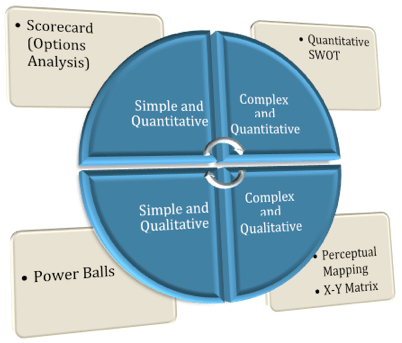
When seeking consensual understanding, as in decision-making, for example, the right structure makes it easier for your participants. Consider the PowerBall approach when you can help drive a group toward a simple decision surrounding a well-articulated question (e.g., What should we buy?).
For complicated situations, use the Scorecard approach that separates fuzzy from SMART criterion. By applying weightings you generate a quantitative score to compare your options. For highly complex situations like portfolio management, always embrace the TO-WS (SWOT) analysis (introduced to the MGRUSH workshops in its quantitative form in 2004). In the facilitator’s world, our approach to TO-WS is like comparing a Tchaikovsky composition to playing the same note over and over on a kazoo.
Structured Decision-Making Matrix
Harmony Over Agreement
As facilitators, our business constraints rarely afford the time and luxury of sitting around the campfire singing Kum-Ba-Yah and building trust. Therefore, build your structure in advance. Then lead the method best suited to reconcile the business challenges and trade-offs you expect. Everyone agreeing will keep you in the box, suffocating innovation. But with harmony, you don’t even see the box, as you lead to the creation of a solution that no single participant envisioned when they entered your workshop.
______
Don’t ruin your career by hosting bad meetings. Sign up for a workshop or send this to someone who should. MGRUSH workshops focus on meeting design and practice. Each person practices tools, methods, and activities every day during the week. Therefore, while some call this immersion, we call it the road to building high-value facilitation skills.
Terrence Metz, president of MG RUSH Facilitation Training, was just 22-years-old and working as a Sales Engineer at Honeywell when he recognized a widespread problem—most meetings were ineffective and poorly led, wasting both time and company resources. However, he also observed meetings that worked. What set them apart? A well-prepared leader who structured the session to ensure participants contributed meaningfully and achieved clear outcomes.
Throughout his career, Metz, who earned an MBA from Kellogg (Northwestern University) experienced and also trained in various facilitation techniques. In 2004, he purchased MG RUSH where he shifted his focus toward improving established meeting designs and building a curriculum that would teach others how to lead, facilitate, and structure meetings that drive results. His expertise in training world-class facilitators led to the 2020 publication of Meetings That Get Results: A Guide to Building Better Meetings, a comprehensive resource on effectively building consensus.
Grounded in the principle that “nobody is smarter than everybody,” the book details the why, what, and how of building consensus when making decisions, planning, and solving problems. Along with a Participant’s Guide and supplemental workshops, it supports learning from foundational awareness to professional certification.
Metz’s first book, Change or Die: A Business Process Improvement Manual, tackled the challenges of process optimization. His upcoming book, Catalyst: Facilitating Innovation, focuses on meetings and workshops that don’t simply end when time runs out but conclude with actionable next steps and clear assignments—ensuring progress beyond discussions and ideas.
by Facilitation Expert | Nov 14, 2013 | Meeting Support, Meeting Tools
This Meeting Icebreaker is from our collection of practical tips, tools, and techniques. Our tips are gathered from our experience, training classes, and alumni contributions.
IceBreaker Tip One: Warming Up A Group
This icebreaker tip is useful for people who are unfamiliar with each other, or for familiar groups that need some new dimension to their relationships for the purpose of the workshop. Because it may take up to one-half hour for a group of nine, manage your time accordingly.
Ice Breaker Tip — Newspaper or Magazine Headline
- 2 minutes: Have each person write their name on a small piece of paper. As they finish, collect the names in a container (e.g., bowl, box). Next, have each participant draw or select a piece of paper.
- 5-10 minutes: Allow a few minutes for each person to find the person named on their piece of paper and “interview” them. In addition, encourage them to take notes from the interview because you want them to share the highlights.
- 3 minutes: Now have the participants write a newspaper or magazine headline that describes an event or accomplishment of the person named on their piece of paper. Consider a specific newspaper or magazine that most members of the group are likely to read. Either emphasize a personal or professional accomplishment, but consistently emphasize the perspective you choose. Point your participants to a frequently read page or within a specific column of the magazine or newspaper.
- 5-10 minutes: Finally, have each person read the headline for the person named on the piece of paper.
IceBreaker Tip Two: Alternative
Move the headline to some point in the future (e.g., five years from now) when it becomes the aspiration of the participant rather than an actual accomplishment.
______
Don’t ruin your career by hosting bad meetings. Register for a workshop or forward this to someone who should. MGRUSH facilitation workshops focus on meeting design and practice. Each participant practices tools, methods, and activities every day during the week. Therefore, while some call this immersion, we call it the road to building high-value facilitation skills.
Terrence Metz, president of MG RUSH Facilitation Training, was just 22-years-old and working as a Sales Engineer at Honeywell when he recognized a widespread problem—most meetings were ineffective and poorly led, wasting both time and company resources. However, he also observed meetings that worked. What set them apart? A well-prepared leader who structured the session to ensure participants contributed meaningfully and achieved clear outcomes.
Throughout his career, Metz, who earned an MBA from Kellogg (Northwestern University) experienced and also trained in various facilitation techniques. In 2004, he purchased MG RUSH where he shifted his focus toward improving established meeting designs and building a curriculum that would teach others how to lead, facilitate, and structure meetings that drive results. His expertise in training world-class facilitators led to the 2020 publication of Meetings That Get Results: A Guide to Building Better Meetings, a comprehensive resource on effectively building consensus.
Grounded in the principle that “nobody is smarter than everybody,” the book details the why, what, and how of building consensus when making decisions, planning, and solving problems. Along with a Participant’s Guide and supplemental workshops, it supports learning from foundational awareness to professional certification.
Metz’s first book, Change or Die: A Business Process Improvement Manual, tackled the challenges of process optimization. His upcoming book, Catalyst: Facilitating Innovation, focuses on meetings and workshops that don’t simply end when time runs out but conclude with actionable next steps and clear assignments—ensuring progress beyond discussions and ideas.
by Facilitation Expert | Oct 31, 2013 | Leadership Skills
To improve or enhance your personal skills and to help you understand the skills to seek in others that support effective change, you will find seven top skills for managing change.
Change Management
These skills are those most frequently identified by employers according to Syracuse University public affairs professor Bill Coplin, author of “10 Things Employers Want You To Learn In College.” With our focus on change and business process improvement, we have modified them and listed them in order of priority as they apply to facilitating and managing change:
1. Integrity—
“Do what you say you are going to do.” Without integrity and work ethic, all the other skills could be dangerous. Coplin includes self-motivation and time management.
2. Communications—
Because the greatest and most innovative ideas are impotent if they are not adequately explained to others. Coplin separates verbal or oral communications from written ones and also emphasizes editing and proofing one’s work.
3. Team Work—
Because change never occurs in a vacuum and effective change relies on distributed ownership. Stakeholders need to embrace the change or it will fail. Coplin mentions one-on-one, relationship building, and influencing people through leadership.
4. Infomediary—
Because effectively receiving, archiving, and distributing information that each stakeholder needs to plan, operate, and control the change effort to their level of satisfaction. Colin refers to gathering information and keeping it organized.
5. Measurement—
“If you can’t measure it, you can’t manage it” so become adept with quantitative tools, statistics, graphs, and spreadsheets. Know how to objectively measure why something is important.
6. Questioning—
Few skills are harder to teach and yet as important as knowing the right question to ask. Subject matter experts abound in most organizations, they need to be stimulated by the right question in the proper context, and they can deliver.
7. Problem Solving—
While Coplin emphasizes identifying problems, developing possible solutions, and launching solutions, we would add the importance of properly analyzing the problems as well. Do not leap from identification to solution without a thorough understanding of the implications of the problem.
______
Don’t ruin your career by hosting bad meetings. Sign up for a workshop or send this to someone who should. MGRUSH workshops focus on meeting design and practice. Each person practices tools, methods, and activities every day during the week. Therefore, while some call this immersion, we call it the road to building high-value facilitation skills.
Related articles
- What is Change Management? (catherinescareercorner.com)
Terrence Metz, president of MG RUSH Facilitation Training, was just 22-years-old and working as a Sales Engineer at Honeywell when he recognized a widespread problem—most meetings were ineffective and poorly led, wasting both time and company resources. However, he also observed meetings that worked. What set them apart? A well-prepared leader who structured the session to ensure participants contributed meaningfully and achieved clear outcomes.
Throughout his career, Metz, who earned an MBA from Kellogg (Northwestern University) experienced and also trained in various facilitation techniques. In 2004, he purchased MG RUSH where he shifted his focus toward improving established meeting designs and building a curriculum that would teach others how to lead, facilitate, and structure meetings that drive results. His expertise in training world-class facilitators led to the 2020 publication of Meetings That Get Results: A Guide to Building Better Meetings, a comprehensive resource on effectively building consensus.
Grounded in the principle that “nobody is smarter than everybody,” the book details the why, what, and how of building consensus when making decisions, planning, and solving problems. Along with a Participant’s Guide and supplemental workshops, it supports learning from foundational awareness to professional certification.
Metz’s first book, Change or Die: A Business Process Improvement Manual, tackled the challenges of process optimization. His upcoming book, Catalyst: Facilitating Innovation, focuses on meetings and workshops that don’t simply end when time runs out but conclude with actionable next steps and clear assignments—ensuring progress beyond discussions and ideas.
by Facilitation Expert | Oct 10, 2013 | Meeting Structure, Meeting Tools
Facilitators rely on hundreds of tools to gather information, support decision-making, encourage innovation, build camaraderie, strive for higher quality, or guide a facilitator through an unplanned pathway. Therefore, your selection of the “best” structured facilitation tools depends on many factors.
A note of caution—Beginning facilitators often have a difficult time feeling comfortable because of the newness of the tools. Some experienced facilitators overuse a tool. They may forget that when you are comfortable using a hammer, not everything is a nail. Some guidelines to follow when using tools:
Overview of Helpful Structured Facilitation Tools
- There is more than one appropriate option. For example, we can capture initial input or meaning from participants through Brainstorming (i.e., narrative), Creativity (i.e., drawing), PowerBalls (i.e., iconic), or TO-WS (SWOT) (i.e., numeric).
- Only use a tool if it is correcting a problem or situation. The tool must add value or it distract from the method. For example, do not lead a team-building exercise if the team is highly functional.
- Do not ask the group permission to use a tool. You are the leader and need to set the method—so do it.
- Never present the tool as a game or a gimmick. This often leads to resistance. Discipline your rhetoric when explaining the Purpose tool. For example, do not ask about ‘today’s purpose’ since you are expected to know the purpose of the meeting.
- Except for team-building tools, explain the deliverable from each tool used and how it supports completing the deliverable.
- Do not be afraid to use a new tool—they have all been field-tested and work well when used properly.
- Build tool contingencies into your agenda—ie, plan to use a specific tool. However, if a problem arises, do not be afraid to substitute for something more appropriate.
- For tools designed to correct situations such as team dysfunction and lack of creativity, remember that most groups did not become dysfunctional in ten minutes and the situation will not be corrected through a ten-minute exercise. It often takes numerous exercises and a great deal of time to see a real difference. Do not give up and you will earn their respect for perseverance.
The “Right” Structured Facilitation Tool
Selecting the best tool to use by understanding the desired outcome. Avoid becoming so comfortable with one or two that those are the only tools you use. To select an appropriate tool:
- Identify the problem.
- Define the desired outcome.
- Review the tool selection chart below to help determine which tool helps achieve your desired outcome.
Team-Building Tools
Suggested steps for effective team-building exercises include:
- Prepare your materials in advance, along with prompts and assignments (e.g., CEO and team names), and rehearse new or complicated tools.
- Provide clear and explicit instructions, preferably posted or written down as handouts. Emphasize any rules.
- Monitor group activity closely, especially in the beginning, and make yourself readily available for clarifying areas of fear, doubt, or uncertainty.
- Compare the purpose with the output. Reinforce the learning and how it applies to accelerating the group’s performance toward your meeting or workshop deliverables.
Structured Decision-Making Tools
Use the following matrix to help guide you to the most appropriate decision-making tools based on the type of information
(i.e., qualitative or quantitative) and complexity of the decision
(i.e., concrete or abstract).
Decision-Making Matrix to Guide Selection of Structured Facilitation Tools
Additional Sources for Structured Facilitation Tools
Continue to add to your tool chest. When co-located in an enterprise with other facilitators, build a Community of Practice (i.e., CoP) that archives tools, visual prompts, and retrospective reviews. Strive to speed up selection and avoid repetition for your participants.
For additional exercises and tools for facilitators look at Games Trainers Play and More Games Trainers Play by John Newstrom and Edward Scannell, New York, McGraw-Hill Book Company, various. You can also order the IAF (International Association of Facilitators) Handbook of Group Facilitation and other resources at Amazon.com among others. There are thousands of tools and resources for facilitators and team-building tools in English and other languages.
______
Don’t ruin your career by hosting bad meetings. Sign up for a workshop or send this to someone who should. MGRUSH workshops focus on meeting design and practice. Each person practices tools, methods, and activities every day during the week. Therefore, while some call this immersion, we call it the road to building high-value facilitation skills.
Terrence Metz, president of MG RUSH Facilitation Training, was just 22-years-old and working as a Sales Engineer at Honeywell when he recognized a widespread problem—most meetings were ineffective and poorly led, wasting both time and company resources. However, he also observed meetings that worked. What set them apart? A well-prepared leader who structured the session to ensure participants contributed meaningfully and achieved clear outcomes.
Throughout his career, Metz, who earned an MBA from Kellogg (Northwestern University) experienced and also trained in various facilitation techniques. In 2004, he purchased MG RUSH where he shifted his focus toward improving established meeting designs and building a curriculum that would teach others how to lead, facilitate, and structure meetings that drive results. His expertise in training world-class facilitators led to the 2020 publication of Meetings That Get Results: A Guide to Building Better Meetings, a comprehensive resource on effectively building consensus.
Grounded in the principle that “nobody is smarter than everybody,” the book details the why, what, and how of building consensus when making decisions, planning, and solving problems. Along with a Participant’s Guide and supplemental workshops, it supports learning from foundational awareness to professional certification.
Metz’s first book, Change or Die: A Business Process Improvement Manual, tackled the challenges of process optimization. His upcoming book, Catalyst: Facilitating Innovation, focuses on meetings and workshops that don’t simply end when time runs out but conclude with actionable next steps and clear assignments—ensuring progress beyond discussions and ideas.