by Facilitation Expert | Nov 8, 2012 | Meeting Support
The National Speakers’ Association stated that the most important change speakers could make to be more effective would be to be more facilitative.
By that, they meant the use of interaction, solicitation, and capture of participants’ ideas. Whether you are a speaker, teacher, coach, or traditional facilitator, it is good to develop competence around how to use easels, large Post-It® paper, and broad chiseled markers. Here are some tips for you or your documentor. The paper continues to offer superior benefits to digital capture because most complex issues cannot be fully rendered or understood with one screen of bulleted items. Additionally, if it is not documented, it did not happen.
“Never use computer applications for something that you do not understand and cannot first do yourself.”
—Francis Webster Jr
Begin with good materials and supplies. Few things will frustrate an expert facilitator more than cheap paper and poor-quality easels. Most will carry their own, preferred markers. Large, Post-It style presentation sheets provide immediate and visual feedback to participants. Working with paper makes it faster to edit and refer to work that was drafted or completed earlier.
When you use easels and large-format paper, consider the following tips:
- Anticipate where you will mount your sheets. Be sensitive about everyone’s sight lines. Save your prime, center real estate for scrubbing and scoring ideas during each agenda step.
- Banners or headlines provide an excellent opportunity for iconic support and color splash. Create them in advance. Then unveiled, they connote a strong sense of preparation and importance.

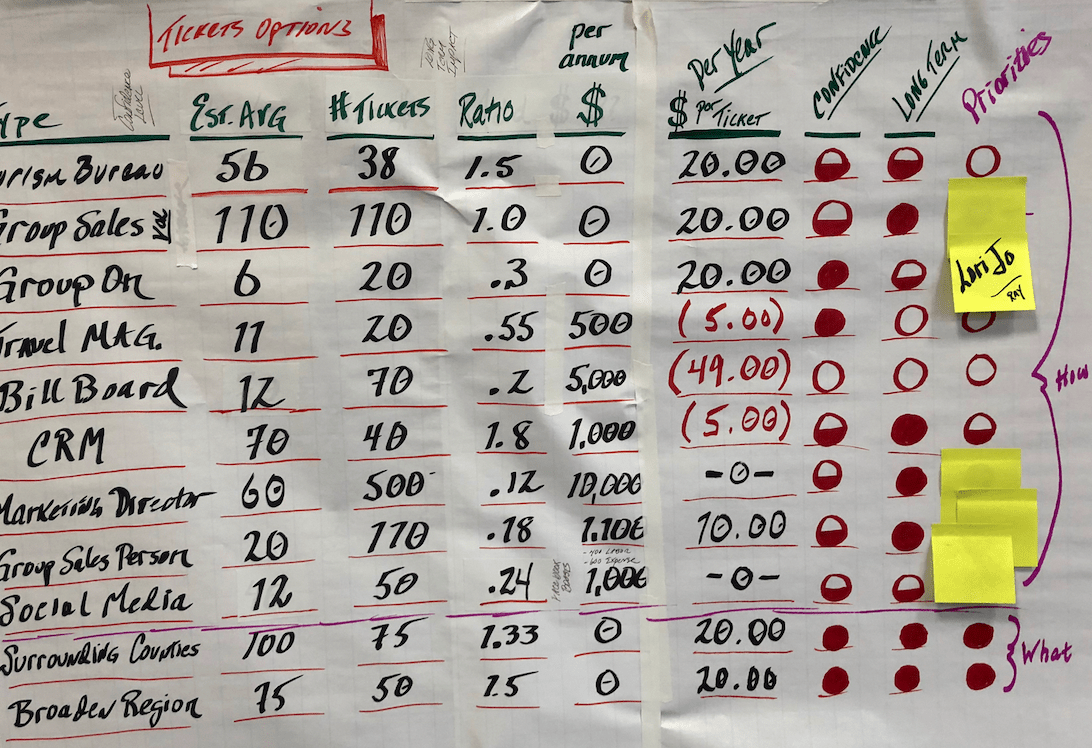
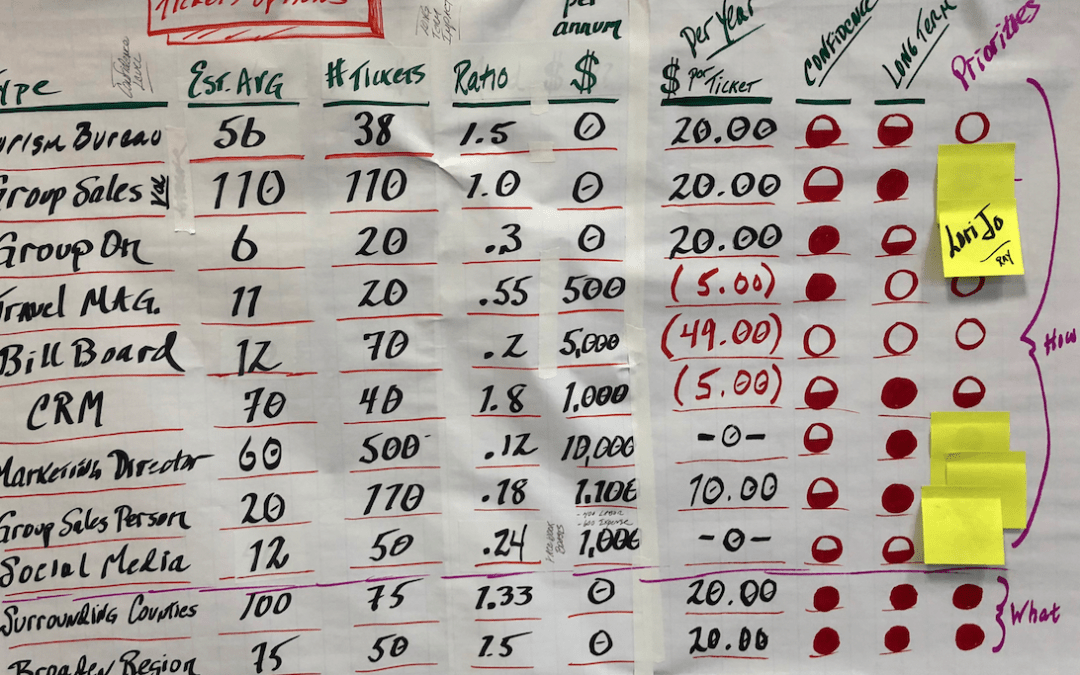
Easel Sample
- Experts suggest using a minimum of three colors per sheet. Only use black or dark blue for primary content. Use red for edits and scoring, and use green for linking, or edits (shows chronological shift). Use lighter colors for grid lines, table lines, or illustrations.
- Pre-drawn illustrations (in pencil or light marker) enable you to draw over thin lines with broad markers in the session as needed.
- Rip, do not flip, completed pages. Participants need to see their prior work and a bunch of flipped sticky pages get caught up in a clump that is difficult to disentangle.
Additionally when you use easels . . .
- Save valuable real estate along the left-hand column, defaulting to hyphens of indented items that may be further defined or scored during the analysis step with a prioritization tool.
- Use flip chart graph paper with blueline squares to keep the size of your writing consistent. Try out the size of the letters before the session to see if the person farthest away can read them. Capital letters should be two to three inches tall and lowercase letters should be one to two inches in height.
- Visual displays whether illustrative, iconic, or colorful prove to stimulate participants and increase the quality of contributions and feedback.
- Wedge tip markers work best for writing and pointed tip markers provide good highlights. Use the broad side or flat edge of the wedge tip so that your writing is visible from six to eight meters.
- You may speed up the capture process during the ideation step of Brainstorming by using two scribes (i.e., documentors). Work this out in advance, and if relying on a participant for help, give him or her some time at the end to add his or her own ideas.
Other Support
For additional and specific product recommendations, see your FAST Session Leader reference manual or refer to the Alumni Only resource section of our website. Specifically, the document entitled Facilitator’s Tool Kit lists many of the items that can be used to support more effective facilitation through the use of easels.
“The problem with digitizing brainstorming is that we don’t need to save what we brainstorm . . . The critical thing is the conclusion . . . The slick brainstorming capture tools . . . Will probably not be as successful as hoped. There are significant differences among collecting and processing and organizing and different tools are usually required for them.” [pg 271] — David Allen, Getting Things Done
______
Don’t ruin your career by hosting bad meetings. Sign up for a workshop or send this to someone who should. MGRUSH workshops focus on meeting design and practice. Each person practices tools, methods, and activities every day during the week. Therefore, while some call this immersion, we call it the road to building high-value facilitation skills.
Terrence Metz, president of MG RUSH Facilitation Training, was just 22-years-old and working as a Sales Engineer at Honeywell when he recognized a widespread problem—most meetings were ineffective and poorly led, wasting both time and company resources. However, he also observed meetings that worked. What set them apart? A well-prepared leader who structured the session to ensure participants contributed meaningfully and achieved clear outcomes.
Throughout his career, Metz, who earned an MBA from Kellogg (Northwestern University) experienced and also trained in various facilitation techniques. In 2004, he purchased MG RUSH where he shifted his focus toward improving established meeting designs and building a curriculum that would teach others how to lead, facilitate, and structure meetings that drive results. His expertise in training world-class facilitators led to the 2020 publication of Meetings That Get Results: A Guide to Building Better Meetings, a comprehensive resource on effectively building consensus.
Grounded in the principle that “nobody is smarter than everybody,” the book details the why, what, and how of building consensus when making decisions, planning, and solving problems. Along with a Participant’s Guide and supplemental workshops, it supports learning from foundational awareness to professional certification.
Metz’s first book, Change or Die: A Business Process Improvement Manual, tackled the challenges of process optimization. His upcoming book, Catalyst: Facilitating Innovation, focuses on meetings and workshops that don’t simply end when time runs out but conclude with actionable next steps and clear assignments—ensuring progress beyond discussions and ideas.
by Facilitation Expert | Oct 25, 2012 | Communication Skills
The effective facilitator helps meeting participants become better listeners. Dr. Ralph Nichols, “Father of the Field of Listening”, notes three behaviors that perfectly align with the roles of facilitator, and your hope to be more effective, that create better listeners during meetings.
First of all, anticipate the speaker’s next point
.
As a facilitator, your anticipation helps shape your direction. For example, should you walk closer to the speaker or to the easel to capture their comments? Therefore, if you anticipate correctly, learning has been reinforced. If you anticipate incorrectly, participants wonder why, causing unnecessary noise.
Another is to identify the supporting elements a speaker uses in building points.
The primary role of the facilitator is to make it easy to extract the participants’ points of view. Then, ensure that the supporting reasons are captured and recorded, preferably on an easel, screen, or whiteboard so that all the meeting participants can view the same information.
Build understanding among your participants by seeking the reasons and evidence supporting their thoughts. Or, as we say in the MGRUSH curriculum, “Make Your Thinking Visible.” Typically speakers rely on three methods to convince others:
Better Listening
- They explain the point,
- Speakers get emotional and harangue the point, or
- They illustrate the point with a factual illustration.
A sophisticated listener knows this.
He or she spends a little time identifying the difference between thought speed and speaking speed to identify the evidence being used to support any claims. Consequently, listening behavior becomes highly profitable if measured by communication efficiency.
A third way that improves the listening skills of your participants make summaries of the main evidence and examples. Good listeners take advantage of short pauses to summarize and absorb support for participants’ claims. Periodic summaries reinforce learning tremendously.
Most of us listen poorly for a variety of reasons. First, we have not been trained and few training opportunities exist (although the MGRUSH Professional Facilitative Leadership workshop offers a significant exception). We think faster than others speak. Plus, listening represents hard work and requires complete concentration. While it remains a challenge to be a good listener, good listeners get big rewards.
______
Don’t ruin your career by hosting bad meetings. Sign up for a workshop or send this to someone who should. MGRUSH workshops focus on meeting design and practice. Each person practices tools, methods, and activities every day during the week. Therefore, while some call this immersion, we call it the road to building high-value facilitation skills.
Terrence Metz, president of MG RUSH Facilitation Training, was just 22-years-old and working as a Sales Engineer at Honeywell when he recognized a widespread problem—most meetings were ineffective and poorly led, wasting both time and company resources. However, he also observed meetings that worked. What set them apart? A well-prepared leader who structured the session to ensure participants contributed meaningfully and achieved clear outcomes.
Throughout his career, Metz, who earned an MBA from Kellogg (Northwestern University) experienced and also trained in various facilitation techniques. In 2004, he purchased MG RUSH where he shifted his focus toward improving established meeting designs and building a curriculum that would teach others how to lead, facilitate, and structure meetings that drive results. His expertise in training world-class facilitators led to the 2020 publication of Meetings That Get Results: A Guide to Building Better Meetings, a comprehensive resource on effectively building consensus.
Grounded in the principle that “nobody is smarter than everybody,” the book details the why, what, and how of building consensus when making decisions, planning, and solving problems. Along with a Participant’s Guide and supplemental workshops, it supports learning from foundational awareness to professional certification.
Metz’s first book, Change or Die: A Business Process Improvement Manual, tackled the challenges of process optimization. His upcoming book, Catalyst: Facilitating Innovation, focuses on meetings and workshops that don’t simply end when time runs out but conclude with actionable next steps and clear assignments—ensuring progress beyond discussions and ideas.
by Facilitation Expert | Oct 18, 2012 | Meeting Support
You must consider these three questions before you take on the role of session leader for any meeting or workshop.
Prompted by “Three (Incredibly Simple) Questions The Most Successful People Use To Change The World,” Forbes contributor Mike Maddock published an article that could have been cut and pasted (figuratively) from the MG RUSH Facilitation Reference manual. Indeed, to lead a successful meeting, these three questions (slightly modified) should be considered for every meeting or workshop before the meeting begins, especially when you are the session leader.
Before the Meeting You Must Know — What is the deliverable?
(Forbes: What’s the outcome I want?)
Three Questions Before Meetings
Start with the end in mind. What does DONE look like? Where are you going? How do you know when you get there? For meetings, our focus is clearly on output (i.e., a thing) rather than outcome (ie, a new condition) since we are typically unable to generate new outcomes before the meeting ends. We can however create the input required to catalyze new outcomes, and that is the purpose of the meeting.
#2 You Should Know — What are the problems and challenges I foresee?
(Forbes: What stands in my way?)
Emphasizing the importance of thorough preparation and interviewing your participants in advance, your preparatory time should be stressed when collaboration is required or consensus is absolutely necessary. What people, issues, or components of the culture are going to get in the way of collaboration and consensus? Your answers will yield the insight necessary to build optimal agendas and activities for each specific meeting situation.
You Could Know #3 — Who has already created this type of deliverable?
(Forbes: Who has figured it out already?)
Chances are, you are not the first session leader in the history of mankind to confront your type of deliverable and situational challenges. Find others who have already done it. The manager of one MGRUSH FAST alumnus calls it, “Once stolen, half done.” Focus on others within your own organization through formal networks like a Community of Practice (CoP) or Community of Excellence (CoE) and informal relationships and friendships. Learning from the experience of others will jumpstart your chances of success, so please do not be shy about asking for help.
______
Don’t ruin your career by hosting bad meetings. Sign up for a workshop or send this to someone who should. MGRUSH workshops focus on meeting design and practice. Each person practices tools, methods, and activities every day during the week. Therefore, while some call this immersion, we call it the road to building high-value facilitation skills.
Related articles
Terrence Metz, president of MG RUSH Facilitation Training, was just 22-years-old and working as a Sales Engineer at Honeywell when he recognized a widespread problem—most meetings were ineffective and poorly led, wasting both time and company resources. However, he also observed meetings that worked. What set them apart? A well-prepared leader who structured the session to ensure participants contributed meaningfully and achieved clear outcomes.
Throughout his career, Metz, who earned an MBA from Kellogg (Northwestern University) experienced and also trained in various facilitation techniques. In 2004, he purchased MG RUSH where he shifted his focus toward improving established meeting designs and building a curriculum that would teach others how to lead, facilitate, and structure meetings that drive results. His expertise in training world-class facilitators led to the 2020 publication of Meetings That Get Results: A Guide to Building Better Meetings, a comprehensive resource on effectively building consensus.
Grounded in the principle that “nobody is smarter than everybody,” the book details the why, what, and how of building consensus when making decisions, planning, and solving problems. Along with a Participant’s Guide and supplemental workshops, it supports learning from foundational awareness to professional certification.
Metz’s first book, Change or Die: A Business Process Improvement Manual, tackled the challenges of process optimization. His upcoming book, Catalyst: Facilitating Innovation, focuses on meetings and workshops that don’t simply end when time runs out but conclude with actionable next steps and clear assignments—ensuring progress beyond discussions and ideas.
by Facilitation Expert | Sep 26, 2012 | Leadership Skills
Comparing facilitators vs dictators we surprisingly discover that the term ‘facilitator’ becomes more popular. As measured by frequency of use, the trend for facilitator rises since 1995. The message is clear. If you want to be more popular, be a facilitator and not a dictator!
For example, in the chart and results below, we compared the occurrences of the terms ‘war’ and ‘peace.’ As you can tell, the use of both terms are declining. The term ‘war’ remains largely prevalent and the term ’peace’ experienced a slight rise during the Viet-Nam conflict era, the 70’s.
“Brain Breaks” and other mental stimulation are valuable for increasing group performance as measured by the velocity and innovativeness of ideas. Therefore, use Google’s Ngram Viewer as a way to stimulate group energy, team building, and topic-related discussion—all at the same time. Consequently, have some fun on your own, and help get participants back from breaks and lunch in a timely fashion with this tool. For other “Brain Breaks” do not forget to access your MG RUSH alumni resources.
-
War or Peace
Simply turn your browser to http://books.google.com/ngrams and insert commas to separate phrases or terms and compare their occurrence in published English language books over the past 200 years.
Facilitators vs. Dictators
In a world where everyone can engage in decisions that affect them
______
Lead the Change—One Meeting at a Time
Are you ready to transform how decisions are made, problems are solved, and alignment is built in your organization?
True meeting leadership goes beyond setting an agenda. It requires a facilitator who can navigate complexity, balance voices, and drive toward outcomes with clarity and consensus. Our Professional Meeting Leadership Workshop and facilitation training equips you to do just that—blending human-centric methods with structured analytical tools to foster rigor, inclusivity, and results that stick.
- Practice live.
- Get expert feedback.
- Build confidence that lasts.
Whether your meetings suffer from unclear objectives, disengaged participants, or decision fatigue, this workshop will help you identify the root causes, apply proven facilitation techniques, and emerge as the leader every team needs.
Take the first step today—transform your meetings and magnify your impact.
______
👉 Click here to reserve your seat now.
#facilitationtraining #meetingdesign
Because every meeting should be a catalyst for change—not just another calendar event.
______
With Bookmarks no longer a feature in WordPress, we provide the following for your benefit and reference.
______
Related articles
Terrence Metz, president of MG RUSH Facilitation Training, was just 22-years-old and working as a Sales Engineer at Honeywell when he recognized a widespread problem—most meetings were ineffective and poorly led, wasting both time and company resources. However, he also observed meetings that worked. What set them apart? A well-prepared leader who structured the session to ensure participants contributed meaningfully and achieved clear outcomes.
Throughout his career, Metz, who earned an MBA from Kellogg (Northwestern University) experienced and also trained in various facilitation techniques. In 2004, he purchased MG RUSH where he shifted his focus toward improving established meeting designs and building a curriculum that would teach others how to lead, facilitate, and structure meetings that drive results. His expertise in training world-class facilitators led to the 2020 publication of Meetings That Get Results: A Guide to Building Better Meetings, a comprehensive resource on effectively building consensus.
Grounded in the principle that “nobody is smarter than everybody,” the book details the why, what, and how of building consensus when making decisions, planning, and solving problems. Along with a Participant’s Guide and supplemental workshops, it supports learning from foundational awareness to professional certification.
Metz’s first book, Change or Die: A Business Process Improvement Manual, tackled the challenges of process optimization. His upcoming book, Catalyst: Facilitating Innovation, focuses on meetings and workshops that don’t simply end when time runs out but conclude with actionable next steps and clear assignments—ensuring progress beyond discussions and ideas.
by Facilitation Expert | Sep 20, 2012 | Communication Skills
Numerous alumni have asked if we have read Crucial Conversations: Tools for Talking When Stakes are High, and so we did.
Most of us do not take the time to read everything on our “Book List”. Therefore, please find our takeaways from Crucial Conversations as they apply to being a more effective facilitator. For your benefit, they are listed sequentially according to the page numbers in the first edition (2002).
First Part
Crucial Conversations and the Dialogue Model
- Glossary – Crucial conversations provide a discussion between two or more people where the stakes are high, opinions vary, and emotions run strong.
- Page xii – Crucial conversations do not simply transact and inform, rather they transform. They create a middle way, not a compromise, between two opposites on a straight-line continuum, like a higher middle ground. Think of the apex of a triangle.
- Page xiii – Most breakthroughs in life are truly “break-withs” meaning that we must let go of old habits, patterns, and beliefs to allow room for new ideas to rise.
- Page 20 – Skilled facilitators find a way to get all the relevant information considered in the discussion, providing an integrative path whereby the question is not “Who gets the biggest piece?” but rather “How can we make the pie bigger?”
- Page 24 – Decision-making quality is improved with increased shared meaning and crucial conversations. For additional discussion on this critical topic, see our posting on the importance of rhetorical precision and how participants can be in violent agreement with each other, and need someone to listen.
- Page 29 – Ironically, the most talented people continuously try to improve their dialogue skills. Hopefully, that means you and I as well.
- Page 43 – Focus on AND, not BUT. Stifle comments that begin with “X, Y, and Z may be true BUT . . .” and force your participants to use the word AND as in “X, Y, and Z may be true AND . . .”
- Page 49 – When it’s safe, people can say anything. When it’s unsafe, participants start to go blind. Remember the first responsibility of the facilitator is to protect the people in the room. The deliverable is sought only to serve the people and not the other way around. Make them safe, first and foremost.
Second Part
- Page 126 – Begin with facts because facts are the least controversial, the most persuasive, and the least insulting. By MG Rush standards, facts are objective components to which we can all agree. Remember to convert the subjective (as in subject matter expert) to the objective by asking about the unit of measurements (resulting in objective Scoville units rather than subjective comments about the chili being hot).
- Page 141 – One of the best ways to persuade others is with your ears—by listening to them. Frequently participants simply need to know that someone else understands their point of view. Do not forget that active listening implies providing reflection about what they said and confirming whether or not you were correct, an essential component of crucial conversations.
- Page 164 – Four methods of decision-making: command, consult, vote, and consensus. While the FAST technique discourages voting, even these world-class authors (e.g., Steven Covey) suggest using consensus building for complex issues with high stakes, where everyone must support the final choice.
- Page 182 – Dialogue Model (slightly modified)
See www.crucialconversations.com for further insight: Crucial Conversations: Tools for Talking When Stakes are High by Kerry Patterson (Author), Joseph Grenny (Author), Ron McMillan (Author), Al Switzler (Author), Stephen R. Covey (Author), Publisher: McGraw-Hill; first edition (June 18, 2002), ISBN-10: 0071401946, ISBN-13: 978-0071401944
______
Don’t ruin your career by hosting bad meetings. Sign up for a workshop or send this to someone who should. MGRUSH workshops focus on meeting design and practice. Each person practices tools, methods, and activities every day during the week. Therefore, while some call this immersion, we call it the road to building high-value facilitation skills.
Terrence Metz, president of MG RUSH Facilitation Training, was just 22-years-old and working as a Sales Engineer at Honeywell when he recognized a widespread problem—most meetings were ineffective and poorly led, wasting both time and company resources. However, he also observed meetings that worked. What set them apart? A well-prepared leader who structured the session to ensure participants contributed meaningfully and achieved clear outcomes.
Throughout his career, Metz, who earned an MBA from Kellogg (Northwestern University) experienced and also trained in various facilitation techniques. In 2004, he purchased MG RUSH where he shifted his focus toward improving established meeting designs and building a curriculum that would teach others how to lead, facilitate, and structure meetings that drive results. His expertise in training world-class facilitators led to the 2020 publication of Meetings That Get Results: A Guide to Building Better Meetings, a comprehensive resource on effectively building consensus.
Grounded in the principle that “nobody is smarter than everybody,” the book details the why, what, and how of building consensus when making decisions, planning, and solving problems. Along with a Participant’s Guide and supplemental workshops, it supports learning from foundational awareness to professional certification.
Metz’s first book, Change or Die: A Business Process Improvement Manual, tackled the challenges of process optimization. His upcoming book, Catalyst: Facilitating Innovation, focuses on meetings and workshops that don’t simply end when time runs out but conclude with actionable next steps and clear assignments—ensuring progress beyond discussions and ideas.