by Facilitation Expert | Dec 27, 2012 | Meeting Agendas, Meeting Structure, Meeting Support, Meeting Tools
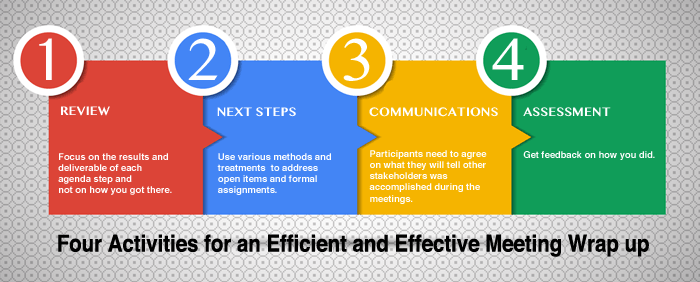
Daniel Pink’s book When: The Scientific Secrets of Perfect Timing stresses the importance of the meeting wrap-up. He calls it “ending on a high note.” Others refer to the power of the recency effect. Below find four critical activities needed to facilitate clear and actionable results during your meeting wrap-up. The result from many productive meetings can be summed up with four words: “WHO DOES WHAT & WHEN.“
#1-Review, #2-Next Steps, #3-Communications, and #4-Assessment.
Do not skip any of these four activities but expand and contract your treatment of them based on your situation and constraints.

For an Effective Meeting Wrap-up, End Your Meetings – Don’t Let Them Stop
Meeting Wrap-up #1 – Review
Do not relive the session, but do review the outputs, decisions, assignments, and so on. Focus on the results and deliverables from each Agenda Step, not on how you got there. Participants do not need a transcript. They need to be reminded about significant takeaways and offered the opportunity to ask for additional information or clarification before the session ends. Be prepared to use the Definition Tool to address uncertainties or disagreements about the meaning of something.
If possible and practical, use the documentation generated during the session to structure a quick walk-through. During the walk-through, include real-life examples for participants to see how well the deliverable performs. Next, assign responsibility to “Parking Lot” items (i.e., Open Issues) that remain valid and unresolved.
Meeting Wrap-up #2 – Next Steps
Two types of action items are developed during meetings: items within the scope and required to complete the deliverable and items out of scope but too important or opportunistic to disregard.
Assignments Within the Scope of the Deliverable
During the meeting, record open issues as they arise. Various terms describe open issues that develop during meetings, most frequently called a meeting parking lot.
Have your group list the action items that they have already agreed to or will undertake—starting tomorrow. List the items, clarify them, and have someone take responsibility. Assign a deadline (month, day, year) for a status update.
Consider applying the RASI tool (Transform Your Responsibility Matrix Into a GANTT Chart) to convert your action items into a project plan. Remember, absence or silence is unacceptable during assignments. Therefore, do not permit making assignments to someone who is not attending the meeting, either live or virtually.
Assignments Out of Scope of the Deliverable
Facilitate your meeting parking lot activity after you have completed closed issues and assigned other action items that are within the scope of the deliverable. Then, review each open issue. Make sure the open issue remains valid. Over the course of meetings, some open issues are no longer “open”. If so, delete them or mark them accordingly (e.g., OBE = Overcome by Event, or taken care of).
Standard Activities for Managing a Meeting Parking Lot
Append each open issue using the following sequence:
-
- The issue is more fully defined—a complete, coherent statement of description
- Note the single individual responsible for communicating back to the group on the status of the open issue (frequently viewed as who ‘will do’ or complete the open issue)
- Expected completion or progress update (month, day, year)
- How progress or completion will be communicated to your group of participants
- If follow-up requires a file, give the file a name to make future ‘searches’ easier
- Consider email size limitations, file naming conventions, and file-server security restrictions
Alternative Methods for Managing a Meeting Parking Lot
We call a simple method for managing meeting parking lot issues a “2 by 4.” Meant to connote a standard piece of lumber, the method suggests a quick, three-question approach—namely:
To – By – For to Manage Meeting Parking Lot
- To: Do what?
- By: Who and when?
- For: What purpose or benefit?
Steve Jobs, ex-CEO of Apple Inc., called this assignment activity essential, the heart of a meeting. He called the person assigned a specific task the DRI (“Directly Responsible Individual”). For each project, and every task in that project, he wanted someone accountable. Their congratulations or blame depended on how they did.
For complex open issues, or big hairy audacious goals (BHAG) that might constitute major or multiple new products or projects and cannot simply be assigned to someone, use the Content Management Tool. Use the output from this meeting (what) as input for a future meeting when the time, place, and people are available to conduct further analysis and make appropriate decisions or assignments. In that next meeting, begin with this open issue as input by asking “So what?” or “Why do we care?
Once the next steps and assignments are clear, your meeting is nearly over, except for . . .
Meeting Wrap-up #3 – Communications
Here you lead the participants to agree on what they will tell other stakeholders was accomplished during the meeting. Additionally, you get your group to agree on how it will communicate results to others.
At a minimum, team members need an “elevator speech” that can deliver an effective synopsis of the meeting results. At the other extreme, if the meeting is strategic, there could be numerous audience types such as the investment community, suppliers, trade personnel, etc. If so, identify the key audience members before discussing the message, medium of communication, and frequency of communication for each.
When it is important that it sounds like the participants attended the same meeting together, consider agreeing on the rhetoric used to describe the meeting. Typically, the two major audiences are:
- What do we tell our bosses or superiors?
- What do we tell people dependent on our results (i.e., stakeholders)?
Take a few moments to homogenize the rhetoric and help them agree on what they will tell people who ask. More importantly, agreement on what NOT to tell others. At a minimum consider two audiences and record the bullets or sound bites for each. Separately consider, for example, participants’ superiors and other stakeholders (e.g., peers or customers). See STOP! Were We Even In The Same Meeting? for detailed instructions.
If necessary, discuss HOW TO communicate with the target audience such as face-to-face, email, etc. For complicated communications plans, further, discuss frequency or how often to set up regular communications. It may be necessary to schedule the communications so that the superiors are informed before other stakeholders. Failing to plan suggests planning to fail. Meeting participants will use separate methods and discrete rhetoric that may generate different understandings among stakeholders who are expected to share similar understandings.
Meeting Wrap-up #4 – Assessment
Get feedback on how well you did and what you can do to be better. Set up or mark a whiteboard by the exit door and create two columns, typically PLUS and DELTA (ie, the Greek symbol ∆ or “change”) but also known as OFI (Opportunity for Improvement), “Benefits & Concerns” (also known as the “B’s & C’s”), “Star/Delta”, and Appreciative (+) or Opportunistic (-). Have each participant write down on a small Post-it® note, at least one thing they liked about the meeting (+) and one thing they would change (∆). Ask them to mount each note in its respective column as they exit.
Effective leaders will not let their meetings wrap up until participants have been offered a final opportunity to comment or question, action steps have been discussed, messaging has been agreed to, and feedback for continuous improvement has been solicited. Continue to fortify your skill set with additional tools and improvement suggestions available in our Facilitation Best Practices.
One way to stir things up in meetings would be to begin calling the Parking Lot a Meeting Refrigerator. Here is why.
Other terms used by organizations include Issue Bin, Coffee Pot, Water Cooler, Elevator Speech, Limbo, Chestnuts, Popcorn, and our favorite, Refrigerator. (Refrigerator reflects a term used in the Middle East because the items temporarily stored there can be preserved and cooked up later). Regardless of the term you use, open issues need to be managed properly rather than left unassigned as a list of items without context or assigned next steps.
Changing an organizational culture provides as many challenges as you can imagine, typical of mergers and acquisitions. Without some patience, time, and more patience, most efforts fail. Meanwhile, change itself faces so much resistance that it will not happen ‘overnight.’
We can however take little stabs at calibrating, modifying, and shifting behaviors. For example, calling the Parking Lot a Meeting Refrigerator. Eventually, change occurs once it hits an inflection point.
The term Parking Lot connotes a place of rest, where no progress is made, and stuff begins to rust. Sometimes, people forget or ignore items left in the parking lot. Therefore, they might rust or accumulate a lot of dust (or snow) before we manage them.
Place items in a Meeting Refrigerator (instead of a Parking Lot) to preserve and protect them. In addition, some things we take out of a Meeting Refrigerator can be re-cooked to provide an entire meal(s), where our business meals are frequently called projects. So call the ‘Parking Lot’ a Meeting Refrigerator because your open items are worth preserving and protecting, rather than ignoring.
______
In a world where everyone can engage in decisions that affect them
______
Lead the Change—One Meeting at a Time
Are you ready to transform how decisions are made, problems are solved, and alignment is built in your organization?
True meeting leadership goes beyond setting an agenda. It requires a facilitator who can navigate complexity, balance voices, and drive toward outcomes with clarity and consensus. Our Professional Meeting Leadership Workshop and facilitation training equips you to do just that—blending human-centric methods with structured analytical tools to foster rigor, inclusivity, and results that stick.
- Practice live.
- Get expert feedback.
- Build confidence that lasts.
Whether your meetings suffer from unclear objectives, disengaged participants, or decision fatigue, this workshop will help you identify the root causes, apply proven facilitation techniques, and emerge as the leader every team needs.
Take the first step today—transform your meetings and magnify your impact.
👉 Click here to reserve your seat now.
#facilitationtraining #meetingdesign
Because every meeting should be a catalyst for change—not just another calendar event.
______
With Bookmarks no longer a feature in WordPress, we provide the following for your benefit and reference.
______
Terrence Metz, president of MG RUSH Facilitation Training, was just 22-years-old and working as a Sales Engineer at Honeywell when he recognized a widespread problem—most meetings were ineffective and poorly led, wasting both time and company resources. However, he also observed meetings that worked. What set them apart? A well-prepared leader who structured the session to ensure participants contributed meaningfully and achieved clear outcomes.
Throughout his career, Metz, who earned an MBA from Kellogg (Northwestern University) experienced and also trained in various facilitation techniques. In 2004, he purchased MG RUSH where he shifted his focus toward improving established meeting designs and building a curriculum that would teach others how to lead, facilitate, and structure meetings that drive results. His expertise in training world-class facilitators led to the 2020 publication of Meetings That Get Results: A Guide to Building Better Meetings, a comprehensive resource on effectively building consensus.
Grounded in the principle that “nobody is smarter than everybody,” the book details the why, what, and how of building consensus when making decisions, planning, and solving problems. Along with a Participant’s Guide and supplemental workshops, it supports learning from foundational awareness to professional certification.
Metz’s first book, Change or Die: A Business Process Improvement Manual, tackled the challenges of process optimization. His upcoming book, Catalyst: Facilitating Innovation, focuses on meetings and workshops that don’t simply end when time runs out but conclude with actionable next steps and clear assignments—ensuring progress beyond discussions and ideas.
by Facilitation Expert | Dec 6, 2012 | Leadership Skills
Leadership style depends largely on the flow of content: Directive—one-way, Consultative—equal partner in content, and Exploratory—facilitative, not adding content.
Directive
A leader who predominantly gives direction and guidance with little participation or content added by the group characterizes this leadership style. Directive leadership is appropriate when the purpose is to share information quickly and clearly, such as briefings, staff meetings, symposiums, etc.
Consultative
This leadership style is characterized by consulting with colleagues and subordinates in an open and respectful, not manipulative manner, during the meeting. Consultative leadership is appropriate when the purpose is to have the group make decisions with contributions and equal participation from the leader.
Exploratory
This pure and optimal facilitation style should be the predominant approach used for task-building and assignment meetings. In an exploratory approach, the leader is neutral in terms of contributing content to the meeting but is responsible for providing and managing the technique and agenda. In many task-related meetings, an outside facilitator is used to provide exploratory leadership while the business owner participates with a consultative leadership style.
No One Style
There is neither a single ‘right’ answer nor one right leadership style. The appropriate style is dependent on the particular type of meeting situation and the nature of the group. Leaders of teams that work well together can use the exploratory style more frequently. Leaders with contentious groups either need to be directive or employ a neutral facilitator for their meetings. Managing meetings is much like managing people—be flexible and use the most appropriate style depending on the situation.
Guidelines
Strolling and Smiling Makes You More Likable
The same skills are required to lead a meeting as are required to facilitate a meeting. Keep the following guidelines in mind, especially when leading:
- Plan and choose to use the most appropriate leadership style before you get into the meeting. For leading without facilitation, you will probably be either directive or consultative. If you are a facilitator, be consistent with being exploratory.
- Let the group know at the outset of the meeting which style of leadership you intend to use. They will respond positively if they know how to work with the style and role that you have chosen.
- If you are being consultative, use facilitation skills to get the group to participate as much as possible.
- Be aware of the influence you and your ideas have on the group. When you are not neutral, as when you are voicing an opinion about content, the members listen to your ideas. If they are dropping out, back off and become more exploratory.
- A good meeting leader may be a good facilitator with an opinion, but be careful. When leading content is appropriate, follow the guidelines above as well as general guidelines for managing people. Lead, but never continually remind the group that you are the leader.
Regardless of Style, Increase Your Leadership Likability By Strolling and Smiling More
Some of the best meeting designers are also capable of facilitating complex topics requiring much pre-thought and structure. However, sometimes they fall flat on the personality factor, coming off as dispassionate, aloof, or insensitive.
Most facilitators default in the other direction, they are typically warm and possess leadership likability but are frail when it comes to workshop breakdown structure and asking precise questions. It is frankly easier to teach a meeting designer or methodologist how to warm up to an audience than it is to teach people how to think—that is, how to think clearly. Simply start strolling and smiling more.
As most North Americans are afraid of public speaking, the worst thing they could do is hide behind a podium to protect themselves. The separation amplifies the ‘me’ versus ‘them’ space, causing them to become fearful and underperform. In the role of facilitator, soften the edges by integrating yourself. Do not speak AT the participants; rather have a conversation WITH the participants.
Strolling Helps
Increase Friendliness by Avoiding Podiums
Becoming conversational and more natural increases likability. One solution involves getting closer, measured in terms of physical proximity, to your participants. The easiest way to achieve closeness without violating personal space is to stroll closer to them.
When stuck in a small conference room with a big table or a huddle room with no perimeter, the strolling is difficult but can be managed by walking around the table, and around the room. The U-shaped seating arrangement however makes it much easier to stroll around, get closer to participants, and therefore be more conversational.
Use your space wisely. If participants are vibrant and need a documenter, then stay at the easel as a scribe, while their energy remains high. But when uncertainty or disagreement arises, begin to slowly step forward to make it easier to demonstrate active listening, and to display a sense of respect and importance toward the participant who is speaking.
In the case of an argument, make sure that evidence and claims to support the participants’ positions go through you, and not around you. There is probably no better time to be in the middle of the U-shaped seating environment than when participants are arguing. They need a referee, and serving as a referee is part of the role of facilitator.
Smiling Helps More
The two universally accepted non-verbal gestures are open hands and smiling. Open hands signify culturally that you have no weapons and will not harm the participants. Open hands are far more welcoming than the opposite, pointing.
Smiling is also accepted throughout all cultures. A genuine, smile is found appealing and increases the likeliness that your participants will warm up to you. We must be careful however not to smile too much, inappropriately, or to laugh too loud.
Please smile occasionally, even with serious topics. If the facilitator remains too stern and sober, the participants will tense up, reducing the likelihood of collaboration and innovative thinking. If you need further help to learn to smile, practice. Use your introduction material to practice and ask a co-worker or family member to observe and comment on the appropriate timing for a warm smile.
______
Don’t ruin your career by hosting bad meetings. Sign up for a workshop or send this to someone who should. MGRUSH workshops focus on meeting design and practice. Each person practices tools, methods, and activities every day during the week. Therefore, while some call this immersion, we call it the road to building high-value facilitation skills.
Related articles
- When To Get All Bossypants (inc.com)
- Every Leader Is an Artist (blogs.hbr.org)
Terrence Metz, president of MG RUSH Facilitation Training, was just 22-years-old and working as a Sales Engineer at Honeywell when he recognized a widespread problem—most meetings were ineffective and poorly led, wasting both time and company resources. However, he also observed meetings that worked. What set them apart? A well-prepared leader who structured the session to ensure participants contributed meaningfully and achieved clear outcomes.
Throughout his career, Metz, who earned an MBA from Kellogg (Northwestern University) experienced and also trained in various facilitation techniques. In 2004, he purchased MG RUSH where he shifted his focus toward improving established meeting designs and building a curriculum that would teach others how to lead, facilitate, and structure meetings that drive results. His expertise in training world-class facilitators led to the 2020 publication of Meetings That Get Results: A Guide to Building Better Meetings, a comprehensive resource on effectively building consensus.
Grounded in the principle that “nobody is smarter than everybody,” the book details the why, what, and how of building consensus when making decisions, planning, and solving problems. Along with a Participant’s Guide and supplemental workshops, it supports learning from foundational awareness to professional certification.
Metz’s first book, Change or Die: A Business Process Improvement Manual, tackled the challenges of process optimization. His upcoming book, Catalyst: Facilitating Innovation, focuses on meetings and workshops that don’t simply end when time runs out but conclude with actionable next steps and clear assignments—ensuring progress beyond discussions and ideas.
by Facilitation Expert | Nov 29, 2012 | Meeting Support
While there are three primary types of business meetings: information-sharing, instructional or directional task-related meetings, and facilitated or developed task-related meetings, an effective leader must closely manage the meeting boundaries to prevent scope creep and get done on time.
Information-Sharing Meetings
Control Meeting Boundaries
Information-sharing meetings primarily capture one-way communication with the information presented by the speaker to the group. Furthermore, this type of meeting includes symposiums, instructional groups, staff meetings, and other presentations that attempt to communicate essential information to a group. Interaction from participants with the meeting leader normally gets limited to questions and comments.
Task-Related Meetings
Task-related meetings use the knowledge and experience of group members to accomplish a work task, such as problem-solving, decision-making, fact-finding, planning, etc. These meetings are highly interactive and involve two-way communication between all participants. Task-related meetings also tend to fall apart more quickly with poor meeting management. The two differences include:
- Directed—the leader runs the meeting and controls the agenda. These are the most common types of meetings.
- Facilitated—an impartial facilitator runs the meeting and controls the agenda and technique. These are the least common but are growing in use, as they are the most effective for decision-making and building consensus.
The Model Meeting
To effectively manage a meeting, a meeting leader must pay attention to the dynamics of the group. Having a model to work from helps the leader understand the group’s behavior to keep meeting dynamics in balance. This enables the leader to sort problems from non-problems and respond appropriately.
Why a Model?
Looking back on the list of the 14 most frequently mentioned problems in meetings (see “Some of the Challenges and Costs Associated with Hosting Meetings”), we can attribute all of them to one primary cause; a lack of structure. If this sounds like an oversimplification, it is, but only partially. You may be asking yourself, “If structure has been the only problem with meetings, why are meetings in corporate America a waste of money?” It seems like unstructured meetings are the effect of meeting dementia. Take a closer look at the components of the model meeting.
Meeting Boundaries
Meeting boundaries provide the limits or scope, which separate the meeting and its components from the external environment. Clear and unbroken boundaries are essential to good meeting management. It is the meeting leader’s responsibility to keep the boundaries from being violated (broken) resulting in a breakdown in structure. Therefore, consider both types of meeting boundaries:
- Time boundaries
- Physical boundaries
Time Boundaries
Time boundaries govern the start time and stop time of the overall meeting, as well as the length of the meeting. Meetings starting late seem to be an accepted norm. All meetings should start at their scheduled time and not exceed the stop time.
Barring a major catastrophe, every meeting must start precisely on time. Meetings that start late are in trouble right from the start. The delay starts to send a message to the participant that degrades the perceived importance of the meeting. The meeting is taken less seriously and sets the stage for additional boundary violations.
If the meeting begins late because the leader is not ready, he or she loses credibility which is hard to recover. Meetings that start late because the leader is waiting for latecomers are just as bad. This communicates positive reinforcement to the latecomers, while negatively reinforcing those that came on time.
Running overtime must be avoided at all costs. In cases where the discussion is crucial, continue only after obtaining consensus from the group. Otherwise, summarize and reschedule another meeting to conclude the discussion.
How many meetings extend beyond their useful length? The meeting duration should never exceed 45 to 50 minutes unless it is a facilitated workshop. By setting up your meetings for 45 or 50-minute increments, you provide a courtesy to the participants, affording them time to refresh between meetings.
Meetings more than one hour long take too much energy and have the opportunity to drag. Workshops, properly facilitated, can last for a number of days, but the rationale for the extended duration generates a deliverable. Standard meetings taking longer than one hour should be broken into multiple sessions of fifty minutes.
Physical Boundaries
Physical boundaries separate the meeting space from the rest of the outside world. The physical environment impacts the psychological environment. Most noteworthy, studies show that a formal atmosphere inhibits the mood of both groups and individuals. The best meeting results occur when people feel comfortable. When informality balances with focus on the work task. Psychologists refer to this as a state of “relaxed concentration”. The meeting leader’s responsibility ensures that proper physical boundaries are established and maintained.
______
Meetings must rise above the tiny opening of words and embrace the fullness of human insight—through listening, visuals, stories, numbers, and symbols. The transformation begins not with tools, but in mindset. Leave your ego at the threshold, and step into the structures of meetings that get results.
In a world where everyone can engage in decisions that affect them
______
Lead the Change—One Meeting at a Time
Are you ready to transform how decisions are made, problems are solved, and alignment is built in your organization?
True meeting leadership goes beyond setting an agenda. It requires a facilitator who can navigate complexity, balance voices, and drive toward outcomes with clarity and consensus. Our Professional Meeting Leadership Workshop and facilitation training equips you to do just that—blending human-centric methods with structured analytical tools to foster rigor, inclusivity, and results that stick.
- Practice live.
- Get expert feedback.
- Build confidence that lasts.
Whether your meetings suffer from unclear objectives, disengaged participants, or decision fatigue, this workshop will help you identify the root causes, apply proven facilitation techniques, and emerge as the leader every team needs.
Take the first step today—transform your meetings and magnify your impact.
______
👉 Click here to reserve your seat now.
#facilitationtraining #meetingdesign
Because every meeting should be a catalyst for change—not just another calendar event.
With Bookmarks no longer a feature in WordPress, we provide the following for your benefit and reference.
______
Related articles
- Mission or Vision – What is the Difference? (mgrush.com/blog)
- Facilitating Crucial Conversations (mgrush.com/blog)
- How to Design Culture: 16 Patterns to Build Adaptive Learning Organizations (emergentbydesign.com)
Terrence Metz, president of MG RUSH Facilitation Training, was just 22-years-old and working as a Sales Engineer at Honeywell when he recognized a widespread problem—most meetings were ineffective and poorly led, wasting both time and company resources. However, he also observed meetings that worked. What set them apart? A well-prepared leader who structured the session to ensure participants contributed meaningfully and achieved clear outcomes.
Throughout his career, Metz, who earned an MBA from Kellogg (Northwestern University) experienced and also trained in various facilitation techniques. In 2004, he purchased MG RUSH where he shifted his focus toward improving established meeting designs and building a curriculum that would teach others how to lead, facilitate, and structure meetings that drive results. His expertise in training world-class facilitators led to the 2020 publication of Meetings That Get Results: A Guide to Building Better Meetings, a comprehensive resource on effectively building consensus.
Grounded in the principle that “nobody is smarter than everybody,” the book details the why, what, and how of building consensus when making decisions, planning, and solving problems. Along with a Participant’s Guide and supplemental workshops, it supports learning from foundational awareness to professional certification.
Metz’s first book, Change or Die: A Business Process Improvement Manual, tackled the challenges of process optimization. His upcoming book, Catalyst: Facilitating Innovation, focuses on meetings and workshops that don’t simply end when time runs out but conclude with actionable next steps and clear assignments—ensuring progress beyond discussions and ideas.
by Facilitation Expert | Nov 22, 2012 | Managing Conflict
Amazingly, talented people who care can come together and yet fail demonstrably in a ‘meeting.’
Meetings fail because the participants do not know HOW TO succeed. Meeting challenges include anything that takes the energy from meetings. To deal with low energy, first understand the causes of meeting challenges.
Chaos
Without Structure
To contend with difficulties, take a closer look at how a normal business meeting processes information. Like all other forms of energy, unless you harness and manage meetings within a structured environment, chaos will result. The structure takes the creative energy generated in a group and converts it into something productive. The creative energy available to any group comes as ideas and information. When information and ideas are processed in business meetings, it is usually done without adequate structure.
Information Problems
Meeting Challenges
The following information processing problems occur because of unstructured meetings:
- Disruptive interruptus—limits the continuity of the group’s ideas.
- Inconclusive progressions—moving on to another topic and not adequately concluding or summarizing the previous topic.
- Information queuing—mentally storing comments while waiting for an opportunity to speak. When the time comes, the timing is inappropriate and the discussion gets derailed.
- Mixing abstractions—two people talking at different perspectives and levels of detail, different wavelengths, or different levels of resolution.
- Solution jumping—prematurely discussing solutions before the problem has been adequately defined.
- Topic jumping—inappropriately changing the topic. (In the average unstructured meeting, groups change topics every minute and a half.)
Complicating Factors
Complicating even further are the tactics used by meeting leaders to deal with information-processing problems. Three common and unsuccessful approaches:
- Heavy-handed control—overreaction that results in the inhibition of creativity and analysis.
- Symposium style—speaking one at a time in sequence. Eliminates the advantage of spontaneous interaction.
- Withdrawal—results in no direction at all.
Decision Problems
Decisions are made generally by:
- Default (that’s the way they wanted it anyway)
- Dominance (the squeaky wheel syndrome)
- Groupthink (no one disagrees or questions the decision because all assume someone—usually a strong leader—has the right answer. This is one of the explanations for the “Bay of Pigs” incident—no one argued with the decision).
- Sheer exhaustion (we give up—do what you want)
Decision Styles
In response to the problems of decision-making, some leaders have adopted tactics such as:
- Authoritarian (good control and quick, but is often wrong and creates low morale)
- Consensus (encourages participation/ unanimity, but is slow without someone to facilitate it through discipline and structure)
- Majority rules (very democratic and participative, but allows tyranny of the majority and is slow)
- Minority rules (permits persuasion, but creates political resentment)
Underdevelopment
Remember, while the number of meetings is growing, the mismanagement of meetings is costing a substantial amount of money each year. Wasted time equals wasted resources. Meeting leadership is an underdeveloped management skill, but it can be learned.
Meeting Types
There are as many types of meetings as there are meeting leaders. Most meetings, however, fall into three general categories:
- Information sharing meetings
- Task-related meetings—directed or instructional
- Task-related meetings—facilitated or developed
Loss of Creative
Energy
Session leaders typically use more than 60 percent of the communication time available in a meeting, leaving at most 40 percent of the talk time for participants, or 24 minutes in a one-hour meeting. Unequal distribution means much of the creative energy located within the group is not being tapped, decreasing the productivity of the meeting. Hence, it’s no wonder meetings fail because of low energy.
______
Don’t ruin your career by hosting bad meetings. Sign up for a workshop or send this to someone who should. MGRUSH workshops focus on meeting design and practice. Each person practices tools, methods, and activities every day during the week. Therefore, while some call this immersion, we call it the road to building high-value facilitation skills.
Related articles
- 3 Ways to Keep Meetings Short (Every Time) (inc.com)
- How to Design Culture: 16 Patterns to Build Adaptive Learning Organizations (emergentbydesign.com)
Terrence Metz, president of MG RUSH Facilitation Training, was just 22-years-old and working as a Sales Engineer at Honeywell when he recognized a widespread problem—most meetings were ineffective and poorly led, wasting both time and company resources. However, he also observed meetings that worked. What set them apart? A well-prepared leader who structured the session to ensure participants contributed meaningfully and achieved clear outcomes.
Throughout his career, Metz, who earned an MBA from Kellogg (Northwestern University) experienced and also trained in various facilitation techniques. In 2004, he purchased MG RUSH where he shifted his focus toward improving established meeting designs and building a curriculum that would teach others how to lead, facilitate, and structure meetings that drive results. His expertise in training world-class facilitators led to the 2020 publication of Meetings That Get Results: A Guide to Building Better Meetings, a comprehensive resource on effectively building consensus.
Grounded in the principle that “nobody is smarter than everybody,” the book details the why, what, and how of building consensus when making decisions, planning, and solving problems. Along with a Participant’s Guide and supplemental workshops, it supports learning from foundational awareness to professional certification.
Metz’s first book, Change or Die: A Business Process Improvement Manual, tackled the challenges of process optimization. His upcoming book, Catalyst: Facilitating Innovation, focuses on meetings and workshops that don’t simply end when time runs out but conclude with actionable next steps and clear assignments—ensuring progress beyond discussions and ideas.
by Facilitation Expert | Nov 15, 2012 | Meeting Support
Meetings are frequently a fix for poor leadership. Most would rather go to a movie than sit in a two-hour meeting. Almost all poor movies at least contain a beginning, middle, and end. Indirect meeting costs represent a huge area for cost control and improved return on investment.
Meetings are very expensive. Today’s business world is asymmetric, and holding meetings to share information may be a poor use of precious resources. Dashboard devices provide a better means for information updates than staff meetings. The Scrum approach addresses three questions during daily Scrums, but participants frequently remain standing so that meetings adjourn quickly:
- What has been accomplished since we last met?
- What accomplishments are targeted next?
- Which challenges require additional support?
Indirect Meeting Costs and Challenges
The best reason to pull people together is to build something that we cannot do apart, to arrive at consensus, to decide on something. Consider replacing weekly meetings with periodic workshops, knowing that the use of facilitators greatly improves productivity.
Role of Meetings
We live in a meeting society. Along with billions of people, our world also contains more than 200 nation-states, 4 million local communities, 20 million economic organizations, 200 million extended families, and hundreds of millions of other formal and informal groups. In order for groups to exist, individuals that make up these groups must meet and interact.
Current Trends
The increased growth in the number and length of meetings is due to the accelerated rate of change that now rules today’s business environment. The rapid and constant change in technology, particularly information technology and business process management, has dramatically increased the volatility of the global marketplace. As technology takes over more routine functions and allows faster access to data, managerial skills shift, calling for increased communication clarity and small group skills.
Flatter Structures
Another trend emerging as a result of an accelerated environment is the growth of more efficient and flatter organizational structures. These organizations have fewer management layers and, therefore fewer levels of decision-making. Flatter structures result in more group decision-making by specialists from disparate areas within the organization. Consequently, the ability to effectively communicate cross-functional support in meetings has taken on increased importance.
Participative
Management
A by-product of replacing hierarchy with holarchy is an increasing emphasis on participative employee ownership. Participative management bases itself on the following premises:
- The quality of decisions is improved if all employee expertise is considered, and
- The act of employee participation leads to better acceptance of the decisions.
50 Percent Productive
Studies have estimated that meetings are at most 50 percent productive. Thus the typical manager wastes approximately 240 hours per year (about 30 days) at a cost to the average Fortune 500 Company of greater than one hundred billion USD per year. By using proper meeting management, a single company could recover 25 to 35 percent of these costs or hundreds of millions per year.
Intangible Costs
The intangible costs associated with poor meeting management are overlooked at all levels of management. Meetings serve as opportunities for senior management to appraise and search out potential leaders within an organization. As lower-level managers take on more responsibilities, they spend more of their time in meetings with executives at higher levels. Consequently, their success as executives is tied to their ability to make the most out of their meeting time.
Psychological Costs
Participating in a poorly run meeting is frustrating, resulting in apathy, resentment, and a lack of commitment toward the meeting’s outcome. This attitude carries over to the workplace. Therefore, in many cases, subverting good ideas that come from the meetings.
Meeting Dementia
People and organizations have developed “meeting dementia because poorly run meetings have been around for so long and remain prevalent. Some view poorly run and unproductive meetings as the norm, and that’s just the way it is. This viewpoint seems to have been inherited by observing others who have led poorly run meetings, who in turn learned from others making the same mistakes, and so on.
Indirect Meeting Costs and Challenges
The major problems with meetings, surprisingly, don’t have to do with personalities or the inability of group members to get along with one another. Almost all problems are typically task-related—i.e., people do not know the mechanics of HOW TO lead effective meetings. The following list highlights 14 of the most frequently mentioned problems by over 1,000 managers:
- Getting off subject
- No goals or agenda
- Too long
- Poor preparation
- Inconclusive
- Disorganized
- Ineffective leader/ lack of control
- Irrelevant information discussed
- Time wasted
- Started late
- Ineffective for making decisions
- Interruptions (inside and out)
- Dominators
- Rambling discussion
Meetings must rise above the tiny opening of words and embrace the fullness of human insight—through listening, visuals, stories, numbers, and symbols. The transformation begins not with tools, but in mindset. Leave your ego at the threshold, and step into the structures of meetings that get results.
In a world where everyone can engage in decisions that affect them
______
Lead the Change—One Meeting at a Time
Are you ready to transform how decisions are made, problems are solved, and alignment is built in your organization?
True meeting leadership goes beyond setting an agenda. It requires a facilitator who can navigate complexity, balance voices, and drive toward outcomes with clarity and consensus. Our Professional Meeting Leadership Workshop and facilitation training equips you to do just that—blending human-centric methods with structured analytical tools to foster rigor, inclusivity, and results that stick.
- Practice live.
- Get expert feedback.
- Build confidence that lasts.
Whether your meetings suffer from unclear objectives, disengaged participants, or decision fatigue, this workshop will help you identify the root causes, apply proven facilitation techniques, and emerge as the leader every team needs.
Take the first step today—transform your meetings and magnify your impact.
______
👉 Click here to reserve your seat now.
#facilitationtraining #meetingdesign
Because every meeting should be a catalyst for change—not just another calendar event.
______
With Bookmarks no longer a feature in WordPress, we provide the following for your benefit and reference.
______
Terrence Metz, president of MG RUSH Facilitation Training, was just 22-years-old and working as a Sales Engineer at Honeywell when he recognized a widespread problem—most meetings were ineffective and poorly led, wasting both time and company resources. However, he also observed meetings that worked. What set them apart? A well-prepared leader who structured the session to ensure participants contributed meaningfully and achieved clear outcomes.
Throughout his career, Metz, who earned an MBA from Kellogg (Northwestern University) experienced and also trained in various facilitation techniques. In 2004, he purchased MG RUSH where he shifted his focus toward improving established meeting designs and building a curriculum that would teach others how to lead, facilitate, and structure meetings that drive results. His expertise in training world-class facilitators led to the 2020 publication of Meetings That Get Results: A Guide to Building Better Meetings, a comprehensive resource on effectively building consensus.
Grounded in the principle that “nobody is smarter than everybody,” the book details the why, what, and how of building consensus when making decisions, planning, and solving problems. Along with a Participant’s Guide and supplemental workshops, it supports learning from foundational awareness to professional certification.
Metz’s first book, Change or Die: A Business Process Improvement Manual, tackled the challenges of process optimization. His upcoming book, Catalyst: Facilitating Innovation, focuses on meetings and workshops that don’t simply end when time runs out but conclude with actionable next steps and clear assignments—ensuring progress beyond discussions and ideas.