by Facilitation Expert | Aug 8, 2013 | Facilitation Skills
Getting participants to focus on the same thing at the same time represents one of the hardest thing to accomplish with a group of people. Therefore, learning to remove distractions reflects a core skill and primary responsibility of the meeting leader.
Your Rosetta Stone: Remove Distractions
Remember that all questions you have about what you can or should do may be answered by the question, “Is it a distraction or not?” If it is not a distraction, then it should be acceptable. If it is a distraction, then it is your responsibility to remove distractions so that your group can remain focused on the topic.
For example, if you put your hands in your pocket to rest for a few minutes, it is probably OK. However, if you start juggling your keys or coins, the distraction is unacceptable. If a participant closes their eyes, let them rest. If they start snoring, then intervene to remove the distraction.
Core Skills Where You Need to Remove Distractions

Remove the Electronic Leashes
As a facilitator, you need to manage four core skills including presentation, active listening, questioning, and observation/ neutrality. For these to be effective, you must reduce or eliminate distractions so that the group can stay focused.
These four core skills are critical to effective facilitation.
- Presentation skills are necessary for effective communication
- Active listening is a tool for effective understanding
- Questioning is a tool for effective information-gathering
- Neutrality is a tool for balance and integrity
Removing distractions is an essential discipline for core skills and may guide all of your behavior.
Note for example the challenges that correspond with the four skills:
- Verbal disfluencies and fillers such as saying “Uhm” too often
- Observing something else when the meeting participant is talking
- Providing answers rather than method
- Making judgments or using the word “I” too often
______
Don’t ruin your career by hosting bad meetings. Sign up for a workshop or send this to someone who should. MGRUSH workshops focus on meeting design and practice. Each person practices tools, methods, and activities every day during the week. Therefore, while some call this immersion, we call it the road to building high-value facilitation skills.
Terrence Metz, president of MG RUSH Facilitation Training, was just 22-years-old and working as a Sales Engineer at Honeywell when he recognized a widespread problem—most meetings were ineffective and poorly led, wasting both time and company resources. However, he also observed meetings that worked. What set them apart? A well-prepared leader who structured the session to ensure participants contributed meaningfully and achieved clear outcomes.
Throughout his career, Metz, who earned an MBA from Kellogg (Northwestern University) experienced and also trained in various facilitation techniques. In 2004, he purchased MG RUSH where he shifted his focus toward improving established meeting designs and building a curriculum that would teach others how to lead, facilitate, and structure meetings that drive results. His expertise in training world-class facilitators led to the 2020 publication of Meetings That Get Results: A Guide to Building Better Meetings, a comprehensive resource on effectively building consensus.
Grounded in the principle that “nobody is smarter than everybody,” the book details the why, what, and how of building consensus when making decisions, planning, and solving problems. Along with a Participant’s Guide and supplemental workshops, it supports learning from foundational awareness to professional certification.
Metz’s first book, Change or Die: A Business Process Improvement Manual, tackled the challenges of process optimization. His upcoming book, Catalyst: Facilitating Innovation, focuses on meetings and workshops that don’t simply end when time runs out but conclude with actionable next steps and clear assignments—ensuring progress beyond discussions and ideas.
by Facilitation Expert | Aug 1, 2013 | Facilitation Skills
Turning Facilitation Guidelines Into Gold
As facilitator, you exhibit your weight in gold by following these fifteen simple, yet critical facilitation guidelines.
15 Facilitation Guidelines
- Session leaders must observe and listen to all that the group says and does. Be there! Immerse your body, mind, and spirit in the method of the group.
- Recognize all group input and encourage participation. Your ability to convey interest and enthusiasm in the group about the importance of the deliverable will be critical to your success as a session leader.
- Scan the group for nonverbal responses (including observers).
- Facilitation represents a helping mechanism. Ask questions rather than lecturing the workshop participants. Listen and keep your group involved.
- Stay on the task. Never lose sight of the holarchy. Avoid straying to other topics no matter how informative the topic may be or how much it may interest you or the group. Let the participants help keep the group on course if you are a weak process policeman.
-
Of all the facilitation guidelines, the most important may be to stay neutral. Do not lose your neutrality. Eliminate your personal bias and opinions from the discussion. The goal remains for the participants to provide answers or options, not you.
- Learn to expect hostility, but do not become hostile with your group or any participant. You must develop an attitude of acceptance. You may not agree necessarily with what is being said, but you can listen, accept, and record their answers and opinions. Let the group evaluate the content.
- Avoid being the expert authority on the subject. You can be an authority figure, but your role is to listen, question, enforce the method, or offer tools and options.
- Put the participants on break at no longer than 90-minute intervals. Be specific about the length of breaks, typically ten minutes. Adhere to your times and always be punctual.
- Use breaks to free a discussion when it is deadlocked. Breaks give the participants a chance to clear their minds and come to a new understanding.
- Do not let your prejudices interfere with your role as a session leader. Let go of the need to win everyone over to your point of view. The group will do the work. You are there to serve the group. Assist them in reaching the outcome.
- During breaks, arrange the flip chart pages, taped on the wall, to build a histogram of progress made in the workshop.
- During transitions and before you break for lunch or the end of the day, summarize the workshop progress and next steps. Give the group a thought to ponder and commend them for the amount of work they have completed.
- Do not keep people too long (eight to nine hours are about as long as people can remain productive).
- Stop a workshop if the group is sluggish and difficult to control, even if they wish to continue. Explain that, when people are burnt out, no progress occurs.
Additionally, there are three guiding principles of effective facilitation.
The fifteen guidelines above may come and go, taking breaks for example. Throughout any ceremony, event, meeting, or workshop, however, the following principles stay in place from start to finish. They include:
- First and foremost the principle of No Harm, and where used, explaining the purpose behind Safety Moments. For diversity and other messages, some embrace OE Moments as well (i.e., Operational Excellence).
- The second is focus and staying vigilant to remove distractions.
- The third is managing and stressing perspective or point of view and leaving egos in the hallway.
No Harm Demands Collaboration
NO HARM
The principle of No Harm provides an essential basis for a group of people coming together to work and decide collaboratively. The facilitator must be both conscious of the principle and its enforcement in the role of process policeman. Nothing is more important to encourage full participation than having the feeling (from a participant’s point of view) that you will not be harmed by what you say.
Let us never forget that the reason for meetings is to generate deliverables but the reason for deliverables is to serve the people. People always come first.
FOCUS
It is virtually impossible to get a group to focus by telling them to focus. We must be wise enough, as facilitators, to remove all the distractions. By removing distractions the only items remaining are those that demand the group make traction and progress to get DONE.
Distractions come in many varieties including physical (e.g., temperature), emotional (e.g., job security), intellectual (e.g., future impact), intuitional (e.g., impact on others), etc. Removing distractions is the biggest hurdle faced by facilitators. Doing so creates traction.
Traction cannot be developed by telling a group to focus. Facilitators must remove distractions so that the only thing remaining for the group is to focus on the issue at hand. Scope creep occurs when discussion advances beyond the scope of the deliverable, and frequently becomes a distraction, causing non-productive meetings.
PERSPECTIVE
When working for a company, organization, NGO, or other entity, participants must be reminded that they represent others through their role. Roles dictate diverse types of behavior and mannerisms. For example, most people treat a parent differently than a child or a cousin. Because they are in different roles, facilitators must remind participants about their role and the duty (fiduciary responsibility) to speak on behalf of others, whether current or future stakeholders.
______
In a world where everyone can engage in decisions that affect them
______
Lead the Change—One Meeting at a Time
Are you ready to transform how decisions are made, problems are solved, and alignment is built in your organization?
True meeting leadership goes beyond setting an agenda. It requires a facilitator who can navigate complexity, balance voices, and drive toward outcomes with clarity and consensus. Our Professional Meeting Leadership Workshop and facilitation training equips you to do just that—blending human-centric methods with structured analytical tools to foster rigor, inclusivity, and results that stick.
- Practice live.
- Get expert feedback.
- Build confidence that lasts.
Whether your meetings suffer from unclear objectives, disengaged participants, or decision fatigue, this workshop will help you identify the root causes, apply proven facilitation techniques, and emerge as the leader every team needs.
Take the first step today—transform your meetings and magnify your impact.
______
👉 Click here to reserve your seat now.
#facilitationtraining #meetingdesign
Because every meeting should be a catalyst for change—not just another calendar event.
______
With Bookmarks no longer a feature in WordPress, we provide the following for your benefit and reference.
______
Terrence Metz, president of MG RUSH Facilitation Training, was just 22-years-old and working as a Sales Engineer at Honeywell when he recognized a widespread problem—most meetings were ineffective and poorly led, wasting both time and company resources. However, he also observed meetings that worked. What set them apart? A well-prepared leader who structured the session to ensure participants contributed meaningfully and achieved clear outcomes.
Throughout his career, Metz, who earned an MBA from Kellogg (Northwestern University) experienced and also trained in various facilitation techniques. In 2004, he purchased MG RUSH where he shifted his focus toward improving established meeting designs and building a curriculum that would teach others how to lead, facilitate, and structure meetings that drive results. His expertise in training world-class facilitators led to the 2020 publication of Meetings That Get Results: A Guide to Building Better Meetings, a comprehensive resource on effectively building consensus.
Grounded in the principle that “nobody is smarter than everybody,” the book details the why, what, and how of building consensus when making decisions, planning, and solving problems. Along with a Participant’s Guide and supplemental workshops, it supports learning from foundational awareness to professional certification.
Metz’s first book, Change or Die: A Business Process Improvement Manual, tackled the challenges of process optimization. His upcoming book, Catalyst: Facilitating Innovation, focuses on meetings and workshops that don’t simply end when time runs out but conclude with actionable next steps and clear assignments—ensuring progress beyond discussions and ideas.
by Facilitation Expert | Jul 11, 2013 | Planning Approach
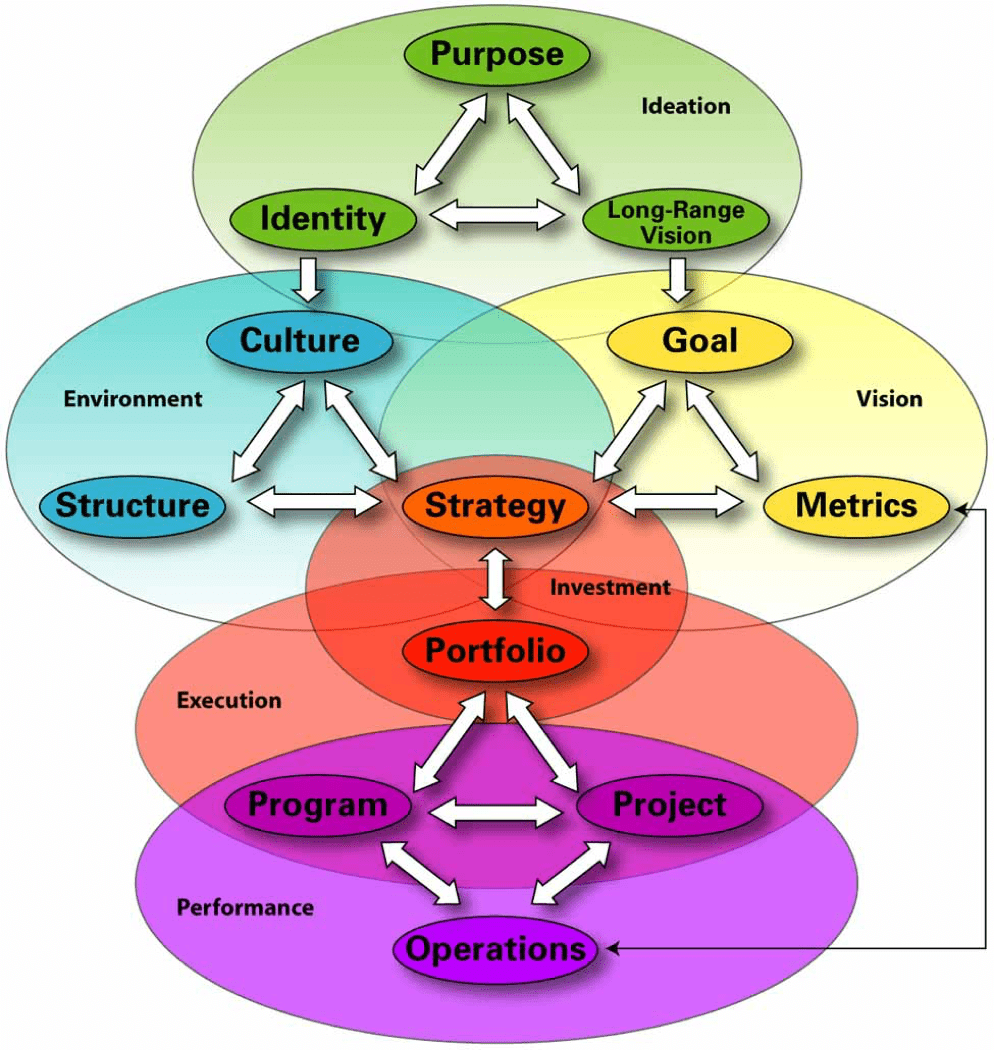
Executing Your Strategy was published by Harvard Business School Press and written by two MGRUSH alumni.
This tightly woven book provides a formula and clear instruction on how to transform strategy into projects and activities. Authors Mark Morgan and William Malek (both ex-professors of Stanford University), spoke with us about the importance of professional facilitation to helping groups “plan your work” (strategy) and “work your plan” (project).
Strategy Execution Framework
They frame a strong argument for their six INVEST imperatives (or, domains). You will find their phases quite valuable when managing your own program portfolios:
- Ideation—communicating purpose, identity, and intent
- Nature—aligning strategy with culture and structure
- Vision—clarity of goals and metrics
- Engagement—portfolio management
- Synthesis—program and project execution
- Transition—benefit to mainstream operations
From an our selfish perspective, they highly recommend building a Center for Strategic Excellence. The Center would anchor itself upon effective, neutral facilitators and structured meeting design. We hope you are doing your best across your departments to nurture facilitative leadership around you, your staff, and your program office. Their INVEST approach will help.
______
Don’t ruin your career by hosting bad meetings. Sign up for a workshop or send this to someone who should. MGRUSH workshops focus on meeting design and practice. Each person practices tools, methods, and activities every day during the week. Therefore, while some call this immersion, we call it the road to building high-value facilitation skills.
Terrence Metz, president of MG RUSH Facilitation Training, was just 22-years-old and working as a Sales Engineer at Honeywell when he recognized a widespread problem—most meetings were ineffective and poorly led, wasting both time and company resources. However, he also observed meetings that worked. What set them apart? A well-prepared leader who structured the session to ensure participants contributed meaningfully and achieved clear outcomes.
Throughout his career, Metz, who earned an MBA from Kellogg (Northwestern University) experienced and also trained in various facilitation techniques. In 2004, he purchased MG RUSH where he shifted his focus toward improving established meeting designs and building a curriculum that would teach others how to lead, facilitate, and structure meetings that drive results. His expertise in training world-class facilitators led to the 2020 publication of Meetings That Get Results: A Guide to Building Better Meetings, a comprehensive resource on effectively building consensus.
Grounded in the principle that “nobody is smarter than everybody,” the book details the why, what, and how of building consensus when making decisions, planning, and solving problems. Along with a Participant’s Guide and supplemental workshops, it supports learning from foundational awareness to professional certification.
Metz’s first book, Change or Die: A Business Process Improvement Manual, tackled the challenges of process optimization. His upcoming book, Catalyst: Facilitating Innovation, focuses on meetings and workshops that don’t simply end when time runs out but conclude with actionable next steps and clear assignments—ensuring progress beyond discussions and ideas.
by Facilitation Expert | Jul 4, 2013 | Communication Skills
We have learned during facilitated meetings and workshops, that it’s not easy for participants to respond to broad questions like “How do you solve global hunger?” While meaningful, the question’s scope is too broad (and perhaps vague) to stimulate specific, actionable (ie, SMART) responses like “We could convert eight abandoned mine shafts in Somalia to create temperature controlled food storage areas.” To improve group clarity, use the following.
Extemporaneous leaders have a tendency to transition during meetings with broad questions like, “Are we OK with this list?”, “Can we move on?”, or “Anything else?”. Facilitate with structure and precision by modifying your transitions with these three questions, adapted to your own situation:
- Do we need to clarify anything? (scrub for clarity)
- Do we need to delete anything? (scrub for relevancy or redundancy)
- Do we need to add anything to this list? (scrub for omissions)
The three detailed questions make it easier for meeting participants to analyze, agree, and move on.
______
Don’t ruin your career or reputation with bad meetings. Register for a workshop or forward this to someone who should. MGRUSH professional facilitation workshops focus on practice. Each participant thoroughly practices and rehearses tools, methods, and approaches throughout the week. While some call this immersion, we call it the road to building impactful facilitation skills.
Related articles
- Punctuation Precision, Humorously Proven by “Eats, Shoots & Leaves” (mgrush.com/blog)
- 40 Proven Questions to Determine and Mitigate Meeting or Workshop Risk (1 of 5) (mgrush.com/blog)
- You Can Effectively Facilitate a Group of People With These Three Principles (mgrush.com/blog)
- SCAMPER is a Mnemonic to Prompt for Excellent, Impromptu Questions (mgrush.com/blog)
Terrence Metz, president of MG RUSH Facilitation Training, was just 22-years-old and working as a Sales Engineer at Honeywell when he recognized a widespread problem—most meetings were ineffective and poorly led, wasting both time and company resources. However, he also observed meetings that worked. What set them apart? A well-prepared leader who structured the session to ensure participants contributed meaningfully and achieved clear outcomes.
Throughout his career, Metz, who earned an MBA from Kellogg (Northwestern University) experienced and also trained in various facilitation techniques. In 2004, he purchased MG RUSH where he shifted his focus toward improving established meeting designs and building a curriculum that would teach others how to lead, facilitate, and structure meetings that drive results. His expertise in training world-class facilitators led to the 2020 publication of Meetings That Get Results: A Guide to Building Better Meetings, a comprehensive resource on effectively building consensus.
Grounded in the principle that “nobody is smarter than everybody,” the book details the why, what, and how of building consensus when making decisions, planning, and solving problems. Along with a Participant’s Guide and supplemental workshops, it supports learning from foundational awareness to professional certification.
Metz’s first book, Change or Die: A Business Process Improvement Manual, tackled the challenges of process optimization. His upcoming book, Catalyst: Facilitating Innovation, focuses on meetings and workshops that don’t simply end when time runs out but conclude with actionable next steps and clear assignments—ensuring progress beyond discussions and ideas.
by Facilitation Expert | Jun 27, 2013 | Communication Skills
Eats, Shoots and Leaves
Our bias about the importance of rhetorical precision has been discussed and emphasized in other blogs. Hard to believe it took us almost ten years to read Lynne Truss’s book, “Eats, Shoots and Leaves”. Her primary chapter topics include the use or abuse of apostrophes, commas, dashes, and other. To understand the title, note the implied humor that follows “A panda walks into a café . . .” Here are some of our favorite examples, copied dot for dot from the book, to prove the importance of a single dot of ink and how it could affect building consensus.
A woman, without her man, is nothing.
A woman: without her, man is nothing.
Or
“A re-formed rock band is quite different from a reformed one. Likewise, a long-standing friend is different from a long standing one. A cross-section of the public is quite different from a cross section of the public.”
Or
Is it extra-marital sex or extra marital sex?
Is it a pickled-herring merchant or a pickled herring merchant?
If you are sensitive to details, you will enjoy this book, light reading or reading under a light. As Joseph Robertson wrote in 1785,
“The art of punctuation is of infinite consequence in writing (NOTE: facilitative documenting); as it contributes to the perspicuity, and consequently to the beauty, of every composition.”
This is one self-help book that gives you permission to love punctuation.
______
Meetings must rise above the tiny opening of words and embrace the fullness of human insight—through listening, visuals, stories, numbers, and symbols. The transformation begins not in tools, but in mindset. Leave your ego at the threshold, and step into the structures of meetings that get results.
In a world where everyone can engage in decisions that affect them
______
Lead the Change—One Meeting at a Time
Are you ready to transform how decisions are made, problems are solved, and alignment is built in your organization?
True meeting leadership goes beyond setting an agenda. It requires a facilitator who can navigate complexity, balance voices, and drive toward outcomes with clarity and consensus. Our Professional Meeting Leadership Workshop and facilitation training equips you to do just that—blending human-centric methods with structured analytical tools to foster rigor, inclusivity, and results that stick.
- Practice live.
- Get expert feedback.
- Build confidence that lasts.
Whether your meetings suffer from unclear objectives, disengaged participants, or decision fatigue, this workshop will help you identify the root causes, apply proven facilitation techniques, and emerge as the leader every team needs.
Take the first step today—transform your meetings and magnify your impact.
______
👉 Click here to reserve your seat now.
#facilitationtraining #meetingdesign
Because every meeting should be a catalyst for change—not just another calendar event.
______
With Bookmarks no longer a feature in WordPress, we provide the following for your benefit and reference.
______
Related article
- Beguiling Grammar (writeatyourownrisk.wordpress.com)
Terrence Metz, president of MG RUSH Facilitation Training, was just 22-years-old and working as a Sales Engineer at Honeywell when he recognized a widespread problem—most meetings were ineffective and poorly led, wasting both time and company resources. However, he also observed meetings that worked. What set them apart? A well-prepared leader who structured the session to ensure participants contributed meaningfully and achieved clear outcomes.
Throughout his career, Metz, who earned an MBA from Kellogg (Northwestern University) experienced and also trained in various facilitation techniques. In 2004, he purchased MG RUSH where he shifted his focus toward improving established meeting designs and building a curriculum that would teach others how to lead, facilitate, and structure meetings that drive results. His expertise in training world-class facilitators led to the 2020 publication of Meetings That Get Results: A Guide to Building Better Meetings, a comprehensive resource on effectively building consensus.
Grounded in the principle that “nobody is smarter than everybody,” the book details the why, what, and how of building consensus when making decisions, planning, and solving problems. Along with a Participant’s Guide and supplemental workshops, it supports learning from foundational awareness to professional certification.
Metz’s first book, Change or Die: A Business Process Improvement Manual, tackled the challenges of process optimization. His upcoming book, Catalyst: Facilitating Innovation, focuses on meetings and workshops that don’t simply end when time runs out but conclude with actionable next steps and clear assignments—ensuring progress beyond discussions and ideas.