MG RUSH facilitation training workshops offer various approaches to build prioritized criteria, options, consensual plans, and innovative solutions. The following provides an overview ending with an abstract infographic of structured facilitation.
1. Pillars of MG RUSH Facilitation
MG RUSH facilitation training workshops are designed around the following core elements:
a. Decision Quality & Prioritization
MG RUSH emphasizes decision-making frameworks that ensure groups do not just discuss ideas but reach consensual, high-quality decisions efficiently.
-
- FAST Decision-Making Framework – Ensures speed while maintaining rigor.
- Weighted Decision Matrices – Help prioritize options based on differing criteria. Note our Quantitative TO-WS Analysis (non-narrative SWOT).
- Consensus-Building Techniques – Uses tools like Perceptual Mapping and Real-Win-Worth where the challenge is not in building lists but in knowing the proper analytics and what to do with the lists.
b. Meeting Pathway Model (MPM)
The Meeting Pathway Model (MPM) is a step-by-step guide that ensures full preparation so that meetings remain goal-oriented, engaging, and productive.
The model includes:
-
- Pre-Meeting Preparation – Identifying constraints (scope), goals (deliverables), stakeholders, and obstacles.
- Opening the Meeting – Setting the tone and transferring ownership of the session’s purpose, scope, objectives, and basic agenda to the participants.
- Facilitation Techniques – Using proven tools to lead productivity with the right questions in the right sequence, combined with active-listening that stresses the rationale and support for participants’ claims.
- Consolidating Outcomes – Ensuring agreements and open issues are fully documented, including content, context, and agreed-upon action steps.
- Closing the Meeting – Confirming what DONE looks like, the transfer of ownership, communications plan (so that everyone sounds like they were in the same meeting) and next steps.
c. Facilitation Workshops & Certifications
MG RUSH offers fundamental and professional levels of facilitation training, including:
-
- Essential Facilitation Skills Training (3-day intensive)
- Professional Certified Facilitator Training (CSPF)
- Advanced Facilitation for Agile headsets.
- Scrum, Lean, and Sigma Facilitation for specific frameworks.
Each course includes real-world practice, role-playing, and feedback to refine skills.
2. Foundational MG RUSH Facilitation Techniques
a. Structured Questioning
Facilitators learn how to ask the right questions at the right time to guide discussions and ensure comprehensive analysis.
-
- Divergent Questioning – Expanding ideas, exploring new perspectives.
- Convergent Questioning – Narrowing down to the best ideas (by getting rid of the worst ideas first).
- Clarifying Questioning – Ensuring mutual understanding and support from others before decision-making.
b. Neutrality & Objectivity in Facilitation
MG RUSH facilitators are trained to remain neutral, to ensure that all voices are heard and participants focus on evidence, examples, and facts.
-
- Use of structured speaking skills (i.e., for professionals paid to attend the meeting, speaking-up is not an opportunity to contribute, it is a fiduciary obligation).
- Avoiding content judgments and working against bias.
- Applying evidence-based reasoning over ‘hunches’ to get DONE.
c. Conflict Resolution & Managing Group Dynamics
Facilitators are shown techniques to identify, address, and resolve individual thinking conflict, group behavioral conflict, argumentative conflict, and environmental conflict in a productive manner. (the idea is “not to get rid of the butterflies, but to teach them to fly in formation”).
-
- Consensus Mapping – Creating common purpose among various perspectives.
- Root-Cause Analysis – Using tools like 5 Whys, DeBono’s Thinking Caps, and Fishbone Diagrams (i.e., Ishikawa).
- Structured Conflict Resolution Models – Encouraging dialogue based on an integral purpose, documented claims, appeal to objectives, and escalation (if necessary).
3. Practical Applications of MG RUSH Facilitation
MG RUSH-trained facilitators are highly trusted and valued, particularly during:
-
- Strategic Planning Workshops
- Enterprise-Wide Prioritization and Decision-Making Sessions
- Product Development & Innovation Initiatives
- Business Process Improvement Mandates
- Cross-Functional Team Alignment Assignments
The structured nature of MG RUSH ensures that meetings yield clear, actionable results rather than endless discussions. Our meetings don’t stop because they run out of time. Rather, they end because they deliver results.
4. Summary of MG RUSH Methodological Benefits
✅ Increases Meeting Efficiency – No more excessively wasted time; agenda topics are goal-driven with documented outputs.
✅ Builds Consensus Effectively – Helps align teams and stakeholders around the highest quality decisions.
✅ Eliminates Facilitator Bias – Facilitators develop improved muscle memory to remain neutral and embrace “more is better.”
✅ Enhances Group Engagement – Transfer of ownership over the life-cycle from preparation to next step assignments remain productive and inclusive.
✅ Scales Across Organizations – Has been applied in small teams through large-scale corporate settings.
5. Structured Facilitation Training Programs
a. MG RUSH Facilitation Training & Coaching
MG RUSH stresses decision quality, meeting design, and prioritization. Key elements include:
-
- Action Planning & Prioritization Techniques: Helping teams reach consensus effectively, from simple through complicated to complex situations.
- Facilitation Workshops: Hands-on immersion and oral/written feedback that earns participants certification credits like FAC CLPs, SAVE CVS PDUs and CEUs.
- Meeting Pathway Framework: A step-by-step guide to leading structured, results-driven sessions.
b. Business Process Improvement (BPI) Facilitation
The Change or Die (CoD)-BPI framework focuses on stakeholder analysis, workflow diagrams, and structured decision-making to drive business process enhancements. Key principles:
-
- Consensus-based decision-making over voting.
- SMART (Specific, Measurable, Adjustable, Relevant, Time-based) Objectives for OKR environments.
- Visual facilitation devices, legends, and templates to enhance engagement.
c. Quantum Facilitation
This cutting-edge approach integrates quantum mechanics concepts like interconnectivity, non-linearity, and the observer effect to navigate complexity. Principles include:
-
- Distributed Leadership: Encouraging shared responsibility in decision-making.
- Adaptive Processes: Using real-time data to refine meeting design strategies.
- Liminal Thinking: Helping teams transition between uncertainty and clarity.
d. Zero Distance Facilitation
Based on the RenDanHeYi (RDHY) model, this approach removes hierarchical barriers and promotes close engagement between teams and customers (end-users). This model:
-
- Encourages micro-enterprises that yield faster innovation.
- Aligns facilitation with real-time, real-world user feedback.
- Applies agile frameworks for iterative decision-making.
e. Collaboration & Innovation Hubs
Facilitation is embedded into organizations through Collaboration and Innovation Hubs, which:
-
- Provide structured facilitation training across customer touch points.
- Establish digital tools and standards for hybrid facilitation.
- Measure impact via performance metrics .
6. Graphical Representation
Here is a abstract flow approximating the complexity of group-decision-making coupled with innovation:
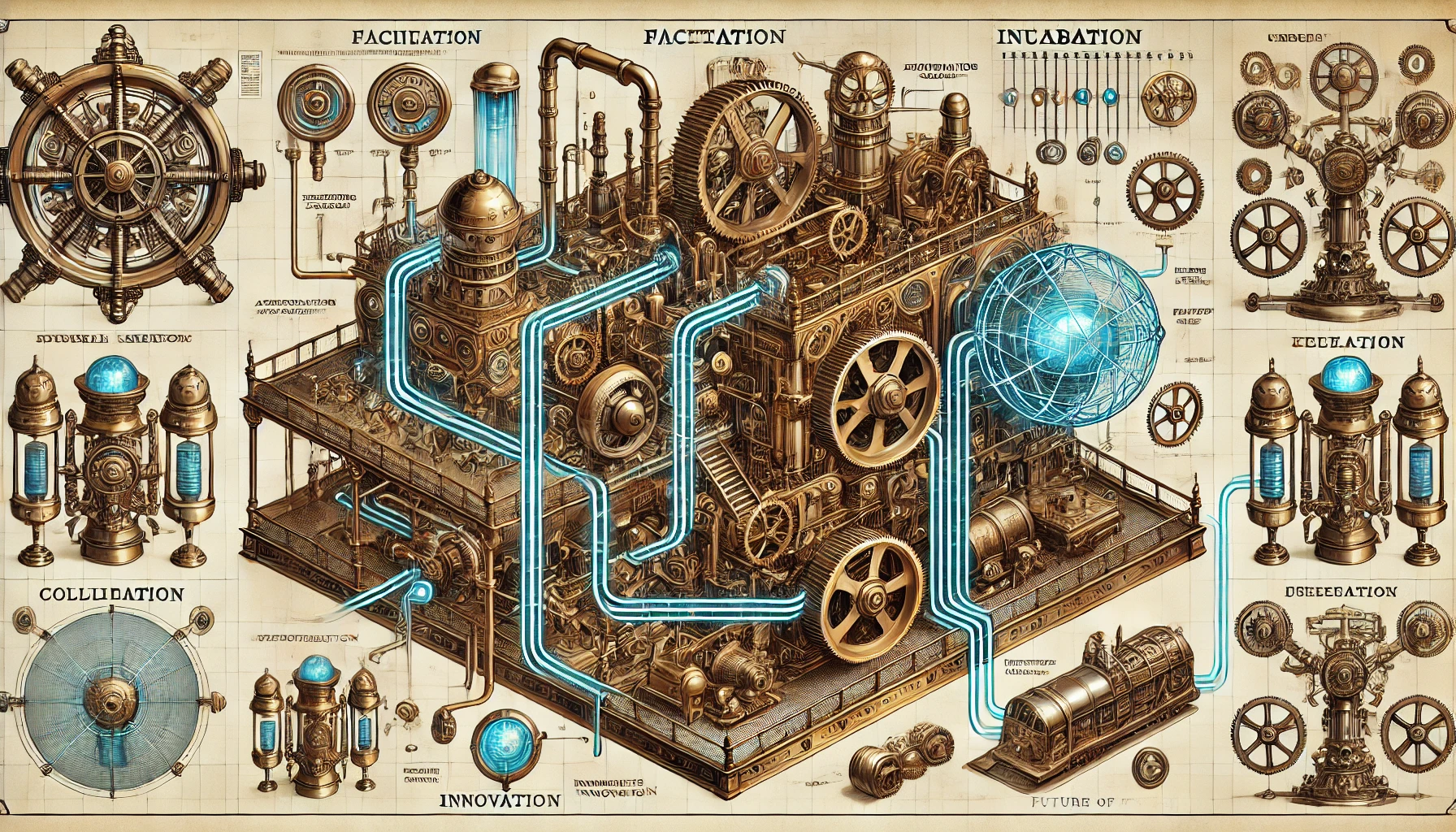
MG Rush Facilitation & Innovation Abstract
7. Key Takeaways
- MG RUSH training is ideal for structured, results-driven facilitation.
- BPI methodology helps with process improvement via stakeholder analysis.
- Quantum facilitation is best for complex problem-solving and innovation.
- Zero Distance facilitation aligns closely with user-centric decision-making.
- Innovation Hubs offer a company-wide approach to building a facilitative culture.
Next Steps
Would you like assistance in selecting the best training for your specific needs? Let us know how we can further your cause and career!
- Help choosing the right MG RUSH course for your needs?
- A thorough narrative of the MG RUSH training methodology?
- Meeting with your team and addressing their questions?
Let us know how we can assist because nobody is smarter than everybody.
______
Lead the Change—One Meeting at a Time
Are you ready to transform how decisions are made, problems are solved, and alignment is built in your organization?
True meeting leadership goes beyond setting an agenda. It requires a facilitator who can navigate complexity, balance voices, and drive toward outcomes with clarity and consensus. Our Professional Meeting Leadership Workshop and facilitation training equips you to do just that—blending human-centric methods with structured analytical tools to foster rigor, inclusivity, and results that stick.
- Practice live.
- Get expert feedback.
- Build confidence that lasts.
Whether your meetings suffer from unclear objectives, disengaged participants, or decision fatigue, this workshop will help you identify the root causes, apply proven facilitation techniques, and emerge as the leader every team needs.
Take the first step today—transform your meetings and magnify your impact.
👉 Click here to reserve your seat now.
#facilitationtraining #meetingdesign
Because every meeting should be a catalyst for change—not just another calendar event.
______
With Bookmarks no longer a feature in WordPress, we provide the following for your benefit and reference.
- 20 Prioritization Techniques = https://foldingburritos.com/product-prioritization-techniques/
- Creativity Techniques = https://www.mycoted.com/Category:Creativity_Techniques
- Facilitation Training Calendar = https://mgrush.com/public-facilitation-training-calendar/
- Liberating Structures = http://www.liberatingstructures.com/ls-menu
- Management Methods = https://www.valuebasedmanagement.net
- Newseum = https://www.freedomforum.org/todaysfrontpages/
- People Search = https://pudding.cool/2019/05/people-map/
- Project Gutenberg = http://www.gutenberg.org/wiki/Main_Page
- Scrum Events Agendas = https://mgrush.com/blog/scrum-facilitation/
- Speed test = https://www.speedtest.net/result/8715401342
- Teleconference call = https://youtu.be/DYu_bGbZiiQ
- The Size of Space = https://neal.fun/size-of-space/
- Thiagi/ 400 ready-to-use training games = http://thiagi.net/archive/www/games.html
- Visualization methods = http://www.visual-literacy.org/periodic_table/periodic_table.html#
______
Terrence Metz, president of MG RUSH Facilitation Training, was just 22-years-old and working as a Sales Engineer at Honeywell when he recognized a widespread problem—most meetings were ineffective and poorly led, wasting both time and company resources. However, he also observed meetings that worked. What set them apart? A well-prepared leader who structured the session to ensure participants contributed meaningfully and achieved clear outcomes.
Throughout his career, Metz, who earned an MBA from Kellogg (Northwestern University) experienced and also trained in various facilitation techniques. In 2004, he purchased MG RUSH where he shifted his focus toward improving established meeting designs and building a curriculum that would teach others how to lead, facilitate, and structure meetings that drive results. His expertise in training world-class facilitators led to the 2020 publication of Meetings That Get Results: A Guide to Building Better Meetings, a comprehensive resource on effectively building consensus.
Grounded in the principle that “nobody is smarter than everybody,” the book details the why, what, and how of building consensus when making decisions, planning, and solving problems. Along with a Participant’s Guide and supplemental workshops, it supports learning from foundational awareness to professional certification.
Metz’s first book, Change or Die: A Business Process Improvement Manual, tackled the challenges of process optimization. His upcoming book, Catalyst: Facilitating Innovation, focuses on meetings and workshops that don’t simply end when time runs out but conclude with actionable next steps and clear assignments—ensuring progress beyond discussions and ideas.
