
Even lousy movies and novels have three components: a beginning, a middle, and an end. A meeting participant (or ceremony, event, session, or workshop) should expect every session they attend to provide at least ten clear outputs. Seven clear results from the Introduction and three outputs from the Wrap.
Below is a checklist of the ten outputs a meeting participant should receive followed by detailed support for each.
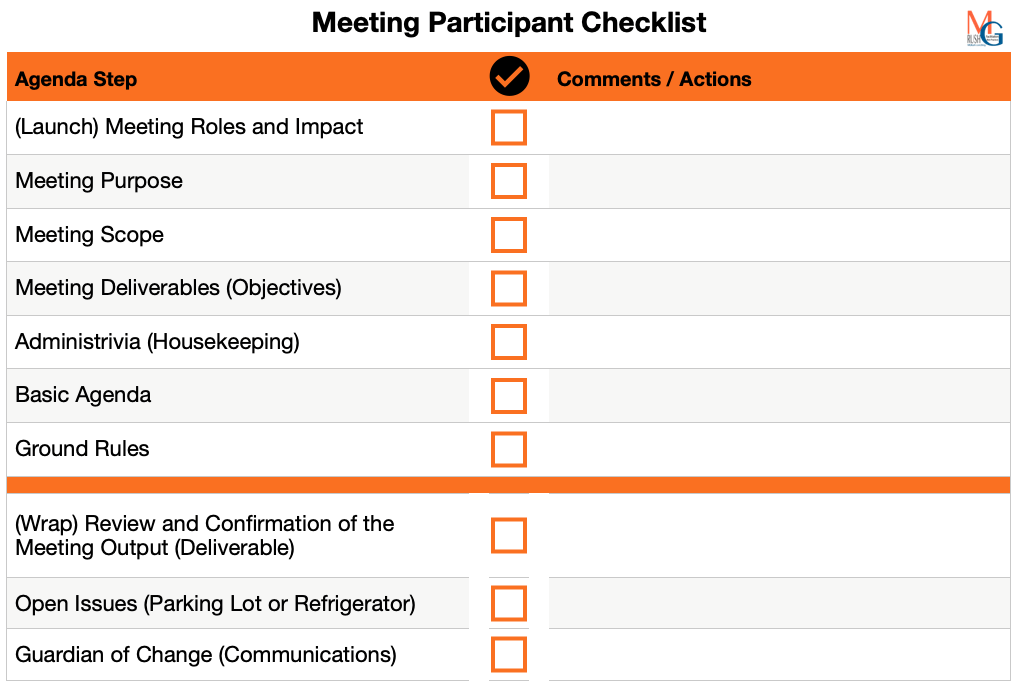
Meeting Participant Checklist
1. Roles and Impact
- Facilitators should emphasize their own content neutrality and lack of bias.
- The facilitator should stress that participants are all equal (put on your sweaters to hide rank and leave your egos and titles in the hallway)
- The meeting impact should be quantified as to why the meeting is important, typically in currency (e.g., $,$$$,$$$.$$) and/or FTP (Full-time People)
2. Meeting Purpose
- An articulate statement of the Meeting Purpose (50 words or less).
- If the leader is unable to provide a clear statement of the meeting’s purpose, they are probably not ready to lead the meeting.
3. Situational Scope
- An articulate statement of the Meeting Scope.
- This may have been combined in the Purpose statement if the scope is rather simple or concrete such as geographical.
- However, if the scope is complex as with many IoT (Internet of Things) products and services, then it should be separate.
- Keep in mind that scope creep kills projects and products.
- And scope creep begins in meetings.
4. Meeting Deliverables (Objectives)
- A narrative statement, illustration, or sample that provides a clear understanding of the output from the session.
- Agilists refer to deliverables as DONE or what DONE looks like.
- Optimally, the leader provides an example from a surrogate product, project, or template.
5. Administrivia (Housekeeping)
- Covers contextual concerns, not related to the content of the deliverable.
- Examples include:
- Fire exits and safety evacuation procedures
- Bathroom locations and frequency of breaks
- Food and beverage provisions (if any)
- They might include icebreakers here, or insert as a step eight
6. Basic Agenda
- In the Launch or Introduction, the leader should explain each of the agenda steps, focusing on:
- What does the deliverable or DONE look like for each step?
- Why the steps are provided in the sequence shown?
- How each step relates to completing the deliverable and getting DONE.
- While explaining they should prepare you for the timing and duration of breaks, lunch, or other non-meeting issues that could affect timing.
- Optimally, the leader provides a metaphor or analogy explaining the relationship of the steps. You know that a picture is worth a thousand words. Well, a metaphor is worth a thousand pictures (and a story is worth a thousand metaphors).
7. Ground Rules
- Ground rules should be provided if you want to get more done, faster.
- “Be Here Now” because disabling electronic leashes reduces distractions.
- “Silence is Agreement” applies in for-profit situations. If you are being paid to attend the meeting, speaking up is not an opportunity, it is an obligation.
- “Make Your Thinking Visible” appropriately requests the cause behind the symptom, forcing all of us to provide evidence or objective proof of our claims.
- See “Ground Rules and Ideation Rules for Optimal Group Behavior in Meetings” for a list of others you may want to request as a participant.
- Unless icebreakers are inserted here, this step should conclude the Introduction.
8. (Wrap) Review and Confirmation of the Meeting Output (Deliverable)
- You are entitled to a complete review of the agreed-upon output from the meeting.
- During the review, take the following questions into account:
- What questions or issues of clarity do you have?
- What is missing that may be critical, important, or substantive?
- Even though the output (e.g., a decision) may not be your favorite, is the output robust enough that you will support it?
- If not, what needs to be removed or modified?
9. Open Issues (Parking Lot or Refrigerator)
- You are entitled to a complete review of the agreed-upon output from the session.
- Make sure you understand the Open Issue because frequently Open Issues are ‘thrown’ into the Parking Lot and may be somewhat cryptic.
- Be prepared to volunteer to take responsibility to report back to the group on the status of the Open Issue (you are not necessarily the ‘doer’).
10. Guardian of Change (Communications Plan)
- Make sure the leader takes a few minutes to build agreement around what the participants are going to tell others was accomplished during the session.
- Typically, the message to your superior might be different than the message to other stakeholders such as employees or contractors.
- Try to ensure that it sounds like all the participants were in the same meeting together.
Here’s a thumbnail of our approach to Structured Note Taking many find useful. Click HERE to download the full-size PDF.
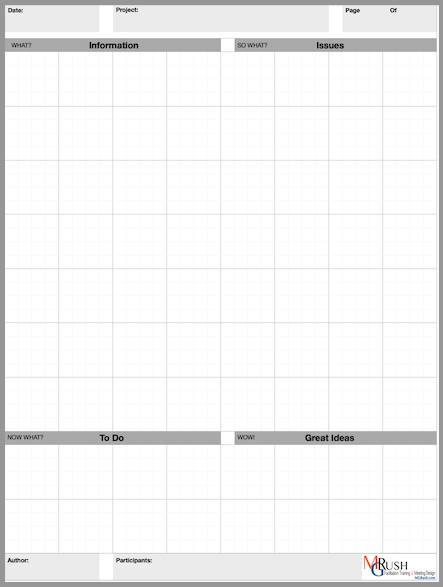
Structured Note Taking
MIDDLE STEPS OF THE AGENDA
Here are the Basic Agendas for over 30 types of deliverables. Alumni can use their passwords to access the annotated versions in a .DOCX format, making them easy to modify. The annotated agendas include the following for EACH agenda step:
- Purpose of the agenda step
- Estimated time
- PROCEDURE or method including recommended tools and the questions to ask
- Visual or multi-media support suggested
- Output from the agenda step (Deliverable)
- Script for concluding the step, including the suggestion of a metaphor
PLANNING AGENDAS
Planning [From Strategic to Team]
- Launch
- Mission (WHY are we here?)
- Values (WHO are we?)
- Vision (WHERE are we going? How do we know if we got there or not?)
- Success Measures (WHAT are our measurements of progress?)
- Current Situation (WHERE are we now? Quantitative TO-WS Analysis)
- Actions (WHAT should we do?—from strategy through tasks)
- Alignment (Is this the right stuff to do?)
- Roles and Responsibilities (WHO does WHAT, by WHEN?)
- Guardian of Change (WHAT should we tell our stakeholders?)
- Review and Wrap
Project Planning
- INTRODUCTION
- CURRENT SITUATION
- MEASURES OF SUCCESS
- PROJECT STRATEGY
- PROJECT TASKS
- ROLES AND RESPONSIBILITIES
- DEPENDENCY DIAGRAM
- NEXT STEPS
- WRAP & DISMISS
Riffs and Variations
- ASSUMPTIONS, CONSTRAINTS, and DEPENDENCIES
- BUDGET, TIMELINE, AND RESOURCE ALIGNMENT
- BUSINESS CASE OR PURPOSE
- COMMUNICATIONS PLAN and TOUCH POINTS
- CORRECTIVE ACTIONS
- DETAILED WORK BREAKDOWN STRUCTURE
- FLEXIBILITY MATRIX
- FRAMING DIAGRAM (eg, IS NOT/ IS)
- ISSUE ESCALATION PROCEDURE
- OPEN ISSUES MANAGEMENT
- PHASE GATES REVIEWS, MILESTONES, OR DECISION POINTS
- RISK ASSESSMENT AND GUIDELINES
- STAKEHOLDERS DESCRIPTIONS
Sprint Planning
- Launch
- Potential Sprint Goal
- Product Backlog Sizing
- Capacity Planning
- Backlog Selection
- Backlog Tasking
- Final Sprint Goal
- Review and Wrap
Sprint Review
- Launch
- Sprint Goal Reflection
- Sprint Reflection Demonstration
- “DONE”
- Acceptance
- Revisions
- Next Steps
- Review and Wrap
Sprint Retrospective
- Launch
- WHAT (Facts, Learnings)
- SO WHAT (Implications, Insight)
- NOW WHAT (Recommendations, Kaizen Improvements)
- Testing
- Review and Wrap
Sprint Riffs and Variations
- Action Conversion
- Categorizing
- Context Diagram
- Framing
- Guardian of Change
- Prioritization Tools
- Purpose Tool
- Requirements Gathering
- Root Cause Analysis
- Speedboat
- Splitting Stories
- TO-WS Lite
- User Story and Acceptance Criteria
- Temporal Shift
Problem-solving
- Launch
- Definition of the Object or Situation (problem state)
- Purpose of the Object or Situation (ideal state)
- Symptoms (externally identifiable factors)
- Causes
- Actions (for each cause):
-
- Preventions
- Cures
- Us
- Them
- Testing
- Review and Wrap
Project Risk Assessment
- Launch
- External Risk
- Internal Risk
- Hybrid Risk
- Consensual Review
- Prioritization
- Review and Wrap
Scenario Planning
- Launch
- Sunny Skies
- Stormy Skies
- Partly Sunny Skies
- Partly Cloudy Skies
- Probably Skies
- Ranges of Probability
- Targets and Thresholds
- Review and Wrap
Strategy Mapping
- Launch
- Financial Perspective
- Customer Perspective
- Internal Perspective
- Growth Perspective
- Cultural Challenges
- Leadership Challenges
- Alignment
- Teamwork
- Review and Wrap
Reflective Thinking
- Introduction
- Define and Limit the Problem
- Analyze the Problem
- Criteria
- Optional Solutions
- Selection
- Implementation
- Wrap
Resource Life Cycle
- INTRODUCTION
- PRODUCT OR SERVICE RESOURCES
- LIFE CYCLE
- ENABLING RESOURCES
- LIFE CYCLE FOR EACH RESOURCE
- PRECEDENCE BETWEEN RESOURCES
- WRAP & DISMISS
Solution Generation
- Introduction
- Ventilation
- Clarification
- Analysis of Problem
- Set Criteria
- Suggest Solutions
- Evaluate Solutions
- Deselect Sub-Optimals
- Select Solution(s)
- Implement the Solution
- Roles & Responsibilities
- Guardian of Change
- Review & Wrap
ANALYSIS AGENDAS
Appreciative Inquiry
- Launch
- Discovery
- Dream
- Design
- Destiny
- Testing
- Review and Wrap
After Action Review (Hot Wash)
- Launch
- Success Objectives
- Goals and Considerations
- What Worked and Hampered
- Issues and Risks
- Review and Wrap
Context Diagram
- INTRODUCTION
- PURPOSE OF THE BUSINESS AREA
- WHO INTERACTS (Enablers)
- WHAT COMES IN (Inputs)
- WHAT GOES OUT (Outputs)
- MODEL AND VALIDATION (Walk-thru)
- REVIEW AND WRAP
Activity Flows [Requirements]
- Introduction
- Purpose of the Business Area
- Support Activities (verb-noun)
- Processes
- Purpose of Each Process
- Life cycle Activities
- Procedures (or, SIPOC or Requirements)
- Review and Wrap
Data Flow Diagram
- Introduction
- THE BASE (Display or build the context diagram)
- BUSINESS PROCESSES
- MATCHED INPUTS AND OUTPUTS WITH PROCESSES
- STORES OF INFORMATION
- EACH PROCESS
- NEEDED DATA
- GENERAL REQUIREMENTS
- Review and Wrap
Decision-making Approach
- Launch
- Purpose of the Object
- Options
- Decision Criteria
- Deselection and Decision
- Testing
- Review and Wrap
Decision Support
- Introduction
- WHAT QUESTIONS DO YOU NEED TO ANSWER
- WHAT INFORMATION IS NEEDED
- WHERE IS THE INFORMATION CURRENTLY STORED
- WHERE SHOULD THE INFORMATION BE STORED
- HOW WILL THE INFORMATION BE USED
- INTERACTION
- OPERATING CHANGES
- Review and Wrap
FMEA (Failure Mode & Effect Analysis)
- INTRODUCTION
- DEFINE FMEA SCOPE (CHARTER)
- IDENTIFY FAILURE MODES
- IDENTIFY EFFECTS OF FAILURE MODES
- VALUE EFFECTS BY: SEVERITY
- RATE EFFECTS BY: INCIDENCE
- RATE EFFECTS BY: DETECTION
- VALUE EFFECTS BY: CONFIDENCE
- CALCULATE COMPOSITE RISK RATING
- IDENTIFY CORRECTIVE ACTIONS
- PRIORITIZE CORRECTIVE ACTION
- CALCULATE REVISED COMPOSITE RISK RATING
- WRAP
Logical Modeling
- INTRODUCTION
- PURPOSE OF THE BUSINESS AREA
- “THINGS” THAT SUPPORT THE PURPOSE
- HOW THINGS RELATE
- DESCRIBING EACH “THING”
- BUSINESS RULES
- WALKTHROUGH
- WRAP
Mandate Compliance
- Introduction
- Mandate Review
- Requirements Modeling
- Model Integration
- Guardian of Change
- Wrap and dismiss
Peer Review Inspection
- INTRODUCTION
- PRI SCOPE (Peer Review Inspection)
- RESOURCES* & PRIORITIZED ARTIFACTS
- OVERVIEW
- DEFECTS
- CAUSE-EFFECT (Optional)
- CORRECTIVE ACTIONS (REWORK)
- DEFECT LOG AND REPORT
- WRAP
Real-Win-Worth
- Launch
- To What Extent Is the Opportunity Real?
- How Can We Win Compared to Competitive Options?
- To What Extent is the opportunity Worth Doing?
- Review and Wrap
DESIGN AGENDAS
Basic Design Agenda
- INTRODUCTION
- THE ACTIVITY
- REQUIRED INFORMATION
- SCREENS, REPORTS, OR SWIM LANES
- ENVIRONMENT
- OPERATING CHANGES
(repeat for each activity or process)
- REVIEW AND WRAP
Transaction (JAD or Joint Application Development)
- INTRODUCTION
(for each activity linking to the Design Agenda above)
1 PLANNING
2 RECEIVING
3 ARRIVAL PROCESSING
4 ASSIGNING
5 PROCESSING
6 RECORDING
7 DISPOSITION
8 PERFORMANCE EVALUATION
- WRAP
Organizational Design
- INTRODUCTION
- THE VISION
- ORGANIZATION OBJECTIVES
- CRITERIA FOR DESIGN
- ORGANIZATIONAL STRATEGIES
- CRITERIA FOR STRATEGIES
- PROTOTYPICAL ORGANIZATION
- TEST DESIGN—RASI AND SCENARIOS
- LATERAL COORDINATION
- EVOLUTIONARY PATH
- WRAP
Object-Oriented Design
- INTRODUCTION
- OBJECTS
- ACTIONS
- MESSAGES BETWEEN OBJECTS
- SCREENS, REPORTS, SWIM-LANES
- WRAP
You have just viewed a few hundred thousand dollars of time it took to build the annotated support behind each. Let us know what questions you might have. We aim to serve.
______
Lead the Change—One Meeting at a Time
Are you ready to transform how decisions are made, problems are solved, and alignment is built in your organization?
True meeting leadership goes beyond setting an agenda. It requires a facilitator who can navigate complexity, balance voices, and drive toward outcomes with clarity and consensus. Our Professional Meeting Leadership Workshop and facilitation training equips you to do just that—blending human-centric methods with structured analytical tools to foster rigor, inclusivity, and results that stick.
- Practice live.
- Get expert feedback.
- Build confidence that lasts.
Whether your meetings suffer from unclear objectives, disengaged participants, or decision fatigue, this workshop will help you identify the root causes, apply proven facilitation techniques, and emerge as the leader every team needs.
Take the first step today—transform your meetings and magnify your impact.
👉 Click here to reserve your seat now.
(Limited availability)
Because every meeting should be a catalyst for change—not just another calendar event.
______
And earn up to 40 professional development credits.
- CDUs (IIBA)
- CLPs (Federal Acquisition)
- PDUs (SAVE International)
- SEUs (Scrum Alliance)
- 4.0 CEUs (General Professions)
______
With Bookmarks no longer a feature in WordPress, we provide the following for your benefit and reference.
- 20 Prioritization Techniques = https://foldingburritos.com/product-prioritization-techniques/
- Creativity Techniques = https://www.mycoted.com/Category:Creativity_Techniques
- Facilitation Training Calendar = https://mgrush.com/public-facilitation-training-calendar/
- Liberating Structures = http://www.liberatingstructures.com/ls-menu
- Management Methods = https://www.valuebasedmanagement.net
- Newseum = https://www.freedomforum.org/todaysfrontpages/
- People Search = https://pudding.cool/2019/05/people-map/
- Project Gutenberg = http://www.gutenberg.org/wiki/Main_Page
- Scrum Events Agendas = https://mgrush.com/blog/scrum-facilitation/
- Speed test = https://www.speedtest.net/result/8715401342
- Teleconference call = https://youtu.be/DYu_bGbZiiQ
- The Size of Space = https://neal.fun/size-of-space/
- Thiagi/ 400 ready-to-use training games = http://thiagi.net/archive/www/games.html
- Visualization methods = http://www.visual-literacy.org/periodic_table/periodic_table.html#
- Walking Gorilla = https://youtu.be/vJG698U2Mvo
______

Terrence Metz, president of MG RUSH Facilitation Training, was just 22-years-old and working as a Sales Engineer at Honeywell when he recognized a widespread problem—most meetings were ineffective and poorly led, wasting both time and company resources. However, he also observed meetings that worked. What set them apart? A well-prepared leader who structured the session to ensure participants contributed meaningfully and achieved clear outcomes.
Throughout his career, Metz, who earned an MBA from Kellogg (Northwestern University) experienced and also trained in various facilitation techniques. In 2004, he purchased MG RUSH where he shifted his focus toward improving established meeting designs and building a curriculum that would teach others how to lead, facilitate, and structure meetings that drive results. His expertise in training world-class facilitators led to the 2020 publication of Meetings That Get Results: A Guide to Building Better Meetings, a comprehensive resource on effectively building consensus.
Grounded in the principle that “nobody is smarter than everybody,” the book details the why, what, and how of building consensus when making decisions, planning, and solving problems. Along with a Participant’s Guide and supplemental workshops, it supports learning from foundational awareness to professional certification.
Metz’s first book, Change or Die: A Business Process Improvement Manual, tackled the challenges of process optimization. His upcoming book, Catalyst: Facilitating Innovation, focuses on meetings and workshops that don’t simply end when time runs out but conclude with actionable next steps and clear assignments—ensuring progress beyond discussions and ideas.
