
A decision matrix supports both decision-making and decision quality at the same time. A decision matrix can be viewed as the ‘logic’ behind all decisions, providing the rationale for both the support and reasons to de-select or de-emphasize one of the options.
Method to Create a Decision Matrix
First, determine and agree upon the “Purpose” of the object or topic being decided. Then separately list and define your options. Follow up with a detailed and objective understanding of the decision criteria. Copy them into a simple X-Y grid as shown below.
Use the “Creativity” tool or narrative “Brainstorming” to develop lists of both the options being considered and the criteria to be used to evaluate the options. By applying “PowerBalls” and carefully wording our questions, we can now assess the impact of each criterion on each of the options with a simple decision matrix. For example, if we want to know which sports to target in a marketing campaign, we might develop two lists and populate the decision matrix as shown below:
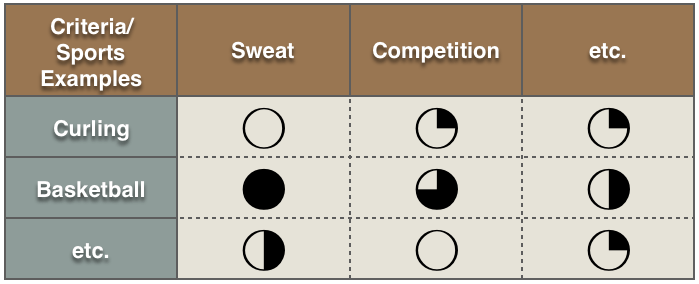
Basic Decision Matrix
- At the intersection of each criterion and option, ask precisely the following at the start of your analysis effort.
“TO WHAT EXTENT DOES ‘X’ IMPACT (OR RELATE) TO ‘Y’?”
- From the example above we might determine that from the perspective of a sports drink company, ‘Basketball’ is a more desirable option than ‘Curling.’
CAUTION: AVOID THE CLOSE-ENDED QUESTION “Does ‘X’ involve ‘Y’?” There is always a subject matter expert who can draw the correlation. Conceding ‘Relativity’ we are not after “Does it?”. Rather, we are focused on the degree, intensity, level, or to what extent does it.
Benefits of a Decision Matrix
Always provide your executive sponsor or steering team with a decision matrix to back up your decision. This simple but highly effective visual tool preempts their common question, “Why did you select ‘X’?” The decision matrix provides a visual display of your rationale and trail of logic. Furthermore, if the decision changes, it forces the team to adjust their logic. Once documented, it enables your team to be consistent with subsequent decisions.
______
Lead the Change—One Meeting at a Time
Are you ready to transform how decisions are made, problems are solved, and alignment is built in your organization?
True meeting leadership goes beyond setting an agenda. It requires a facilitator who can navigate complexity, balance voices, and drive toward outcomes with clarity and consensus. Our Professional Meeting Leadership Workshop equips you to do just that—blending human-centric methods with structured analytical tools to foster rigor, inclusivity, and results that stick.
- Practice live.
- Get expert feedback.
- Build confidence that lasts.
Whether your meetings suffer from unclear objectives, disengaged participants, or decision fatigue, this workshop will help you identify the root causes, apply proven facilitation techniques, and emerge as the leader every team needs.
Take the first step today—transform your meetings and magnify your impact.
👉 Click here to reserve your seat now.
(Limited availability)
Because every meeting should be a catalyst for change—not just another calendar event.
______
And earn up to 40 professional development credits.
- CDUs (IIBA)
- CLPs (Federal Acquisition)
- PDUs (SAVE International)
- SEUs (Scrum Alliance)
- 4.0 CEUs (General Professions)
______
With Bookmarks no longer a feature in WordPress, we provide the following for your benefit and reference.
- 20 Prioritization Techniques = https://foldingburritos.com/product-prioritization-techniques/
- Creativity Techniques = https://www.mycoted.com/Category:Creativity_Techniques
- Facilitation Training Calendar = https://mgrush.com/public-facilitation-training-calendar/
- Liberating Structures = http://www.liberatingstructures.com/ls-menu
- Management Methods = https://www.valuebasedmanagement.net
- Newseum = https://www.freedomforum.org/todaysfrontpages/
- People Search = https://pudding.cool/2019/05/people-map/
- Project Gutenberg = http://www.gutenberg.org/wiki/Main_Page
- Scrum Events Agendas = https://mgrush.com/blog/scrum-facilitation/
- Speed test = https://www.speedtest.net/result/8715401342
- Teleconference call = https://youtu.be/DYu_bGbZiiQ
- The Size of Space = https://neal.fun/size-of-space/
- Thiagi/ 400 ready-to-use training games = http://thiagi.net/archive/www/games.html
- Visualization methods = http://www.visual-literacy.org/periodic_table/periodic_table.html#
- Walking Gorilla = https://youtu.be/vJG698U2Mvo
______
Demonstration Video

Terrence Metz, president of MG RUSH Facilitation Training, was just 22-years-old and working as a Sales Engineer at Honeywell when he recognized a widespread problem—most meetings were ineffective and poorly led, wasting both time and company resources. However, he also observed meetings that worked. What set them apart? A well-prepared leader who structured the session to ensure participants contributed meaningfully and achieved clear outcomes.
Throughout his career, Metz, who earned an MBA from Kellogg (Northwestern University) experienced and also trained in various facilitation techniques. In 2004, he purchased MG RUSH where he shifted his focus toward improving established meeting designs and building a curriculum that would teach others how to lead, facilitate, and structure meetings that drive results. His expertise in training world-class facilitators led to the 2020 publication of Meetings That Get Results: A Guide to Building Better Meetings, a comprehensive resource on effectively building consensus.
Grounded in the principle that “nobody is smarter than everybody,” the book details the why, what, and how of building consensus when making decisions, planning, and solving problems. Along with a Participant’s Guide and supplemental workshops, it supports learning from foundational awareness to professional certification.
Metz’s first book, Change or Die: A Business Process Improvement Manual, tackled the challenges of process optimization. His upcoming book, Catalyst: Facilitating Innovation, focuses on meetings and workshops that don’t simply end when time runs out but conclude with actionable next steps and clear assignments—ensuring progress beyond discussions and ideas.
