
Previously, we defined ‘best’ as projects that performed well in an innovation test, focusing on the relative technology and market risks associated with new ideas (e.g., processes, products, etc.). With the Real-Win-Worth framework—designed for experienced facilitators and meeting designers, but equally valuable for beginners—we take this a step further by isolating the most promising candidates for success.
The Real-Win-Worth Three-step Screening Approach:
- How Real is the opportunity,
- To what extent we can Win compared to competitive options, and
- To what extent the opportunity is Worth doing?
MGRUSH has been a long-term supporter of decision matrices. With some leaning on George Day[1], the following questions provide the framework you can modify for your situation.
“The R-W-W (Real-Win-Worth) screen(ing) is a simple but powerful tool built on a series of questions about the innovation concept or product, its potential market, and the company’s capabilities and competition.” – George Day
The Real-Win-Worth approach provides objective scores but requires expert reviews at each stage. If the idea is ‘great’, but we cannot win—there is no need to go further. Even if we have the capacity to win, if the concept is not worth much, there is no need to go further. As a consensus-building tool, the Real-Win-Worth approach provides a disciplined method for exposing assumptions while identifying knowledge gaps (and areas of superiority).
Successful screening depends upon the quality of the questions you use. Therefore, to arrive at a consensual understanding of answers to the final question about each of Real-Win-Worth, develop a robust set of detailed questions. Because neither Mr. Day nor MGRUSH can tell you how to modify the basic questions for your situation, first understand the intent and then determine what you need to make an informed decision during each of the three stages.
To what extent the opportunity is Real
Consider two critical vectors. Value the feasibility of the product, service, or solution and the extent to which it is attractive (e.g., internal or external customers). Answer these factors by exploring the questions they contain. Eight representative questions are provided below. Rarely should the questions be posed as close-ended. Rather, by exploring the “extent” or amount, you develop varying degrees across the vector.
Typically, your best (perhaps most innovative) solutions will score higher relative to each other. For example, with question 2.2. (To what extent do we have the technology and expertise to make it?) Your range could be . . . Note the non-linear weighting suggested below, ranging from zero through nine. Ultimately the ideas that score best will pass on to the next phase or stage.
To what extent we can Win compared to competitive options
After determining the extent to which your customer demand and solution are both real, assess your ability to succeed against competitive options. According to Day,
“Two of the top three reasons for new-product failures, as revealed by audits, would have been exposed by the Can we win? analysis: Either the new product didn’t achieve its market-share goals, or prices dropped much faster than expected. (The third reason is that the market was smaller, or grew more slowly, than expected.)”
Begin by reviewing the additional six questions that explain the two factors of synergies and advantages. Then, consider pulling in the results from any research efforts to help answer the questions. Focus on an open-ended answer of likely outcomes or projections. For example,
To what extent the opportunity is Worth doing
Finally, the last stage addresses predictive factors including financial risk/ reward and strategic fit. Financial projections can be general or refined, but apply consistent rigor to everything you evaluate. Additionally, keep in mind that forecasts of financial returns from innovative solutions are notoriously unreliable. Day notes from his research that . . .
“Given the susceptibility of financial forecasts to manipulation, overconfidence, and bias, executives should depend on rigorous answers to the prior questions in the screen for their conclusions about profitability.”
The ranges you need to use should be modified for your scale. Remember that risk/ reward factors while specific, are nevertheless projections. Therefore, aggregate the group input for evaluation since the Wisdom of the Crowd suggests that nobody is smarter than everybody. Here are some illustrative placeholders for one of the nine questions suggested below.
Facilitator Considerations
Consider holding a facilitated session to collaboratively develop your evaluation criteria and key questions. You may find that having individuals score candidates privately, followed by aggregating the results, creates a strong foundation for decision-making. This approach ensures the session is grounded in collective understanding and diverse perspectives. Remember, the highest-scoring idea(s) may not automatically win, but it’s essential to avoid overanalyzing suboptimal options. Instead, guide the group’s focus toward the most promising candidates to make informed, effective final decisions.
Please consider the following Real-Win-Worth questions as guidelines, meant to be freely adapted and customized to fit your specific context. Additionally, toward the end of this article, you will find illustrative examples of questions along with a potential range of responses for each.
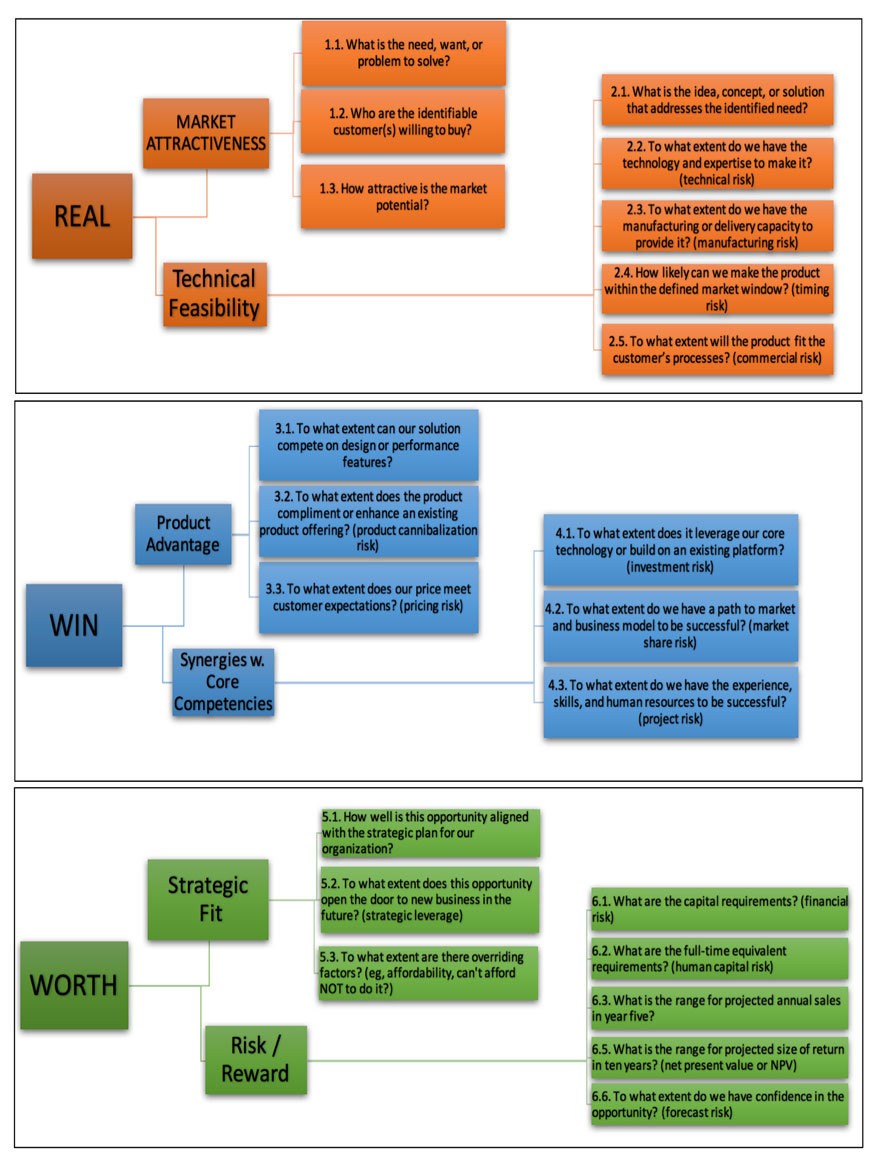
Real-Win-Worth Nodes
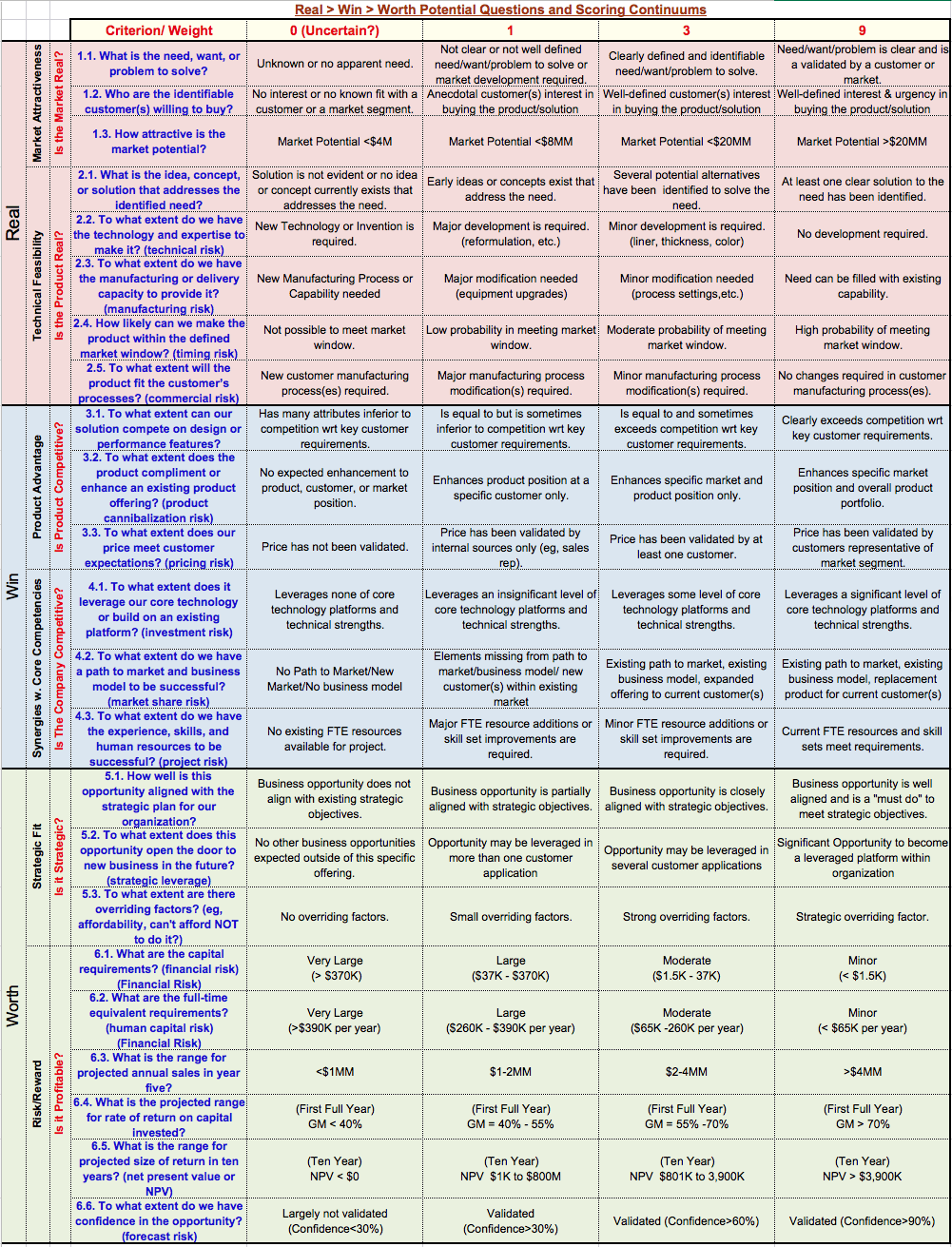
Real-Win-Worth Illustration
[1] See “Is It Real? Can We Win? Is It Worth Doing? Managing Risk and Reward in an Innovation Portfolio” which appeared in the December 2007 edition of the Harvard Business Review
In a world where everyone can engage in decisions that affect them
______
Lead the Change—One Meeting at a Time
Are you ready to transform how decisions are made, problems are solved, and alignment is built in your organization?
True meeting leadership goes beyond setting an agenda. It requires a facilitator who can navigate complexity, balance voices, and drive toward outcomes with clarity and consensus. Our Professional Meeting Leadership Workshop and facilitation training equips you to do just that—blending human-centric methods with structured analytical tools to foster rigor, inclusivity, and results that stick.
- Practice live.
- Get expert feedback.
- Build confidence that lasts.
Whether your meetings suffer from unclear objectives, disengaged participants, or decision fatigue, this workshop will help you identify the root causes, apply proven facilitation techniques, and emerge as the leader every team needs.
Take the first step today—transform your meetings and magnify your impact.
👉 Click here to reserve your seat now.
#facilitationtraining #meetingdesign
Because every meeting should be a catalyst for change—not just another calendar event.
______
With Bookmarks no longer a feature in WordPress, we provide the following for your benefit and reference.
- 20 Prioritization Techniques = https://foldingburritos.com/product-prioritization-techniques/
- Creativity Techniques = https://www.mycoted.com/Category:Creativity_Techniques
- Facilitation Training Calendar = https://mgrush.com/public-facilitation-training-calendar/
- Liberating Structures = http://www.liberatingstructures.com/ls-menu
- Management Methods = https://www.valuebasedmanagement.net
- Newseum = https://www.freedomforum.org/todaysfrontpages/
- People Search = https://pudding.cool/2019/05/people-map/
- Project Gutenberg = http://www.gutenberg.org/wiki/Main_Page
- Scrum Events Agendas = https://mgrush.com/blog/scrum-facilitation/
- Speed test = https://www.speedtest.net/result/8715401342
- Teleconference call = https://youtu.be/DYu_bGbZiiQ
- The Size of Space = https://neal.fun/size-of-space/
- Thiagi/ 400 ready-to-use training games = http://thiagi.net/archive/www/games.html
- Visualization methods = http://www.visual-literacy.org/periodic_table/periodic_table.html#
______

Terrence Metz, president of MG RUSH Facilitation Training, was just 22-years-old and working as a Sales Engineer at Honeywell when he recognized a widespread problem—most meetings were ineffective and poorly led, wasting both time and company resources. However, he also observed meetings that worked. What set them apart? A well-prepared leader who structured the session to ensure participants contributed meaningfully and achieved clear outcomes.
Throughout his career, Metz, who earned an MBA from Kellogg (Northwestern University) experienced and also trained in various facilitation techniques. In 2004, he purchased MG RUSH where he shifted his focus toward improving established meeting designs and building a curriculum that would teach others how to lead, facilitate, and structure meetings that drive results. His expertise in training world-class facilitators led to the 2020 publication of Meetings That Get Results: A Guide to Building Better Meetings, a comprehensive resource on effectively building consensus.
Grounded in the principle that “nobody is smarter than everybody,” the book details the why, what, and how of building consensus when making decisions, planning, and solving problems. Along with a Participant’s Guide and supplemental workshops, it supports learning from foundational awareness to professional certification.
Metz’s first book, Change or Die: A Business Process Improvement Manual, tackled the challenges of process optimization. His upcoming book, Catalyst: Facilitating Innovation, focuses on meetings and workshops that don’t simply end when time runs out but conclude with actionable next steps and clear assignments—ensuring progress beyond discussions and ideas.

Hi to every one, it’s actually a nice for me to pay a visit this
site, it consists of important Information.
Appreciate the value comment Freddie. We pour a lot of genuine knowledge into actions you can take to be more effective immediately.