
Use ground rules to help manage individual and group behavior during meetings and workshops.
You can lead meetings and discussions without ground rules, but did you ever leave an unstructured meeting with a headache? The term “discussion” is rooted similarly to the terms “concussion” and “percussion.” A little bit of structure will ensure that you get more done, fast.
Primary Ground Rules
Consider a few, select ground rules for every meeting, regardless of your situation. We consider the following four ground rules so important we use them in every meeting or workshop. The fifth meeting ground rule shown below (“No Hiding”) has been added for online meetings.
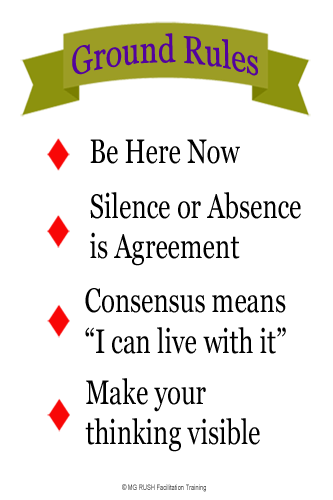
Ground Rules poster available at the MGRUSH Facilitation Store
1. Be Here Now
First and foremost, speaks to the removal of distractions and getting participants to focus. “Be Here Now” demands that electronic leashes be reined in—i.e., phones on stun mode, laptops down, be punctual after breaks, and pay attention. The hardest thing to do with a group of smart people is to get them to focus on the same issue at the same time.
Your job is to remove distractions so that they can focus.
2. Consensus means “I can live with it”
We are NOT defining consensus as everyone’s favorite or top choice. Nor are we suggesting that our decisions will make everyone ‘happy.’ We are facilitating to a standard that everyone can professionally support. Participants agree they will NOT try to undermine the results after the meeting ends. If so, they are guilty of displaying a lack of integrity. We strive to build an agreement that is robust enough to be considered valid by everyone. No one should lose any sleep over the results. Remember, however, it may not be their ‘favorite’ course of action.
3. Silence or absence implies consensus
This ground rule applies to structured, for-profit situations and NOT necessarily unstructured, political, or social meetings. During our standard business meetings, participants have a duty to speak up. It remains the primary responsibility of the facilitator to protect all the meeting participants. It is NOT their job to reach down someone’s throat and pull it out of them. If participants have information to bear in a discussion, then it is their responsibility to share it. Participant involvement is their obligation, not simply their opportunity. Their silence speeds us up since we don’t have time to secure an audible from every participant on every point discussed in a meeting. Their silence indicates two positions that need to be stressed by the facilitator, namely:
- They will support it, and
- They will not lose any sleep over it.
If either is not true, shame on them—they are being paid to participate. If they cannot accept their fiduciary responsibility, they should work somewhere integrity is not valued.
4. Make your thinking visible
People do not think causally. They think symptomatically. Two people eating from the same bowl of chili may argue over how “spicy” it is. Note, that they seldom argue about verbs and nouns. Rather they argue about modifiers (e.g., adjectives and adverbs). They subjectively argue about spiciness. To one, the chili is hot. To the other, it is not. They are both right. A great facilitator will get them to ‘objectify’ their discussion so that they both can agree that the chili is 1,400 Scoville Units. They don’t think Scoville Units however, they think ‘hot”. As facilitator you must challenge them to make their thinking visible.
5. No hiding
For video conferences, enforce a rule that prohibits people from turning off their live video stream. When hidden, no one has any idea what they are doing or if they are even listening. Dr. Tufte uses the term “flatland” to describe the two-dimensional view, such as the view of online participants on a screen. Working in flatland makes it difficult enough to observe nonverbal reactions. Culturally, you may need to get participants’ permission to use this rule but don’t back down. Enforce “no hiding.”
Be Here Now — Our Most Popular Meeting Ground Rule
Constantly Reinforce Be Here Now
Simply applying the ground rule Be Here Now won’t alone solve the problem, but it will help, especially if you take the time to explain everything it means to your participants.
Arrow—
- Post a visual agenda and put an arrow or other device on it to indicate where the group is on the agenda. Do not use the check box approach since it is never clear if the group is on the last checked box or the next unchecked box. Shopping mall signs indicate where you are, not where you were.
Consciousness—
- Ask participants to “be here now’ and strive to keep their consciousness focused on listening and contributing. Ask them to stay fresh, and if necessary, take more frequent breaks. Bio-breaks should be offered more frequently in the morning and with virtual meetings (e.g., video presence). Consider 30-second “stretch” breaks every thirty minutes; offering up quick deep knee bends or shoulder turns to keep participants awake and fresh. Some cultures refer to this as a 30-30, and if it is part of your culture, use a timepiece or timer to signal each 30-minute segment.
Leashes—
- Have participants disengage their electronic leashes and beware because the vibration mode does not mean silent, only lower tones. If participants cannot wait to address an electronic request, have them take it out of the room, but do not allow laptops, smartphones, and multitasking. Groups that claim to multi-task, perform mentally at the level of chimpanzees. Do you really want to facilitate a roomful of monkeys?
Punctuality—
- Participants should not arrive late, either at the meeting start or after breaks. Start meetings on time so that you don’t punish the people who attend on time. Use MGRUSH timers to ensure on-time attendance after breaks.
Updates—
- If participants are late or leave the room and then return, do not stop the meeting to give them a personal update. Personal updates penalize the on-time participants. Rather, refresh the tardy participants during the next break or pair them off with somebody and send them to the hallway for a one-on-one update, if the update cannot wait until the next break.
Consistently Demonstrate Be Here Now
To Be Here Now is infectious so lead the way. Arrive early and first. Watch your time closely and call breaks as needed. More is better so that participants can attend to their electronic updates. Most all agree that four 5-minute breaks during a morning session are better than one 20-minute break. Monitor them tightly however and do not allow leakage. Your group depends on you for their success.
Additional Meeting Ground Rules
We refer to other ground rules as ‘situational’. You will vary their use depending on meeting type, participants, deliverables, and timing. Some secondary meeting ground rules we have found particularly effective are shown below. We don’t have space to discuss them all, but our favorites, based on frequency of use, are italicized:
- Be curious about different perspectives
- Bring a problem, bring a solution
- Challenge (or, test) assumptions
- Chime in or chill out
- Discuss undiscussable issues
- Don’t beat a dead horse
- Everyone has wisdom
- Everyone will hear others and be heard
- Focus on “WHAT” not “HOW”
- Focus on interests, not positions
- Hard on facts, soft on people
- It’s not WHO is right; It’s WHAT is right
- No “Yeah, but”—Make it “Yeah, AND…”
- No big egos or war stories
- Nobody is smarter than everybody
- No praying underneath the table (i.e., texting)
- One conversation at a time (Share airtime)
- Players win games, teams win championships
- Put on Your Sweaters (leave your egos and titles in the hallway)
- Share reasons behind questions and answers
- (or,) Share all relevant information
- Speak for easy listening—headline first, background later
- The team is responsible for the outcome
- The whole is greater than the sum of the parts
- Topless meetings (i.e., phones on stun, no laptops)
- We need everyone’s wisdom
Brainstorming Ideation Rules
Here is an entirely different set of ideation rules that should be used during the Ideation step of the Brainstorming tool. While covered in detail in another article, we are providing the list below for your convenience. With these ideation rules or any of the above ground rules, do not hesitate to contact us for additional explanations:
- 5-Minute Limit Rule (i.e., ELMO doll — Enough, Let’s Move On)
- Accept the views of others
- All ideas allowed
- Be creative — experiment
- Build on the ideas of others
- Everyone participates
- Fast pacing, high-energy
- No discussion
- No word-smithing
- Passion is good
- Stay focused on the topic
- Suspend judgment, evaluation, and criticism
- The step (or workshop) is informal
- When in doubt, leave it in
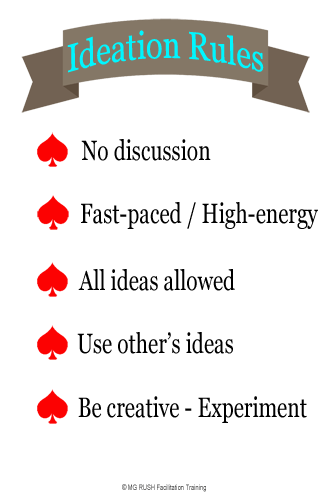
Ideation Ground Rules poster available at the MGRUSH Facilitation Store
______
Meetings must rise above the tiny opening of words and embrace the fullness of human insight—through listening, visuals, stories, numbers, and symbols. The transformation begins not with tools, but in mindset. Leave your ego at the threshold, and step into the structures of meetings that get results.
In a world where everyone can engage in decisions that affect them
______
Lead the Change—One Meeting at a Time
Are you ready to transform how decisions are made, problems are solved, and alignment is built in your organization?
True meeting leadership goes beyond setting an agenda. It requires a facilitator who can navigate complexity, balance voices, and drive toward outcomes with clarity and consensus. Our Professional Meeting Leadership Workshop and facilitation training equips you to do just that—blending human-centric methods with structured analytical tools to foster rigor, inclusivity, and results that stick.
- Practice live.
- Get expert feedback.
- Build confidence that lasts.
Whether your meetings suffer from unclear objectives, disengaged participants, or decision fatigue, this workshop will help you identify the root causes, apply proven facilitation techniques, and emerge as the leader every team needs.
Take the first step today—transform your meetings and magnify your impact.
______
👉 Click here to reserve your seat now.
#facilitationtraining #meetingdesign
Because every meeting should be a catalyst for change—not just another calendar event.
______
With Bookmarks no longer a feature in WordPress, we provide the following for your benefit and reference.
- 20 Prioritization Techniques = https://foldingburritos.com/product-prioritization-techniques/
- Creativity Techniques = https://www.mycoted.com/Category:Creativity_Techniques
- Facilitation Training Calendar = https://mgrush.com/public-facilitation-training-calendar/
- Liberating Structures = http://www.liberatingstructures.com/ls-menu
- Management Methods = https://www.valuebasedmanagement.net
- Newseum = https://www.freedomforum.org/todaysfrontpages/
- People Search = https://pudding.cool/2019/05/people-map/
- Project Gutenberg = http://www.gutenberg.org/wiki/Main_Page
- Scrum Events Agendas = https://mgrush.com/blog/scrum-facilitation/
- Speed test = https://www.speedtest.net/result/8715401342
- Teleconference call = https://youtu.be/DYu_bGbZiiQ
- The Size of Space = https://neal.fun/size-of-space/
- Thiagi/ 400 ready-to-use training games = http://thiagi.net/archive/www/games.html
- Visualization methods = http://www.visual-literacy.org/periodic_table/periodic_table.html#
______

Terrence Metz, president of MG RUSH Facilitation Training, was just 22-years-old and working as a Sales Engineer at Honeywell when he recognized a widespread problem—most meetings were ineffective and poorly led, wasting both time and company resources. However, he also observed meetings that worked. What set them apart? A well-prepared leader who structured the session to ensure participants contributed meaningfully and achieved clear outcomes.
Throughout his career, Metz, who earned an MBA from Kellogg (Northwestern University) experienced and also trained in various facilitation techniques. In 2004, he purchased MG RUSH where he shifted his focus toward improving established meeting designs and building a curriculum that would teach others how to lead, facilitate, and structure meetings that drive results. His expertise in training world-class facilitators led to the 2020 publication of Meetings That Get Results: A Guide to Building Better Meetings, a comprehensive resource on effectively building consensus.
Grounded in the principle that “nobody is smarter than everybody,” the book details the why, what, and how of building consensus when making decisions, planning, and solving problems. Along with a Participant’s Guide and supplemental workshops, it supports learning from foundational awareness to professional certification.
Metz’s first book, Change or Die: A Business Process Improvement Manual, tackled the challenges of process optimization. His upcoming book, Catalyst: Facilitating Innovation, focuses on meetings and workshops that don’t simply end when time runs out but conclude with actionable next steps and clear assignments—ensuring progress beyond discussions and ideas.

The information you provide is highly applicable and valuable. Thanks.