
The Tyranny of the Blank Calendar Invite
Structure does not pose as the enemy of creativity; it serves as its prerequisite. Structure fails to arrive as a blank calendar invitation—a “Quick Catch-Up” or “Marketing Sync” — a meeting invitation with little description, few if any attachments, and rarely an agenda.
The lack of structure induces meeting fatigue, and actively suppresses the innovative breakthroughs your organization seeks. To combat this, meeting leaders do not solely rely on their in-meeting facilitation; they change the rules of engagement before the session even starts by implementing a boundary-setting directive we will call the “No Agenda, (No Attendance)” rule. Far from creating rigid, bureaucratic gridlock, this strict structural boundary creates the exact mechanism required to let raw, unstructured brilliance emerge.
The 4 Pillars of a Legitimate Meeting Invitation
With the “No Agenda” rule your organization establishes a strict, four-pillar standard for what constitutes a “legitimate” meeting invitation. If an invite lacks any of these four pillars, invitees reserve the right—and professional obligation—to DECLINE.
1. Meeting Purpose
If the leader cannot articulate the purpose of their meeting, they are not ready to justify your attendance.
2. Meeting Scope
Optimally, a scope statement or boundaries are provided. We don’t have time or expertise to solve for everything. To make the scope clear, they should also detail what the meeting will NOT include.
3. Meeting Objective
The deliverable needs to drive the meeting so that participants can get DONE. Does the leader know what DONE looks like for the meeting? Provide a single, output-driven sentence defining what success looks like by the time the meeting ends. Do not use passive verbs like “discuss” or “update.” Use active, decisive language.
4. Meeting Agenda
With the above, we know WHY the meeting is important (if not, don’t attend) and WHAT will be covered. The leader must also have a sense of HOW they are going to accomplish the meeting objectives. We call that an Agenda.
(For some sessions, a Pre-Read Mandate helps shift data delivery out of the meeting. If it can be read in an email, it should be banned from the meeting slide deck. If data, status updates, or reports can be read in an email, they ought to be sent as a pre-read at least 24 hours in advance.}
“The meeting room should be reserved exclusively for processing, debating, and deciding—not for reading slides aloud.”
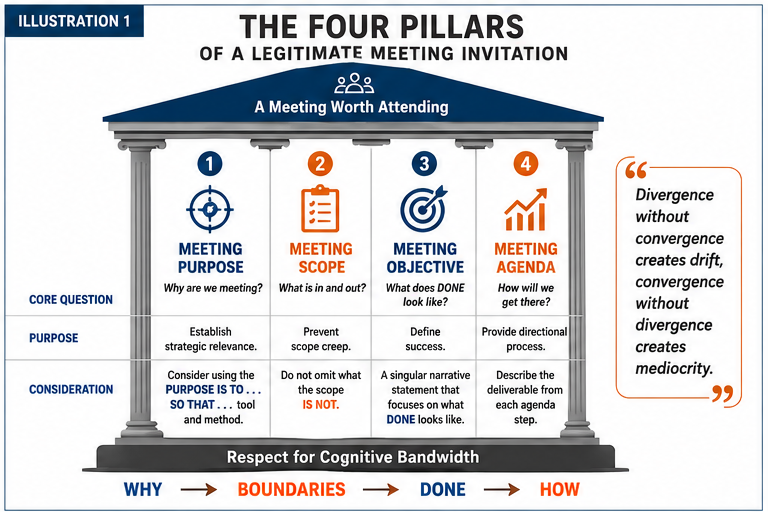
The Four Pillars of a Legitimate Meeting Invitation
The “No Agenda, No Attendance” rule is not intended as a bureaucratic weapon, but an indication of cultural liberation. Structure is not the enemy of creativity; it is its prerequisite.
The structured approaches in business meetings drastically increases efficiency that drives actionable outcomes. Structure eliminates wasted time, aligns participants quickly, and transforms passive discussions into concrete business results.
Most importantly, structure helps shift the group from emotional arguing to objective evaluation. Structure speeds up the transition from speculative debating to systematic, evidence-based inputs. Solid structure forces a group to evaluate its options against concrete drivers rather than personal intuition. Structure reduces the influence of personal bias so that evidence, strategy, and shared criteria guide the decision.
The Anatomy of the Rule: No Agenda, No Attendance
The Bill of Rights: Establish the cultural precedent that declining a meeting without these four pillars is not disrespectful. In a like manner, paid professionals don’t simply have an opportunity to contribute in meetings, they are being paid to attend and therefore have an OBLIGATION to contribute, a fiduciary responsibility, a duty.
The Paradox of Structure: Architecture Frees Art
“Facilitation is not about controlling people. Facilitation reduces unnecessary friction so collective intelligence can emerge.”
To the untrained eye, forcing meetings into rigid, predefined boxes sounds like the death of organic creativity. This fear misunderstands the nature of human cognition. When a meeting lacks structure, the human brain consumes massive amounts of cognitive energy simply trying to navigate the environment. Participants sit in a defensive, anxious state, wondering: What are we trying to accomplish? Who is in charge here? When will this end? How do I get my voice heard over the loudest person in the room? By the time the conversation accidentally stumbles into a creative opportunity, the team’s mental bandwidth finds itself depleted by structural friction.
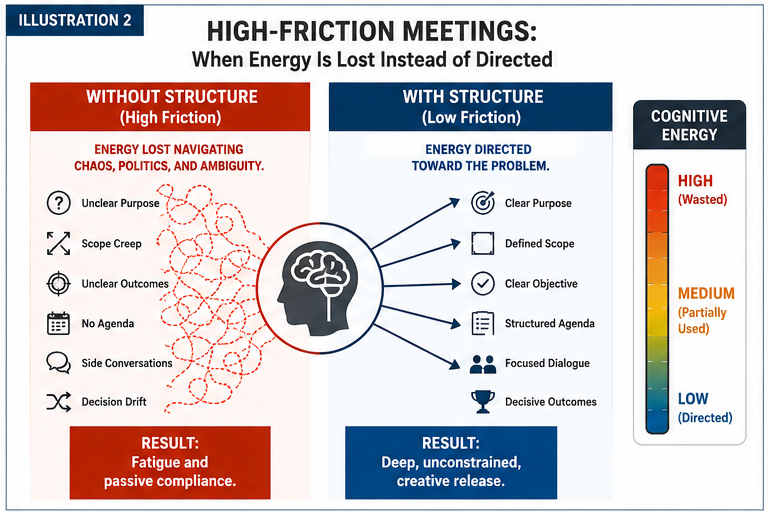
High-Friction Meetings: When Energy Is Lost Instead of Directed
The Cognitive Load Argument
Cognitive overload and friction kill innovation. When a meeting lacks structure, participants use their mental bandwidth trying to figure out how to navigate to the deliverable, leaving little or zero energy for what they are contributing to build.
To an audience, a brilliant jazz solo looks entirely unconstrained. But jazz musicians can only improvise with such jaw-dropping freedom because they share a rigid, non-negotiable underlying structure: a fixed chord progression, a strict tempo, and a mutual understanding of the key signature. Without that rigid framework, jazz music becomes background noise.
Structure creates psychological safety. When the rules of the meeting are clearly mapped in an agenda, participants no longer have to fight for survival. They can safely drop their guard, transition out of defensive corporate posturing, and channel 100% of their cognitive capacity into solving the business bottleneck.
A clear meeting design democratizes the room. It strips power away from loud, dominant personalities who thrive in chaotic environments, allowing introverted or analytical thinkers to prepare their brilliance, sometimes in advance.
Cultivating Unstructured Brilliance Inside the Structure
How do we extract unstructured brilliance once the structural container is built? We do it by carefully facilitating “white space” into our structured approach. Innovation is not the absence of structure. Innovation derives from disciplined divergence followed by intentional convergence.
“Divergence without convergence creates drift, convergence without divergence creates mediocrity.”
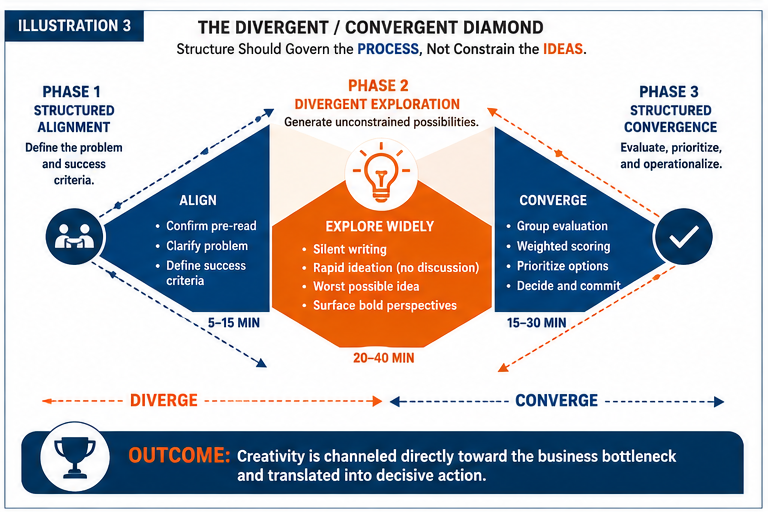
Diverge/Converge Diamond
Visualizing the Divergent/Convergent Diamond:
-
Phase 1 (Structured)
Aligning on the precise problem statement (perhaps contained in the pre-read). The first 5-15 minutes of every meeting are rigorously structured. The facilitator confirms the pre-read was ingested, aligns the team on the exact problem statement, and locks in the success criteria. Everyone starts from the exact same baseline of truth.
-
Phase 2 (Unstructured)
Opening the floodgates. Using strict, rapid-fire (NO DISCUSSION) ideation to let raw genius surface without judgment. Because the team knows exactly what problem they are solving, they can push creative boundaries safely.
During this block, deploy structured tools that yield unstructured outputs:
-
-
- Silent Writing: Give the team five minutes of absolute silence to write down their wildest ideas on digital sticky notes. This completely strips away the hierarchy bias of the room, allowing an introverted designer’s brilliant insight to post alongside an executive’s idea.
- Worst Possible Idea: Force the team to ideate ways to intentionally cause the problem to fail spectacularly. This playful, inverted structure breaks creative blocks and unearths hidden risks that traditional approaches miss.
-
-
Phase 3 (Structured)
Using group input to get DONE, perhaps a weighted scoring matrix to capture and operationalize options and criteria. The facilitator brings the group back to the structured container, utilizing a tool such as a weighted scoring matrix to objectively grade the wild ideas against the success criteria established earlier.
The Outcome
Creativity is channeled directly toward a business bottleneck, rather than evaporating into a useless tangent and requires a deliberate shift in organizational culture. Power dynamics make it terrifying for a mid-level manager to decline a senior executive’s blank calendar invite. Therefore, leadership must deliberately operationalize the boundary. Alternatively, distribute a limited (few) “Get Out of Jail” cards that people can leverage to avoid applying this structure, for whatever reason.
“Structure should govern the PROCESS, not constrain the IDEAS.”
Implementation Guide: Shifting Company Culture Safely
The Leadership Blueprint
Implementing the “No Agenda, No Attendance” rule requires more than a casual announcement; it requires a deliberate shift in organizational culture. Power dynamics make it terrifying for a mid-level manager to decline a senior executive’s blank calendar invite.
The transformation fails unless the C-suite models the behavior. Executives, directors, and other management leaders may model the behavior by declining incomplete meeting requests from their direct reports, using it as a coaching moment to demand rigorous preparation.
The Automated Guardrails
Take the friction out of compliance by baking the rule into your digital workspace:
-
Change Default Meeting Lengths
Shift your organization’s default calendar settings from 30 and 60 minutes to 25 and 50 minutes. This gives employees critical breathing room between sessions to process action items.
-
Mandatory Agenda Fields
Utilize email templates or calendar descriptions that pre-populate with blank fields for Meeting Purpose, Meeting Scope, Meeting Objective, and Meeting Agenda text fields in Google Calendar or Outlook invites. If an organizer leaves them blank, the invite stands out as incomplete.
-
Polite Rejections
Declining a meeting shouldn’t feel like a rejection; rather celebrate it as a defense of the company’s bottom line. Provide polite, professional scripts for associates to use when pushing back. You can still retain integrity without sounding adversarial. Instead of just hitting “Decline” or suffering in silence, consider one of these responses:
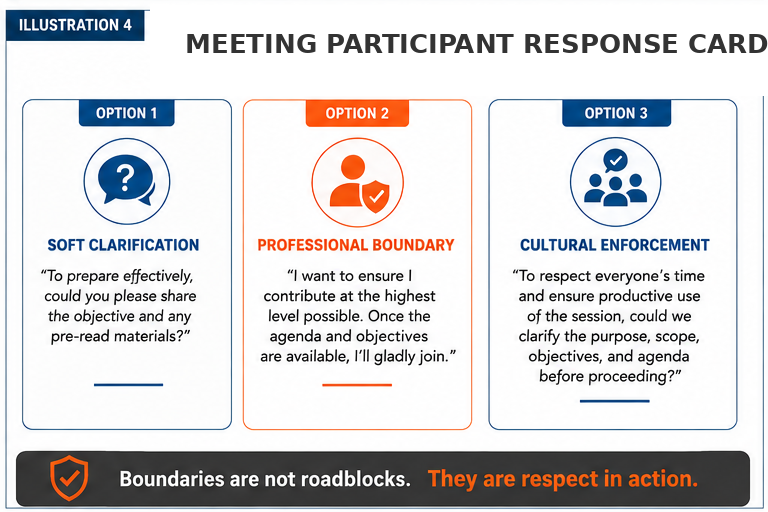
Meeting Participant Response Card
Conclusion: The Ultimate ROI of Enforced Boundaries
Every blank calendar invite represents an unhedged operational expense. When highly compensated professionals sit in a room for an hour with vague or audible-only directions, the organization is actively burning thousands of dollars in lost productivity, context-switching friction, and employee morale.
The “No Agenda, No Attendance” rule is not about building walls or enforcing cold, rigid bureaucracy. By demanding a clear structure before the meeting begins, you sweep away the administrative noise and conversational anxiety that paralyzes modern teams. You create a secure, intentional workspace where calendars are clean, deep work gets protected, and true, unstructured corporate brilliance finally has the room to breathe.
Why This Matters
You will transform your thought leadership into an operational behavior change that becomes culturally transformative. Imagine an organizational culture that adopts the “No Agenda” rule. Calendars become intentional and the meetings that remain are electric, high-stakes hubs of innovation. Meeting volume declines while meeting value rises.
- The Amazon Narrative Format: Contrast PowerPoint-driven chaos with Jeff Bezos’s famous rule where meetings start with 15 minutes of silent reading of a 6-page memo. This forces structure onto the writer and gives creative freedom to the reader.
- The Pixar “Braintrust”: Pixar uses an incredibly rigid feedback structure (frankness, no hierarchy, strict focus on the story) to allow directors to find brilliant creative solutions to broken movie plots.
- The Shopify Calendar Purge: Shopify’s mandated the radical deletion of thousands of recurring meetings to force teams to rebuild their collaborative frameworks from scratch with explicit intent.
The Final Charge
Protect your team’s cognitive bandwidth with deliberate structural boundaries. Human brilliance does not emerge from chaos alone. It emerges when disciplined structure creates the conditions for contribution, trust, and intelligent convergence.
Conclusion: Meetings That Get Results Mastery
To transform meetings from dreadful to dynamic, from wasteful to worthwhile, become a facilitative leader. That means:
- Aligning around shared understanding and outcomes
- Clarifying intent, not just content
- Designing experiences that democratize participation
- Elevating quiet voices
- Leading by listening
Meetings must rise above the tiny opening of words and embrace the fullness of human insight—through listening, visuals, stories, numbers, and symbols. The transformation begins not in tools, but in mindset. Leave your ego at the threshold, and step into the structures of meetings that get results.
In a world where everyone can engage in decisions that affect them
______
Lead the Change—One Meeting at a Time
Are you ready to transform how decisions are made, problems are solved, and alignment validates in your organization?
True meeting leadership goes beyond setting an agenda. It requires a facilitator who can navigate complexity, balance voices, and drive toward outcomes with clarity and consensus. Our Professional Meeting Leadership Workshop and facilitation training equips you to do just that—blending human-centric methods with structured analytical tools to foster rigor, inclusivity, and results that stick.
- Practice live.
- Get expert feedback.
- Build confidence that lasts.
Whether your meetings suffer from unclear objectives, disengaged participants, or decision fatigue, this workshop will help you identify the root causes, apply proven facilitation techniques, and emerge as the leader every team needs.
Take the first step today—transform your meetings and magnify your impact.
👉 Click here to reserve your seat now.
#facilitationtraining #meetingdesign
Because every meeting should be a catalyst for change—not just another calendar event.
______
With Bookmarks no longer a feature in WordPress, we provide the following for your benefit and reference.
- 20 Prioritization Techniques = https://foldingburritos.com/product-prioritization-techniques/
- Facilitation Training Calendar = https://mgrush.com/public-facilitation-training-calendar/
- Liberating Structures = http://www.liberatingstructures.com/ls-menu
- Management Methods = https://www.valuebasedmanagement.net
- People Search = https://pudding.cool/2019/05/people-map/
- Scrum Events Agendas = https://mgrush.com/blog/scrum-facilitation/
- Teleconference call = https://youtu.be/DYu_bGbZiiQ
- Visualization methods = http://www.visual-literacy.org/periodic_table/periodic_table.html#
______

Terrence Metz, president of MG RUSH Facilitation Training, was just 22-years-old and working as a Sales Engineer at Honeywell when he recognized a widespread problem—most meetings were ineffective and poorly led, wasting both time and company resources. However, he also observed meetings that worked. What set them apart? A well-prepared leader who structured the session to ensure participants contributed meaningfully and achieved clear outcomes.
Throughout his career, Metz, who earned an MBA from Kellogg (Northwestern University) experienced and also trained in various facilitation techniques. In 2004, he purchased MG RUSH where he shifted his focus toward improving established meeting designs and building a curriculum that would teach others how to lead, facilitate, and structure meetings that drive results. His expertise in training world-class facilitators led to the 2020 publication of Meetings That Get Results: A Guide to Building Better Meetings, a comprehensive resource on effectively building consensus.
Grounded in the principle that “nobody is smarter than everybody,” the book details the why, what, and how of building consensus when making decisions, planning, and solving problems. Along with a Participant’s Guide and supplemental workshops, it supports learning from foundational awareness to professional certification.
Metz’s first book, Change or Die: A Business Process Improvement Manual, tackled the challenges of process optimization. His upcoming book, Catalyst: Facilitating Innovation, focuses on meetings and workshops that don’t simply end when time runs out but conclude with actionable next steps and clear assignments—ensuring progress beyond discussions and ideas.
