
How to facilitate unavoidable collaboration bias begins by understanding the causes and consequences of collaboration bias, as experienced by facilitators guiding leadership teams or review boards in high-stakes, consensus-driven environments.
What Is Collaboration Bias?
Collaboration bias refers to the favoring of harmony, cohesion, or agreement at the expense of rigor, dissent, and divergent thinking. The bias stems from the well-intentioned—but misapplied—belief that collaboration is inherently good. Our facilitation training always stresses that the best time to hold a meeting is during high conflict situations. In facilitation settings, collaboration bias is evidenced by premature agreement, suppressing conflict, and a cultural emphasis on agreeable participants.
¶ NOTE: Collaboration bias is not groupthink itself. Rather, it is a condition that makes groupthink more likely in environments that reward conformity or penalize friction.
Collaborative Biases
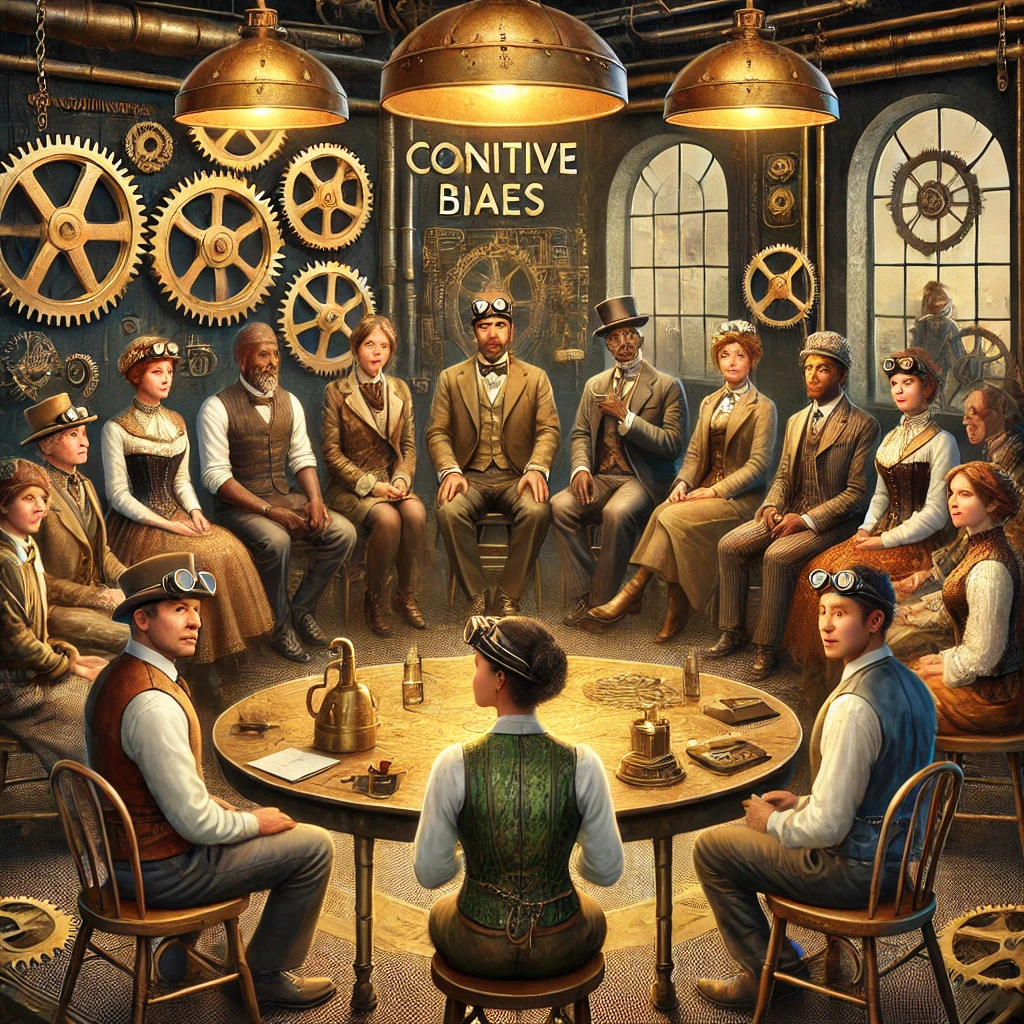
How Collaboration Bias Causes Failure
1. Early Convergence
Facilitators and leaders may encourage alignment before exploring all the options. They shortcut deliberation that leads to pseudo-consensus—where participants outwardly agree but inwardly dissent.
-
Symptoms: “Looks good to me” or “I’ll go with the group”.
-
Result: Decisions lack depth, surface-level consensus crumbles under stress, and stakeholders disengage.
2. Suppressing Dissent
A focus on “getting along” unintentionally marginalizes those who challenge prevailing views. Critical voices are silenced not by censorship, but by cultural signaling that prioritizes cohesion over candor. In the words of Dr. Brené Brown, people need to be “fiercely kind” but not overly nice. She argues that “nice” implies that one questions the motivation, as in “Why is that person being nice to me?”
-
Implication: Important red flags, risks, and options go unexamined.
3. Illusion of Shared Understanding
The bias of shared understanding leads to alignment without validating it. Agreement on words does not guarantee agreement on their meaning or implications. Note for example, the differences between “goals” and “objectives” or “missions” and “vision.” We have seen numerous times when people were in ‘violent agreement‘ with each other but using different terms to describe the same concept.
¶ NOTE: An expert facilitator resists the urge to “smooth over” tension. Instead, they design space for constructive friction to surface and be challenged by the group.
Three proven actives work to manage meeting conflict, taken in order: 1) Confirm the purpose in writing, 2) For each party, capture the reasons their position best supports the purpose, and 3) Align those documented reasons against the product/project objectives, the program goals, the department or business unit OKRs, and the organizational strategic plan. Determine which position best supports the aggregate by facilitating “To what extent _______ ?”
How Collaboration Bias Affects Decision-Making
Function of Decision-Making | Impact of Collaboration Bias |
|---|---|
| Problem Framing | Narrows the frame too early to preserve agreement |
| Criteria Setting | Criteria are selected for acceptability, not relevance or rigor |
| Option Generation | Reduces diversity and novelty of options |
| Risk Assessment | Underestimates downside due to collective optimism |
| Final Decision | Over-indexes on palatable over probable |
¶ NOTE: Teams under collaboration bias default to lowest common denominator decisions. Facilitative leadership designs meetings that increase psychological contrast—not just comfort.
Impact on Creativity, Problem-Solving, and Innovation
Collaboration bias is particularly corrosive during innovation and complex problem-solving efforts:
-
Creativity stalls when new ideas are seen as disruptive rather than additive.
-
Problem-solving regresses to routine solutions because unorthodox thinking is perceived as destabilizing.
-
Innovation is stifled by group inertia—novelty requires disruption, and disruption is muted by cultural cohesion.
¶ NOTE (Meeting Design Principle): Design with dissent as a resource, not a problem. Use Perceptual Mapping (Decision Matrix), Spider DQ, or Real-Win-Worth to maintain idea tension until the rationales naturally converge.
Effect on Planning and the Planning Process
Planning appears smoother under collaboration bias because conflict is hidden or avoided. But:
-
Scenarios lack variability—a common culture of expectation replaces robust contingency thinking.
-
Milestones are shaped by groupthink, not capability—leading to under estimating or over committing.
-
Resource allocation ignores edge cases—because no one “wanted to rock the boat.”
¶ NOTE: Decision review boards are notably vulnerable when planning becomes a compliance exercise instead of a strategic analysis.
Controlling Collaboration Bias to Overcome Groupthink
Controlling for collaboration bias provides a foundation to resist groupthink. While groupthink is a well-documented failure of blind agreement, collaboration bias sets the trap by:
-
Rewarding sameness
-
Punishing complexity
-
Confusing alignment with consent
Techniques for Expert Facilitators and Leadership Teams:
| Technique | How Technique Counters Bias |
|---|---|
| Bookending Extremes | Forces exploration beyond comfort zones |
| Pre-Mortem Analysis | Makes dissent constructive and expected |
| Anonymous Input | Reduces status conformity |
| Devil’s Advocate by Design | Institutionalizes opposition |
| Consent-Based Governance | Requires “no objections,” not forced agreement |
| Gradient of Agreement Scale | Surfaces nuanced positions, not binary yes/no |
¶ NOTE: Leaders must model intellectual humility and curiosity. When executives signal that disagreement is valued, psychological safety becomes common and systemic.
Meeting Design for Consensual Support
Here’s a meeting design blueprint for expert facilitators working with leadership teams or decision boards under the charge of building consensus while resisting collaboration bias:
PHASE 1: DISCOVERY — Mapping the Range
-
Tool: Bookend Questions — “What’s the best/worst this could look like?”
-
Output: Shared context that includes outliers
PHASE 2: DIVERGENCE — Expand Possibilities
-
Tool: Field Analysis / Perceptual Mapping
-
Facilitation Move: Allow minority perspectives to lead and explain
PHASE 3: CRITERIA SETTING — Define Decision Quality
-
Tool: Weighted Prioritization
-
Focus: Clarity on what makes a decision “good,” not just acceptable
PHASE 4: CONVERGENCE — Structured Alignment
-
Tool: Gradient of Agreement scale (0–5)
-
Objective: Consent, not unanimity; make disagreement visible
PHASE 5: COMMITMENT — Decision Readiness
-
Tool: Pre-Mortem + Commitment Rounds
-
Deliverable: Documented alignment with risk caveats clearly named
Final Reflection
Collaboration bias masquerades as cooperation but often yields complacency. An expert facilitator’s role is to transform passive agreement into active alignment, ensuring that consensus reflects deliberate synthesis (integral Yes-And thinking), not just emotional comfort.
¶ NOTE: In your next planning session, how will you design for productive friction rather than quick agreement? How will you structure for evidence, not just politeness?
See Meetings That Get Results: A Facilitator’s Guide (or script) to apply these design principles in a your next meeting or workshop.
______
Lead the Change—One Meeting at a Time
Are you ready to transform how decisions are made, problems are solved, and alignment is built in your organization?
True meeting leadership goes beyond setting an agenda. It requires a facilitator who can navigate complexity, balance voices, and drive toward outcomes with clarity and consensus. Our Professional Meeting Leadership Workshop and facilitation training equips you to do just that—blending human-centric methods with structured analytical tools to foster rigor, inclusivity, and results that stick.
- Practice live.
- Get expert feedback.
- Build confidence that lasts.
Whether your meetings suffer from unclear objectives, disengaged participants, or decision fatigue, this workshop will help you identify the root causes, apply proven facilitation techniques, and emerge as the leader every team needs.
Take the first step today—transform your meetings and magnify your impact.
👉 Click here to reserve your seat now.
#facilitationtraining #meetingdesign
Because every meeting should be a catalyst for change—not just another calendar event.
______
With Bookmarks no longer a feature in WordPress, we provide the following for your benefit and reference.
- 20 Prioritization Techniques = https://foldingburritos.com/product-prioritization-techniques/
- Creativity Techniques = https://www.mycoted.com/Category:Creativity_Techniques
- Facilitation Training Calendar = https://mgrush.com/public-facilitation-training-calendar/
- Liberating Structures = http://www.liberatingstructures.com/ls-menu
- Management Methods = https://www.valuebasedmanagement.net
- Newseum = https://www.freedomforum.org/todaysfrontpages/
- People Search = https://pudding.cool/2019/05/people-map/
- Project Gutenberg = http://www.gutenberg.org/wiki/Main_Page
- Scrum Events Agendas = https://mgrush.com/blog/scrum-facilitation/
- Speed test = https://www.speedtest.net/result/8715401342
- Teleconference call = https://youtu.be/DYu_bGbZiiQ
- The Size of Space = https://neal.fun/size-of-space/
- Thiagi/ 400 ready-to-use training games = http://thiagi.net/archive/www/games.html
- Visualization methods = http://www.visual-literacy.org/periodic_table/periodic_table.html#
______

Terrence Metz, president of MG RUSH Facilitation Training, was just 22-years-old and working as a Sales Engineer at Honeywell when he recognized a widespread problem—most meetings were ineffective and poorly led, wasting both time and company resources. However, he also observed meetings that worked. What set them apart? A well-prepared leader who structured the session to ensure participants contributed meaningfully and achieved clear outcomes.
Throughout his career, Metz, who earned an MBA from Kellogg (Northwestern University) experienced and also trained in various facilitation techniques. In 2004, he purchased MG RUSH where he shifted his focus toward improving established meeting designs and building a curriculum that would teach others how to lead, facilitate, and structure meetings that drive results. His expertise in training world-class facilitators led to the 2020 publication of Meetings That Get Results: A Guide to Building Better Meetings, a comprehensive resource on effectively building consensus.
Grounded in the principle that “nobody is smarter than everybody,” the book details the why, what, and how of building consensus when making decisions, planning, and solving problems. Along with a Participant’s Guide and supplemental workshops, it supports learning from foundational awareness to professional certification.
Metz’s first book, Change or Die: A Business Process Improvement Manual, tackled the challenges of process optimization. His upcoming book, Catalyst: Facilitating Innovation, focuses on meetings and workshops that don’t simply end when time runs out but conclude with actionable next steps and clear assignments—ensuring progress beyond discussions and ideas.
