
Have you ever heard someone say in a meeting “I don’t know why we’re doing this project in the first place?” Odds are, the meeting is being held to advance the project, not re-validate it. The person asking the question has now imposed their agenda on the group. They have forced scope creep [1].
Whenever meeting participants ask questions, they have shifted from the role of subject matter expert to the role of meeting designer. They have forced scope creep. By diverting attention to ‘their’ question, the group follows ‘their’ agenda. Consequently, they risk not having enough time to complete the meeting deliverable.
Getting Groups to Focus Prevents Scope Creep
Prevent Scope Creep
The hardest task to accomplish when leading a group of people is to get them to focus. Participants’ minds drift, twist, and become partially selective. When the right group of people assembles, they can accomplish any task at hand if the leader gets them focused. Yet they continue to drift, discuss, and argue about issues that are not within the scope of the meeting. They impose their own scope creep.
Expert facilitation saves an incredible amount of time and money. For one, a well-prepared facilitator knows the scope of the meeting and puts it in writing. As a result, they do not allow someone to discuss topics that are not in scope. This includes re-justifying the project. When people argue about the validity or purpose of a project, the discussion is usually NOT within the meeting scope. Yet only a conscious facilitator can police scope creep carefully.
Remember these two secrets to prevent scope creep in meetings.
First, the session leader or facilitator needs to make the meeting scope clear when the meeting begins, as well as secure agreement from the participants about the meeting scope. Frequently, meeting scope limits include geography, duration, or situation—capturing only PART OF the project scope.
Secondly, the facilitator needs to know the precise question the group should be addressing. When the facilitator does not know the question, ANY answer is appropriate. Most meeting facilitators should focus on context before meetings rather than content, by knowing the right questions and the proper sequence to ask them. They cannot afford to ask a DUMB question (i.e., Dull, Ubiquitous, Myopic, and Broad).
Scope Creep in Meetings is Costly
While it’s a well-known fact that scope creep kills projects, scope creep also dramatically impacts the quality of meetings. Based on our research with a Fortune 100 company, more than 50 meetings are required to complete an ‘average’ project. The average is computed as greater than USD$250,000 in value but less than $1.0 million in total cost invested[2]. Much, if not most, of the budget is actually consumed by the labor value during meetings, and most budgets do not reflect the costs of the customer’s time. And that’s where scope creep begins.
Expert Facilitation Can Reduce the Amount of Total Meeting Time by Half
Most meetings stay partially focused and on topic. They do not spend an entire hour talking about Monday Night Football. Participants typically offer up some good content. The problem is, that the meeting ends when the time is over, not when the meeting deliverable is complete and robust. Therefore, the deliverable of many meetings becomes the most despicable deliverable of all — another meeting.
Meeting leaders cannot control the scope if they are not fully aware of the scope of the project, the meeting, the agenda steps, and the questions the group needs to answer. While each scope is related, they remain discrete, and differences must be clear in the mind of the leader. However, when the meeting leader cannot articulate the scope, participants can freely talk about whatever comes to mind. Sound familiar?
While some contend that all too often participants get too ‘deep in the weeds’, we discovered that conversation in the opposite direction wastes more time. People talking about projects, programs, business unit objectives, and enterprise performance — all topics typically ‘out of scope’ for their specific meeting deliverable.
Scope Creep is the Opposite of Detailed Answers and Requirements
Unprofessional facilitators permit such discussion when they do not refine their questions. They typically ask broad questions when, in fact, they need detailed answers. They ask for the deliverable rather than aggregating the components that add up to create the deliverable.
Here’s an example:
Let’s say your group’s deliverable is a marketing plan. An untrained facilitator might begin by asking “What does the marketing plan look like?” Imagine the number of ways this question could be answered. Such broad, open-ended questions leave meetings wide open to scope creep. Rather, a professional facilitator would know, or have done her research beforehand, and understand that a marketing plan is a function of segmentation, targeting, positioning, media, message, etc., and thus a better question would be “What is the primary target audience for the product you’re trying to market?” A question is specific enough to produce specific, measurable answers.
In addition, if the question were “What are our top three market segments?” (another good, precise question) a trained facilitator would not allow one or two people to divert the group into a discussion over social media outlets, as such content (while relevant at some other point in the process) would be out of the scope of the question at hand. (For more on how to handle open issues click HERE.)
In the aggregate . . .
By systematically addressing a series of questions, answers fold together to create the meeting deliverable.
As soon as participants start arguing over issues unrelated to the details required to support the specified deliverable (ie a specific marketing plan for a specific product) they are imposing scope creep, and putting the team at risk of failing to deliver in the amount of time allowable. The facilitator must stop the discussions unrelated directly to the deliverable.
Quite simply, to prevent scope creep in meetings, the facilitator needs to know the scope of the specific question being asked. If they don’t, people can talk about whatever they want.
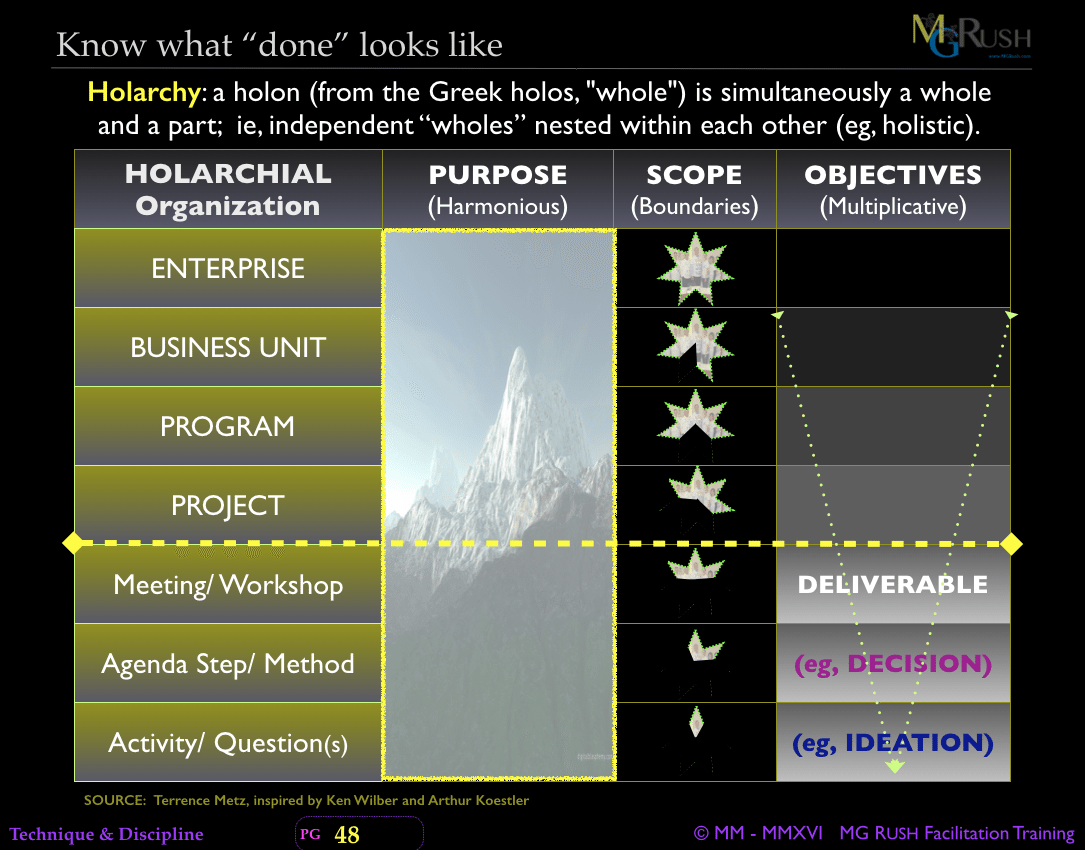
Understanding Scope Creep and Precision of the Question During Your Meeting
The Consciousness of the Holarchy Helps Prevent Scope Creep
The holarchy chart illustrates the narrowing of the scope, from the enterprise through the question being discussed in a meeting. The facilitator must provide precise questions that support the completion of agenda steps and the completion of the meeting deliverable. When the facilitator does not know the right question to ask, all hell breaks loose, and rightfully so, scope creeps . . . Do not let it happen to you. Also, see our discussion specifically on the Holarchy for further explanation. And remember, consciousness comes before competence.
[1]The Project Management Institute’s PMBOK® Guide describes scope creep as “adding features and functionality (project scope) without addressing the effects on time, costs, and resources, or without customer approval” (PMI, 2008, p 440).
[2]Size definitions are never the same for all organizations, but nearly all define “moderate” as projects with a minimum threshold between $50,000 and $1,000,000 total investment.
-
______
Meetings must rise above the tiny opening of words and embrace the fullness of human insight—through listening, visuals, stories, numbers, and symbols. The transformation begins not with tools, but in mindset. Leave your ego at the threshold, and step into the structures of meetings that get results.
In a world where everyone can engage in decisions that affect them
______
Lead the Change—One Meeting at a Time
Are you ready to transform how decisions are made, problems are solved, and alignment is built in your organization?
True meeting leadership goes beyond setting an agenda. It requires a facilitator who can navigate complexity, balance voices, and drive toward outcomes with clarity and consensus. Our Professional Meeting Leadership Workshop and facilitation training equips you to do just that—blending human-centric methods with structured analytical tools to foster rigor, inclusivity, and results that stick.
- Practice live.
- Get expert feedback.
- Build confidence that lasts.
Whether your meetings suffer from unclear objectives, disengaged participants, or decision fatigue, this workshop will help you identify the root causes, apply proven facilitation techniques, and emerge as the leader every team needs.
Take the first step today—transform your meetings and magnify your impact.
______
👉 Click here to reserve your seat now.
#facilitationtraining #meetingdesign
Because every meeting should be a catalyst for change—not just another calendar event.
______
And earn up to 40 professional development credits with our facilitation training.
- CDUs (IIBA)
- CLPs (Federal Acquisition)
- PDUs (SAVE International)
- SEUs (Scrum Alliance)
- 4.0 CEUs (General Professions)
______
With Bookmarks no longer a feature in WordPress, we provide the following for your benefit and reference.
- 20 Prioritization Techniques = https://foldingburritos.com/product-prioritization-techniques/
- Creativity Techniques = https://www.mycoted.com/Category:Creativity_Techniques
- Facilitation Training Calendar = https://mgrush.com/public-facilitation-training-calendar/
- Liberating Structures = http://www.liberatingstructures.com/ls-menu
- Management Methods = https://www.valuebasedmanagement.net
- Newseum = https://www.freedomforum.org/todaysfrontpages/
- People Search = https://pudding.cool/2019/05/people-map/
- Project Gutenberg = http://www.gutenberg.org/wiki/Main_Page
- Scrum Events Agendas = https://mgrush.com/blog/scrum-facilitation/
- Speed test = https://www.speedtest.net/result/8715401342
- Teleconference call = https://youtu.be/DYu_bGbZiiQ
- The Size of Space = https://neal.fun/size-of-space/
- Thiagi/ 400 ready-to-use training games = http://thiagi.net/archive/www/games.html
- Visualization methods = http://www.visual-literacy.org/periodic_table/periodic_table.html#
______

Terrence Metz, president of MG RUSH Facilitation Training, was just 22-years-old and working as a Sales Engineer at Honeywell when he recognized a widespread problem—most meetings were ineffective and poorly led, wasting both time and company resources. However, he also observed meetings that worked. What set them apart? A well-prepared leader who structured the session to ensure participants contributed meaningfully and achieved clear outcomes.
Throughout his career, Metz, who earned an MBA from Kellogg (Northwestern University) experienced and also trained in various facilitation techniques. In 2004, he purchased MG RUSH where he shifted his focus toward improving established meeting designs and building a curriculum that would teach others how to lead, facilitate, and structure meetings that drive results. His expertise in training world-class facilitators led to the 2020 publication of Meetings That Get Results: A Guide to Building Better Meetings, a comprehensive resource on effectively building consensus.
Grounded in the principle that “nobody is smarter than everybody,” the book details the why, what, and how of building consensus when making decisions, planning, and solving problems. Along with a Participant’s Guide and supplemental workshops, it supports learning from foundational awareness to professional certification.
Metz’s first book, Change or Die: A Business Process Improvement Manual, tackled the challenges of process optimization. His upcoming book, Catalyst: Facilitating Innovation, focuses on meetings and workshops that don’t simply end when time runs out but conclude with actionable next steps and clear assignments—ensuring progress beyond discussions and ideas.
