by Facilitation Expert | Mar 23, 2017 | Leadership Skills, Meeting Support
MGRUSH Certified, Professional, Endorsed Facilitators are truly special.
 Thousands of alumni have earned promotions to executive positions, directorships, and C-level responsibility. MGRUSH facilitators lead groups ranging from the Joint Chiefs of Staff to greenfield initiatives about the genetic bar-coding of zebra meat to prevent illegal poaching. Furthermore, many alumni branch out on their own as independents, frequently providing pro-bono support for charitable organizations. While others contribute as valuable keystones, embedded in organizations for survival and growth. Here we provide you with some endorsed facilitators, that are as good or even better than you have ever experienced before.
Endorsed Facilitators
Since we are frequently asked for facilitator referrals, we thought it would be prudent to share some of the “best of the best”. As authors and instructors, our endorsed facilitators maintain high standards, while consistently generating results that clients need. Today, about five percent of our incoming students have their Ph.D. or Doctorate and more than half have advanced/master’s degrees. Most importantly, our alumni understand that galvanizing consensus and effective meeting management depend on integrating three components:
Integrating Leadership, Facilitation, AND Meeting Design
Meetings capture a huge investment of time. Unproductive meetings affect your profit and loss statement, morale, and potential growth of your biggest asset, your people. Many of us attend frequent and important meetings. However, little (if any) structured training has been provided to help us become better meeting participants, and more important, meeting leaders. More effective meetings for teams and groups are dependent on improving three areas of behavior, namely:
WHY —
Leadership training ensures that we begin with the end in mind. WHY we’re meeting equates with what DONE looks like. The best facilitators in the world will fail miserably if they don’t know where they are going. Yet the worst facilitators can still succeed when the deliverable is clear. Effective leadership draws a line of site about the impact of the meeting on the quality of life of its participants.
WHAT —
Once it has been made clear where we are going, facilitation skills make it easier to know WHAT to do to make a meeting successful. Unfortunately, we have developed poor muscle memory over the years. Some behaviors need to be ‘unlearned’ before new behaviors are embraced. The only way to change such behaviors is through practice and immersion. Talking heads (i.e., the instructor’s lips are moving) won’t do it. Only active participation and practice will work at instilling effective and facilitative behaviors.
HOW —
Even a great facilitator who knows where they are going (i.e., What DONE looks like) still needs help. They need to know HOW they are going to build consensus and get a group of people from the meeting Introduction to the Wrap. While the best meeting design or approach (i.e., Agenda) has more than one right answer, there is one wrong answer — if the meeting leader does not know HOW they are going to do it.
Our endorsed facilitators have proven themselves. Get to know them if you need a more effective enterprise, business unit, program office, or project direction. They will lead your group to new horizons. FIND OUT MORE
______
Don’t ruin your career by hosting bad meetings. Sign up for a workshop or send this to someone who should. MGRUSH workshops focus on meeting design and practice. Each person practices tools, methods, and activities daily during the week. Therefore, while some call this immersion, we call it the road to building high-value facilitation skills.
Terrence Metz, president of MG RUSH Facilitation Training, was just 22-years-old and working as a Sales Engineer at Honeywell when he recognized a widespread problem—most meetings were ineffective and poorly led, wasting both time and company resources. However, he also observed meetings that worked. What set them apart? A well-prepared leader who structured the session to ensure participants contributed meaningfully and achieved clear outcomes.
Throughout his career, Metz, who earned an MBA from Kellogg (Northwestern University) experienced and also trained in various facilitation techniques. In 2004, he purchased MG RUSH where he shifted his focus toward improving established meeting designs and building a curriculum that would teach others how to lead, facilitate, and structure meetings that drive results. His expertise in training world-class facilitators led to the 2020 publication of Meetings That Get Results: A Guide to Building Better Meetings, a comprehensive resource on effectively building consensus.
Grounded in the principle that “nobody is smarter than everybody,” the book details the why, what, and how of building consensus when making decisions, planning, and solving problems. Along with a Participant’s Guide and supplemental workshops, it supports learning from foundational awareness to professional certification.
Metz’s first book, Change or Die: A Business Process Improvement Manual, tackled the challenges of process optimization. His upcoming book, Catalyst: Facilitating Innovation, focuses on meetings and workshops that don’t simply end when time runs out but conclude with actionable next steps and clear assignments—ensuring progress beyond discussions and ideas.
by Facilitation Expert | Mar 16, 2017 | Facilitation Skills, Meeting Support
The lead article in the March-April (2017) Harvard Business Review reads like a promotion for our MG RUSH Professional Leadership, Facilitation, and Methodology training. The principal recommendations in Johnson and Christfort’s article, The New Science of Teamwork, have been a mainstay in our curriculum for over ten years now. With the research they amassed to support their thesis, our curriculum has become more valid than ever.
The New Science of Teamwork Personality Styles
First, they substitute the following four styles for similar styles found in Myers-Briggs, DISC, E-Colors, and others:
- Pioneer
- Driver
- Guardian
- Integrator
You should read the article to develop a richer understanding of the similarities and differences to other personality typing methods you know about. Our article follows their assumption, conclusions, and recommendations—plus a few they are missing.
Their assumption, a valid one, suggests that most teams fall short of their potential. They even find that dysfunction may cause some teams to regress rather than progress their organization. They suggest fostering “productive friction” which puts the term ‘argument’ in its proper and positive connotation.
Not surprisingly they find that cognitive diversity and a blending of all the styles will yield the highest quality decisions and group outputs. Further, their conclusions primarily suggest to:
- Pull opposite types closer together, and
- Seek input from people with non-dominant styles, paying attention to sensitive introverts.
For more than a decade we have been major promoters of “healthy dissent”. Their specific recommendations echo our own. However, they are missing a few important tips when leveraging personality types in a meeting or workshop environment.
The New Science of Teamwork Recommendations
For Guardians and Integrators (the two non-dominant styles) they suggest identical methods found in our curriculum such as (listed in the sequence found in their article):
- Allowing them more time to respond.
- Changing the group perspective to focus on input from the point-of-view found in the lens of Guardians and
- Encouraging non-dominant styles to contribute early (NOTE: We recommend that you always call on your virtual participants first, before allowing your in-person people to speak).
- Encouraging the use of whiteboards (or easels) to depersonalize their input.
- Keeping the pace brisk, but allowing time for non-dominant styles to consider the supporting details (e.g., separate ideation from analysis).
- Paying closer attention to introverts, who may be rarely heard.
- Relying on them to show up better prepared and thoroughly read with supporting details than typically found with the dominant types of Pioneers and Drivers.
- Requesting their input in advance.
- Securing their input in writing, rather than audibly.
- Using round-robin and brainstorming tools to gather ideas without judgment.
The New Science of Teamwork Omissions
They missed some tips particularly relevant to conducting more effective meetings. Additional suggestions to embrace include (also found in the MG RUSH curriculum):
- Interviewing participants in advance to emphasize the role of the facilitator is to protect the people in the meeting, giving them additional comfort to speak up.
- Establishing in advance that titles should be kept in the hallway and that all participant voices will be treated as equal, regardless of title and rank outside the meeting room.
- Pointing out in advance certain topics or questions where you, as meeting leader, expect them to take the lead based on their personal expertise.
- Never call on people by name (except virtual participants), beseech them nonverbally, and always give anyone the opportunity at any time to say “pass” and save face.
- Most importantly, use smaller breakout teams and sessions more frequently, especially when ideating and capturing ideas (without judgment). Assuredly, introverted people are more comfortable speaking within a small group than in a large group.
Their personality profiles are summarized effectively on page 57 of the article with an overview of the style factors and what both energizes and alienates each style. Give it a read if you want to get more productivity out of your groups and teams. Their discovery is old news for MG RUSH alumni but remains extremely valid if you want to become a more effective facilitator.
______
Don’t ruin your career by hosting bad meetings. Sign up for a workshop or send this to someone who should. MGRUSH workshops focus on meeting design and practice. Each person practices tools, methods, and activities daily during the week. Therefore, while some call this immersion, we call it the road to building high-value facilitation skills.
Terrence Metz, president of MG RUSH Facilitation Training, was just 22-years-old and working as a Sales Engineer at Honeywell when he recognized a widespread problem—most meetings were ineffective and poorly led, wasting both time and company resources. However, he also observed meetings that worked. What set them apart? A well-prepared leader who structured the session to ensure participants contributed meaningfully and achieved clear outcomes.
Throughout his career, Metz, who earned an MBA from Kellogg (Northwestern University) experienced and also trained in various facilitation techniques. In 2004, he purchased MG RUSH where he shifted his focus toward improving established meeting designs and building a curriculum that would teach others how to lead, facilitate, and structure meetings that drive results. His expertise in training world-class facilitators led to the 2020 publication of Meetings That Get Results: A Guide to Building Better Meetings, a comprehensive resource on effectively building consensus.
Grounded in the principle that “nobody is smarter than everybody,” the book details the why, what, and how of building consensus when making decisions, planning, and solving problems. Along with a Participant’s Guide and supplemental workshops, it supports learning from foundational awareness to professional certification.
Metz’s first book, Change or Die: A Business Process Improvement Manual, tackled the challenges of process optimization. His upcoming book, Catalyst: Facilitating Innovation, focuses on meetings and workshops that don’t simply end when time runs out but conclude with actionable next steps and clear assignments—ensuring progress beyond discussions and ideas.
by Facilitation Expert | Mar 9, 2017 | Analysis Methods, Problem Solving
Too often, we rush straight to asking for the deliverable. For instance, if the goal is to develop a plan to mitigate burnout in the IT Service Department, we tend to jump to ‘solving’ by immediately asking for ideas on what actions to take.
MG RUSH structured facilitation training embraces an evidence-based management approach that says Y = f (X + X + x + x), where ‘Y’ is a function of ‘X’ and there are big ‘Xs and little ‘x’s. The following perspectives change the point of view of your participants and create higher quality big ‘Xs and little ‘x’s.
30 Questions to Transform Points of View Therefore, we are going to draw upon five established approaches to derive 30 different ways to refocus a point of view, namely:
-
The 6 M’s
- Methods, Machines, Materials, Manpower, Measurements, and Mother Nature
-
The 7 P’s
- Packaging, People, Place, Policies, Positioning, Price, Procedure[2], Product/ Service, Promotion
-
The 5 S’s
- Safety, Skills, Suppliers, Surroundings, Systems
-
Six Trends from the World Future Society (WFS)
- Demographic—covers specific population groups, family composition, public health issues, etc
- Economic—includes finance, business, work and careers, and management
- Environmental—includes resources, ecosystems, species, and habitats
- Governmental—includes world affairs, politics, laws, and public policy
- Societal—covers lifestyles, values, religion, leisure, culture, and education
- Technological—includes innovations, scientific discoveries, and their effects
-
Six Purchasing Value/ Utility Levers and Potential Bottlenecks
Idea Generation
Use an idea-generating technique to identify the factors within each category that could cause the problem, issue, and/ or effect being studied. For example, to change the point of view, the facilitator could ask . . .
“What are our methods affecting/ causing _______ ?” or,
“What is the impact of convenience given _______ ?” or,
“How might our skills be leveraged against _______ ?” etc.
Changing Perspective or Point of View
The first eighteen above are frequently used when conducting root cause analysis (RCA). We’ve found them helpful in a variety of situations, enabling us to ask sharper questions. When you consider all 30 points of view collectively, it’s unlikely that any critical factor in your business situation would fall outside their scope.
While you may not use all 30 at once, focusing on a few of the most relevant perspectives will deepen your group’s understanding. This approach shifts the conversation from superficial ‘Y’ questions to the more essential ‘X’ factors. By identifying the key drivers in advance, you can also organize more effective breakout sessions that target the most important aspects of your situation.
[1] IT = Information Technology
[2] Potentially the same or certainly similar to ‘methods’ mentioned in ‘The 6 M’s’.
______
Lead the Change—One Meeting at a Time
Are you ready to transform how decisions are made, problems are solved, and alignment is built in your organization?
True meeting leadership goes beyond setting an agenda. It requires a facilitator who can navigate complexity, balance voices, and drive toward outcomes with clarity and consensus. Our Professional Meeting Leadership Workshop and facilitation training equips you to do just that—blending human-centric methods with structured analytical tools to foster rigor, inclusivity, and results that stick.
- Practice live.
- Get expert feedback.
- Build confidence that lasts.
Whether your meetings suffer from unclear objectives, disengaged participants, or decision fatigue, this workshop will help you identify the root causes, apply proven facilitation techniques, and emerge as the leader every team needs.
Take the first step today—transform your meetings and magnify your impact.
👉 Click here to reserve your seat now.
#facilitationtraining #meetingdesign
Because every meeting should be a catalyst for change—not just another calendar event.
______
With Bookmarks no longer a feature in WordPress, we provide the following for your benefit and reference.
______
Terrence Metz, president of MG RUSH Facilitation Training, was just 22-years-old and working as a Sales Engineer at Honeywell when he recognized a widespread problem—most meetings were ineffective and poorly led, wasting both time and company resources. However, he also observed meetings that worked. What set them apart? A well-prepared leader who structured the session to ensure participants contributed meaningfully and achieved clear outcomes.
Throughout his career, Metz, who earned an MBA from Kellogg (Northwestern University) experienced and also trained in various facilitation techniques. In 2004, he purchased MG RUSH where he shifted his focus toward improving established meeting designs and building a curriculum that would teach others how to lead, facilitate, and structure meetings that drive results. His expertise in training world-class facilitators led to the 2020 publication of Meetings That Get Results: A Guide to Building Better Meetings, a comprehensive resource on effectively building consensus.
Grounded in the principle that “nobody is smarter than everybody,” the book details the why, what, and how of building consensus when making decisions, planning, and solving problems. Along with a Participant’s Guide and supplemental workshops, it supports learning from foundational awareness to professional certification.
Metz’s first book, Change or Die: A Business Process Improvement Manual, tackled the challenges of process optimization. His upcoming book, Catalyst: Facilitating Innovation, focuses on meetings and workshops that don’t simply end when time runs out but conclude with actionable next steps and clear assignments—ensuring progress beyond discussions and ideas.
by Facilitation Expert | Mar 2, 2017 | Analysis Methods, Decision Making, Prioritizing, Problem Solving
TRIZ represents a methodology focused on innovative processes or product improvement. Use it when you need innovative thinking that extends beyond common process flow diagrams and requirements gathering. Look at further variations such as ARIZ, I-TRIZ, P-TRIZ, 40 Inventive Principles (with Applications in Service Operations Management), Reverse Fishbone, TRIZICS, USIT, SIT, and/or ASIT.
“TRIZ” is a Russian acronym for “Theory of Inventive Problem Solving” (Teoriya Resheniya Izobreatatelskikh Zadatch, pronounced trees). The inventor, Genrich Altshuller, patented an underwater diving apparatus and built a rocket-propelled boat by the tenth grade. He was later arrested and sentenced to the Gulag for 25 years. While Alex Osborn promoted his new ‘brainstorming‘ method, Altshuller performed hard labor in coal mines while refining an alternative hypothesis to innovation. Eventually, Altshuller studied over 200,000 patent files to identify patterns of technological innovation.
Altshuller discovered that the evolution of a process is not a coincidence. Rather it is governed by certain objective laws or “principles” suggesting that inventiveness and creativity can be learned. TRIZ is not based on psychology but on technology.
TRIZ provides a systematic and structured approach to thinking, supported by numerous tools. Based on patterns of invention and systems evolution, organizations using TRIZ obtain the ability to focus their knowledge and talents on the problem-solving process. TRIZ inspired Boeing designs, Ford solutions, Hewlett Packard projections, and Dow Chemical improvements.
Compare TRIZ to other diverse business process methodologies with symbolic notation and syntax, including, Entity Relationship Diagrams (ERD), ANSI standard flowcharts, data flow diagrams, Unified Modeling Language (UML), CRUD (create, read, update, delete) matrices, PAOC (plan, acquire, operate, and control), and many others. Unlike other more commonly used models, the TRIZ Matrix does not solve problems, it gives hints about where to look.
TRIZ – Fun Examples
TRIZ Founder Genrich Altshuller
This article seeks to inform you about TRIZ rather than providing a primer about TRIZ. There are numerous variations of TRIZ, as there are with Agile, SDLC, etc. The following examples demonstrate how TRIZ intends to go beyond the obvious by truly starting with the end in mind.
Note, for example, that the jack in your automobile makes it easier to access a tire, not simply to raise the vehicle. If your vehicle was on soft dirt in a rural area, it might be quicker to dig a hole. TRIZ might help the manufacturer develop a jack handle or bar shaped like a shovel at one end.
Another TRIZ example. . .
Currently, helicopter pilots are unable to escape the helicopter in case of technical problems. A good solution would be to eject the pilot upward before he parachutes down. However, then you expose the pilot to the danger of being hit by the rotor. (Solution: Remove the rotor before ejecting the pilot)
The men’s restrooms were not so clean at Schiphol Airport in Holland:
“Many men weren’t aiming very well and were missing the target…”
They solved the problem by drawing a small fly on the walls of the urinals to attract the attention of the men using the restrooms. It turns out that when a man concentrates on a certain spot, he naturally also aims in that direction. (During the European Soccer Championships that took place in Holland and Belgium, they replaced the flies at Schiphol airport with miniature orange plastic soccer goals!)
And our favorite TRIZ example . . .
A wise Chinese Emperor decided to divide his legacy between his two sons in an unusual way. He called his two sons, both excellent horse riders, and told them:
“One of you will inherit the largest portion of my legacy. You will both take part in a riding contest to determine who this will be. The winner will inherit the most. Oh… I forgot to tell you one of the conditions. The winner of this contest is the one whose horse comes last in the race. If a winner is not announced by the end of the day tomorrow, neither of you will get the inheritance.”
Both of his sons were utterly confused. “What kind of contest is that?” they thought. It was obvious to both that each would try to ride as slowly as possible, and this way the race would never end. They went to consult a wise old Chinese sage. (The old sage told the two sons to switch horses. By doing this, each of them would try to ride as fast as possible to make their horse come last.)
For more information on TRIZ, visit The TRIZ Journal at: http://triz-journal.com/
Some TRIZ research . . .
Genrich Altshuller started analyzing thousands of patents worldwide in search of trends, patterns, and evolution of technical systems. Research told him that know-how originates from knowledge-based tools because they support a systematic approach toward innovation when applied to technological or business challenges.
Technical systems include “everything that performs a function”, e.g., cars, pens, books, and knives. Lev Shuljak proceeds to explain TRIZ:
“These laws [which govern the development of technical systems] reveal that, during the evolution of a technical system, improvement of any part of that system having already reached its pinnacle of functional performance will lead to conflict with another part. This conflict will lead to the eventual improvement of the less evolved part. This continuing, self sustaining process pushes the system ever closer to its ideal state. Understanding this evolutionary process allows us to forecast future trends in the development of a technical system.”
TRIZ has evolved as well. After the “Classical TRIZ Era” (1946-1985), new advancements were pushed forward in the Kishnev Era (1985-1992). New concepts like Anticipatory Failure Determination (AFD), the Innovative Situation Questionnaire (ISQ), the enhancement of ARIZ (Algorithm for Inventive Problem Solving), and others were introduced. From 1992 to the present, TRIZ westernized and adapted to the U.S. market: marking the Era of Ideation-TRIZ (I-TRIZ). I-TRIZ brought not only further enhancements for IPS (Inventive Problem Solving) and AFD but also new concepts like Directed Evolution (DE). More details about the different Eras can be found at Ideation International.
TRIZ — Stop Doing Counterproductive Activities and Behaviors to Make Space for Innovation*
Liberating Structures (developed by Henri Lipmanowicz and Keith McCandless) provides a 35-minute exercise using TRIZ to help groups let go of what they know limits their success by inviting creative destruction. In other words, they seek an understanding of what we might stop doing.
TRIZ makes it possible to challenge sacred cows safely and encourages heretical thinking. The question “What must we stop doing to make progress on our deepest purpose?” induces seriously fun yet very courageous conversations. Since laughter often erupts, issues that are otherwise taboo get a chance to be aired and confronted. With creative destruction come opportunities for renewal as local action and innovation rush in to fill the vacuum. Whoosh!
Their procedure provides five activities with clear instructions:
- Structuring the invitation
- Arranging the space and materials
- Ensuring distributed and equal participation
- Configuring the groups
- Sequencing five steps, ten minutes each
They also provide Tips and Traps, Riffs and Variations, and Examples as they do with most of their well-constructed tools.
________________________________________________________
*This work is provided and licensed under a Creative Commons License.
In a world where everyone can engage in decisions that affect them
______
Lead the Change—One Meeting at a Time
Are you ready to transform how decisions are made, problems are solved, and alignment is built in your organization?
True meeting leadership goes beyond setting an agenda. It requires a facilitator who can navigate complexity, balance voices, and drive toward outcomes with clarity and consensus. Our Professional Meeting Leadership Workshop and facilitation training equips you to do just that—blending human-centric methods with structured analytical tools to foster rigor, inclusivity, and results that stick.
- Practice live.
- Get expert feedback.
- Build confidence that lasts.
Whether your meetings suffer from unclear objectives, disengaged participants, or decision fatigue, this workshop will help you identify the root causes, apply proven facilitation techniques, and emerge as the leader every team needs.
Take the first step today—transform your meetings and magnify your impact.
👉 Click here to reserve your seat now.
#facilitationtraining #meetingdesign
Because every meeting should be a catalyst for change—not just another calendar event.
______
With Bookmarks no longer a feature in WordPress, we provide the following for your benefit and reference.
______
Terrence Metz, president of MG RUSH Facilitation Training, was just 22-years-old and working as a Sales Engineer at Honeywell when he recognized a widespread problem—most meetings were ineffective and poorly led, wasting both time and company resources. However, he also observed meetings that worked. What set them apart? A well-prepared leader who structured the session to ensure participants contributed meaningfully and achieved clear outcomes.
Throughout his career, Metz, who earned an MBA from Kellogg (Northwestern University) experienced and also trained in various facilitation techniques. In 2004, he purchased MG RUSH where he shifted his focus toward improving established meeting designs and building a curriculum that would teach others how to lead, facilitate, and structure meetings that drive results. His expertise in training world-class facilitators led to the 2020 publication of Meetings That Get Results: A Guide to Building Better Meetings, a comprehensive resource on effectively building consensus.
Grounded in the principle that “nobody is smarter than everybody,” the book details the why, what, and how of building consensus when making decisions, planning, and solving problems. Along with a Participant’s Guide and supplemental workshops, it supports learning from foundational awareness to professional certification.
Metz’s first book, Change or Die: A Business Process Improvement Manual, tackled the challenges of process optimization. His upcoming book, Catalyst: Facilitating Innovation, focuses on meetings and workshops that don’t simply end when time runs out but conclude with actionable next steps and clear assignments—ensuring progress beyond discussions and ideas.
by Facilitation Expert | Feb 23, 2017 | Communication Skills, Meeting Support
Research by the National Speakers’ Association shows that becoming more facilitative (i.e., more interactive or service-oriented) is the single most important change a speaker or presenter can make. Following, you will find three powerful presenter tips to use before, during, and after presentations.
If you have not compiled a personal handbook with presenter tips about your personal approach, do so now. Consider keeping prior handouts and slides, agendas, a master glossary, and evaluation summaries. Continuously improve your agendas and capture detailed annotations for the agenda steps you frequently use in events, meetings, and presentations. Especially document complex challenges requiring brainstorming, decision-making, prioritization, and so on. Reflect on the speaking environment and organizational culture to determine when certain tools work best or fail. Your handbook ought to be dynamic, organized, and useful.
The use of interaction, discussion, and structure enlivens participants’ ideas and reactions. In the role of a speaker, embrace the following presenter tips to ensure your presentations shine!
1. Before TIPs
Take extra caution to precisely articulate your presentation’s purpose, scope, and objectives.
-
- Do not rely on a vague and dull purpose statement such as to “educate” or “inform”. With instant, worldwide online access, there are far more effective ways to become informed and learn new material than to attend a live presentation. Presentations are normally intended to shape and guide behavior. WHICH behaviors and WHAT decisions need to be made that will affect or impact your audience?
- Stipulate the scope of your presentation to help manage time and keep your audience focused. What should be included and more importantly, NOT included? Scope represents the boundaries of your presentation and subsequent discussion.
- Consider your statement of presentation objectives as a discrete package you could document and hand off to somebody. If I was unable to attend your presentation but you could hand me the benefits, what would they be?
Provide a comprehensive pre-read that stresses the questions your presentation addresses. Add some structure including selective ground rules to get more done, faster. Consider an attractive presentation template. Specific participant behavioral guidelines you may want to encourage (listed alphabetically):
-
-
- Caution participants about voice inflections that may indicate disdain or an otherwise counterproductive attitude
- Let each person respond without interruption
- Share in accepting post-meeting follow-up assignments
- Stay on topic and agenda, begin and end on time
- Welcome conflict but separate issues from personalities
2. During TIPs
Remember that the business audience for most topics (i.e., those more complicated than individual, private decisions) should consider three different perspectives, Each type of business participant needs their own scorecard or method of measuring the input received from your presentation. Most organizations operate with a solution sponsor, a financial decision-maker (accountable for final approval), and an operator (primary user of the product, system, or solution):
-
-
Presenter Tips to Be More Effective: Organizational Decision-Making
The solution sponsor is held responsible for the identification of solutions and getting the results sought by executive sponsors. Sponsors may decide alone or with a project or product team. They frequently approve the solution concept, request funding, and make a commitment to the results and benefits that will be accrued. In a hospital setting, for example, the solution sponsors may be the directors of finance and/ or radiology.
- Executive sponsor(s} represent the person or group of individuals who authorize solutions. They really do not want to attend more presentations or view more data; they simply want results. For example, in a hospital setting, the sponsor might be the vice president of HIS (health information systems).
- Individuals who will operate the new solution (e.g., a new MRI system) and likely have a strong voice in the brand and model selected. In a medical setting, the operator may include radiologists or radiology technicians. They could be responsible for moving patients in and out of the MRI as quickly as possible while transferring patient images and information to the appropriate diagnostician.
Presenter Tips During Presentations
Especially when time-constrained, encourage audience participants to interact with you as if their message delivered results to someone’s voicemail. Alternatively, encourage responses that would fit on a single 4X6 notecard. Have participants use actual notecards for scripting their “voicemail,” stressing the main points. Encourage them to get to the question or main point by the second sentence.
3. After TIPs
When questions are asked after your presentation, be more facilitative by repeating the questions and comments loud enough so that everyone can hear and respond as appropriate. Use an easel or whiteboard to reflect the input of your participants so that everyone can absorb the comments provided by other participants. Visual reflection frequently outperforms auditory reflection for impact and memory retention.
Consider our Guardian of Change tool to build a consensual understanding of what the presentation means to everyone. Presumably, you want all the meeting participants to depart with a message that sounds like they were in the same presentation together. The Guardian of Change tool helps generate comparable rhetoric and harmonious actions. You certainly don’t want participants in the hallway to sound and behave as if they were in different meetings together.
Presenter Tips After Presentations
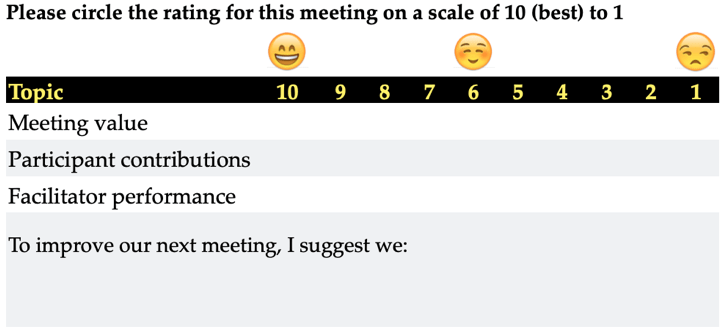
Consider some variant of a Plus-Delta or a more robust anecdotal evaluation template that assesses the effectiveness of you and the meeting. A tool that moderates between the two is shown below. It provides numerical feedback but relies on three questions and optional, anecdotal feedback. The questions shown are solid but also illustrative. Do not hesitate to substitute questions that provide you more value, yet rely on a similar format. With this template, you can print two per sheet, reducing the visual burden on your participants by keeping it small.
Moderately Robust Tool for Performance Assessment
______
Don’t ruin your career by hosting bad meetings. Sign up for a workshop or send this to someone who should. MGRUSH workshops focus on meeting design and practice. Each person practices tools, methods, and activities daily during the week. Therefore, while some call this immersion, we call it the road to building high-value facilitation skills.
Terrence Metz, president of MG RUSH Facilitation Training, was just 22-years-old and working as a Sales Engineer at Honeywell when he recognized a widespread problem—most meetings were ineffective and poorly led, wasting both time and company resources. However, he also observed meetings that worked. What set them apart? A well-prepared leader who structured the session to ensure participants contributed meaningfully and achieved clear outcomes.
Throughout his career, Metz, who earned an MBA from Kellogg (Northwestern University) experienced and also trained in various facilitation techniques. In 2004, he purchased MG RUSH where he shifted his focus toward improving established meeting designs and building a curriculum that would teach others how to lead, facilitate, and structure meetings that drive results. His expertise in training world-class facilitators led to the 2020 publication of Meetings That Get Results: A Guide to Building Better Meetings, a comprehensive resource on effectively building consensus.
Grounded in the principle that “nobody is smarter than everybody,” the book details the why, what, and how of building consensus when making decisions, planning, and solving problems. Along with a Participant’s Guide and supplemental workshops, it supports learning from foundational awareness to professional certification.
Metz’s first book, Change or Die: A Business Process Improvement Manual, tackled the challenges of process optimization. His upcoming book, Catalyst: Facilitating Innovation, focuses on meetings and workshops that don’t simply end when time runs out but conclude with actionable next steps and clear assignments—ensuring progress beyond discussions and ideas.